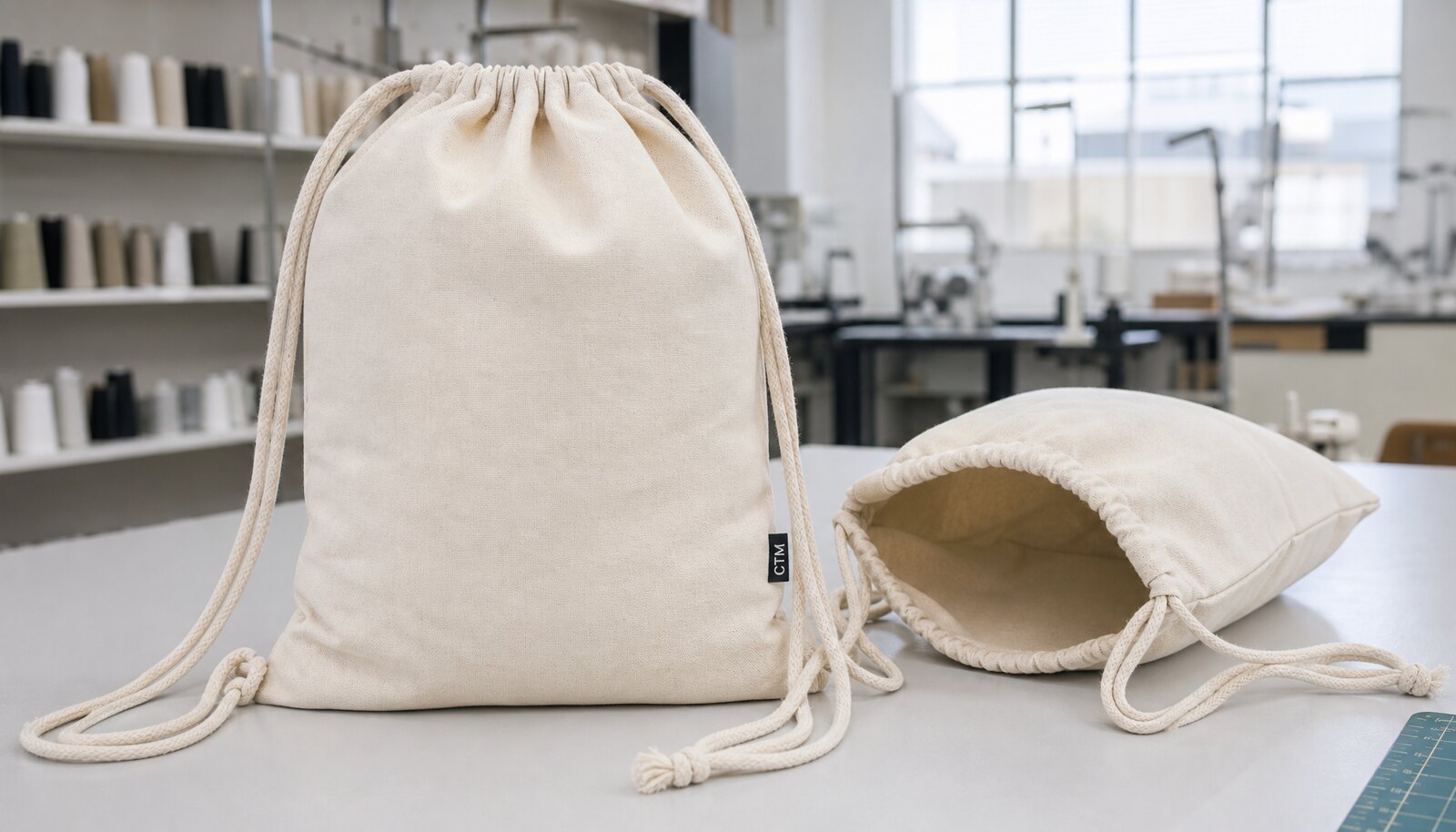
Why gift shop buyers should check compliance before asking for price
A cotton drawstring backpack can look like a simple item, but for a gift shop buyer it is really a bundle of decisions: textile weight, cord construction, decoration method, label requirements, carton handling, and the evidence a supplier can provide if your retailer asks for proof. If those variables are left open, the quote is usually built on assumptions. That is how a bag that looked fine in a sample can arrive with a lighter fabric, a different print process, weak cord exits, or packing that creates extra labor at receiving.
The point of a compliance checklist is not to overcomplicate a basic product. It is to make sure the supplier is quoting the exact bag you want to sell. In gift shop programs, buyers usually care about three things first: shelf appearance, repeatability, and traceable production. If the bag is for a museum shop, tourist shop, seasonal gift set, or branded resale program, those priorities matter more than a generic catalog description. A supplier who can only say “good quality” is not giving procurement enough to compare.
This is also where many sourcing mistakes start. Buyers often approve a nice-looking sample, then later discover that the bulk run uses a different fabric lot, a different print cure, a weaker reinforcement point, or a packing format that shifts work back to the warehouse. Compliance checks prevent that by tying the quote, the sample, and the bulk order to one written specification. The supplier does not need to be legalistic; it just needs to be specific.
For procurement teams, the practical rule is simple: if the supplier cannot tell you who owns the fabric, who prints, who packs, and what proof backs those steps, then the quote is not yet comparable. At that stage, you have a price, not a controlled buying decision.
- Use compliance to compare quotes on the same spec, not on assumptions.
- Treat sample approval and documentation as part of procurement, not an afterthought.
- For gift shop programs, repeatability and shelf readiness matter as much as unit price.
Build the bag spec first: the cost driver is usually fabric and construction, not the logo
The biggest price swing in a custom cotton drawstring backpack usually comes from fabric choice and construction detail, not from the artwork. A lighter cotton reduces cost, but it also changes the way the bag hangs, how it feels in hand, and how well it keeps its shape on display. For lightweight souvenir or giveaway use, a lower-weight cotton may be acceptable. For retail resale or a product that needs to feel more substantial, buyers usually need a heavier cloth and better reinforcement. The right answer depends on how the bag will be used, not just on the target unit price.
Do not lock in a GSM range without also defining the bag’s job. As a commercial benchmark, many buyers use lighter fabrics for event or promo use and heavier fabrics when the bag is expected to carry boxed merchandise or survive repeated handling. But a benchmark is not a substitute for a spec. If you do not define the load expectation, the supplier may offer the lightest cloth that still looks acceptable in a photo. That may be fine for a free gift and wrong for retail.
Construction details are the other major cost and quality driver. Drawstring backpacks usually fail at the cord channel, top edge, bottom corners, and cord exits. Ask for seam allowance, stitch density or stitch count, reinforcement method, and cord diameter. If the bag will carry harder items, ask whether the top stress area uses a bar tack, double stitch, or reinforced seam. These details tell you whether the supplier actually understands bag construction or is simply buying time with broad claims.
Shrinkage is another point that is easy to miss. If the cotton is not pre-shrunk, the buyer should decide whether the finished dimensions already include an allowance for shrinkage after handling or washing. Otherwise a bag can meet the approved size at shipment but still look undersized later. The commercial fix is simple: define the finished size, composition, finish, and allowable variance in the RFQ so the supplier quotes against the same expectation.
A supplier with real bag experience will talk about panels, channels, reinforcement, and consistency. A weak supplier will only talk about appearance. For procurement, that difference matters because the first quote is easy; the repeat order is where process control gets tested.
- Define the bag’s use case before choosing a fabric weight benchmark.
- Ask for reinforcement details at cord exits and other stress points.
- Build shrinkage into the size spec if the fabric is not pre-shrunk.
- Prefer measured construction details over broad quality claims.
Know your supplier route: factory, trader, stockist, or retail-service provider
Different supplier types can all sell the same backpack, but they do not carry the same risk. A direct sewing factory usually gives the buyer the clearest control over cutting, sewing, printing, and packing. That matters when the design is fixed, the order may repeat, or the retailer expects stable documentation. A factory quote is often easier to audit because the buyer can ask who owns each process step and who signs off on the final pack.
A trading company can be useful when the buyer needs coordination across multiple SKUs, communication support, or shipment consolidation. The trade-off is that the trading company may not control the line where the bag is actually made. That means the buyer should still ask for the factory name, the production location, the sample source, and who has authority to approve deviations. If the trader cannot identify the bulk factory, sample approval is weaker than it looks.
A stockist or off-the-shelf supplier can be useful for urgent replenishment or simple promotions. But stock product usually comes with limits: fixed colors, fixed fabric weights, limited reinforcement options, and decoration applied later under less control. That may be acceptable for a short-term campaign. It is not the same as a custom retail program with controlled specs.
Retail-service suppliers sit somewhere between manufacturing and fulfillment. They may offer labels, barcode application, polybagging, or shelf-ready packing. That can save the gift shop warehouse work later, but only if the supplier’s quote includes those services clearly. A low unit price is less useful if you still have to relabel, repack, or sort cartons after arrival.
Procurement should not choose the supplier type by label alone. Ask who buys the fabric, who approves the strike-off, who controls sewing quality, and who signs the final pack-out. The supplier who can answer those questions clearly is usually the one you can manage most effectively.
If you want the shortest rule: use a factory for repeatable production, a trader for coordination, a stockist for urgency, and a retail-service supplier only when the packing labor is worth paying for. Then verify the actual process behind the sales title.
- Direct factory: strongest for process control and repeatability.
- Trader: useful for coordination, but verify the actual bulk factory.
- Stockist: good for urgency, weak for custom control.
- Retail-service supplier: compare price against reduced warehouse labor.
What compliance evidence to request in the quote package, by market and channel
For gift shop procurement, compliance should mean evidence, not general reassurance. The first step is to ask for product-specific identification: model name, material description, finished size, decoration method, and the lot or batch reference that the evidence covers. A generic certificate that does not mention your bag is not enough to compare suppliers. The quote should also tell you whether the cotton is raw, bleached, dyed, enzyme-washed, or pre-shrunk, because each one affects the final product and the paperwork trail.
If you sell into a retailer that reviews restricted substances or product safety documentation, ask for evidence that matches the channel expectation. That may include a fabric test report, a material declaration, an ink or print declaration, or a finished-goods test report if the retailer requires one. The important point is not the document title alone; it is whether the report covers the actual fabric, print, or accessory in your order. Ask for the lab name, report number, issue date, sample description, and whether the report is current enough for the order being quoted.
If the supplier says the document came from a third-party lab, ask whether the tested sample is the same construction you are buying or an earlier equivalent. If the supplier uses subcontracted printing, label application, or packing, ask which steps are in-house and which are outsourced. Outsourced work can be fine, but it changes traceability and can affect which evidence you should request. A buyer should be able to trace the bag from material to sewing to decoration to pack-out without guessing.
For retail channels, also ask about labeling and marking requirements up front: fiber content, care instructions, country of origin, barcode, SKU, and any language or symbol rules the channel requires. These items are cheap when added early and annoying when added after production. If the supplier cannot explain the label chain clearly, the compliance file is not complete enough for ordering.
The practical verification step is to compare every document detail against the sample and the quote. Product name, model code, fabric description, date, and issuing party should line up. If they do not, the supplier should explain the mismatch and update the file. Do not accept an inconsistent document pack just because the price is good; a mismatched file is hard to defend later if a retailer asks questions.
- Request product-specific evidence, not generic certificates.
- Match report date, sample description, and model code to the quote.
- Clarify whether printing, labels, or packing are subcontracted.
- Check channel-specific label requirements before the PO is issued.
Which compliance checks matter most for cotton drawstring backpacks
The best compliance checks are the ones that connect directly to how the bag will be sold. Start with material and chemical declarations if your retail channel requires them. Ask what was tested, which component was tested, and under what standard or declaration. A statement that the bag is safe is not enough for procurement; you need to know whether the fabric, print ink, labels, or accessory parts were actually covered.
Colorfastness is a practical risk for a bag that will be touched, folded, and displayed repeatedly. If the bag is dyed or printed, ask for rub-resistance expectations and how the supplier controls curing or finishing. A logo that smears, flakes, or transfers onto hands can create immediate retail complaints even if the bag technically meets a simple appearance check. For darker colors and dense prints, this deserves more attention than buyers often give it.
Load and seam performance are equally important. Drawstring backpacks fail where the load is carried: the cords, the top channel, and the stress points at the corners or exits. Ask the supplier how it tests these points internally and what pass/fail result it expects. A lightweight souvenir bag can have a modest load target, but if the bag is sold as a reusable accessory or expected to carry boxed merchandise, the internal acceptance limit should be stricter.
Label and marking compliance is easy to overlook until the carton arrives. If the bag needs fiber content, care, country-of-origin, barcode, or hangtag information, the supplier should show the label position and attachment method before production starts. That is especially important when the retail channel has rules for readability or placement. A label that is technically present but hard to scan or poorly located can still cause receiving problems.
The best procurement practice is to review the product, the document, and the physical sample together. If those three do not agree, the quote is not ready. Compliance is strongest when the bag, the evidence, and the use case all point to the same product.
- Ask what component was tested and what the result actually covers.
- Check rub resistance, curing, and transfer risk for printed or dyed bags.
- Set a realistic load target and seam test for the intended retail use.
- Confirm label, barcode, and origin marking requirements before sampling is approved.
Compare print methods on durability, setup cost, and replenishment risk
Print method affects more than appearance. For many gift shop orders, screen printing remains the most practical option for simple logos, one- or two-color artwork, and repeat volume. It usually gives good opacity and acceptable cost when the ink system and cure are controlled. But a screen-printed logo can still crack, bleed, or feel stiff if the supplier uses the wrong ink load or cure method. So the method name alone is not the decision; the production controls matter.
Heat transfer and digital methods are useful when the artwork has more detail, multiple colors, or a shorter run. They can also be helpful when the buyer expects frequent design changes or smaller seasonal orders. The trade-off is durability and replenishment consistency. A transfer that looks sharp at first may be more vulnerable to folding or abrasion. Digital print can handle complexity, but color consistency across replenishment lots needs active control if you want the same result next season.
The right comparison is therefore commercial, not aesthetic. Ask the supplier for a strike-off or pre-production print on the actual fabric, not a substitute cloth. Then define acceptable color difference, edge sharpness, coverage, and rub performance. If the artwork includes fine lines, gradients, or small text, ask the supplier to state whether those elements survive the chosen print method at production scale. That is where many samples fail and quotes need adjustment.
Buyers should also ask where the decoration happens. In-house printing gives more control over first-piece approval and defect correction. Outsourced decoration can be fine, but it should be named in the quote because it changes lead time, traceability, and sometimes the final print quality. The decision should match the use case: durable simple logos for repeat retail programs, or faster, lower-volume methods for seasonal or promotional items.
If the bag will be handled frequently in a gift shop, durability usually deserves more weight than fancy artwork. If the run is short-lived and the margin is tight, setup cost may matter more. The supplier should be able to explain that tradeoff in concrete terms instead of saying every method is “best quality.”
- Screen print: usually best for simple logos and repeat volume.
- Transfer or digital: useful for detail or short runs, but verify durability on the actual fabric.
- Require a strike-off or print proof on the exact bag material.
- Set pass/fail criteria for color, edge sharpness, and rub resistance before PO release.
Use sample approval as a control point, not a visual courtesy
A sample should establish the buying standard, not just reassure the buyer. That means the pre-production sample must match the intended bulk build as closely as possible: same fabric, same cord, same decoration method, same label position, and same packing format. If any of those are different, the sample is only a reference. It is not a reliable approval for production control.
To make sample approval useful, keep one sealed master sample and tie it to the purchase order. Also keep the artwork file, the approved color reference, and any deviations that were accepted. If the supplier sends several versions, label them clearly and record which version is frozen for production. That avoids a common problem in bag sourcing: the factory making the easiest version instead of the approved one.
The approval criteria should be measurable. The bag should hang evenly, the cords should slide smoothly, the seams should be clean at the channel and corners, and the print should not peel, bleed, or crack under normal handling. If the bag is intended to carry retail merchandise, run a practical load check using a representative product weight. You do not need to over-engineer the test; you do need to test the condition that matters for your sales channel.
If you use an AQL-style inspection process, state the defect categories before production closes. A critical defect would be a broken seam, missing cord, wrong origin mark, or incorrect size outside tolerance. A major defect might be a misprinted logo, noticeable shade mismatch, or weak reinforcement. A minor defect might be loose thread ends or slight wrinkle marks. The supplier should know these categories before packing starts, not after you discover a problem.
The strongest sample process is the one you can repeat. If the next season comes back with a different lot, the retained master sample becomes your best comparison tool. That is especially important for gift shops, where the same style may be reordered seasonally but sold under the expectation that it will look the same.
- Approve one retained master sample and connect it to the PO.
- Measure the finished bag, not just the artwork or flat panel.
- Classify defects as critical, major, or minor before inspection.
- Freeze the sample details that matter: fabric, cord, print, label, and packing.
Build a QC checklist the factory can actually run on the floor
Quality control becomes useful only when it is specific enough to execute. For cotton drawstring backpacks, the QC process should begin with incoming fabric verification: width, visible defects, shade, and weight against the approved spec. The first-piece approval should confirm seam allowance, cord path, reinforcement placement, print position, and label placement. Finished inspection should then check both appearance and function, not just carton count.
Defect categories should be written down before the order starts. Critical defects are product-stopping issues: missing cord, open seam, wrong size beyond tolerance, incorrect compliance marking, or serious print failure. Major defects are issues likely to trigger customer complaint or retail rejection: visible stain, strong shade variation, poor print registration, weak reinforcement, or a bag that does not close correctly. Minor defects are small cosmetic issues such as loose threads or slight fold marks. If the supplier is left to define these on its own, the classification will usually be too forgiving.
AQL sampling is useful if it is used honestly. Tell the supplier the sample size and acceptance level before the line is released. Even if the factory does not formally run AQL, the same logic applies: inspect more carefully at stress points, print areas, and label placement. Request photos from first-piece approval and from the carton pack-out stage. For remote sourcing, photo evidence is often the fastest way to catch a recurring issue before the whole shipment is closed.
Measurement tolerances should be specific enough to avoid arguments later. Define allowable variation for bag width, bag height, cord length, seam allowance, and print position. If the supplier’s internal tolerance is wider than yours, it should be stated upfront. Buyers do not need a long quality manual for a backpack, but they do need a few hard numbers. That is what makes the order repeatable.
One practical rule: inspect the points where failure would create a customer complaint, not just the points that are easy to measure. On a drawstring bag, that means cords, seams, print, labels, and pack accuracy first.
- Inspect incoming fabric, first-piece output, in-line sewing, and finished cartons.
- Write critical, major, and minor defect definitions before production starts.
- Set AQL sampling and acceptance levels before the line closes.
- Use photo evidence for first-piece approval and carton packing checks.
Packing and labeling can change the landed cost more than buyers expect
Packing often looks minor on a quote sheet until the cartons arrive. A cotton drawstring backpack can be packed in bulk, folded with tissue, polybagged individually, labeled for retail, or configured for shelf-ready display. Each method changes labor, carton size, and the risk of creasing or print damage. For a gift shop program, the right choice depends on what happens after receiving. If your warehouse repacks the items, bulk packing may be cheapest. If the product goes directly to shelf, retail-ready packing can save time even if the unit price is higher.
Labeling deserves the same level of detail. Buyers often focus on the bag and leave labels until later, which is how barcode placement, care instructions, country-of-origin marks, and fiber content become last-minute problems. If the channel requires multilingual labeling or a specific label format, it should be in the RFQ. Also specify where labels are attached—inside seam, side seam, outer hangtag, or bag interior—because placement affects both appearance and durability.
To compare suppliers fairly, normalize the pack plan. Ask each supplier to quote the same inner-pack quantity, outer carton count, folding direction, and protection method. Request carton dimensions and gross weight so you can compare freight and warehouse storage accurately. A bag with a low ex-factory price can become expensive if the cartons are oversized or if the supplier leaves barcode application for your team to finish.
If the supplier offers retail-ready packing, make sure the value is visible in the quote. It should include individual polybags if used, barcode labels, carton marks, and any unit-level or case-level labeling labor. Otherwise you will compare a simple bulk quote against a finished retail quote and draw the wrong conclusion. Procurement should compare landed cost per sellable unit, not just the bag price.
The shortest rule here is: compare suppliers on the same packing plan, or the quote comparison will not be real.
- Specify bulk pack, polybag, tissue wrap, or shelf-ready packing in the RFQ.
- Define label type, content, placement, and attachment method early.
- Request carton dimensions, gross weight, and pallet assumptions before award.
- Compare landed cost per sellable unit, not just ex-factory price.
Break MOQ and lead time into stages so the schedule is believable
MOQ is not just a bargaining number; it tells you how the factory runs. A simple cotton drawstring backpack with one-color screen print and basic packing can usually support a lower MOQ than a style with multiple print colors, custom labels, and retail-ready packaging. If the supplier is offering a very low MOQ, ask what makes it possible. The answer may be efficient planning—or it may be a stock fabric, a stock cord, or a lighter-touch QC process. Buyers should know which one before they commit.
Lead time should be split into milestones instead of being quoted as one number. Ask for sample timing, strike-off timing, bulk production timing, and shipping preparation. In gift shop sourcing, the biggest delay is often artwork approval or label sign-off, not sewing. If the supplier outsources printing or packing, those steps need to appear in the schedule too. A realistic lead time is one you can plan around; a compressed lead time with missing process steps is usually just a sales number.
For repeat orders, ask how the supplier will manage replenishment. Can it hold approved fabric or label stock? Can it repeat the same print color next season? Can it reserve production capacity during peak periods? Those questions matter because a quote is not useful if the factory cannot repeat it when you reorder. Seasonal gift shop programs often fail not because the first order was wrong, but because the replenishment order was not managed against the same spec.
The commercial fix is to tie MOQ and lead time to the exact order configuration. If you change fabric, packing method, or decoration, the MOQ and lead time should change too. That prevents hidden substitutions and keeps the supplier from promising a schedule that only works on paper.
If the supplier cannot explain the lead time by stage, the schedule is not ready for procurement approval.
- Treat MOQ as a signal of process complexity, not just a negotiation point.
- Break lead time into sample, approval, production, and shipping stages.
- Ask how replenishment orders will match the same shade, fabric, and print.
- Tie MOQ and lead time to one exact spec so the quote cannot drift later.
Specification comparison for buyers
| Supplier option | What to verify | Commercial advantage | Buyer risk to control |
|---|---|---|---|
| Direct sewing factory | cord material proof, reinforcement close-ups, load-test photos, approved sample tag, and bulk-line first-piece record | Better sample-to-bulk control and faster production feedback | May be weaker on export paperwork or branded packing unless checked early |
| Trading company | Factory name, production photos, trim-source proof, and who owns QC decisions | Can coordinate small mixed orders and extra services | Markup can hide real factory capability and slow defect decisions |
| Specialized bag workshop | cord diameter, eyelet or reinforced channel, bottom corner reinforcement, seam allowance, bar-tack position, and load target | More practical for detailed construction, trims, and repeat programs | Capacity may be limited during peak seasons |
| Low-price general supplier | 6-10 oz cotton canvas, 210D polyester, rPET, or blended cotton with shrinkage and colorfastness expectations set before sampling | Useful for simple promotional runs with loose specs | Material downgrades, weak packing, and vague inspection scope can erase savings |
| Retail-ready supplier | fold direction, cord protection, bundle count, carton compression, moisture bag, and retail label position | Can handle labels, SKU separation, carton marks, and receiving rules | Higher unit cost must be compared against reduced warehouse work |
| Compliance-focused supplier | Fabric records, labeling review, test plan, and production traceability | Safer for retail programs and repeat brand orders | Documentation claims need evidence, not only sales language |
| Local sample room plus bulk factory | Signed sample, bulk factory handoff, first-piece photos, and deviation owner | Good for complex branding before large production | Sample room quality may not match bulk line unless handoff is controlled |
Buyer checklist before sampling
- Freeze one written spec before requesting prices: finished size, fabric composition, GSM, cord diameter, reinforcement method, print placement, label plan, and packing format.
- Require the supplier to state whether the cotton is greige, bleached, dyed, enzyme-washed, or pre-shrunk, and whether shrinkage has already been built into the finished size.
- Ask for a pre-production sample made with the same fabric, cord, decoration method, and packing method intended for bulk production.
- Request evidence tied to the exact product or a clearly identified equivalent lot; do not accept generic certificates with no product name, report number, date, or material description.
- Lock carton pack count, inner-pack method, barcode format, carton marks, and who supplies the labels before you issue the PO.
- Get separate quote lines for fabric, cutting, sewing, decoration, labels, packing, testing, cartons, and freight basis so landed cost can be compared on the same basis.
- Set tolerances for bag width, bag height, cord length, seam allowance, print position, and acceptable shade variation before sample approval.
- Ask whether any stage—printing, embroidery, label application, or packing—is subcontracted, and who owns the final QC decision.
- Confirm whether your channel needs fiber content, care label, country-of-origin, SKU, hangtag, or barcode compliance before production starts.
- Request one signed master sample, one photo record of the approved sample, and one first-piece approval record before mass production begins.
Factory quote questions to send
- What exact fabric weight in GSM are you quoting for this bag size, and what tolerance do you hold during incoming inspection and cutting?
- Is the cotton pre-shrunk, enzyme-washed, bleached, dyed, or greige, and what shrinkage range should we expect after handling or washing?
- Which decoration method are you quoting—screen print, heat transfer, digital print, embroidery, woven patch, or label—and what setup fees apply?
- Can you itemize fabric, cord, printing, sewing, reinforcement, packing, testing, cartons, and freight basis separately?
- What is your MOQ for this exact combination of fabric, size, color, and print method, and how does MOQ change if we add labels or retail packaging?
- Will the pre-production sample be made on the same line, with the same materials, and by the same subcontractors as mass production?
- Which compliance documents can you provide for fabric, ink, accessories, and finished goods, and how do you identify the lot or batch they cover?
- What are your standard tolerances for bag dimensions, seam allowance, cord length, print position, and shade variation from carton to carton?
- How do you perform load or pull testing on the cords and top seams, and what pass/fail level do you use internally?
- How are goods packed per inner pack and export carton, and can you share carton dimensions, gross weight, and carton marks before PO approval?
Quality-control points to confirm
- Fabric GSM should match the approved spec within an agreed tolerance; record both supplier-stated GSM and buyer-verified measurements from a finished-bag sample.
- Check fabric composition and finish against the approved file: cotton type, weave, surface treatment, and whether the handfeel changes after folding or compression.
- Inspect seam construction at the cord channel, side seams, bottom corners, and stress points; look for skipped stitches, loose threads, uneven seam allowance, or weak back-tacking.
- Verify bar-tack or reinforcement placement at cord exits and top stress areas if the bag is intended to carry heavier retail items.
- Measure bag width, height, and cord length on a sample lot of finished units; do not rely on one perfect sample.
- Confirm print alignment, edge sharpness, coverage, and cure quality; check for bleed, cracking, ghosting, flaking, or poor rub resistance.
- Review color shade against the approved reference under agreed lighting; note carton-to-carton and panel-to-panel variation separately.
- Test opening and closing function: cords should slide smoothly, tension should be balanced, and the bag should hang evenly without twisting.
- Run a practical load check appropriate to the program; the bag should carry a representative retail load without seam opening, cord pullout, or excessive deformation.
- Inspect labels, fiber-content marks, country-of-origin marks, hangtags, and barcode stickers for placement, legibility, and accuracy.