Start With the Delivery Date, Not the Bag Spec
Corporate gifting schedules fail when the buyer starts with decoration details instead of the calendar. The useful first question is not which cotton bag looks best; it is what date the bags must be in hand, where they will land, and how much buffer the project has for artwork approval, sampling, sewing, packing, and freight. A bag that is simple on paper can still miss the event if the approval chain is slow or the ship mode changes late.
Work backward from the distribution date and separate factory time from transit time. A realistic schedule for custom cotton drawstring backpacks usually includes spec lock, quote comparison, sample confirmation, bulk production, packing, export booking, and final delivery. If the event is fixed, build a margin for customs delay, port congestion, or a late logo correction. Ask every supplier to quote against the same milestone, ideally ex-factory after final approval, so the lead-time numbers mean something.
- Set the event date, not just the departure date.
- Build a schedule with approval, production, packing, and transit as separate steps.
- Assign one person to own timeline changes so late artwork does not silently reset the clock.
Choose Fabric Weight and Construction for Real Use
Fabric weight drives both the feel and the production risk. For most corporate gifting orders, 160-180 gsm cotton is the practical middle ground: it feels substantial, prints cleanly, and holds shape better than a light giveaway bag. If the brief is more premium or the bag will carry books, bottles, or a full welcome kit, 200-240 gsm gives the bag more body and better resistance to wrinkling. Lighter fabric can save money, but it can also make the logo show through, reduce opacity, and create a cheap hand feel that buyers notice immediately.
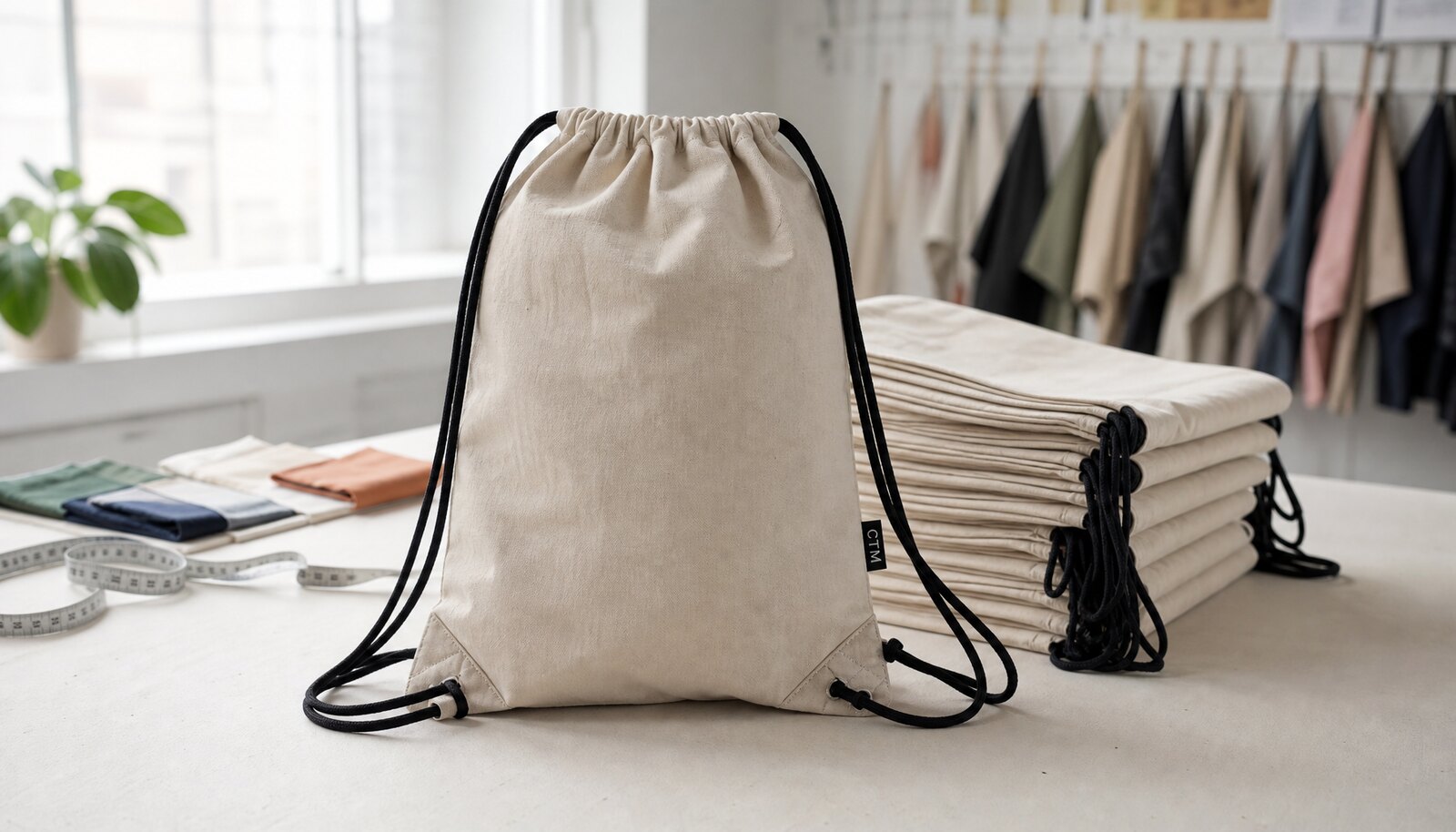
Construction matters just as much as GSM. A double drawcord, reinforced corners, and a clean sewn channel usually outperform a thin decorative build when the bag is actually loaded. Cotton rope, twisted cord, or polyester cord each change the look and the lead time, especially if the factory needs to source a non-standard accessory. Before you approve the spec, think about what will be inside the bag on arrival: brochure only, notebook plus pen, water bottle, or a heavier event kit. That load should drive the fabric and seam choice.
- Use 160-180 gsm for most gifting programs that need balance between cost and structure.
- Move to 200-240 gsm when the bag must feel premium or carry heavier inserts.
- Specify reinforcement at cord exits and bottom corners if the bag will be reused.
Print Method and Logo Placement Change the Schedule
Decoration is usually the second-biggest lead-time driver after fabric availability. Screen print is still the best default for simple one- or two-color logos on natural cotton because it is efficient, repeatable, and easier to control at scale. Embroidery, woven labels, patches, or heat transfers can improve the perceived value, but each one adds setup time and another approval point. If the campaign deadline is tight, keep the logo simple and put the effort into clean placement and solid fabrication instead of adding decorative complexity that the schedule cannot absorb.
Placement affects both quality and speed. A center-front print on a flat panel is easy to produce and inspect. A side label, bottom mark, or logo crossing a seam introduces alignment risk and often requires a physical sample instead of a quick digital signoff. If the brand insists on Pantone accuracy, ask for a lab dip or fabric color reference and a strike-off on the actual cloth. A logo that looks fine on screen can shift once it hits textured cotton, especially if the fabric is dyed or the weave is open.
- Keep the first order to one primary decoration method unless the brand has already approved the process.
- Use physical strike-offs for dark fabric, unusual placements, or detailed logos.
- Ask how the factory cures the print and whether wash or rub resistance is part of the process.
MOQ, Color Count, and Packing Drive the Quote More Than Buyers Expect
MOQ is rarely an arbitrary number. It comes from fabric roll usage, cutting waste, printing setup, and packing efficiency. A single natural color with one logo and one size is straightforward. Add multiple bag colors, multiple print variants, or individual polybags and the factory has to break the flow, which usually raises the unit price and extends the lead time. Buyers who understand this can see why two quotes that look similar at first glance may not be comparable at all.
A better buying approach is to ask for pricing at the target MOQ, at a lower test quantity, and at a repeat order volume. That exposes where the setup cost sits and whether the factory is overloading the base unit price with hidden tooling. For corporate gifting programs, also ask whether a small overrun is allowed and whether extra bags can be held for a reorder. That matters when the event team discovers a few more attendees, or when the client wants to add a late-stage VIP group.
- Keep the order to one or two colors if the deadline is tight.
- Request quote breaks at the target MOQ, a smaller pilot run, and a repeat run.
- Separate setup fees from recurring unit price so you can compare suppliers fairly.
Sample Approval Should Prove the Spec, Not Just the Look
A sample is valuable only if it answers the questions that affect bulk production. For custom cotton drawstring backpacks, the pre-production sample should confirm fabric hand feel, size, seam quality, cord length, logo placement, and color. If the bag carries a printed logo, check the actual print edge, opacity, and registration on the real cloth. A polished photo or PDF proof is not enough when the project is tied to a fixed gifting date and the buyer needs confidence that the bulk run will match the approved look.
If the design includes more than one colorway or logo variant, label each sample clearly and make the approval record unambiguous. Keep one sealed reference sample if possible, and note the acceptable tolerances in writing. That makes it much easier to resolve disputes later if a bulk run drifts slightly. If the factory says the style is unchanged and wants to skip sampling, push back unless the previous sample was built on the same fabric, with the same print method, and the same packing spec.
- Approve a pre-production sample before bulk sewing begins.
- Record the approved sample date, material, print method, and packaging notes.
- Retain one reference sample so bulk inspection has a physical comparison point.
Direct Factory, Trading Company, or Local Decorator: Choose the Route by Risk
The cheapest unit price is not always the lowest landed cost. A specialist bag factory usually gives the buyer the best control over fabric sourcing, sewing quality, and packing consistency. A trading company can be useful when the program includes multiple items or when the buyer wants one contact point for coordination, but the procurement team still needs to know which factory is actually making the bags and who owns final QC. If the order is important enough to miss a campaign date, that chain of responsibility has to be visible.
A local decorator or domestic inventory supplier can solve an urgent deadline, but the tradeoff is lower spec flexibility. You may get faster printing, yet the blank bag may not match the exact cotton weight, size, or construction the brand wants. That route works when speed is the real constraint and the buyer can accept a standard blank. It is weaker when the project needs a specific textile feel, a custom side label, or a production standard that will be repeated in future orders.
- Direct factories are best when fabric control and repeatability matter most.
- Trading companies help with multi-item kits, but the buyer should still identify the real production site.
- Local decorators work for rush orders, but they limit fabric and construction choices.
Packing and Carton Logic Matter in Corporate Gifting
Corporate gifting orders often fail in packing rather than in sewing. A bag can be perfectly made and still create problems if it is folded the wrong way, packed without a clear count, or shipped in cartons that do not match the receiving team’s distribution plan. Decide early whether the bags should ship bulk folded, individually polybagged, tissue wrapped, or pre-kitted with inserts. Every extra layer of packing adds labor and can extend the lead time, but the right packing spec can save hours in the warehouse after arrival.
Carton markings should match how the bags will be issued. If one lot goes to HR, another to a conference desk, and a third to a distributor, the carton labels should support that split. Ask for master carton dimensions, gross weight targets, and an inner pack count that fits the receiving site’s handling limits. If the buyer does not control packing logic, the shipping team may still need to re-sort the goods after import, which wastes the time the project was trying to save.
- State whether the bags ship bulk folded or individually packed.
- Match carton counts to the actual distribution plan, not just the factory’s convenience.
- Use clear carton marks if the order will be split by department, region, or event zone.
QC Thresholds Should Be Written Before Production Starts
The most useful QC plan for cotton drawstring backpacks is measurable. The buyer should not rely on a general instruction like "good quality" because that leaves room for interpretation. Specify acceptable GSM tolerance, size tolerance, seam allowance, logo position, and color match before the first cut is made. If the brand needs a consistent premium look, define what is not acceptable too: loose stitches, off-center prints, obvious shade variation, or drawcords that do not sit evenly in the channel.
The highest-risk defects are usually small but visible. A crooked logo, weak bartack, or drawcord that pulls unevenly will be noticed quickly because the bag is handled in public. For that reason, the first-batch inspection should focus on stress points and repeat defects, not just cosmetic appearance. If the buyer receives mixed lots from different production lines or fabric rolls, ask for lot separation and pack counts by lot so a problem can be isolated before the whole shipment is affected.
- Define tolerances for size, color, print placement, and seam quality before bulk production.
- Inspect stress points such as cord exits, bottom corners, and bartacks first.
- Separate lots if there are multiple fabric rolls, print runs, or packing lines.
Plan the Schedule Backward and Protect the Critical Path
A practical schedule starts with the delivery date and moves backward through every dependency. The buyer should allow time for artwork signoff, sample correction, bulk production, packing, freight booking, export processing, customs, and final distribution. If the project is tied to a conference, product launch, or employee event, the goods need to arrive early enough that a single late truck or port delay does not break the campaign. This is where many good RFQs fail: the factory lead time looks fine, but the transit and handoff time was never written down.
The real risk is usually the gap between steps, not the sewing time itself. A bag can be finished on schedule and still miss the event because the artwork was revised after approval, the carton marks were wrong, or the forwarder booked a later sailing. Put one owner on the calendar and make sure that person knows when the artwork is frozen, when the sample is approved, and when the shipment must be released. The more fixed the event date, the less room there is for loose coordination.
- Work backward from the event date and include every handoff.
- Freeze artwork early so the supplier does not restart sampling.
- Separate factory lead time from ocean or air transit time in the plan.
Write RFQs That Produce Comparable Quotes
A clean RFQ is the fastest way to avoid quote noise. The supplier should not have to guess the bag size, fabric weight, print method, logo size, pack style, carton requirements, destination, or target delivery date. If even one of those items is left open, each supplier will fill the gap differently, and the buyer will end up comparing apples to oranges. The result is usually a cheap-looking quote that turns expensive once the missing assumptions are added back in.
Ask for quote data broken into fabric, cutting and sewing, decoration, packing, sample, tooling, and freight assumptions. That line-item structure reveals the real cost driver and makes it easier to negotiate without damaging the spec. It also helps the buyer spot where the supplier is making a tradeoff: lower unit price with higher setup, faster lead time with simpler packing, or stronger print quality with a slightly higher MOQ. A quote that explains its assumptions is more useful than one that just states a unit price.
- Send one spec sheet to every supplier so the quotes are comparable.
- Require separated line items for setup, samples, packaging, and freight assumptions.
- Ask what changes if the buyer adjusts MOQ, print method, or packing format.
Specification comparison for buyers
| Spec decision | Recommended option | When it fits | Buyer risk to check |
|---|---|---|---|
| Fabric weight for giveaway bags | 160-180 gsm natural cotton from a direct bag factory | Corporate gifting jobs that need a clean hand feel, enough structure for inserts, and sensible freight weight | Ask for finished GSM, shrinkage tolerance, and whether the quote assumes prewashed or raw cotton |
| Print method for a simple logo | 1-2 color screen print done at the same factory | One logo, flat artwork, and a timeline that leaves little room for decoration delays | Check registration tolerance, curing method, and whether the print is on finished bags or cut panels |
| Supplier route for a single-bag program | Specialist bag factory with in-house cutting, sewing, printing, and packing | One item, one spec, and a fixed in-hand date where control matters more than shopping the lowest line price | Verify who owns QC, who approves the first bulk run, and whether packing is done on site |
| Supplier route for a gift kit with multiple items | Trading company coordinating a vetted bag factory and pack-out partner | Programs that combine bags with notebooks, pens, inserts, or mailers | Confirm the actual factory name, inspection access, and who is liable if one component slips |
| Sample approval path | Pre-production sample plus first-bulk photo approval | Any new artwork, dark fabric, unusual placement, or brand that needs tight visual control | Do not rely on a PDF mockup alone; check size, color, and placement on the real material |
| Logo placement complexity | Center-front logo or a simple side label | When the bag needs fast approval, low decoration risk, and repeatable bulk production | Odd placements raise rejection risk if the logo sits near seams, drawcord channels, or fold lines |
| Packing route for distribution | Bulk fold with carton counts by department or destination | Warehouse distribution, conference handout, or employee onboarding where the buyer controls final issue | Make sure the carton marks, pack counts, and label language match the receiving plan |
| Rush sourcing route | Local decorator on imported blanks or domestic inventory stock | Short lead-time campaigns where speed is more important than exact fabric customization | Higher unit cost, limited size/color control, and possible mismatch between blank quality and brand standard |
Buyer checklist before sampling
- Set the in-hand date, not just the ship date, and add a buffer for artwork correction, customs, and local distribution.
- Lock bag dimensions, fabric GSM, cord type, and logo placement before asking for quotes.
- Decide whether the order needs screen print, embroidery, woven label, heat transfer, or a combination.
- Confirm the target MOQ, allowed overrun, and whether repeat orders can reuse the same setup.
- Define the sample path: digital proof, physical strike-off, pre-production sample, and first-bulk approval.
- Specify packing: individual polybag, bulk fold, insert card, carton count, and carton markings.
- Provide final artwork in vector format with Pantone references or a clearly stated color target.
- Identify the delivery terms, destination, and who handles freight booking and import paperwork.
Factory quote questions to send
- What is the lead time from final artwork approval to ex-factory shipment, and what steps sit on the critical path?
- What fabric GSM, weave width, and shrinkage assumption are included in the quote?
- Which print method is included, how many colors are priced, and what happens if the logo changes after sampling?
- What are the setup charges for printing, embroidery, labels, or packaging, and are they one-time or repeatable on reorder?
- What MOQ applies to the quoted price, and how does the unit price change at lower and higher volumes?
- What sample stages are included, and which sample fees can be credited back on bulk order?
- What packing specification is assumed per unit, per inner pack, and per master carton?
- What freight or export assumptions are included, and which costs are excluded from the unit price?
Quality-control points to confirm
- Measure finished bag size against the approved spec and keep the tolerance narrow enough that inserts still fit after sewing and packing.
- Check fabric GSM and weave consistency across the lot so the bags do not vary in drape, opacity, or print sharpness.
- Inspect drawcord symmetry, channel stitching, and knot security because these fail first when the bag is loaded.
- Verify seam allowance, corner reinforcement, and bartacks at stress points before bulk packing starts.
- Confirm logo position, print registration, and color match against the approved strike-off, not against a screen preview.
- Rub-test the print and fold the bag to make sure the logo does not crack, smear, or misalign after compression.
- Audit packing counts, carton marks, and destination labels so the receiving team gets the right quantities by lot or department.
- Set an inspection rule for repeated defects, not just isolated defects, because recurring errors usually point to a machine or setup issue.