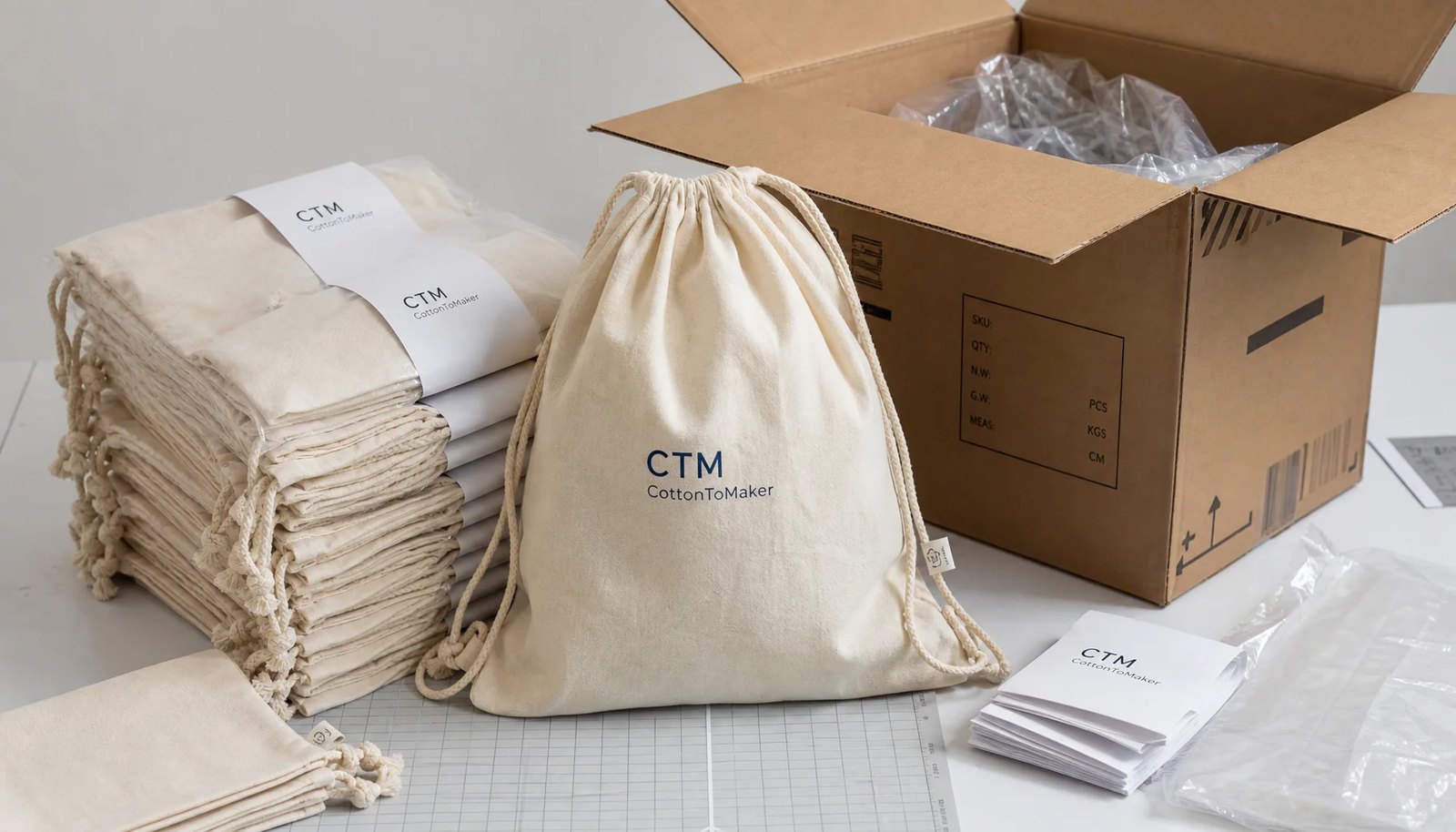
Start With the Receiving Reality
A custom cotton drawstring backpack may look like a simple campus item, but a bookstore receives it as inventory. It has a SKU, a barcode, a selling season, a storage location, and often a department owner. The carton packing plan decides whether staff can count cartons quickly, move goods safely, protect printed panels, and send the right artwork to the right campus group without opening every box.
The trouble usually starts when suppliers quote different hidden assumptions. One quote may include loose bulk packing, 200 pieces per carton, no barcode application, and a generic carton mark. Another may include individual recyclable polybags, UPC labels, 100 pieces per carton, carton liners, stronger export cartons, and SKU-level labels. Both suppliers may call the item a custom cotton drawstring backpack. They are not quoting the same delivered result.
Move-in week makes those differences painful. A bookstore team does not have spare time to sort mixed artwork, apply missing labels, flatten crushed retail packs, or recount loose bags for admissions, alumni, athletics, and store stock. A low unit price can become expensive when it causes rework, delayed floor placement, freight corrections, damaged prints, or department allocation disputes.
Build the packing plan before approving the purchase order. Tie together product construction, print durability, retail handling, master carton protection, and freight efficiency. The aim is not to overpack every order. The aim is to specify the least complicated packing system that still fits the sales channel, transit route, and campus receiving process.
- Use one written specification and carton plan for all suppliers before comparing unit prices.
- Separate unit cost, print setup, retail packing, barcode or hangtag application, and export carton cost in the quote sheet.
- Request pieces per carton, carton dimensions, gross weight, and net weight at quotation stage, not after production.
- Match carton quantity to bookstore receiving limits and product protection, not only factory convenience.
- Identify whether cartons ship to one warehouse, several campus stores, event teams, or department-level destinations.
Lock the Backpack Specification First
A carton plan is only useful when the base backpack is stable. For university bookstore programs, a common finished size range is about 34-38 cm wide by 40-45 cm high. A practical standard is 35 x 42 cm. It can hold notebooks, folded apparel, a water bottle, welcome-kit inserts, and small bookstore purchases without creating an oversized carton.
Do not confuse the cutting pattern with finished size. Cotton moves during cutting, sewing, trimming, pressing, and folding. A commercially realistic tolerance for a standard cotton drawstring backpack is often +/-1 cm in width and height, measured flat after sewing and pressing. If the backpack must fit a boxed kit, folder, or printed insert exactly, negotiate the tolerance before sampling. Tight tolerance usually means more control time.
Fabric weight changes more than handfeel. It affects seam strength, print opacity, folding bulk, carton gross weight, and freight cube. Many bookstore retail programs use 6 oz to 8 oz cotton canvas, roughly 200-270 GSM. A 5 oz cotton bag, around 170 GSM, may be acceptable for a short-term giveaway, but it can feel thin and show print-through. A 10 oz canvas bag, around 320-340 GSM, feels more substantial, yet it adds sewing load and may reduce pieces per carton.
Color also needs a decision. Natural cotton can have seed flecks and mild shade variation, which may support an eco-positioned look. Bleached or dyed cotton gives a cleaner brand background but needs swatch approval, shade tolerance, and inspection under consistent lighting. If the artwork uses light ink on dark cotton, test opacity on the exact fabric weight, not on a substitute panel.
- Standard bookstore size: 35 x 42 cm finished size, measured flat, with written tolerance.
- Typical retail fabric: 6 oz to 8 oz cotton canvas, about 200-270 GSM, with GSM tolerance stated.
- Entry promotional fabric: 5 oz cotton may reduce cost but should be limited to lighter-duty use.
- Premium canvas: 10 oz cotton improves perceived value but may require fewer pieces per carton.
- Construction controls: confirm seam allowance, channel width, drawcord length, corner reinforcement, and eyelet policy.
Treat Drawcords as a Load-Bearing Part
Drawcords are not a decorative afterthought. They carry weight, affect comfort, and change how the backpack folds inside a carton. Cotton cord in the 5-7 mm range usually gives the right balance for campus use: natural appearance, reasonable shoulder feel, and manageable bulk. Thinner cord can reduce cost, but it may dig into shoulders and wear faster. Thicker cord can feel better in hand, yet it increases fold thickness and can reduce clean carton fill.
Ask the supplier to quote cord material, diameter, finished length, color, and end treatment. Cotton cord may fray if the cut ends are not finished properly. Polyester or poly-cotton cord may resist abrasion better, but it changes the material story. If the bookstore markets the product as cotton or eco-oriented, clarify whether that claim applies only to the body fabric or also to the drawcord, labels, and packing materials.
The lower corner is the usual stress point. Some bags capture the cord inside a folded fabric corner. Others use metal eyelets, triangle reinforcements, bartacks, or separate tabs. Each option has a different look, cost, and inspection requirement. A nice-looking sample is not enough if the corner tears when a student carries books or event materials.
For practical procurement, define a simple loaded pull check. For example, a 5 kg static load for 30 seconds per lower corner may be suitable for a standard 6-8 oz bookstore bag unless the buyer has a formal test method. This is not a universal lab standard, but it gives the factory a clear pass/fail expectation. If the backpack will carry heavier contents, state the load, duration, and failure criteria in the purchase order.
- Cord diameter: specify 5-7 mm for most bookstore cotton drawstring backpacks unless a different feel is required.
- Cord length: approve finished length on a worn sample, not only on a flat measurement.
- Corner test: define load, duration, and failure criteria before mass production.
- Eyelets: require rust-free, centered, smooth, secure eyelets if metal hardware is used.
- Claim control: clarify whether sustainability or cotton content claims include cord, labels, and packaging.
Choose Printing With Folding in Mind
Printing is an artwork decision, but it is also a packing decision. Screen printing is often the best fit for university bookstore logos with solid colors, clean line work, and repeatable brand standards. It works well for one- to three-color graphics and repeat orders when screens, ink references, and placement details are documented.
Print placement should be measured from fixed finished bag edges, not judged only by eye. A useful commercial tolerance is often +/-5 mm for smaller logos and +/-10 mm for large front-panel graphics, depending on fabric movement and artwork scale. If the university identity guide requires tighter positioning, say so before sampling. Otherwise, the factory’s normal visual tolerance may not satisfy brand review.
Large ink coverage deserves special attention. A mascot, seal, shield, or block-letter design can stiffen the cotton panel. If the backpack is folded through the print and compressed inside a carton, the buyer should check for cracking, scuffing, transfer, pressure marks, or color rub. Fold the pre-production sample exactly as mass production will be folded, pack it, reopen it, and inspect the print.
Transfer printing can be useful for full-color art, gradients, or small department runs where multiple screens are not practical. Review film edge, handfeel, heat marks, adhesion, and fold behavior on the actual cotton. Embroidery can suit alumni, donor, or premium merchandise, but lighter cotton can pucker, backing can show, and stitch areas can create pressure points when cartons are tightly packed.
- Screen print: use for solid university marks, Pantone targets, repeat orders, and clean cost control.
- Transfer print: use for full-color art, gradients, small department runs, or complex graphics.
- Embroidery: reserve for premium programs and check puckering, backing, stitch density, and carton pressure marks.
- Placement tolerance: write +/-5 mm to +/-10 mm when appropriate instead of relying on “standard tolerance.”
- Fold check: reopen packed samples to inspect cracking, scuffing, transfer lift, and pressure marks.
Set Carton Quantity and Weight Limits
For a standard 35 x 42 cm custom cotton drawstring backpack in 6 oz to 8 oz fabric, 100 pieces per export carton is a sensible planning point. It is easy to count, manageable for many receiving teams, and less likely to crush printed panels than an overfilled carton. It also helps allocation because a carton can be assigned to a department, event, or sales floor without breaking down a very large master box.
The right quantity still depends on the SKU. A 10 oz canvas backpack with thick cotton cords, hangtags, and individual retail packing may need 50-80 pieces per carton. A lightweight unprinted giveaway bag can sometimes be packed at 150-200 pieces if presentation is not important. Large transfer prints, embroidery, premium folding, or delicate hangtags can also justify a lower carton count.
Weight is just as important as piece count. Many bookstore and campus receiving teams prefer manually handled cartons around 15-18 kg, but the buyer’s workplace policy should control. Heavy cartons are more likely to be dropped, dragged, or refused. Oversized but light cartons waste pallet space and may increase dimensional freight cost.
Require the supplier to quote estimated carton length, width, height, gross weight, net weight, and total carton count before purchase order approval. Freight cost may be driven by actual weight, volumetric weight, pallet position, or LCL cube. A supplier with a lower unit price can still create a higher landed cost if the packing is bulky or inefficient.
- Start point: 100 pieces per carton for many 6 oz to 8 oz cotton bookstore backpacks.
- Heavy or premium pack: use 50-80 pieces when fabric, cord, print, or retail packing adds bulk.
- Light bulk pack: use 150-200 pieces only when presentation and compression risk are acceptable.
- Weight target: state maximum gross weight, often 15-18 kg for manual receiving.
- Quote data: require carton dimensions, gross weight, net weight, and total cube before order approval.
Select Retail Unit Packing
University bookstores need backpacks to flow through a retail system. Each unit may need a UPC or EAN barcode, internal SKU sticker, price label, hangtag, department label, or event allocation label. If the item will be sold on a shelf, peg, or display table, approve the folded size, label direction, and scan position before production. If the item goes into orientation kits, counted bundles may be faster than individual retail packing.
Individual polybags protect cotton from dust, carton rub, and light moisture exposure. They keep barcodes cleaner and make receiving easier. Specify the bag material, thickness if required, ventilation holes, warning text, recyclability claim, closure type, and label placement. “Polybag included” is not enough; factories may use different materials, sizes, warning formats, and barcode locations.
Paper bands are a useful alternative when the campus wants to reduce single-use plastic. A paper band can hold a consistent fold, carry a barcode, and create a neat retail presentation. It does not protect as well from humidity, dust, or abrasion during long transit, so buyers often pair it with a master carton liner or inner carton bag. Test the band so it does not slide off during carton handling.
Loose bulk packing has a place, but it should be chosen deliberately. It reduces packing material and labor, yet it increases wrinkles, dust exposure, counting time, and carton-to-carton variation. It may work for immediate volunteer distribution at an event. It is usually a poor fit for retail merchandise arriving into a bookstore warehouse.
- Retail shelf: use individual polybag or paper band, barcode outward, consistent fold, and no mixed SKUs.
- Orientation kits: use counted bundles of 10 or 20 for faster assembly and allocation.
- Plastic reduction: use paper band plus master carton liner when dust and moisture risk still matter.
- Barcode control: test scan position on the approved folded unit before mass packing.
- Loose bulk: approve only when the buyer accepts wrinkles, dust risk, and receiving labor.
Build Cartons That Receiving Can Trust
The export carton is part of the product, not just a shipping container. For international shipments, a 5-ply corrugated export carton is a common requirement for cotton drawstring backpacks. It should tolerate stacking, warehouse handling, transit vibration, and reasonable pallet movement. If the order ships by ocean, sits in a humid warehouse, or moves through LCL consolidation, add a master carton liner or inner bag to reduce dust and moisture exposure.
Carton sealing should be written into the spec. Buyers may require H-taping on top and bottom seams, minimum tape width, plastic strapping where appropriate, or no metal staples if campus receiving prohibits them. A carton should not bulge; bulging reduces stackability and can press into printed panels. It should not be underfilled either, because shifting product can wrinkle cotton and damage retail presentation.
Shipping marks do a lot of work when the order includes multiple departments, artwork versions, or destinations. A good carton mark includes PO number, item description, SKU or barcode reference, artwork or department name, fabric color, quantity per carton, carton number, total cartons, gross weight, net weight, carton dimensions, destination, and country of origin if required by the buyer or import process.
Avoid vague marks such as “cotton bag” or handwritten carton notes. Receiving staff should be able to route cartons without opening them. If cartons are palletized, pallet labels should match carton labels. Ask for carton mark artwork or label proofs before final packing so errors are caught before the goods are sealed.
- Carton board: specify 5-ply export carton unless the route and risk clearly allow lighter cartons.
- Inner protection: use master liner, carton inner bag, or approved moisture-control approach for long transit.
- Sealing: define tape pattern, strapping, staple policy, and pallet-readiness.
- Marks: show PO, SKU, artwork, color, quantity, carton number, destination, and weights.
- Segregation: do not mix artwork, barcode, department, or destination in one carton without written approval.
Control MOQ and SKU Complexity
A cotton drawstring backpack looks simple, but MOQ is shaped by fabric sourcing, dyeing, print setup, trim availability, and packing labor. Natural cotton in a standard weight is usually easier to source at lower quantities. Custom dyed fabric, Pantone-matched cord, woven labels, special hangtags, paper bands, and multiple artwork versions can raise the minimum because the supplier must manage material waste, setup time, and segregation.
For screen printing, 500 to 1,000 pieces per artwork is often more efficient than very small runs, although actual MOQ depends on factory capacity and artwork complexity. Smaller department orders may still be possible, but setup, strike-offs, color matching, and packing controls are spread over fewer units. Five department logos at 200 pieces each may total 1,000 bags, but the factory still manages five artwork controls and usually five SKU packing lines.
Standardization helps. One fabric color, one size, one drawcord, one retail packing method, and one carton quantity can support several artwork versions while keeping sewing and sourcing simpler. The buyer still needs separate labels, carton marks, samples, and inspection by artwork, but avoids the cost of managing multiple fabrics, cords, and pack styles at once.
When quotes vary widely, MOQ assumptions are often the reason. One supplier may include custom dyeing, branded hangtags, barcode application, and carton segregation. Another may assume stock natural cotton, no hangtag, no barcode, and bulk packing. The RFQ should force every supplier to quote MOQ and price breaks by fabric color, artwork, barcode SKU, carton mark, and shipment destination.
- Stock natural cotton: usually easier for lower MOQ and faster sampling.
- Custom dyed cotton: requires lab dips, shade approval, dye-lot control, and often higher MOQ.
- Department logos: treat each artwork as a separate setup and inspection group.
- Special trims: cords, woven labels, hangtags, and paper bands may each carry MOQ or setup cost.
- SKU strategy: standardize size, fabric, cord, and packing before varying artwork.
Approve Samples That Match Production
A flat product photo is not enough for bookstore procurement. The approved sample should show the backpack open, lightly filled, closed with the drawcord, folded in the production method, placed in its retail packing, and arranged in the proposed carton layout. That one sequence reveals print position, cord length, barcode access, fold quality, and possible pressure marks.
Use a controlled sample sequence. First, approve a fabric swatch for GSM, shade, weave, handfeel, odor, and expected shrinkage. Second, approve a print strike-off for Pantone match, ink opacity, registration, line sharpness, and rub behavior. Third, approve a complete pre-production sample with actual stitching, cord, reinforcement, print placement, label, hangtag, fold, and unit packing. Finally, review carton packing photos or a mock pack before bulk packing begins.
For repeat orders, compare the new sample against the previous approved standard. Cotton shade, cord texture, ink color, and folding method can drift between seasons or dye lots. Keep one sealed approved sample at the factory, one with the buyer or importer, and one with the incoming receiving team. If the university color is strict, merchandising should approve print color before logistics signs off on carton layout.
Add a few simple functional checks before production release. Open and close the drawcord several times. Load the bag with the agreed weight. Pull both lower corners. Scan the barcode on the folded unit. Stack several packed units to simulate carton pressure. These checks do not replace formal lab testing when required, but they catch many everyday failures early.
- Fabric swatch: approve GSM, shade, weave density, handfeel, odor, and shrinkage expectation.
- Print strike-off: approve Pantone target, opacity, registration, rub behavior, and fold response.
- Pre-production sample: approve finished size, stitching, cord, reinforcement, logo placement, and labels.
- Packing sample: approve fold size, barcode position, hangtag placement, bundle count, and carton arrangement.
- Reference samples: keep approved standards with factory, buyer, and receiving team.
Require Comparable RFQ Data
A strong RFQ makes suppliers quote the same facts. At minimum, state cotton composition, fabric weight in oz and GSM, finished size, fabric color, drawcord material and diameter, reinforcement method, print method, print color count, print dimensions, retail unit packing, carton quantity, carton dimensions, estimated gross weight, estimated net weight, sample lead time, bulk lead time, MOQ, and Incoterm.
Quote validity matters because cotton fabric, cartons, labels, and freight costs can change between inquiry and order confirmation. Ask how long the price is valid and which assumptions can change it. If artwork is not final, define the quoted print area and color count. If barcodes or hangtags are not ready, require the quote to include application labor once files are supplied.
Incoterms can change the comparison. FOB or FCA can be useful when buyers want to separate production cost from international freight. EXW may look lower, but inland transport, export clearance, and handling sit outside the unit price. DAP or DDP may help buyers without freight resources, but carton dimensions and gross weight are still needed to understand landed cost and receiving workload.
Overrun and underrun tolerance should be defined by SKU, not only by total order. A 3% tolerance on the total order is not the same as 3% on each department artwork. If admissions needs 500 units and alumni needs 500 units, state whether extra or short quantities are acceptable, how they are invoiced, and whether surplus units may be packed with another carton group.
- Product data: fabric, GSM, size, cord, reinforcement, print method, print area, and tolerances.
- Packing data: unit pack, bundle count, carton quantity, carton dimensions, gross weight, and marks.
- Commercial data: MOQ, price breaks, setup costs, sample fees, refund policy, lead time, and quote validity.
- Logistics data: Incoterm, loading port, carton cube, pallet option, HS code suggestion, and export carton strength.
- SKU data: MOQ and tolerance by artwork, barcode, fabric color, department, and destination.
Specification comparison for buyers
| Spec decision | Recommended option | When it fits | Buyer risk to check |
|---|---|---|---|
| Body fabric weight | 6 oz to 8 oz cotton canvas, typically about 200-270 GSM; state the test method and tolerance, such as +/-5% GSM if agreed | Bookstore retail, orientation kits, alumni events, reusable campus merchandise, and replenishment programs | Below about 180 GSM can feel too promotional, show print-through, and distort at seams; above 10 oz adds carton weight, folding bulk, sewing time, and freight cube |
| Finished backpack size | 35 x 42 cm is a practical standard; quote finished size after sewing and pressing with +/-1 cm tolerance unless otherwise approved | Notebooks, folded apparel, welcome-kit inserts, water bottles, and small bookstore purchases without excessive carton bulk | Pattern size is not finished size; oversized bags raise carton cube and may sag if the channel, side seams, or lower-corner reinforcement are weak |
| Drawcord specification | Cotton cord 5-7 mm diameter, matching or contrast color, with secure bottom-corner bar tack, reinforced seam capture, or approved eyelet construction | Balanced shoulder feel, natural appearance, repeatable retail presentation, and campus-friendly daily use | Thin cord can cut into shoulders; thicker cord changes folding bulk; weak corner capture can fail during loaded pull checks |
| Print method | Screen print for solid university logos; transfer print for full-color art or gradients; embroidery only when the premium look justifies added cost and bulk | Screen print fits most one- to three-color bookstore graphics; transfers suit department art with small runs or many colors | Large ink areas can stiffen cotton; confirm Pantone target, rub resistance, fold-crack behavior, transfer edge feel, and placement tolerance |
| Retail unit packing | Individual recyclable polybag, paper band, or counted bundle of 10/20 depending on barcode and distribution needs | Polybag supports clean retail stock; paper band supports plastic-reduction goals; bundles speed orientation kit assembly | Loose bulk packing reduces material cost but increases wrinkle, dust, count, barcode, and receiving-labor risk |
| Master carton quantity | 100 pieces per export carton for many 6-8 oz cotton backpacks; reduce to 50-80 for heavy canvas, thick cord, large prints, or premium retail packing | Good balance for carton counting, manual handling, print protection, LCL planning, and campus warehouse allocation | Overpacking can deform prints, bend hangtags, create bulging cartons, and exceed receiving weight limits; underfilled cartons can crush and shift |
| Carton gross weight target | Set a maximum, commonly 15-18 kg for manually handled cartons unless the buyer’s warehouse permits more | University bookstores, central receiving, campus mailrooms, and event teams that lift cartons without powered equipment | Heavy cartons get dropped, dragged, or refused; carton count and gross weight must be quoted before purchase order approval |
| Export carton construction | 5-ply corrugated export carton with suitable flute strength, H-taping, and master liner or carton inner bag for ocean freight or long storage | International shipments, humid routes, palletized LCL, mixed campus SKUs, and delayed receiving windows | Weak cartons collapse when stacked; missing liner increases dust, moisture, mildew, and carton-rub claims |
| MOQ and SKU structure | Quote MOQ per fabric color, artwork, print color count, barcode SKU, carton mark, and delivery destination | Department logos, alumni designs, campus store exclusives, freshman orientation packs, and bookstore replenishment | A low MOQ may assume stock fabric, simplified packing, digital substitution, no barcode labor, or mixed cartons |
Buyer checklist before sampling
- Lock finished bag width and height, cotton weight in oz and GSM, fabric color standard, drawcord material, cord diameter, cord length, seam allowance, and lower-corner reinforcement before comparing unit prices.
- Provide vector artwork with Pantone or brand color references, print size in centimeters, print location from bag edges, print method preference, and position tolerance such as +/-5 mm for small logos or +/-10 mm for large panels.
- Define whether each unit needs a UPC/EAN barcode, bookstore SKU sticker, price label, hangtag, paper band, recyclable polybag, suffocation warning, bundle pack, or plain bulk pack.
- Set target pieces per master carton, maximum gross weight, target carton dimensions if receiving space is limited, carton numbering sequence, pallet requirement, and whether different SKUs may ever share a carton.
- Request a fabric swatch, print strike-off, pre-production sample, folded retail pack sample, and carton packing photos before releasing bulk packing.
- Approve fabric shade, cotton handfeel, weave density, GSM tolerance, expected shrinkage, odor, and print opacity using physical samples rather than screen photos only.
- State shipment mode and Incoterm, such as EXW, FOB, FCA, CIF, DAP, or DDP, because carton cube and gross weight affect landed cost, carrier billing, and campus receiving.
- Require an inspection checklist covering fabric defects, seam strength, skipped stitches, drawcord function, corner pull, eyelets if used, print rub, barcode accuracy, carton marks, carton count, moisture, odor, and mildew.
- Confirm overrun and underrun tolerance by total order, artwork, fabric color, barcode SKU, carton mark, and department allocation; do not accept only a total-order tolerance when SKUs are split.
- Keep one sealed approved sample at the factory, one with the buyer or importer, and one with the bookstore receiving or QC team for incoming comparison.
Factory quote questions to send
- What cotton fabric are you quoting: composition, yarn/weave description if available, oz weight, GSM, GSM tolerance, and whether it is greige, natural, bleached, dyed stock color, or custom dyed?
- What finished size tolerance will you guarantee after cutting, sewing, trimming, pressing, folding, and packing, and how will finished size be measured?
- What drawcord material, diameter, finished length, color, end treatment, channel width, and lower-corner reinforcement are included in the quoted price?
- Which print method is included, how many colors are included, what is the maximum print area, what Pantone matching method is used, and when does artwork trigger an upcharge?
- What is the MOQ per fabric color, artwork, print color count, barcode SKU, hangtag, paper band, carton mark, and shipment destination?
- How many pieces are packed per inner bundle and master carton, and what are the estimated carton length, width, height, gross weight, net weight, and total cube?
- Are barcodes, hangtags, price stickers, paper bands, recyclable polybags, suffocation warnings, silica gel if approved, master carton liners, pallet labels, and carton shipping marks included or quoted separately?
- What sample sequence do you recommend: fabric swatch, lab dip if dyed, print strike-off, size sample, pre-production sample, packing sample, and carton mock pack; which fees are refundable after order confirmation?
- What is the lead time after deposit, artwork approval, fabric approval, barcode approval, pre-production sample approval, and final packing confirmation?
- What final inspection standard do you accept, such as ANSI/ASQ Z1.4 or ISO 2859-1 AQL, and which defects are classified as critical, major, or minor for cotton drawstring backpacks?
Quality-control points to confirm
- Fabric weight should match the approved swatch within the agreed tolerance, commonly +/-5% GSM if no stricter requirement is set, and should be free from visible holes, oil marks, dye streaks, mildew, severe slubs, and unapproved shade variation.
- Finished size should be measured flat after sewing and pressing; a common tolerance for 35 x 42 cm drawstring backpacks is +/-1 cm in width and height unless a different tolerance is written into the purchase order.
- Print placement should be measured from fixed bag edges and remain within the approved tolerance; common commercial tolerance is +/-5 mm to +/-10 mm depending on artwork size and fabric movement.
- Print appearance should match the approved strike-off for color, opacity, registration, edge sharpness, and coverage, with no obvious pinholes, bleeding, ghosting, smearing, transfer lift, or cracking after the approved fold method.
- Drawcord channel stitching must be even enough for smooth opening and closing, with no skipped stitches, trapped cord, twisted cord, rough edges, or abrasion points that damage the cord.
- Lower-corner reinforcement should pass a buyer-agreed loaded pull check, such as a 5 kg static load for 30 seconds per side for standard bookstore use, unless the buyer specifies a laboratory test or different load.
- Metal eyelets, if used, should be rust-free, securely set, centered, and free from burrs or sharp edges; eyelet use should be confirmed because many cotton drawstring backpacks use sewn corner capture instead.
- Each retail unit should match the approved folding and packing method, including barcode orientation, hangtag position, paper band fit, polybag size, warning text if applicable, bundle quantity, and SKU label accuracy.
- Export cartons should not show crushed corners, burst seams, wet marks, punctures, loose tape, bulging sides, mixed SKUs, unreadable marks, or incorrect carton numbering.
- Final inspection should verify carton count, carton sequence, PO reference, destination label, gross weight range, carton dimensions, product random checks from multiple cartons, and segregation by artwork and barcode SKU.