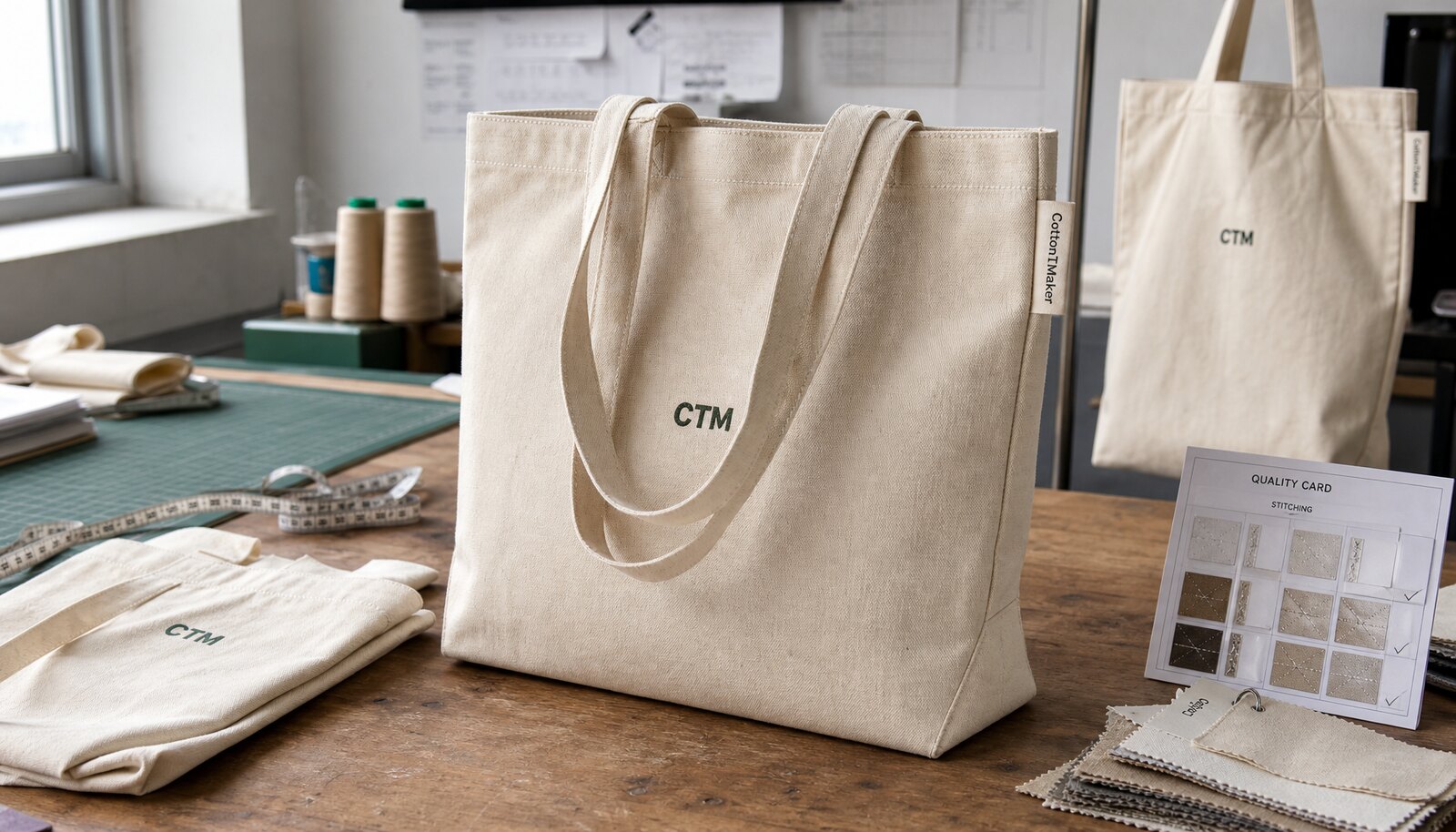
Why cotton bag quotes go wrong before production starts
Most bad cotton bag quotes are not caused by the factory price level. They are caused by missing specs. A buyer asks for a quote on a 'custom cotton tote bag' and receives three numbers that look comparable, but each factory has assumed a different fabric weight, handle length, print process, packing method, and MOQ split.
That creates two problems. First, procurement cannot compare quotes fairly. Second, the supplier with the lowest opening price often adds cost later when the artwork, sample, or packing details finally become clear. A usable RFQ for custom cotton bags needs enough technical detail to lock the quote basis before sampling starts.
- Do not request pricing from bag size and logo only.
- Treat fabric, printing, sewing, and packing as separate cost drivers.
- Ask factories to quote against the same specification sheet, not a loose email description.
Start with the bag use case, not the logo
Factories can only recommend the right cotton bag construction if they understand how the bag will be used. A giveaway bag for trade shows, a retail tote sold in stores, and a grocery carry bag may look similar in photos but they should not be quoted the same way.
When the use case is clear, the factory can suggest a realistic fabric weight, handle length, reinforcement method, and packaging level. This avoids overbuying heavy canvas for a low-cost campaign bag or underbuying thin fabric for a load-bearing retail program.
- Promo or event use usually fits lighter fabric and simple 1-color printing.
- Retail resale usually needs better fabric consistency, cleaner finishing, and label details.
- Grocery or bookstore use often needs a gusset and reinforced handles.
- Brand programs with sustainability claims should state organic cotton requirement at the first quote request.
Lock the core physical specs before asking for price
The fastest way to clean up a cotton bag quote is to freeze the physical spec sheet. For most buyers, the minimum set is finished size, fabric type, GSM or ounce weight, construction details, handle spec, and print location. If one of these stays open, the supplier is forced to guess.
Fabric weight has a direct effect on cost, hand feel, and performance. In cotton bags, a difference between 140 GSM and 180 GSM can materially change both price and carrying strength. The same applies to handle length. A short hand carry handle and a long shoulder handle are not the same consumption.
- Size format: for example 38 cm W x 42 cm H x 10 cm gusset.
- Fabric format: organic cotton plain weave, canvas, twill, or blended construction if allowed.
- Weight format: state GSM or oz and whether you accept a tolerance range.
- Construction format: flat bag, bottom gusset, side gusset, boxed corners, inside pocket, zipper, or magnetic closure.
- Handle format: width, total length, drop length, attachment style, and reinforcement requirement.
Specify printing properly or expect price drift
Print method is one of the biggest reasons cotton bag quotes change after artwork review. A buyer may request a logo print, but the factory still needs to know whether the design is best suited for screen print, heat transfer, digital print, embroidery, or another method. The print area, color count, line detail, and target color accuracy all affect the quotation.
For many bulk cotton bag orders, screen printing is the cleanest quote basis when the artwork is simple and volume is stable. If the artwork includes gradients, photo elements, or many colors, digital or transfer-based options may be considered, but those should be priced on purpose rather than assumed.
- State the maximum print area in centimeters, not only 'front logo'.
- List the number of print colors and whether both sides require printing.
- If Pantone matching matters, say so before the quote, not after sample approval.
- Ask about print durability checks such as rub resistance and curing consistency.
- If the bag is dark dyed cotton, confirm whether a white underbase is required.
Understand MOQ logic so your quote reflects the real order mix
MOQ on cotton bags is rarely one number that applies to every version. Factories often have separate MOQ logic for raw fabric booking, dyed fabric, print setup, and packaging variation. A total quantity of 5,000 pieces may still be inefficient if it is split into ten small colorways and four print layouts.
Procurement teams should ask suppliers to break MOQ by size, fabric color, and artwork version. This is especially important for distributors and retail buyers who want one construction with multiple private labels or seasonal graphics.
- Natural fabric usually gives more flexibility than custom dyed fabric.
- One print design across multiple colors is different from multiple print artworks on one base bag.
- Small order splits can increase waste, setup time, and carton complexity.
- If you expect repeat orders, ask the factory how reorder MOQ changes after the first run.
Use sampling to validate the quote, not just the look
A sample should confirm production assumptions, not only visual approval. Many buyers approve a hand-made sample that looks acceptable, but the bulk order later differs because the sample was made from substitute fabric, manually cut pieces, or a different print process than the quoted bulk plan.
A better approach is to define sample stages clearly. Start with artwork layout confirmation, then a physical sample, then a pre-production sample based on the intended bulk material and print method. If the order is large, this sequence costs less than fixing a full production mistake.
- Check actual fabric weight and hand feel against the approved specification.
- Measure handle drop and overall dimensions after sewing, not from flat cut panels.
- Review print location, color shade, and edge sharpness on the sewn bag.
- Ask whether the pre-production sample uses bulk fabric lot and bulk print method.
- Confirm any tolerance accepted for size, print placement, and shade variation.
Do not leave packing and carton details to the factory default
Packing is often treated as an afterthought, but it affects both landed cost and claim risk. One supplier may quote bulk carton packing, another may include individual polybags, and a third may use inner packs that increase carton count and CBM. Without a written packing instruction, quote comparison becomes unreliable.
For cotton bags, folding method, moisture protection, carton dimensions, and units per carton matter. Retail buyers may also need barcode labels, assortment labels, or retail-ready inner packs. If these requirements appear late, they usually increase cost and can delay shipment booking.
- State whether individual polybags are required or should be avoided.
- Ask for carton dimensions and units per carton at quote stage.
- Confirm carton mark format, shipping mark language, and barcode label location.
- If mix packing is needed, define the assortment ratio clearly.
- Request a packing photo or carton layout during pre-shipment review.
Lead time and quote data should be broken into usable parts
A single lead time number is not enough for planning. Buyers need to know what that number includes and what approvals trigger the next stage. A factory may say 35 days, but that may start after fabric booking, artwork approval, or sample sign-off depending on the supplier.
The same rule applies to quote data. A strong quotation should separate sample cost, bulk unit price, print charge structure if applicable, packaging add-ons, and trade term basis. This helps procurement compare suppliers without hidden assumptions.
- Request separate timing for sample making, sample approval, bulk production, and packing.
- Ask what material booking time changes when fabric is organic, dyed, or custom woven.
- Confirm the validity period of the quote if cotton market cost is volatile.
- Require the quote basis to state EXW, FOB, or other trade term used.
- Ask which changes will trigger re-quotation, such as larger print area or lower per-design quantity.
Specification comparison for buyers
| Spec decision | Recommended option | When it fits | Buyer risk to check |
|---|---|---|---|
| Fabric weight | 140-180 GSM plain weave or 8-10 oz canvas equivalent | Everyday retail tote, promo bag, basic reusable shopping bag | Factories may quote lighter fabric unless tolerance and finished bag use are stated |
| Print method | 1-2 color screen print | Large solid logo, medium volume, standard lead time | Artwork line thickness, Pantone matching, and print position tolerance must be confirmed |
| Bag construction | Bottom gusset with cross-stitched handles | Higher load use, grocery, bookstore, or event giveaway | Some quotes exclude reinforcement and change handle strength |
| Material claim | Organic cotton with source documents requested at quote stage | Brand programs that need traceable material planning | A quote may price regular cotton unless organic requirement is written clearly |
| Packaging | Individual polybag only if required; otherwise bulk pack by carton count | Importers trying to reduce unnecessary packing cost and carton volume | Quotations often vary because one supplier includes inner packs and another does not |
| Sampling route | Digital mockup, then pre-production sample from bulk-like fabric | Standard custom programs needing approval before mass production | A hand-made sample may not reflect print feel, shrinkage, or final sewing consistency |
Buyer checklist before sampling
- State the bag end use first: grocery carry, retail packaging, event giveaway, merch sale, bookstore, wine accessory, or e-commerce insert.
- Lock the exact finished size in W x H x gusset format and state whether dimensions are flat or after sewing.
- Specify fabric type and weight clearly, such as organic cotton plain weave 140 GSM or organic cotton canvas 10 oz.
- Confirm natural, dyed, bleached, or recycled-look fabric appearance because color base changes print result and cost.
- List handle width, handle length, and whether handles are self-fabric, webbing, or reinforced.
- Define print method, print size, number of colors, artwork placement, and whether Pantone matching is required.
- State if both sides print, inside label, woven label, hangtag, barcode sticker, or care label are needed.
- Ask for MOQ by colorway, by print design, and by size, not just total order MOQ.
- Request carton dimensions, units per carton, net and gross weight, and whether carton marks are included.
- Require sample stages: visual mockup, physical sample, pre-production sample, and production approval point.
Factory quote questions to send
- What fabric weight tolerance do you apply in bulk production, and is the quoted GSM before or after washing or finishing?
- Is your quote based on regular cotton or certified organic cotton source material, and what material documents can you provide during order review?
- What is the MOQ per size, per fabric color, and per print design for this bag construction?
- Does the quoted unit price include gusset sewing, handle reinforcement, trimming, thread color matching, and loose thread cleaning?
- Which print method are you quoting, and what artwork limitations should we know for fine lines, halftones, and dark fabric coverage?
- What sample is included before bulk production: digital layout, hand-made sample, or pre-production sample made from bulk fabric?
- What packaging is included in the quote: individual polybag, inner pack, tissue, carton label, barcode label, and carton drop test standard?
- What lead time do you need for sampling, bulk material booking, printing, sewing, packing, and shipment release after approval?
- What common cost changes could occur after artwork review, such as larger print area, zipper addition, wider gusset, or lower MOQ split?
- How do you control handle strength, print position tolerance, needle holes near the print area, and fabric shrinkage risk?
Quality-control points to confirm
- Measure finished bag width, height, gusset, and handle drop against approved tolerance before packing.
- Check fabric hand feel and weight against approved sample to catch GSM substitution or mixed-lot variation.
- Verify print color, registration, opacity, curing, rub resistance, and placement on both flat and sewn panels.
- Inspect handle attachment with load-focused pull check, especially at cross stitch or box stitch points.
- Review seam alignment, skipped stitches, open seams, puckering, and loose thread trimming at side and bottom joins.
- Confirm label content, label position, barcode accuracy, and carton marks against packing list and order spec.
- Open random cartons to verify pack count, folding method, moisture control, and absence of mixed colorways or mixed sizes.
- If bags are washed or dyed, check shrinkage, shade variation, and odor before final shipment release.