1. Start With the Use Case, Not the Logo
A custom conference zipper bag looks simple, but the buying decision is usually about function, not decoration. Procurement teams need to define what the bag must carry, how often it will be reused, and whether it will be handed out as an event giveaway, used by staff, or sold as a branded accessory. A bag built for brochures and notebooks is not the same as a bag that must also hold a charger, a water bottle, and a tablet sleeve. If you skip that step, every quote you receive will be priced against a different assumption.
For most conference programs, the real buying problem is finding a bag that looks professional on day one and still works after the event. That means you need to pin down the target user, the expected load, and the impression you want the bag to make. A flat pouch can be cheap and light, but it may not stand up on a registration desk or carry enough. A gusseted zipper bag costs more, yet it usually gives a better balance of presentation, utility, and perceived value.
- Define the carried contents first: documents, brochures, charger, notebook, or tablet sleeve.
- Set the intended use: giveaway, staff kit, reseller item, or premium event gift.
- Decide whether the bag must stand upright, hold shape, or stay lightweight and foldable.
- Write the brand goal in plain terms: premium, practical, durable, or budget-led.
2. Pick the Right Structure for the Event
Conference zipper bags usually fall into three practical structures: flat, gusseted, or semi-structured. Flat bags are the easiest to ship and the lowest cost to make, but they only work when the load is thin. Gusseted bags add depth and are better for event kits that include a notebook, program, and charger. Semi-structured bags use extra panels, lining, or inserts to improve shape, which helps when the buyer wants a cleaner retail feel or a more executive presentation.
The structure choice affects almost every other line in the quote. A bag with more depth needs more fabric and more labor. A bag with internal padding or board inserts needs different packing and can increase carton volume. Before you ask for a price, decide whether you want the bag to behave like a folder, a tote, or a soft briefcase. That one decision keeps suppliers from quoting wildly different constructions under the same product name.
- Flat format: best for papers and slim brochures, lowest cost, least protective.
- Gusseted format: best for event kits and mixed contents, most common for conference use.
- Semi-structured format: best for premium gifting and retail use, higher labor and better shelf appeal.
- If the bag must carry weight, ask for reinforced side seams and handle anchor points.
3. Fabric Weight Sets the Price and the Feel
Do not let a supplier stop at a fabric name. For conference zipper bags, you need the exact material, the fabric weight, and any coating or backing. A 600D polyester bag with PU or PVC backing is a common middle-ground choice because it gives decent shape, strong print results, and reasonable cost control. In practice, buyers often see this spec around 230 to 280 gsm, but the real result depends on weave density, coating, and finishing. If the factory only gives you denier, ask for the actual gsm and a sample swatch.
For a more premium look, 12 oz canvas is a strong option, often landing around 340 to 420 gsm depending on weave and finish. It feels more natural and can support a higher perceived value, but it also changes print behavior and may need better edge finishing. For budget-heavy programs, 300D polyester can work if the contents are light and the buyer accepts a softer bag. If the event kit includes heavier materials, choose the more structured option. A cheap fabric can make a good design feel low-end very quickly.
- 600D polyester: good balance of structure, durability, and print clarity for most conference bags.
- 12 oz canvas: stronger brand feel, better for premium gifting, but needs careful finishing.
- 300D polyester: suitable for light duty and price-sensitive programs, but watch sagging and wrinkling.
- Ask whether the factory is quoting actual fabric gsm, coating weight, and lining separately.
4. Print Method Should Match the Artwork, Not the Supplier's Favorite Process
The best print method depends on the logo, the fabric, and the durability requirement. Silkscreen is the safest choice for simple logos with one to three solid colors, especially when the bag panel is flat and the artwork does not need gradients. Heat transfer can handle more detail and small type, which is useful when the conference sponsor wants a cleaner brand lockup. Sublimation works well on polyester when the artwork uses full color and the buyer accepts a more integrated print look.
Do not choose a print method only because it is cheapest. A low-cost print that cracks at the fold line or looks weak under bright event lighting will make the product feel cheaper than it really is. For premium conference bags, many buyers combine one clean print with a woven side label, embroidered patch, or debossed detail. That combination usually gives a better balance of brand visibility and long-term wear than a large, high-coverage print that can show abrasion fast.
- Silkscreen: best for bold, simple logos on flat fabric panels.
- Heat transfer: useful for small text, gradients, or multi-color artwork with tight registration.
- Sublimation: strongest fit for polyester and full-color artwork, but less suitable for dark or heavily textured materials.
- Ask for artwork size, position tolerance, and color match standard before sampling.
5. Zippers, Pullers, and Stitching Decide Whether the Bag Lasts
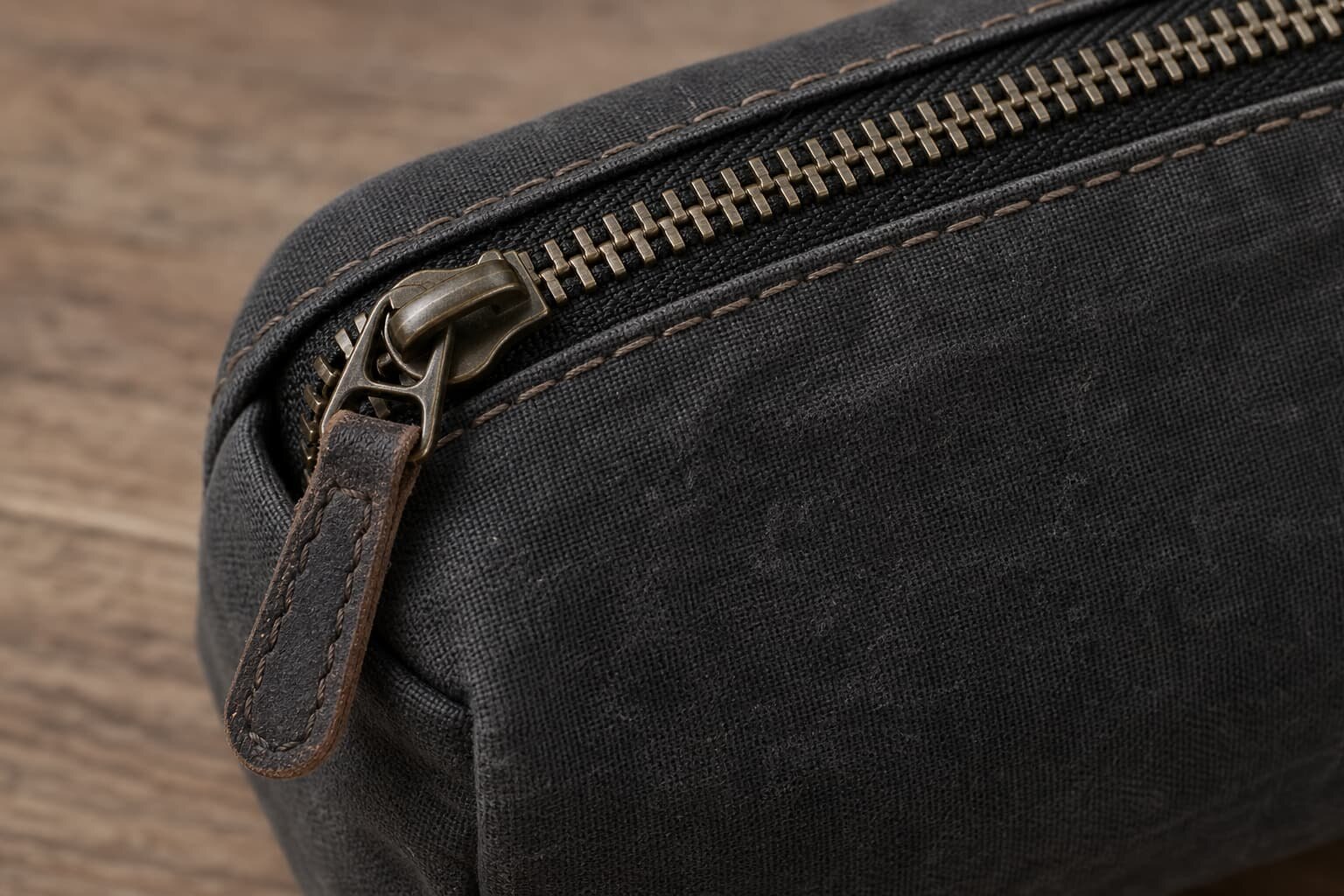
A conference zipper bag lives or dies by the zipper quality. For most buyer programs, a nylon coil zipper in size #5 is the practical standard because it moves smoothly, handles curved stitching better than many metal options, and keeps cost under control. When the bag is larger, heavier, or expected to be reused often, a #8 zipper may be the safer choice. The slider should feel stable, not loose, and the puller should be easy to grip with one hand when the bag is full.
Handles and stress points matter just as much as the zipper. Ask the factory how they reinforce the handle ends, whether they use X-box stitching or bar-tacks, and what thread type they use. A good-looking bag with weak anchors will fail in the first field use if it is loaded with catalogs or electronics. If you need a structured or semi-structured bag, ask for seam allowance, corner finishing, and internal reinforcement details in the quote. Those are the details that separate a real factory spec from a rough sales estimate.
- #5 nylon coil zipper: common for standard conference bags and smooth daily use.
- #8 zipper: better for larger bags or heavier loading, but usually increases cost.
- Auto-lock or locking sliders help stop accidental opening during transport.
- Handle anchors should be reinforced with X-box stitching or bar-tacks, not only single-line stitching.
6. Build the Quote So You Can Compare Suppliers Fairly
A usable quote should break the bag into parts, not just give one unit price. If a supplier only sends a single number, you cannot tell whether they changed the fabric, downgraded the zipper, simplified the print, or removed reinforcement. For a conference zipper bag, the quote should clearly separate body fabric, lining, zipper, puller, print, labor, packaging, and any extra costs such as artwork setup or tooling. That breakdown is what lets you compare one factory to another on equal terms.
MOQ logic also matters. The same bag can have different minimums depending on the fabric color, zipper color, print colors, lining color, and packing method. One-color screen print may have a lower setup burden than a full-color transfer. A stock black zipper may be easy, while a custom-matched zipper tape can increase minimums. When you request pricing, make sure the factory tells you the MOQ per color, per artwork version, and per packaging configuration. Otherwise, the quote will look simple but become expensive once the real production details are fixed.
- Ask for a line-by-line quote: material, trim, print, labor, packing, and options.
- Confirm whether the MOQ changes with color changes, logo changes, or size changes.
- Request both sample cost and bulk price so you can see where the setup work sits.
- Make sure the supplier states what is excluded, especially artwork, testing, and freight.
7. Sample Approval Is Where Most Mistakes Are Prevented
For this product, the sample should not be treated like a showroom sample. It should be a working approval tool. The factory should send a pre-production sample or a production-like prototype that uses the real fabric, zipper, print method, and reinforcement method. If the sample is made from substitute materials, it may look acceptable but fail in bulk production. The purpose of the sample is to confirm what the factory can repeat, not what the designer imagined.
When you review the sample, check the bag as a buyer, not just as a brand owner. Measure the finished size, inspect the logo placement, open and close the zipper repeatedly, and load it with the items that will actually go inside. Check seam symmetry, handle alignment, internal pocket position, and whether the bag still closes cleanly when full. If the program involves multiple colors, ask for fabric swatches or lab dips before bulk cutting starts. That step saves a lot of rework later.
- Check size, gusset, and pocket placement against the approved spec sheet.
- Inspect logo position, color match, and edge quality under normal room light.
- Load the bag with actual contents and test zipper travel, shape, and handle comfort.
- Approve only after the factory confirms the same fabric, trim, and print process for bulk production.
8. Packing and Lead Time Affect Real Delivered Cost
Conference zipper bags are soft goods, so packing can change both damage risk and freight cost. Ask whether the bags will be packed flat, folded once, or shaped with tissue or paper board. If the product has a structured front or side panel, too much compression can leave permanent creases. If there is metal hardware, the factory should add separators or protective polybags so the hardware does not scuff the fabric. Carton count also matters because an overloaded carton can crush the bags, while a carton that is too loose wastes freight space.
Lead time should be split into sample time and bulk time. A realistic factory schedule depends on material availability, print complexity, and order volume. For a standard order, sample production may take about one to two weeks, and bulk production often runs around four to six weeks after approval, but the actual number can move if the bag uses custom color fabric, special trims, or multiple print steps. If your launch date is fixed, ask the supplier to identify the longest-risk path in the schedule before you place the order.
- Confirm inner packing: flat fold, tissue insert, polybag, or paper board support.
- Ask for carton quantity, carton size, gross weight, and outer carton markings.
- Verify whether the bags are packed by color, size, or mixed cartons.
- Get separate timelines for sampling, approval, production, and export booking.
9. Compare Quotes Like a Merchandiser, Not Just a Price Checker
The cheapest quote is often the one that hides the most risk. When you compare suppliers, check whether they are quoting the same fabric weight, the same zipper grade, the same print method, and the same packing method. A small downgrade in any one of those areas can change how the bag looks, how it holds weight, and how long it survives. If two quotes are far apart, the difference is usually in the details, not the labor rate.
A good supplier should be able to restate your spec in writing before they cut the order. If they cannot clearly explain the fabric, zipper, print, reinforcement, and carton plan, they are not yet quoting the same product you are buying. For procurement teams, the goal is not to find the lowest number on paper. The goal is to buy the bag that arrives on time, matches the approved sample, and does not create avoidable claims, rework, or event-day complaints.
- Compare only like-for-like quotes with the same size, materials, print, and packing.
- Treat vague specifications as a risk, not a bargain.
- Check for hidden exclusions such as sampling, artwork setup, testing, or freight.
- Use the approved sample and spec sheet as the final reference for mass production.
Specification comparison for buyers
| Spec decision | Recommended option | When it fits | Buyer risk to check |
|---|---|---|---|
| Body fabric | 600D polyester with PU or PVC backing, about 230-280 gsm | Mid-range conference bags that need structure, print clarity, and a clean professional look | Ask whether the GSM is actual fabric weight or just a denier claim, and confirm coating thickness and hand feel |
| Premium body fabric | 12 oz canvas, about 340-420 gsm depending weave and finish | Executive gifts, retail programs, or brands that want a more natural, textured appearance | Canvas can shrink, fray, or print differently, so approve shrinkage, color variation, and seam finishing |
| Budget body fabric | 300D polyester, about 160-200 gsm | High-volume event giveaways where the bag is light duty and price sensitive | Low GSM bags can feel flimsy and distort after packing brochures, chargers, or a laptop sleeve |
| Print method | Silkscreen for one to three solid logo colors | Simple branding on flat panels with strong color blocks | Check screen count, ink cure, and registration tolerance so the logo does not shift or crack |
| Print method | Heat transfer or sublimation on polyester | Full-color logos, gradients, or artwork with fine detail | Confirm fabric compatibility, wash and rub resistance, and whether the artwork can bleed on dark cloth |
| Closure and structure | #5 nylon coil zipper plus light structure insert | Most conference use cases that need smooth opening and moderate cost control | Verify zipper pull durability, slider lock type, and whether the bag holds shape when loaded |
| Reinforcement | X-box or bar-tack stitching on handles and stress points | Any bag expected to carry catalogs, bottles, chargers, or small laptop accessories | Ask for stitch density and thread type; weak reinforcement usually fails before the zipper does |
Buyer checklist before sampling
- Define the bag use case first: documents only, brochures plus charger, or a heavier conference kit.
- Lock the finished size, gusset depth, and target load before asking for prices.
- Specify the main fabric by material and GSM, not only by name like polyester or canvas.
- Choose one print method and one artwork placement, then confirm the maximum logo size.
- State the zipper grade, puller style, and whether you need a locking slider or double puller.
- Ask for a pre-production sample and compare it against a written spec sheet.
- Confirm inside features such as pocket count, lining, and pen holder before mass production.
- Agree on packing method, carton quantity, and outer carton markings before order release.
- Get lead time in two parts: sample time and bulk production time after approval.
- Request a quote breakdown so you can compare fabric, print, labor, packing, and freight on equal terms.
Factory quote questions to send
- What exact fabric, GSM, and backing are you quoting for the body and lining?
- What is the finished size, gusset depth, and tolerance you are pricing against?
- Which print method is included, how many colors, and what is the print area in centimeters?
- Which zipper grade, slider type, and puller material are included in the base price?
- Are handle reinforcements, bar-tacks, and interior pockets included or treated as options?
- What is the MOQ per color, per artwork, and per order if we change only the logo?
- What is the sample fee, and is it refundable against the bulk order or separate?
- What is the production lead time after sample approval, and what changes it?
- What packing method, carton quantity, and master carton size are included in your quote?
- What items are excluded from the quote, such as artwork setup, tooling, testing, or shipping?
Quality-control points to confirm
- Measure finished dimensions and gusset depth against the approved sample and written spec.
- Check fabric GSM, coating, color, and hand feel against the approved swatch or sign-off sample.
- Inspect print placement, logo sharpness, color density, and edge cracking after flexing.
- Cycle the zipper repeatedly to confirm smooth travel, no teeth separation, and no slider sticking.
- Pull-test the handles and inspect X-box or bar-tack stitching at the stress points.
- Check lining attachment, pocket alignment, and seam allowance inside the bag.
- Verify thread trimming, edge finishing, and that no loose threads or needle damage remain.
- Confirm pack count, polybag method, carton labeling, and carton compression resistance.