Why coffee roasters need a different buying checklist
Coffee roasters rarely buy custom canvas zipper portfolios as a simple promotional giveaway. The product often sits between brand presentation, account management, training, and field sales. It may hold cupping sheets, wholesale account forms, roast profile cards, pricing pages, equipment service notes, distributor documents, or a tablet used by a sales representative. Because it moves through meetings and sampling conversations, the portfolio has to look brand-right while still working after repeated opening, stuffing, and transport.
That makes the buying process different from a generic promo folder. A low-cost canvas pouch can be fine for a one-day event, but a wholesale account portfolio usually needs stronger structure, cleaner stitching, reliable zipper movement, and a thoughtful interior layout. Coffee brands also tend to use natural materials, restrained colors, small labels, and tactile surfaces. On those products, small defects are more visible: a wavy zipper, crooked logo, weak corner, or dirty canvas panel can make the item feel cheaper than the brand intended.
The main procurement risk is vague specification. If the request says only custom canvas zipper portfolio with logo, each factory will fill in the blanks differently. One may quote 10 oz unlined canvas with a basic zipper. Another may assume lining, pockets, reinforced corners, and individual polybags. Both prices may look reasonable, but they are not pricing the same product. A strong RFQ turns design intent into measurable details before the first quote round.
- Common roaster uses include distributor kits, wholesale onboarding folders, sales rep portfolios, trade show document holders, retail accessories, training materials, and account welcome packs
- The product needs to protect papers and tools while reinforcing the brand's material quality and visual identity
- Quote clarity matters because fabric weight, lining, zipper grade, pocket count, and packing method can change unit price more than small artwork changes
- The best buying checklist starts with intended contents, expected use frequency, brand finish, and downstream handling requirements
Define the use case before choosing materials
The best specification starts with the real job the portfolio must perform. A trade show handout may only need to carry a brochure, business card, and small tasting note. A distributor onboarding portfolio may need to hold contracts, sell sheets, pricing information, roast profiles, and several origin cards. A sales rep folder may need stronger zipper performance because it will be opened many times each week. A retail item may require cleaner lining, better hangtag presentation, and more consistent appearance across units.
Procurement teams should document the contents before asking for quotes. This sounds simple, but it prevents many late-stage revisions. If the portfolio must fit letter-size sheets, A4 pages, a 10-inch tablet, a cupping form pad, or a thick printed booklet, those items should be named in the RFQ. Outside dimensions alone are not enough. A portfolio can meet the finished size but still have pockets that are too tight, a zipper opening that restricts access, or corners that bend when filled.
Use case also affects the acceptable level of structure. Soft-folding canvas works for light documents and event use. Semi-structured construction is better for account kits and meeting folders. Rigid or padded panels may be needed for device carry, but those choices add bulk, increase freight volume, and can create more complicated sewing around the zipper. Buyers should decide whether the item is meant to feel natural and flexible or protective and substantial.
- For event giveaways, prioritize simple construction, clean front branding, lower MOQ, and efficient packing
- For wholesale account kits, prioritize document fit, zipper reliability, structured feel, and a professional interior
- For sales rep use, prioritize repeated-use durability, reinforced stress points, and easy one-handed opening
- For retail merchandise, prioritize consistent appearance, neat lining, barcode or hangtag options, and consumer-ready packing
- For internal training or office use, prioritize practical document storage and cost control over complex decorative features
Build the core specification that suppliers can price accurately
A useful RFQ should describe the body, opening, interior, decoration, and packing in concrete terms. For custom canvas zipper portfolios wholesale buyers usually see the biggest quote differences in four areas: canvas weight, lining, pocket layout, and zipper grade. If those are not fixed, prices will not be comparable. A factory quoting 12 oz canvas with lining and three pockets is not competing on the same basis as a factory quoting 10 oz unlined canvas with one sleeve.
A strong starting point for many coffee roaster programs is 12 oz canvas, nylon coil zipper, one document sleeve, one pen loop, and either a woven side label or one-color screen print. This gives enough structure and brand presence without turning the interior into a labor-heavy organizer. If the portfolio must carry tablets, thicker documents, or retail inserts, buyers can add lining, interfacing, padding, or additional pockets in a controlled way.
Dimensions should be written as finished closed size and open size. If there is a gusset, state the gusset depth. If the zipper follows three sides, confirm the opening direction and whether the slider starts at the top, side, or lower corner. If a handle is added, define handle length, webbing width, attachment position, and reinforcement method. These details help the supplier identify sewing difficulty before sampling, not after the buyer has already compared prices.
- Minimum RFQ details: finished size closed, finished size open, canvas weight, fabric composition, zipper type, zipper color, puller type, lining choice, pocket layout, logo method, packing method, and target quantity
- Helpful content details: paper size, tablet size, insert thickness, pen diameter, card size, and whether documents must fit without bending
- Construction details to confirm: seam allowance, binding, top-stitching, reinforcement, corner shape, zipper end treatment, and whether panels need interfacing
- Commercial details to request: MOQ per colorway, price breaks, sample cost, sample lead time, bulk lead time, carton dimensions, and trade term
Choose canvas weight, composition, and structure deliberately
Canvas portfolios are judged quickly by handfeel. For coffee roasters, that tactile impression matters because the product often supports a brand story built around craft, sourcing, and material honesty. Very light canvas can feel too close to a document pouch. Very heavy canvas can become bulky, difficult to sew cleanly, and less efficient to ship. For many B2B programs, 12 oz to 14 oz canvas, roughly 340 to 400 GSM, provides a balanced structure without requiring heavy board inserts.
Fabric composition should be stated clearly. 100% cotton canvas gives a natural hand and accepts many brand stories well, especially for roasters using natural, black, olive, or earthy colors. Cotton-poly blends can improve consistency, abrasion resistance, and color stability depending on the fabric, but they may feel less traditional. Recycled blends may be relevant for some brands, but buyers should avoid vague sustainability language unless documentation and labeling requirements are agreed with the supplier.
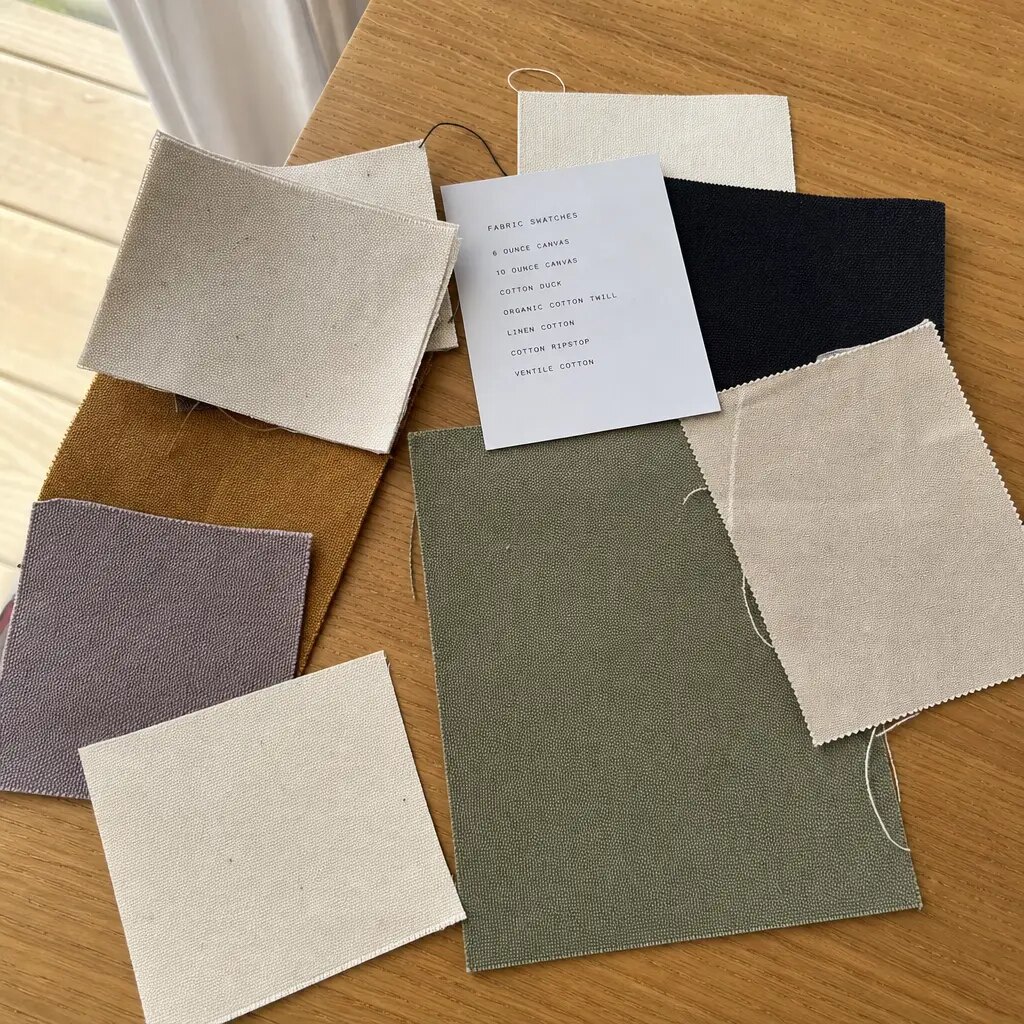
Natural canvas needs special attention. It can show seed specks, slubs, yarn variation, and lot-to-lot shade movement. Those features may be acceptable or even desirable for a craft-oriented product, but they should be approved with a physical swatch. Dyed canvas hides some natural variation and dirt better, but print opacity becomes more important on black, navy, forest, or dark brown fabric. If the design needs a very crisp white mark on dark canvas, a print strike-off is essential.
Structure can come from fabric weight, lining, interfacing, padding, or board. Each option changes the product differently. Interfacing can improve shape without adding much thickness. Foam or padding can protect devices but may make the zipper edge look swollen if poorly managed. Board can create a premium presentation feel but may reduce foldability and raise carton volume. Buyers should specify the intended structure rather than asking the factory to make it more premium after the first sample.
- 10 oz canvas is usually best for soft document use or budget event programs
- 12 oz canvas is a practical middle point for branded portfolios that need better handfeel and shape
- 14 oz canvas suits stronger structure but requires careful sewing around corners and zipper edges
- Lining options include no lining, bound seams, 210D polyester, 300D polyester, light cotton lining, or partial lining
- If adding interfacing, foam, or board, define the thickness, panel coverage, flexibility, and whether the portfolio must lie flat when open
Plan zipper, opening, and interior layout for real workflow
The zipper is one of the highest-risk components because it affects both appearance and daily function. A nylon coil zipper is usually the safest choice for canvas zipper portfolios. It bends around corners more smoothly than many metal zippers, is generally more cost-effective, and reduces the chance of scratching tablets or printed inserts. The buyer should still define zipper tape color, slider color, puller style, opening direction, and zipper gauge or grade where available.
Zipper placement should be tested with the actual contents. A portfolio that looks correct when empty may become difficult to close when filled with a pad, documents, and cards. If the zipper runs close to the edge, corners may wave after packing or after repeated use. If the zipper opening is too narrow, users may struggle to insert papers without bending them. For sales rep or distributor use, the zipper should run smoothly from corner to corner and should not catch on lining, thread, or pocket seams.
Interior design should be useful rather than crowded. Many buyers are tempted to add every organizer feature because it looks impressive in a sample photo. In production, each extra pocket adds cutting, positioning, stitching, and inspection complexity. For coffee roasters, a document sleeve, a few card slots, and a pen loop often cover the majority of needs. Add a notepad slot, elastic band, or zip mesh pocket only when the contents justify it.
Pocket sizing is a common source of disappointment. Card slots can become too tight after binding. A document sleeve can lose usable width after seam allowance. A pen loop can be placed too close to the zipper and create a bulge. The RFQ should specify usable pocket opening dimensions, not only the outer panel design. Sample approval should include physically inserting the intended documents, cards, pens, and brochures.
- Recommended zipper: nylon coil zipper with stable slider, secure puller, smooth corner travel, and reinforced ends
- Zipper checks: no wave, no snag, no separation, no sharp edge, no loose slider, no exposed unfinished end
- Useful interior baseline: one document sleeve, two to four business card slots, one pen loop, and optional small accessory pocket
- Avoid unnecessary complexity: too many narrow pockets can raise defect rate and reduce actual usability
- For handle versions, require bartacks or reinforced box stitching at joins and test the portfolio with realistic loaded weight
Match branding method to canvas texture and channel
Coffee roaster branding often uses small wordmarks, badge logos, line drawings, origin references, or understated marks. Canvas is a textured surface, so artwork that looks sharp on screen may not reproduce cleanly on fabric. Before choosing the logo method, procurement should look at line thickness, text size, color count, desired handfeel, fabric color, and the distance from which the branding needs to be read.
Screen printing is often the most practical option for one- or two-color logos. It is economical at wholesale quantities and works well for bold marks. The risk is detail loss on coarse canvas, especially with small letters, thin rules, or reversed-out designs. White ink on black or dark canvas may require an underbase or multiple passes, which affects cost and handfeel. Buyers should approve a strike-off whenever opacity, color accuracy, or fine detail matters.
Heat transfer can reproduce detailed or multi-color artwork more cleanly than screen print, but it may feel more surface-applied. That can be acceptable for event merchandise or detailed campaign graphics, but some premium roaster brands may prefer a more textile-integrated look. Woven labels, cotton labels, leather-look patches, or sewn fabric patches can be more subtle and consistent. They also reduce the risk of print distortion on textured canvas.
Embroidery should be used carefully. It can look premium on the right artwork, but dense stitching may pucker medium-weight canvas, especially near pockets or zipper seams. If embroidery is requested, the factory should test backing, stitch density, and placement before bulk production. For minimalist roaster branding, a woven side label or small front patch often gives a cleaner B2B result than a large embroidered logo.
- Use screen print for bold simple marks, larger front-panel logos, and economical wholesale runs
- Use heat transfer for detailed art, multiple colors, gradients, or campaign graphics that must remain crisp
- Use woven labels or sewn patches for subtle premium branding and lower visual risk across textured fabric
- Use embroidery only after testing puckering, backing, stitch density, and panel stability
- For any branding method, specify logo size, location, color reference, placement tolerance, and acceptable variation on canvas
Understand MOQ, price breaks, and cost control levers
MOQ is not only a unit count. For custom canvas zipper portfolios, factories think in terms of fabric purchasing, dye lots, trim sourcing, print setup, sewing efficiency, and packing work. A supplier may say the MOQ is 500 pieces, but that may mean 500 pieces in one fabric color, one size, one logo, one zipper color, and one packing method. If the buyer wants five colors at 100 pieces each, the factory may add setup charges, raise unit price, or decline the order.
Coffee roasters often want variations by roast family, event, origin program, distributor tier, or seasonal campaign. The most efficient way to keep the custom look without breaking MOQ is to standardize the construction. Keep the same body size, canvas color, zipper, lining, pocket layout, and logo position. Then vary the small label, print artwork, insert card, or hangtag if needed. This protects production efficiency while still giving the brand room to create program-specific versions.
Price breaks should be requested using the same specification. Ask for 300, 500, 1000, and 3000 pieces with no construction changes. This reveals where the setup cost starts to flatten and whether the supplier's price improves meaningfully with volume. If the price only drops slightly between 500 and 1000 pieces, the product may be labor-driven. If the price drops sharply, material MOQ or decoration setup may be the bigger factor.
Cost control should not rely only on lighter fabric. Reducing canvas weight can save money, but it may also make the product feel less substantial. Better levers often include simplifying the pocket layout, keeping one fabric color, using a standard zipper tape color, choosing woven label branding instead of large complex printing, and avoiding unnecessary individual packaging. Procurement should protect the parts the user will notice most: zipper function, panel shape, and brand finish.
- Lowest-complexity order: one size, one canvas color, one zipper color, one lining choice, one pocket layout, one logo position
- Moderate-complexity order: same construction with two or three artwork versions in the same print size and location
- Higher-risk order: multiple fabric colors, mixed zipper colors, different interiors, low quantity per SKU, and different packing instructions
- Good cost levers: simplify pockets, standardize trims, reduce color splits, avoid custom zipper tape, and confirm packing only where needed
- Poor cost levers: under-specifying fabric, skipping reinforcement, using very cheap zippers, or approving bulk without a branded sample
Compare supplier quotes with a normalized quote sheet
A low quote can be useful, but only if it includes the same product and service level as the other quotes. In this category, missing line items are common. One supplier may exclude lining, individual polybags, barcode stickers, reinforced handle joins, upgraded zipper pullers, or print setup. Another may quote a lighter canvas or a different logo method without calling attention to the change. Procurement teams should normalize quotes before selecting a supplier.
A practical quote sheet divides the product into body material, trims, decoration, labor features, packing, and logistics. This does not require the factory to disclose private costing. It simply forces every supplier to confirm what is included. If one price is much lower, the buyer can identify whether the difference comes from a genuine production advantage or a missing specification. That protects the buyer from late revisions that erase the apparent savings.
Trade terms should also be normalized. EXW, FOB, CIF, and DDP prices cannot be compared as if they are the same. For wholesale import programs, many buyers compare FOB pricing and then calculate freight separately with their forwarder. If a supplier provides only EXW, ask for the local transport and export handling assumptions. If a supplier offers DDP, ask what is included, what is excluded, and whether duties, taxes, or last-mile delivery are clearly stated.
The quote review should end with a written confirmation of assumptions. The purchase order should reference the approved specification, artwork file, sample, packing method, inspection standard, and delivery term. This paper trail is not bureaucracy for its own sake. It is what keeps the final production aligned when the order moves from sales communication to material purchasing, cutting, printing, sewing, and packing.
- Normalize fabric and trims: canvas weight, composition, lining, zipper grade, puller, labels, binding, reinforcement, and accessories
- Normalize decoration: print method, color count, print size, label size, patch material, setup cost, and artwork limitations
- Normalize labor features: pocket count, handle, top-stitching, edge finish, panel structure, and zipper opening style
- Normalize packing: individual bag, carton quantity, carton mark, barcode label, hangtag, carton liner, and moisture protection
- Normalize logistics: trade term, port, production lead time, carton dimensions, gross weight, and readiness date
Use sampling to test function, appearance, and packing
Sampling should not be treated as a photo approval step. A canvas zipper portfolio is a sewn product with several functional points: zipper travel, pocket usability, panel shape, logo behavior, and packing recovery. A digital layout can confirm artwork placement, but it cannot reveal whether the zipper waves around corners, whether the document sleeve is too tight, or whether the print loses detail on textured canvas. For B2B orders, the branded pre-production sample is the most important approval stage.
A useful sampling route begins with specification alignment and a digital layout. If the construction is new, a blank structure sample may be helpful before paying for branded decoration. After that, the buyer should approve a branded sample made with actual canvas, actual lining if any, actual zipper, actual logo method, and intended pocket layout. If the supplier cannot produce the sample exactly because a trim is unavailable, that exception should be documented and resolved before bulk.
The sample should be tested with real contents. Insert the forms, sell sheets, roast profile cards, coffee literature, pen, business cards, tablet, or sample inserts that the portfolio is expected to carry. Zip and unzip it several times. Open it on a table and check whether it lies reasonably flat. Look at the logo under normal office lighting and, if relevant, retail or event lighting. Check whether dark fabric hides the mark too much or whether natural canvas looks warmer than the brand expected.
Packing should be part of sample approval when presentation matters. If the unit is folded, polybagged, nested, or stacked too tightly, shape issues can appear later. For distributor or retail programs, approve the polybag size, sticker placement, barcode, hangtag, insert card, and carton quantity before bulk production. The approved sample should be named as the golden sample and linked to the purchase order and inspection checklist.
- Sample stages can include digital layout, fabric swatch, blank structure sample, print strike-off, branded pre-production sample, and packing sample
- Functional sample tests: document fit, card slot fit, pen loop placement, zipper run, corner shape, lying-flat behavior, and loaded closing
- Appearance sample tests: canvas shade, logo size, print opacity, label placement, stitch consistency, lining neatness, and hardware finish
- Packing sample tests: polybag fit, shape retention, carton count, sticker placement, carton mark, and dust or moisture protection
- Do not release bulk production until exceptions, substitutions, and tolerances are written down
Set QC thresholds before bulk production starts
Quality control for custom canvas zipper portfolios should focus on the defects that affect use, presentation, and repeat ordering. Canvas is a natural textile, so procurement should avoid unrealistic cosmetic standards that treat every slub or seed speck as a defect. At the same time, factories need clear limits. A small natural yarn variation is different from a stain, a crooked logo, a broken zipper, or an interior pocket that cannot hold the intended card.
A practical inspection plan separates critical, major, and minor defects. Critical defects are issues that make the product unusable, unsafe, or commercially wrong: broken zipper, open seam, wrong logo, wrong size category, sharp hardware, severe stain, or mold. Major defects affect saleability or function: severe zipper wave, panel twisting, unreadable print, missing reinforcement, pocket mis-sizing, or obvious stitch failure. Minor defects are limited cosmetic issues that do not harm function, such as small loose threads or slight print texture variation within the approved range.
Measurement points should be simple but specific. Check finished closed size, open size, pocket opening width, logo placement, zipper placement, handle length if used, and carton quantity. Define tolerances in advance. For example, print placement may be allowed within a small agreed range from the top and side edge. Size tolerance may vary by construction, but it should be written. Without tolerance language, both buyer and factory can be technically right and still disagree at final inspection.
QC photos are especially useful for remote buying teams. Ask the factory to provide production photos at cutting, printing or branding, sewing, trimming, packing, and final inspection. This does not replace inspection, but it catches obvious alignment problems earlier. The final inspection should compare bulk units against the approved sample, not against a design mockup. The sample is the physical standard for fabric handfeel, logo appearance, structure, and finishing.
- Critical defects: broken zipper, open seam, sharp hardware, wrong logo, wrong material, wrong size category, major stain, mold, or severe odor
- Major defects: severe panel skew, heavy zipper wave, unreadable logo, missing reinforcement, unusable pocket, broken stitching, or wrong packing method
- Minor defects: small loose thread, slight natural canvas specking, minor shade movement within approval, or small stitch variation away from stress points
- Measurement checks: closed size, open size, pocket width, logo position, zipper location, handle length, carton count, and gross weight
- Inspection references: approved sample, signed artwork, material swatch, packing approval, purchase order, and written tolerance sheet
Specification comparison for buyers
| Spec decision | Recommended option | When it fits | Buyer risk to check |
|---|---|---|---|
| Canvas weight | 12 oz to 14 oz canvas, about 340 to 400 GSM | Best for a structured portfolio that carries cupping sheets, contracts, tablets, sample cards, or wholesale account documents without feeling flimsy | Low-GSM fabric can collapse at the zipper edge, wrinkle after packing, and lower the perceived value during sales meetings or distributor onboarding |
| Fabric composition | 100% cotton canvas for a natural handfeel, or cotton-poly blend when abrasion resistance and shade consistency are more important | 100% cotton suits craft-focused roaster branding; blends can suit heavier field use and darker dyed colors | Suppliers may quote a blend as canvas without stating composition, which can affect handfeel, print behavior, labeling, and sustainability claims |
| Lining construction | Unlined with bound seams for value programs, or 210D/300D lining for a cleaner inside finish | Unlined suits event and internal use; lining suits distributor kits, retail merchandise, and long-term sales rep tools | Some factories quote unlined first, then add lining later and change price, lead time, seam bulk, and inspection criteria |
| Zipper type | Nylon coil zipper with a stable metal or molded puller | Most economical and reliable option for bulk production across multiple colorways and repeated opening cycles | Low-grade zipper tape may shade-drift from the approved sample; metal teeth can scratch devices and create complaints |
| Logo method | Screen print for bold 1-2 color logos; heat transfer for detailed artwork; woven label or patch for understated branding | Screen print works for simple roaster marks; transfer fits small detailed art; woven labels suit premium private label programs | Artwork detail can fill in on textured canvas; white ink opacity on dark canvas needs a strike-off or branded sample approval |
| Handle or no handle | No handle for slim portfolios; short reinforced webbing handle only when field carry is a real requirement | No handle suits desk, meeting, and welcome-kit use; handle suits sales reps carrying samples between accounts | Adding a handle changes carton density, sewing time, reinforcement needs, and failure points around the joins |
| Inner organizer layout | 1 document sleeve plus 2-4 card slots and 1 pen loop for most roaster programs | Fits sales sheets, roast profiles, origin cards, account setup forms, and tasting notes without overbuilding the item | Overbuilt interiors look impressive in samples but slow production and increase defects around binding, pockets, and top-stitching |
| MOQ route | Single fabric color with shared size, zipper, pocket layout, and logo position across SKUs | Best route when the buyer wants lower MOQ, easier inspection, and better price stability | Too many color and artwork variations split MOQ inefficiently and can push unit price up more than expected |
| Packing format | Individual polybag only when needed, then 20-40 pieces per master carton depending on thickness and finished size | Works for distributor stock, ecommerce replenishment, retail handling, or clean warehouse storage | Overpacking increases cube and landed cost; underpacking can crush corners, distort the zipper line, or create dust complaints |
Buyer checklist before sampling
- Define the primary use case first: trade show handout, distributor welcome kit, sales rep folder, retail merchandise, internal office use, or wholesale account onboarding kit
- Specify finished closed size, open size, gusset if any, and the exact paper, tablet, brochure, or sample insert that must fit
- State canvas weight in GSM or oz and confirm whether the weight is finished fabric weight before production, not a vague material description
- Confirm fabric composition: 100% cotton canvas, cotton-poly blend, recycled blend, dyed canvas, natural canvas, or washed canvas
- Decide whether the portfolio must be rigid, semi-structured, or soft-folding, and name any interfacing, padding, or board insert required
- List the exact interior functions needed: document sleeve, pen loop, business card slots, notepad slot, elastic holder, mesh pocket, zip pocket, or plain interior
- Choose zipper type, zipper tape color, puller material, puller finish, opening direction, end treatment, and whether zipper ends must be bartacked
- Name the logo method by panel location, artwork color count, maximum print size, label size, patch material, or embroidery area
- Confirm whether natural cotton shade variation, seed specks, and slubs are acceptable or whether a dyed fabric standard is required
- Set tolerances for finished size, print placement, print color, zipper wave, stitching density, pocket opening width, and fabric shade variance
Factory quote questions to send
- What canvas weight are you quoting in GSM and oz, and is that the finished fabric weight used for production?
- Is the quoted body fabric 100% cotton canvas, cotton-poly blend, recycled blend, or another composition?
- Is the canvas natural, dyed, washed, brushed, laminated, or treated, and what shade variation should we expect between lots?
- Does your price include lining, inner pockets, zipper, puller, labels, reinforcement, binding, individual packing, carton packing, and export carton marks?
- What is the MOQ per fabric color, per logo design, per size, per lining color, and per packing format?
- What print or branding method are you quoting, and what are the limitations for fine lines, small text, halftones, white ink, or dark canvas?
- Can you provide unit price breaks at 300, 500, 1000, and 3000 pieces using the same exact specification?
- What sample stages do you provide: digital layout, blank structure sample, fabric swatch, print strike-off, and branded pre-production sample?
- What are your normal production tolerances for finished size, print placement, zipper placement, stitch density, and fabric shade variance?
- What zipper brand, gauge, or grade do you use, and how do you test zipper run, slider strength, and stop-end security?
Quality-control points to confirm
- Canvas weight should match the approved spec within agreed mill tolerance; verify by random weighing and cut-size comparison when required
- Fabric composition, surface finish, and shade should match the approved sample or swatch; natural cotton slubs and seed specks should stay within the approved range
- Body panels should be visually symmetrical with no twisting, bowing, major skew, or severe corner distortion after sewing and packing
- Finished closed size and open size should stay within the agreed tolerance so A4 sheets, letter sheets, tablets, or inserts fit as intended
- Zipper should run smoothly from corner to corner with no wave, snag, missing teeth, separation, stuck slider, loose puller, or exposed sharp edge
- Zipper ends should be secured with bartacks, backstitches, binding, or another approved construction method
- Logo placement should match approved location tolerance and remain legible on textured canvas from a normal viewing distance
- Print color should match the approved standard as closely as practical for the chosen logo method and fabric base color
- Screen print should show acceptable opacity, no major cracking, no heavy ink bleeding into canvas texture, and no unreadable fine details
- Top-stitch lines should be reasonably straight with no obvious skipped stitches, seam grin, loose thread clusters, broken thread, or uneven tension at stress points