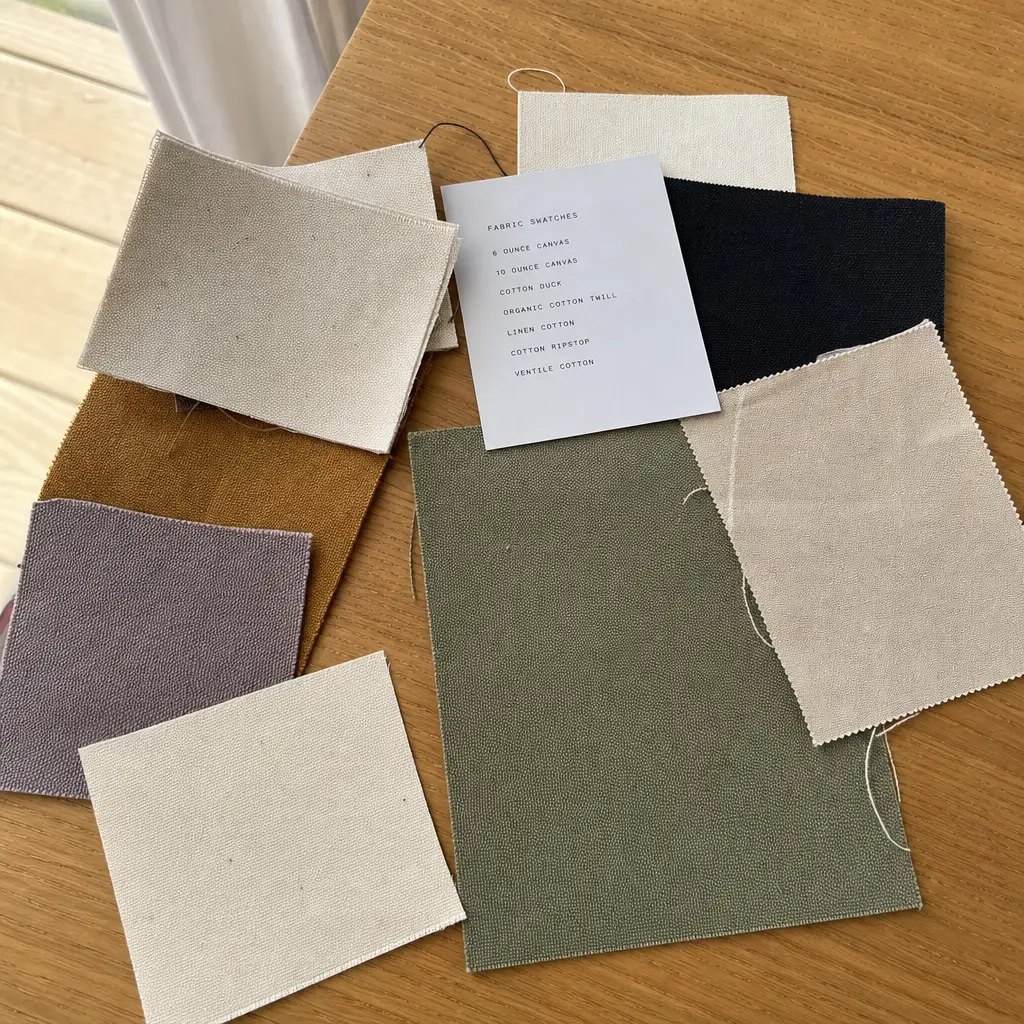
Start with a quote-ready specification
Custom canvas zipper portfolios can look almost identical in a catalog image and still be very different products. One quote may cover a light, unlined canvas folder with a basic zipper and a one-color imprint. Another may include 14 oz or 16 oz canvas, lining, reinforced corners, interior pockets, barcode labeling, and cartons separated by campus code. If both are described as custom canvas zipper portfolios, the lower number is not automatically a saving. It may be a different build.
University bookstore buyers also have operational pressure that a general promotional buyer may not have. The item has to look right on a shelf, scan correctly at POS, respect licensed artwork, survive daily student use, and arrive in cartons that receiving teams can sort quickly. A portfolio can pass a photo review and still fail in the store if the zipper catches, the document sleeve is tight, the print scuffs, or two campus logos are mixed inside the same unmarked carton.
The fix is simple but often skipped: normalize the RFQ before comparing prices. Ask each supplier to quote the same finished size, canvas weight, zipper size, lining plan, pocket layout, decoration method, retail packing, carton marking, sample path, and inspection expectation. If a supplier wants to suggest a lower-cost alternative, keep it as a named alternate instead of letting it replace the base spec quietly.
- Quote the finished product, not only the category name.
- Require both oz and GSM for canvas so weight is not interpreted loosely.
- List zipper size, coil type, slider, puller, tape color, and corner expectation.
- Separate base construction from decoration, tooling, samples, packing, and inspection.
- Use the approved pre-production sample and written spec together as the bulk standard.
Define the campus use case first
The first sourcing decision is not logo size. It is how the bookstore, department, or campus partner will use the portfolio. A retail SKU sold at back-to-school needs consistent shelf presentation, a reliable zipper, a visible barcode, and a finish that feels worth the ticket price. An orientation portfolio may put more weight on fixed delivery, simplified packing, and cost control. A faculty meeting folder or alumni gift can justify heavier canvas, quieter branding, cleaner lining, or a sewn patch instead of a large front print.
Size needs the same practical thinking. For letter-size programs, the portfolio usually needs to hold 8.5 x 11 inch papers without curled corners, plus perhaps a notepad, pen, cards, or a brochure packet. A common outside planning size is about 10.0 x 13.0 inches, but the pattern must allow for zipper tape, seam allowance, binding, lining, and pocket panels. For A4 programs, about 250 x 340 mm outside can be a starting point, but the usable sleeve must be confirmed with real A4 sheets.
Do not approve fit from an empty sample alone. Empty portfolios often zip smoothly because there is no pressure on the corners. Add 20-30 sheets, a thin notebook, a pen, and cards, and the side seam can bow just enough to make the slider drag. If the design includes a tablet sleeve, specify the device, case allowance, and foam thickness because the tablet changes both thickness and bending pressure around the zipper path.
- Bookstore retail SKU: prioritize zipper reliability, barcode visibility, shelf presentation, and logo consistency.
- Orientation kit: prioritize delivery date, cost control, simple packing, and easy event allocation.
- Alumni gift: prioritize premium handfeel, refined decoration, clean lining, and presentation packaging.
- Faculty or office use: prioritize document protection, smooth opening, subdued branding, and useful pockets.
- Loading test: define the exact papers, notepad, pen, cards, brochure, or tablet used for approval.
Specify canvas weight and finish clearly
Canvas language gets vague quickly. A buyer may say heavy cotton canvas, while a supplier may price a lighter fabric that still feels acceptable in a small swatch. Request both ounces and GSM, then ask whether the stated weight is before or after dyeing, washing, coating, calendaring, preshrinking, or water-resistant treatment. As a planning reference, 12 oz canvas is often around 400 GSM, 14 oz around 475 GSM, and 16 oz around 545 GSM, but actual values vary by weave, finish, moisture, and supplier convention.
For many university bookstore zipper portfolios, 14 oz to 16 oz cotton canvas is a useful range. A lined 14 oz canvas can feel structured without making corners too bulky. A 16 oz canvas gives a more premium handfeel and may suit alumni programs or evergreen retail SKUs, but it needs better control of seam allowance, corner radius, needle choice, and zipper installation. More weight is not always better. Very heavy canvas can look substantial while making the zipper harder to operate.
Finish also changes performance. Natural unwashed canvas has a clean campus merchandise look and avoids school-color dye matching, but it may show slubs, seed marks, or shade variation. Dyed canvas can match a university color story, but it requires lab dip approval, crocking review, and lot-to-lot shade tolerance. Washed canvas feels softer and more casual, yet it can distort measurements and logo edges. Coated canvas may add surface resistance, but it can affect ink adhesion, needle marks, folding behavior, and scuffing.
- 12 oz canvas: workable for cost-sensitive programs, usually better with lining or reinforcement.
- 14 oz canvas: balanced baseline for many retail bookstore portfolios.
- 16 oz canvas: premium handfeel with higher seam bulk and tighter zipper-corner control.
- Natural canvas: neutral and easy to merchandise, but still needs shade and slub approval.
- Dyed canvas: requires lab dip approval, crocking review, and lot-to-lot shade tolerance.
- Coated canvas: test ink adhesion, needle marks, folding behavior, and surface scuffing.
Decide the lining and interior build
The inside of the portfolio determines whether the item feels like a retail accessory or a simple promotional folder. Unlined canvas can work when the design calls for a rugged natural look, but raw seams, loose fibers, and uneven interior appearance may not meet bookstore expectations. A lining or self-fabric panel gives the interior a cleaner finish and helps documents slide in smoothly. It also adds a new risk: loose lining can sit too close to the zipper and catch in the slider path.
Common lining choices include 210D polyester, cotton lining, and self-fabric document panels. 210D polyester is practical because it is smooth, tidy, and easy to inspect. Cotton lining supports a natural product story, but it may lint, shrink differently from the shell, or create color-transfer concerns. Self-fabric panels make the product feel heavier and more cohesive, although they increase seam bulk. If a tablet sleeve is added, specify foam thickness in millimeters and test the sleeve with the intended device plus case.
Reinforcement should be placed where stress actually occurs. Zipper ends, zipper corners, document sleeve edges, pen loop attachments, card slot openings, patch corners, and any added handle or strap attachment deserve attention. Overbuilding every seam raises labor cost and can make the portfolio stiff. Underbuilding the stress points can lead to open seams or distorted corners. The tech pack should call out bartacks, backstitching, folded edges, binding width, and hidden reinforcement where those details matter.
- 210D polyester lining: clean, practical, and easy to inspect for retail programs.
- Cotton lining: natural handfeel with lint, shrinkage, and color-transfer checks.
- Self-fabric panel: cohesive canvas look with higher bulk at seams and corners.
- Foam sleeve: specify thickness, density if available, coverage area, and device allowance.
- Binding: improves seam finish but can create bulky zipper corners if too wide.
- Reinforcement: place it at functional stress points instead of adding unnecessary layers.
Treat the zipper as the main function
The zipper is not a small trim choice. It is the part the customer touches every time the portfolio opens. For three-side canvas portfolios, a No. 5 nylon coil zipper is often a practical starting point because it bends around corners more easily than many metal zippers and feels appropriate for a soft business accessory. A No. 3 zipper may reduce cost, but it can feel undersized on heavier canvas. Metal teeth may look premium, yet they are less forgiving around tight portfolio corners.
Most zipper failures come from predictable specification gaps. The corner radius is too sharp. The zipper tape is too light. The lining sits too close to the slider. The seam allowance is not trimmed consistently. The zipper end is buried in a bulky seam. Once bulk cutting starts, these issues become expensive to correct because the panel shape, zipper length, sewing sequence, and seam allowance are already locked.
Ask the factory how it controls the zipper path. The RFQ should require a loaded zipper test, a defined corner-radius expectation or approved sample, reinforced zipper ends, and open-close inspection cycles. In final QC, the zipper should be opened and closed around all corners, not just looked at. If several inspected units hesitate in the same location, treat that as a construction problem rather than random operator error.
- Zipper size: No. 5 nylon coil is a common baseline for letter and A4 canvas portfolios.
- Slider: specify finish, pull strength expectation, puller length, and whether branding is required.
- Tape color: match canvas, contrast intentionally, or use a campus color only with shade control.
- Corner radius: larger rounded corners generally improve smoothness and reduce slider strain.
- End construction: inspect stops, reinforcement, seam bulk, exposed edges, and puller security.
- Loaded cycling: test repeated open-close movement with the approved contents inside.
Match logo method to program life
University artwork adds licensing, color, placement, and durability requirements. Screen printing is efficient for many simple one-color to three-color campus marks, class years, event names, and orientation graphics. It can work well on canvas when the ink system matches the fabric and curing is controlled. Buyers should send vector artwork, Pantone references, print size, placement from finished edges, orientation, and any rules from the university licensing office.
For evergreen bookstore merchandise or higher-value alumni gifts, a patch or label may be a better long-term choice than a large front print. Woven labels are durable for small marks and repeat programs. Embroidered patches create a strong retail look but require thread color, edge finish, backing, and sewing placement approval. Faux leather or rubber patches can feel premium or athletic, but they may require molds, separate minimums, and added lead time. Keep every trim and setup charge visible in the quote.
Heat transfers can reproduce fine lines, gradients, or complex graphics, but textured canvas is not always an easy surface. Test edge lift, gloss, cracking, adhesion after folding, and handfeel. Direct embroidery can pucker canvas panels unless stabilization is planned, so an embroidered patch is often safer for a portfolio front. Whatever method is selected, the approved sample should use the final decoration method rather than a temporary placeholder.
- Screen print: efficient for simple campus logos, slogans, event names, and class-year designs.
- Woven label: durable small-brand detail for repeat bookstore merchandise.
- Embroidered patch: retail-ready appearance with added patch and sewing approvals.
- Faux leather patch: premium look requiring material, embossing, and color approval.
- Heat transfer: useful for detailed art; test adhesion, edge lift, gloss, and fold cracking.
- Placement tolerance: define a common tolerance such as plus or minus 3 mm from approved sample.
Specify pockets by usable dimensions
Interior organization can quietly drive cost, labor time, and defect rates. A simple bookstore portfolio may need only one document sleeve, two card slots, and one pen loop. A complex version may add a tablet sleeve, zipper mesh pocket, elastic organizer, phone pocket, notepad holder, brochure slot, and padded divider. Each feature adds pattern pieces, sewing operations, measurement checks, and opportunities for crooked stitching or tight openings.
Define what the customer will actually use. A document sleeve should state whether it holds loose letter sheets, an A4 pad, a campus brochure packet, or a folder. Card slots should be checked with the actual card type: campus ID, credit card, or business card. A pen loop should be tested with a target pen diameter, not simply drawn on the tech pack. A tablet sleeve should name the device, case allowance, foam thickness, and closure requirement.
Use usable measurements, not only panel measurements. A pocket panel may look large before sewing and become too tight after seam allowance, binding, lining tension, and topstitching. The RFQ should include pocket opening width, pocket depth, placement from edges, and tolerance. Remove pockets that do not support the selling story. Extra organization can raise the wholesale price without improving bookstore sell-through or campus user satisfaction.
- Document sleeve: define paper format, usable width, usable depth, and whether a notepad must fit.
- Card slots: specify opening width, depth, number of slots, and test card type.
- Pen loop: define elastic, canvas, or webbing plus target pen diameter.
- Tablet sleeve: state device size, case allowance, foam thickness, and closure requirement.
- Mesh pocket: approve mesh strength, zipper smoothness, and edge binding.
- Labor control: eliminate pockets that do not improve actual campus use or retail value.
Plan MOQ and campus logo splits
MOQ is tied to more than the number of pieces sewn. Fabric purchasing, cutting efficiency, trim sourcing, print setup, worker changeovers, packing labels, carton marks, and shipment allocation all affect the real minimum. A factory may price efficiently when one construction runs continuously. The same factory may need a higher price or separate minimums when the order is split by dyed fabric, zipper color, patch, label, logo version, barcode, packing method, or destination.
For university bookstore distributors, the cleanest approach is often one shared base construction with multiple logo versions. For example, one natural canvas body, one black No. 5 zipper, one lining color, one pocket layout, one carton quantity, and several screen-printed campus logos can preserve production efficiency. Still, ask how many artwork versions are included, whether each logo has a setup charge, and how finished units will be separated during packing.
Small allocations need written rules. If one purchase order covers several universities, every inner pack and master carton should show campus code, item number, logo version, and quantity. Agree on overrun or underrun policy before production starts, especially when each campus allocation is small. A two percent shortage may be acceptable on a large replenishment run, but painful if it affects a fixed orientation-event count.
- Most efficient split: one construction, one fabric color, one zipper color, one lining, multiple prints.
- Moderate split: shared construction with separate logos, barcodes, and carton labels.
- High-complexity split: separate dyed fabrics, patches, pullers, linings, or packaging by campus.
- MOQ questions: ask per style, fabric color, zipper color, logo version, label version, and packing version.
- Overrun policy: define acceptable overrun or underrun by logo version before production.
- Allocation control: require campus codes on retail labels, inner packs, cartons, and packing lists.
Approve samples in controlled stages
One sample cannot answer every procurement question. A material swatch confirms canvas weight, color, lining, zipper tape, slider, puller, thread, patch, label, and trim quality. A blank fit sample confirms outside size, inside usable capacity, pocket function, zipper path, corner shape, and loaded thickness. A decorated sample confirms logo color, ink behavior, patch attachment, label placement, and decoration handfeel. A packing sample confirms barcode visibility, polybag or belly band size, hangtag placement, carton marks, and shelf presentation.
The riskiest approval is a prototype made from substitute materials. It may help the buyer discuss layout, but it should not become the production standard. Bulk canvas can sew differently from sample-room canvas. Bulk zipper tape can behave differently around corners. Final ink can cure differently from a digital mockup or temporary transfer. Before mass cutting begins, the pre-production sample should use bulk materials and the actual decoration method wherever practical.
Document sample approvals with measurements and comments. If a sample is approved with corrections, write those corrections into the tech pack and require supplier acknowledgement. The buyer and factory should each retain an approved sample or a clear approval record. During final inspection, production units should be compared with the retained pre-production sample plus the written tolerances, not with a marketing rendering.
- Material swatch: approve GSM, color, lining, zipper, puller, thread, label, patch, and trim quality.
- Blank fit sample: approve size, loaded fit, pocket usability, zipper smoothness, and corner shape.
- Decorated sample: approve logo color, edge quality, placement, curing, patch sewing, and handfeel.
- Packing sample: approve barcode position, individual pack, inner pack, carton mark, and shelf appearance.
- Pre-production sample: approve bulk materials, final construction, decoration, and packing before mass cutting.
- Retention standard: keep matching approved samples or clear approval records for inspection reference.
Build QC and packing into the PO
Quality control belongs in the purchase order or technical file, not in a late email after defects appear. For sewn accessories like canvas zipper portfolios, a final AQL inspection is useful, but inline checks matter too. Zipper installation, pocket construction, and print curing are easier to correct while production is moving than after the full order is packed. If the first serious zipper problem is found in final inspection, rework can be slow and inconsistent.
Define defect categories before production. Critical defects include safety issues such as sharp metal edges, mold, contamination, or broken hardware that could injure a user. Major defects include zipper failure, wrong logo, wrong size, open seams, unusable pockets, severe stains, incorrect packing, or barcode failure. Minor defects include small loose threads, slight shade variation within tolerance, or small cosmetic issues that do not affect retail use. Align these categories with the supplier and inspector before shipment.
Packing deserves the same attention as sewing. University bookstore receiving teams need cartons that match the PO, campus code, item number, logo version, and quantity. Individual barcodes should scan without opening the package when that is the agreed format. Carton dimensions and gross weight affect landed cost and labor. A well-made portfolio can still create operational problems if logos are mixed, carton marks are vague, or master cartons are too heavy for normal handling.
- Inspection plan: combine inline checks, pre-shipment inspection, retained sample comparison, and carton verification.
- AQL reference: many buyers use general inspection level II with agreed AQL limits, but levels should be set by PO risk.
- Functional checks: test loaded zipper movement, pocket fit, bartacks, print curing, barcode scan, and carton marks.
- Measurement checks: outside size, pocket openings, logo placement, patch placement, and carton quantity.
- Packing checks: verify campus code, PO, item number, color, logo version, quantity, carton number, and destination.
- Receiving control: keep barcode, inner-pack, and carton-label rules consistent across all campus splits.
Specification comparison for buyers
| Spec decision | Recommended option | When it fits | Buyer risk to check |
|---|---|---|---|
| Canvas body fabric | 14 oz to 16 oz cotton canvas, approximately 475-545 GSM before washing or coating; request an actual GSM tolerance range | Campus bookstore portfolios that need a substantial handfeel, stable sewing, and clean shelf presentation | If the quote only says cotton canvas, suppliers may substitute lighter 10-12 oz fabric; very heavy canvas can create bulky corners and zipper waviness |
| Finished size | Letter format: about 10.0 x 13.0 in outside for 8.5 x 11 in papers; A4 format: about 250 x 340 mm outside, adjusted by pattern | Bookstore retail, orientation packets, faculty folders, conference handouts, and alumni gifts | Inside usable sleeve space can be 10-25 mm smaller than outside size because of zipper tape, seams, binding, lining, and pocket construction |
| Lining structure | 210D polyester lining, cotton lining, or self-fabric document panel; specify seam finishing and attachment method | Polyester keeps the interior cleaner; cotton supports a natural product story; self-fabric panels create a heavier canvas look | Loose lining can catch in the slider path; unlined canvas can expose raw seams, lint, and inconsistent inside appearance |
| Closure hardware | No. 5 nylon coil zipper, color-matched or contrast tape, smooth slider, reinforced zipper ends, metal or molded puller | Three-side closures on letter-size and A4 zipper portfolios | No. 3 zippers may feel weak; tight square corners, light tape, or bulky seam allowances commonly cause snagging and zipper strain |
| Logo decoration | Screen print for simple graphics; woven label, sewn patch, faux leather patch, or rubber patch for repeat retail programs | Screen print fits orientation, class-year, and event artwork; patches and labels suit evergreen bookstore SKUs | Large ink areas can crack, scuff, or feel stiff if ink system, curing, opacity, and fold testing are not specified |
| Interior organization | Baseline: one document sleeve, two card slots, one pen loop; optional tablet sleeve only with device dimensions and foam spec | Practical campus use without turning the item into a complex organizer | Extra pockets increase labor, measurement variation, lining tension, and inspection failures unless usable dimensions are defined |
| MOQ structure | 500-1000 pieces for one shared construction is a common planning range; split logos only after setup, packing, and carton marking are defined | Distributors consolidating several bookstore accounts under one base portfolio | Small color, patch, zipper, or packing splits can create separate MOQs, setup charges, labels, carton marks, and allocation work |
| Retail packing | Individual clear polybag, recycled polybag, paper belly band, or hangtag; barcode visible without opening; master carton marks by campus code | Bookstore receiving teams that need POS scanning, clean allocation, and retail-ready shelf handling | Hidden barcodes, vague carton labels, oversized packaging, or mixed designs in unlabeled cartons slow receiving and raise labor cost |
| Supplier route | Direct sewn-goods factory for repeat canvas portfolio programs; trading company only when consolidating multiple unrelated product types | Direct factory helps when pattern, zipper path, logo placement, and inspection standards need tight control | A quote missing GSM, zipper size, lining spec, decoration method, sample terms, carton data, and inspection scope is not comparable |
Buyer checklist before sampling
- Define the selling channel: bookstore retail SKU, orientation kit, faculty meeting folder, alumni gift, graduation merchandise, conference portfolio, or department-issued supply.
- State the finished outside size, inside usable document area, target loaded thickness, and whether the portfolio must hold letter paper, A4 paper, a notepad, a tablet, or a brochure packet.
- Specify canvas in oz and GSM, and state whether the weight is before or after dyeing, washing, coating, calendaring, preshrinking, or water-resistant treatment.
- Confirm fabric composition, weave type where relevant, color standard, acceptable shade tolerance, colorfastness expectation, and whether fabric lots must be reserved for repeat orders.
- Choose zipper size, coil type, tape color, slider finish, puller material, puller length, zipper end construction, and minimum corner radius expectation.
- Require zipper testing on a loaded sample, not only on an empty flat sample; define the exact contents used for the loading test.
- Confirm lining material, lining color, seam finish, inner binding, pocket layout, pocket usable dimensions, pen loop width, card slot dimensions, and foam thickness if used.
- Send vector artwork with Pantone references, logo size, print or patch position from finished edges, logo orientation, approval tolerance, and university licensing or brand-use rules.
- Separate one-time sample charges, screen charges, plate charges, patch molds, custom puller tooling, artwork setup, barcode labeling, packing materials, and unit price in the quote.
- Ask for MOQ by fabric color, zipper color, lining color, thread color, logo version, patch or label version, packing version, and shipment destination.
Factory quote questions to send
- What is the exact canvas weight in oz and GSM, and what tolerance range should we expect on bulk fabric, for example plus or minus 5 percent?
- Is the canvas greige, dyed, washed, coated, uncoated, preshrunk, brushed, or treated for water resistance, and is the stated weight before or after finishing?
- Can you provide a fabric swatch, color lab dip, and any available internal test reference for shrinkage, colorfastness, or crocking on the quoted material?
- What zipper size, zipper type, tape material, slider type, puller material, puller finish, puller length, and zipper brand level are included in the price?
- How do you construct the zipper corners and zipper ends to reduce snagging, waviness, slider jump, and tooth separation when the portfolio is loaded?
- Is the quoted construction lined or unlined, and what are the lining fabric specification, color, seam finish, attachment method, and binding width?
- What stitch density, thread type, bartack locations, seam allowance, and reinforcement points are included in the quoted construction?
- Which logo method is quoted for our artwork: screen print, heat transfer, embroidery patch, woven label, faux leather patch, rubber patch, direct embroidery, or embossed patch?
- How many logo colors, print positions, artwork versions, campus names, and barcode versions are included before extra setup or running charges apply?
- What is the MOQ per fabric color, zipper color, lining color, logo version, label or patch version, packing version, and shipment destination?
Quality-control points to confirm
- Finished outside size should normally stay within plus or minus 5 mm for the main body unless the buyer defines a tighter retail standard; measure flat, closed, and uncompressed.
- Inside usable document sleeve should be checked with the intended paper size, not only with a ruler; letter-size sheets and A4 sheets need separate approval if both are required.
- Pocket placement should normally stay within plus or minus 3 mm, and usable pocket openings should be checked with the actual card, pen, notepad, brochure, or device size.
- Zipper must open and close smoothly around all corners on empty and loaded samples, with no lining catch, slider jump, coil separation, excessive force, or broken end stops.
- A practical production check is 5-10 open-close cycles on inspected units; increase sampling if the first defects appear at corners or zipper ends.
- Corner sewing should be checked for puckering, zipper waviness, bulky seam allowance, needle damage, uneven binding width, and distorted outside shape.
- Stitching should be even at stress areas, with no skipped stitches, loose threads over 5 mm, broken bartacks, open seams, exposed raw edges, or visible backtracking defects on retail faces.
- Typical stitch density for canvas accessories is often about 7-9 stitches per inch, but the approved sample and factory capability should set the final standard.
- Print or patch placement should match the approved sample within the agreed tolerance, commonly plus or minus 3 mm for standard bookstore designs.
- Ink curing should be checked by dry rub, light scratch, tape pull where appropriate, and folding at the printed area after cooling; test dark canvas and natural canvas separately.