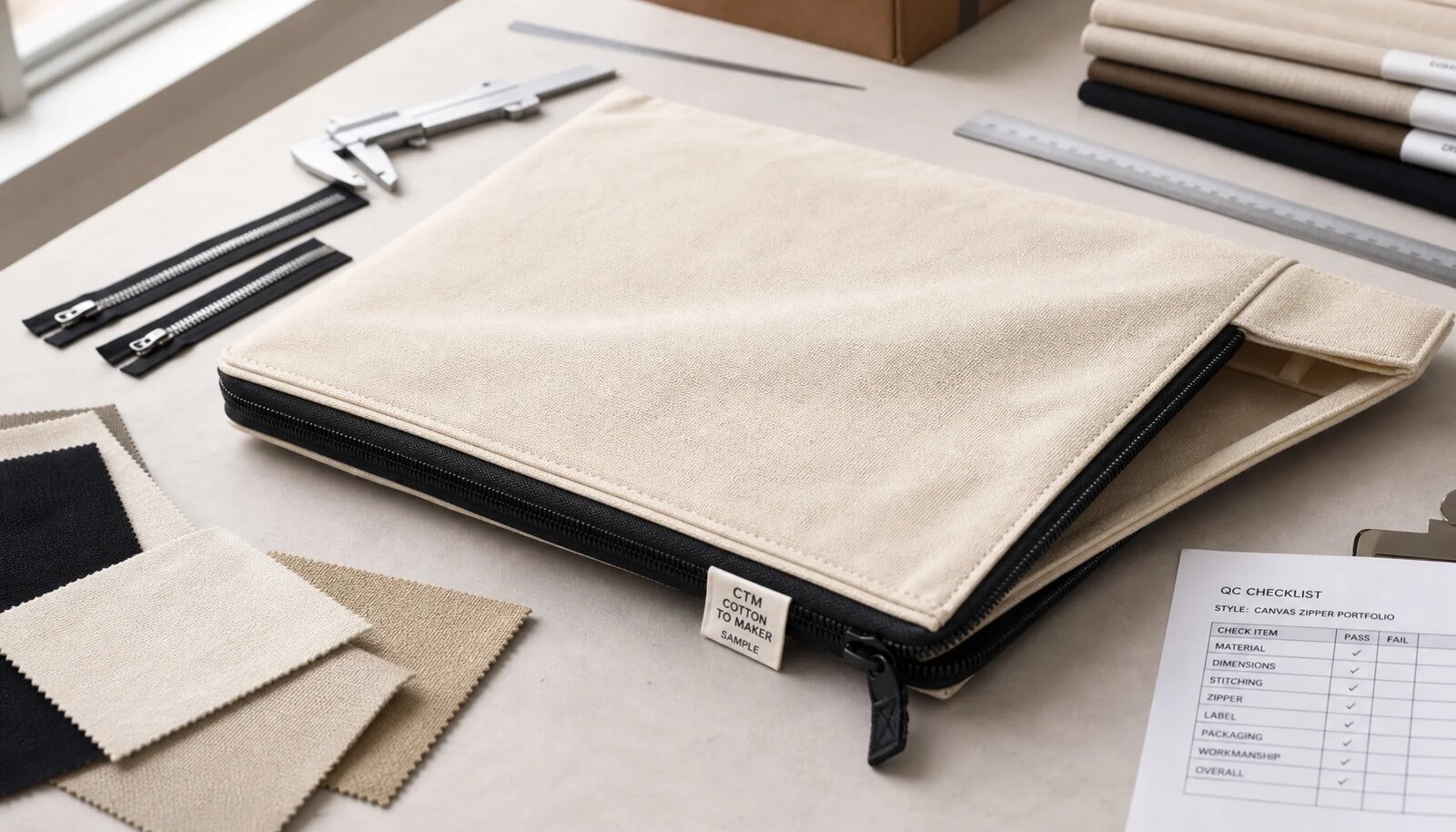
Start With the Gifting Use Case
A custom canvas zipper portfolio looks simple on a product sheet, but in a corporate gifting program it has a lot of jobs. It may hold onboarding papers, conference materials, a sales packet, a board-meeting notebook, or a client welcome kit. It also carries the buyer's brand at the exact moment the recipient forms an impression. That means procurement should not treat it like a generic pouch with a logo. The face panel, zipper line, stitching, logo placement, and packing all affect how the gift is received.
Begin with the business purpose. Who receives the portfolio? Where is it handed over? How long should it last? A one-day event document case can be lighter and simpler than an executive portfolio expected to sit on a desk for months. A flat case for certificates is different from a welcome kit carrying a notebook, pen, cable, brochure, and card. When the use case is vague, factories make assumptions. Those assumptions quietly change fabric weight, zipper choice, lining, capacity, and price.
The most useful sourcing brief lists the real contents. Include width, height, spine thickness, quantity, and approximate loaded weight for each item. State whether documents are A4, US letter, legal, certificate size, or custom inserts. If the portfolios will be mailed individually, add mailer protection, carton strength, and humidity risk to the brief. If they will be loaded at an event, carton organization and fast unpacking may matter as much as the portfolio itself.
Corporate gifting also raises the defect standard. A flat canvas portfolio presents a large visible panel directly to the recipient. Stains, crooked prints, puckered embroidery, wavy zipper tape, twisted corners, and dirty packing marks are easy to spot. Make those details part of the RFQ and inspection plan from the start, not a complaint after delivery.
- Define recipient, handoff setting, distribution channel, and expected reuse before selecting the spec.
- Measure the real contents instead of sizing the portfolio from a catalog photo.
- Separate paper-only use from loaded kit use before choosing flat or gusseted construction.
- Treat front-panel cleanliness, zipper alignment, and logo placement as brand presentation requirements.
Turn the Idea Into a Measurable Spec
The base specification controls cost, lead time, quality risk, and perceived value. For many procurement teams, 12 oz cotton canvas is a practical entry point for document-style programs. It keeps weight controlled and supports straightforward screen printing. A 14 oz canvas usually gives a stronger corporate-gift feel without making production too difficult. A 16 oz canvas can work for premium programs or heavier reuse, but it can increase seam bulk, zipper resistance, print cracking risk, embroidery puckering, and freight cost.
Ask suppliers to state fabric weight in both ounces and gsm. As a rough reference, 12 oz is about 407 gsm, 14 oz is about 475 gsm, and 16 oz is about 542 gsm before finishing. Those numbers still need physical confirmation. Natural canvas, bleached canvas, dyed canvas, washed canvas, coated canvas, laminated canvas, and enzyme-washed canvas do not have the same hand feel or decoration behavior. Washed canvas may feel softer. Coated canvas may resist dirt better but can affect ink adhesion. Custom dyeing can improve brand alignment, but it brings lab dips, shade approval, higher minimums, and extra lead time.
Construction needs the same level of detail as fabric. Specify whether the portfolio is flat, lightly structured, gusseted, lined, bound, or reinforced. Define seam allowance, binding width, corner shape, zipper position, thread color, internal pockets, and reinforcement at stress points. A fabric swatch tells only part of the story. The same canvas can look and behave differently after cutting, folding, sewing, pressing, decoration, and packing.
Tolerances belong in the spec as well. Sewn products cannot be controlled like molded parts, but acceptable variation should be written clearly. Finished width, height, gusset depth, zipper opening, logo placement, and patch angle can all be measured. The exact tolerance should be agreed with the factory during sampling, then repeated in the purchase order and QC checklist.
- Use 12 oz canvas for simpler document handouts and controlled budgets.
- Use 14 oz canvas when the buyer wants a sturdier hand feel without excessive production risk.
- Use 16 oz canvas only after checking seam bulk, zipper smoothness, decoration quality, and freight impact.
- Specify fabric finish, lining, binding, reinforcement, thread color, and corner shape in the RFQ.
- Approve a complete pre-production sample before bulk fabric is cut.
Size Around Real Contents
Outside dimensions are useful for a catalog description. They are not enough for procurement approval. Buyers need usable internal dimensions: internal width, internal height, zipper opening length, and gusset depth if the style has depth. A portfolio may look large enough and still be difficult to load because the zipper opening is short, the corners are tight, lining reduces space, or a pen loop pushes into the document area.
Document format must be written clearly. A4 and US letter are close enough to cause mistakes, but different enough to create loading problems. Legal papers, certificates, presentation folders, spiral notebooks, and tablets each create different requirements. If the gift includes a notebook, measure the spine and cover thickness, not only the front-cover size. If it includes electronics accessories, check whether zipper teeth, seams, or pullers can press against the item.
Load testing should happen before bulk approval. Put the exact contents into the sample, close the zipper, lay it flat, lift it from the corner, and inspect the shape. Look for top-edge gaping, front-panel bowing, corner bulging, zipper strain, twisting, and uneven pulling. Then open and close the zipper repeatedly while the sample is filled. An empty sample that photographs well may still fail the real gifting use.
Interior features should solve a practical problem. A slip pocket can separate a welcome letter or business card. A pen loop can be useful for onboarding or meeting kits. A lining can make the inside cleaner and protect papers from raw seams. Each feature also adds cost, alignment risk, and sometimes MOQ. Keep necessary functions separate from decorative extras when comparing supplier quotes.
- Request usable internal dimensions in addition to finished outside dimensions.
- Confirm A4, US letter, legal, certificate, notebook, tablet, or custom insert requirements.
- Measure zipper opening length because it affects loading more than outside width alone.
- Load-test the sample with exact contents and reject specs that strain when filled.
- Add pockets, pen loops, and lining only when they improve the recipient experience.
Specify the Zipper and Stress Points
The zipper is one of the most touched parts of the portfolio, so it has an outsized effect on perceived quality. A smooth zipper makes the gift feel finished. A sticky or wavy zipper makes even good canvas feel cheap. For most flat document portfolios, a No. 5 nylon coil zipper is a common, practical choice. For larger portfolios, gusseted constructions, or heavier content loads, a No. 8 nylon coil may be more appropriate. Metal zippers can look substantial, but they may add weight, scratch contents, and feel less smooth across a long opening.
A complete zipper spec includes size, type, tape color, slider material, puller style, end stop, and end reinforcement. Stock pullers reduce cost and lead time. Fabric, PU, rubber, metal, or custom-molded pullers can support branding, but they may require tooling, higher MOQ, or separate approval. If the puller is branded, inspect color, logo clarity, edge finish, attachment strength, and whether it marks the canvas in packing.
Zipper tape should lie flat and straight. Wavy tape, uneven stitch tension, or a short zipper opening can make the product look poorly made even when it still closes. Ask how the factory reinforces zipper ends. Bar tacks, folded tape ends, extra stitch rows, or box stitching may be suitable depending on the design. The important point is practical: the zipper end should not distort or pull loose when the loaded portfolio is opened repeatedly.
Do not inspect stress points as cosmetic details. Zipper ends, corners, gusset joins, label attachments, patch edges, and any pull-tab area should receive closer review than long low-stress seams. If the portfolio is meant to hold a loaded kit, the QC standard should include filled-use checks instead of empty-table inspection only.
- Use No. 5 nylon coil for most standard flat portfolios.
- Consider No. 8 nylon coil for gusseted, larger, or heavier-use portfolios.
- Specify tape color, slider finish, puller material, end stop, and reinforcement method.
- Test zipper smoothness while the sample is loaded with real contents.
- Inspect zipper ends and corners as stress points, not just visual details.
Match Branding to Artwork and Gift Tier
Branding choice should follow the artwork, canvas texture, recipient tier, and budget. Screen printing is usually efficient for one- or two-color corporate logos, especially when the mark has clean shapes and solid fills. It is a strong fit for larger wholesale orders and budget-sensitive gifting programs. Still, canvas texture can soften edges and change color density. A digital mockup is useful for layout, but it is not a production approval. Request a strike-off on the actual production fabric and finish.
Heat transfer, DTF, and similar transfer methods can support multicolor artwork, gradients, and small detail. They may be useful for campaign graphics that cannot be simplified. Check hand feel, edge adhesion, flexibility, cracking, and how the transfer behaves when portfolios are stacked or bent. A transfer that looks acceptable on smooth fabric may feel too plastic on natural canvas.
Embroidery, woven labels, PU patches, debossed badges, and small tonal prints often look more premium and less promotional. Embroidery adds texture, but dense stitching can pucker lighter canvas or distort small text. PU patches and debossed badges need careful review of edge finish, color, attachment method, and stitch or adhesive strength. Woven labels can be discreet and repeatable, but label MOQ and lead time should be confirmed separately.
Artwork instructions should be exact. Provide vector files, Pantone or brand color references, maximum logo dimensions, decoration side, orientation, and placement measured from a stable edge or seam. Avoid vague notes such as small logo on front or centered near corner. State the placement tolerance in millimeters, especially on premium gifts where a slight tilt is visible on a clean flat panel.
- Use screen print for simple logos, solid colors, and efficient bulk quantities.
- Use woven labels, PU patches, embroidery, or debossed badges for a subtler premium look.
- Use transfer methods only after checking hand feel, edge adhesion, and bending performance.
- Keep decoration away from zipper seams, folded edges, bulky corners, and high-friction areas.
- Approve artwork on production fabric, not only on a digital mockup.
Compare Quotes on the Same Basis
MOQ is rarely one number. It is a group of minimums tied to fabric, body color, dyeing, zipper tape, lining, puller, patch, woven label, decoration method, printed insert, gift packing, and carton sorting. A supplier may support a lower MOQ for natural canvas with a stock black zipper and one-color print, then require higher quantities for custom-dyed canvas, branded zipper pulls, printed lining, or premium boxes. Ask for MOQ by variable so the team can decide which custom elements are worth keeping.
Quote comparison only works when every supplier prices the same product. Send the same quantity breaks, such as 300, 500, 1,000, and 3,000 pieces, with identical canvas weight, dimensions, zipper, lining, branding method, placement, packing, incoterm, destination, and delivery date. Otherwise one factory may quote cheaper fabric, another may exclude individual packing, and another may assume a different logo process. The lowest unit price may not be the lowest delivered program cost.
Ask suppliers to separate unit price, sample fee, setup fee, screen or plate charge, embroidery digitizing, patch tooling, custom label cost, custom puller tooling, individual packing, export carton packing, inland freight, export documentation, and shipping assumptions. Procurement does not need every internal factory cost, but it does need enough detail to understand what changes when the spec changes.
Splits matter. A 1,000-piece order with one body color and one logo is very different from 1,000 pieces split across four colors, six logo versions, and several destinations. Every split can add setup, sorting, labeling, inspection, packing, and error risk. If the portfolio will be reordered, share the annual forecast and ask whether scheduled batches can hold the same approved materials without forcing excess inventory.
- Request MOQ by body color, logo version, zipper tape, lining, label, puller, patch, and packing type.
- Put all suppliers on the same quantity breaks and the same technical specification.
- Separate sample, setup, decoration, trim, packing, freight, and documentation costs.
- Compare landed program cost, not only ex-factory unit price.
- Disclose color splits, artwork splits, and destination splits before quote approval.
Write an RFQ That Leaves Less to Guess
A strong RFQ reads like a production brief. Include use case, recipient type, contents, target outside size, usable internal size, fabric weight, finish, lining, zipper spec, puller, trim, branding method, artwork placement, quantity, color split, packing method, carton mark requirements, incoterm, destination, and required delivery date. The goal is not to make the document long. The goal is to remove assumptions before the supplier calculates cost.
Artwork should be provided early. Vector artwork is best for logos. Add Pantone, CMYK, RGB, or brand guide references where relevant, while remembering that fabric and decoration method affect the final appearance. Placement should be measured from a clear point: center line, zipper edge, side seam, bottom edge, or corner. If departments, regions, events, or sales teams need different versions, list each version separately.
Commercial terms need the same clarity. State whether the quote should be EXW, FOB, CIF, DAP, or another agreed term. Include destination city, target delivery date, inspection requirements, and whether the factory should quote export cartons only or individual gift packing. If barcode labels, PO numbers, SKU codes, event codes, or destination labels are required, put them in the RFQ instead of adding them after production.
Ask suppliers to confirm what is included, excluded, optional, or subject to MOQ. Also ask for substitution rules. If the supplier may use an equivalent zipper, available thread color, substitute lining, or alternate packing material, that should be visible before order placement. Corporate gifting buyers should require written approval before any fabric, trim, decoration, or packing change.
- Include product specs, artwork, packing, inspection, and commercial terms in one RFQ.
- Measure logo placement from a fixed edge or seam and state allowed tolerance.
- List all colorways, artwork versions, and destination splits at quotation stage.
- Ask suppliers to state what is included, excluded, optional, or subject to MOQ.
- Require written approval before any fabric, zipper, lining, trim, logo, or packing substitution.
Approve Samples With Practical Tests
Sample approval is the buyer's best chance to prevent bulk-order issues. Photos can confirm general shape and placement, but they cannot show canvas hand feel, zipper resistance, panel stiffness, print texture, lining quality, or packing pressure marks. For a new custom style, a physical sample or pre-production sample is strongly recommended. Photo approval is safer for an exact repeat order where the buyer already holds an approved golden sample and the supplier confirms that materials and processes have not changed.
Measure the sample against the RFQ. Check finished width, height, gusset depth, zipper opening, usable internal dimensions, logo size, logo placement, stitch density, thread color, zipper tape, puller, lining, pocket dimensions, binding, and individual packing. Use a ruler or caliper where it matters. Record findings in writing and mark any approved deviations. If the sample is approved with corrections, ask the factory to confirm the corrected production standard before bulk starts.
Function testing should use the real gift contents. Fill the sample, close it, lift it, place it flat, stack it if bulk units will be stacked, and open and close the zipper repeatedly. Ten to twenty open-close cycles on a loaded sample can reveal snagging, slider weakness, tape waviness, or corner strain. Also check whether the front panel remains presentable after the zipper pull and contents press against it.
A pre-production sample is especially important when the first sample used substitute materials or when the order includes custom fabric, custom trim, embroidery, patches, or premium packing. Once approved, it becomes the golden sample. Keep it labeled by colorway, logo version, and revision date. If the order has multiple versions, each version needs its own approval record.
- Use a physical sample for new custom portfolios whenever timing allows.
- Measure the sample against the written spec before approval.
- Test zipper function, shape, and panel presentation while the portfolio is loaded.
- Approve decoration on actual production fabric and finishing.
- Keep approved samples labeled by colorway, logo version, and revision date.
Set QC Standards Before Production
Quality control should be defined before cutting begins. Canvas zipper portfolios are flat and often presented face-up, so visible defects carry real brand risk. Inspectors should focus on fabric shade, stains, panel cleanliness, stitch alignment, zipper straightness, logo placement, patch or label attachment, corner shape, lining, loose threads, packing, and carton marks. The standard should match corporate gifting expectations, not only basic usability.
Agree on defect categories. Critical defects may include wrong logo, wrong fabric, wrong colorway, broken zipper, unsafe sharp trim, severe stains, open seams, or missing units. Major defects may include visibly crooked logo placement, zipper waviness, skipped stitches at stress points, weak patch attachment, heavy shade variation, distorted corners, or packing that damages the face panel. Minor defects may include trim-level loose threads or very small cosmetic issues within the approved standard.
Written tolerances reduce debate. Finished dimensions can have an agreed millimeter tolerance. Logo placement can have a defined position window. Stitch density can be compared with the golden sample. Shade should be judged against approved swatches, lab dips, or production samples under reasonable lighting. Zipper smoothness should be checked after loading because empty inspection misses real-use strain.
Inspection timing matters. In-line checks can catch cutting, stitching, and decoration problems while the factory can still correct them. Final inspection verifies quantity, appearance, measurements, function, packing, carton marks, and shipping readiness. If third-party inspection is required, book it early and tell the supplier. At minimum, request production photos, detail close-ups, packed-item photos, open-carton photos, sealed-carton photos, and shipping-mark photos before final balance release.
- Define critical, major, and minor defects before mass production.
- Set tolerances for dimensions, logo placement, shade, stitching, and zipper function.
- Inspect loaded portfolios, not only empty units laid flat.
- Use in-line checks for early correction and final inspection before shipment release.
- Require written approval before any production substitution.
Control Packing and Delivery Risk
Packing protects the product and shapes the recipient experience. A simple individual polybag may be enough for bulk conference handouts, but it can create pressure marks if the zipper pull presses into the front panel. Premium corporate gifting may call for tissue wrap, insert boards, belly bands, paper sleeves, cotton dust bags, or custom cartons. Decide whether packing is only for transit protection or also part of the handoff presentation.
Flat portfolios need protection from bending, creasing, dirt, humidity, and carton compression. Insert boards can help keep the face panel flat, especially when the logo is large or the canvas is light colored. Zipper pulls should be positioned so they do not dent, stain, or rub the canvas during transit. Natural canvas can show handling marks easily, so ask how the factory keeps packing tables, cartons, and worker handling clean.
Freight assumptions change the real cost of a wholesale order. Before final approval, ask for carton quantity, pieces per carton, carton size, net weight, gross weight, and CBM. Air freight is sensitive to carton volume and dimensional weight. Sea freight takes longer and involves more handling, so carton strength and moisture protection deserve attention. A low unit price can lose its advantage if the carton pack is inefficient or weak.
Corporate programs often need labels and sorting rules. Cartons may require PO numbers, SKU codes, event names, department labels, destination codes, barcode labels, or mixed-pack instructions. If the order ships to multiple offices or fulfillment centers, sorting rules should be set before packing begins. Late label changes increase wrong-carton risk. Before shipment release, review one individually packed item photo, one open carton photo, one sealed carton photo, and one shipping mark close-up.
- Match individual packing to the gifting moment and distribution method.
- Use insert boards or protective layers when the face panel must arrive flat and clean.
- Confirm carton size, carton count, gross weight, net weight, CBM, and pieces per carton.
- Write carton marks, destination codes, PO labels, and mixed-pack rules before packing begins.
- Review packed-product and carton photos before final balance payment or shipment approval.
Specification comparison for buyers
| Spec decision | Recommended option | When it fits | Buyer risk to check |
|---|---|---|---|
| Body fabric for standard corporate gifting | 12 oz to 14 oz cotton canvas, roughly 407 to 475 gsm before finishing | Conference kits, onboarding documents, sales packets, employee welcome sets, and general corporate gifts where durability matters but shipping weight must stay controlled | Ask whether the quoted weight is before or after washing/coating, confirm actual gsm tolerance, and approve shade from a physical swatch or lab dip |
| Body fabric for premium executive gifting | 14 oz to 16 oz cotton canvas with lining, binding, or light panel reinforcement | Board meeting kits, partner gifts, annual client packages, and programs intended for repeated office use | Check seam bulk, corner shape, zipper smoothness, panel stiffness, and whether heavier canvas creates print cracking or embroidery puckering |
| Finished size and capacity | Size from usable internal dimensions, not only outside dimensions | A4 or letter documents, notebooks, brochures, contracts, certificates, tablets, pens, cables, and welcome cards | Confirm internal width/height, zipper opening length, gusset depth, and load test with the exact contents before bulk approval |
| Zipper specification | No. 5 nylon coil for most flat portfolios; No. 8 nylon coil for larger or gusseted styles | Flat document cases, meeting portfolios, and thicker corporate gift kits that need repeated opening and closing | Specify zipper tape color, slider material, puller style, end stop, end reinforcement, and smoothness standard after loading the portfolio |
| Branding for simple corporate logos | Screen print on actual production canvas using Pantone or brand color reference | One- or two-color logos, clean marks, larger orders, and budget-sensitive gifting programs | Require a strike-off on the same fabric finish because canvas texture and washing can change ink edge sharpness and color density |
| Branding for premium appearance | Woven label, PU patch, embroidery, debossed badge, or small tonal print | Executive gifts, discreet brand programs, retail-style business bags, or brands that do not want a large front logo | Check attachment strength, placement tolerance, edge finish, embroidery density, patch adhesive or stitch method, and trim MOQ |
| Interior finish | Unlined canvas for simple document use; 210D or 300D polyester lining for cleaner interiors; cotton lining for a more natural feel | Unlined works for budget document folders; lined works for pen loops, cards, electronics accessories, and premium handoffs | Inspect inside seams, loose threads, lining colorfastness, pocket alignment, and whether lining reduces usable internal space |
| Flat vs gusseted build | Flat for paper only; 1.5 to 2 inch gusset for notebooks or small accessory kits | Flat portfolios suit certificates and paper packs; gussets suit welcome kits with depth and mixed contents | Load-test the approved sample because a guessed gusset can gape when empty or strain when filled |
| Supplier route | Direct factory with sampling, sewing, and decoration control | Best for 500 to 3,000+ pieces, repeat programs, custom trim, and controlled QC standards | Verify substitution rules, inspection access, approved sample retention, packing capability, and whether all suppliers quote the same incoterm |
Buyer checklist before sampling
- Define the business purpose: executive gift, onboarding kit, conference document case, sales meeting packet, employee welcome set, or client handoff.
- List every item going inside the portfolio with dimensions, thickness, quantity, and approximate total loaded weight.
- Confirm document format: A4, US letter, legal, certificate, notebook size, tablet size, or mixed contents.
- Set target outside size, usable internal size, zipper opening length, and gusset depth before requesting bulk pricing.
- Choose body canvas weight, fabric finish, lining, binding, thread color, zipper size, slider finish, puller type, and reinforcement method.
- State whether the canvas is natural, bleached, dyed, washed, enzyme washed, coated, laminated, or untreated, and ask how finishing affects shrinkage and color tolerance.
- Attach vector artwork, Pantone or brand color references, maximum logo dimensions, decoration method preference, and placement measured from a fixed seam or edge.
- Ask every supplier to quote the same quantity breaks, such as 300, 500, 1,000, and 3,000 pieces, using the same construction and packing assumptions.
- Separate unit price, sample fee, setup fee, screen or plate charge, embroidery digitizing fee, patch tooling, label MOQ, packing cost, inland freight, and export charges.
- Confirm MOQ separately for body color, custom dyeing, logo version, zipper tape color, lining color, custom puller, woven label, PU patch, printed insert, and gift packing.
Factory quote questions to send
- What exact canvas weight will you use, in oz and gsm, and is that weight measured before or after washing, coating, or finishing?
- What yarn construction, weave type, and fabric finishing are included in the quote, and can you provide a physical swatch from the production lot?
- Is the canvas natural, bleached, dyed, washed, coated, preshrunk, or untreated, and what shade tolerance or lab dip approval process will you follow?
- What are the finished outside dimensions, usable internal dimensions, zipper opening length, and measurement tolerance in millimeters?
- Will the portfolio be flat or gusseted, and what tested content weight can it hold without bowing, twisting, gaping, or zipper strain?
- What zipper size and type are included: No. 5 or No. 8 nylon coil, resin, or metal, and what is the slider and puller material?
- How are the zipper ends reinforced, and do you use bar tacks, folded tape ends, extra seam reinforcement, or box stitching at stress points?
- Is the inside unlined, bound, or lined, and what lining material, denier, color, pocket structure, and seam finish are included?
- Which logo method do you recommend for this artwork, and can you provide a strike-off or decoration sample on the actual production canvas?
- What placement tolerance will you guarantee for logo position, label position, patch angle, and embroidery alignment?
Quality-control points to confirm
- Canvas weight, thickness, hand feel, shade, and finish match the approved swatch or golden sample, not only the supplier's written description.
- Face panels are free of stains, oil marks, visible dirt, heavy shade bands, unacceptable slubs, weaving flaws, needle scars, abrasion, and pressure marks from packing.
- Finished width, finished height, gusset depth, zipper opening, and usable internal space stay within the written tolerance agreed before production.
- Zipper runs smoothly across the full opening after the portfolio is filled, with no snagging, missing teeth, uneven coil, tape twisting, slider separation, or waviness.
- Zipper ends are reinforced and do not open, pull loose, or distort when the portfolio is loaded with the intended corporate gift contents.
- Seams are straight, secure, and consistent, with no skipped stitches, loose threads, open seams, popped stitches, broken thread, or puckering at stress points.
- Stitch density, stitch length, thread color, binding width, and corner shape match the approved sample across front, back, lining, zipper area, and gusset.
- Logo size, color, placement, angle, and registration stay within the approved artwork window on every inspected panel or trim item.
- Screen print, transfer, embroidery, woven label, PU patch, or debossed badge is clean, firmly attached, centered, and free of cracking, peeling, thread breaks, glue marks, scorching, or edge lifting.
- Interior lining, pockets, pen loops, labels, and seam binding are clean, aligned, colorfast, and free of loose threads or sharp seam ends.