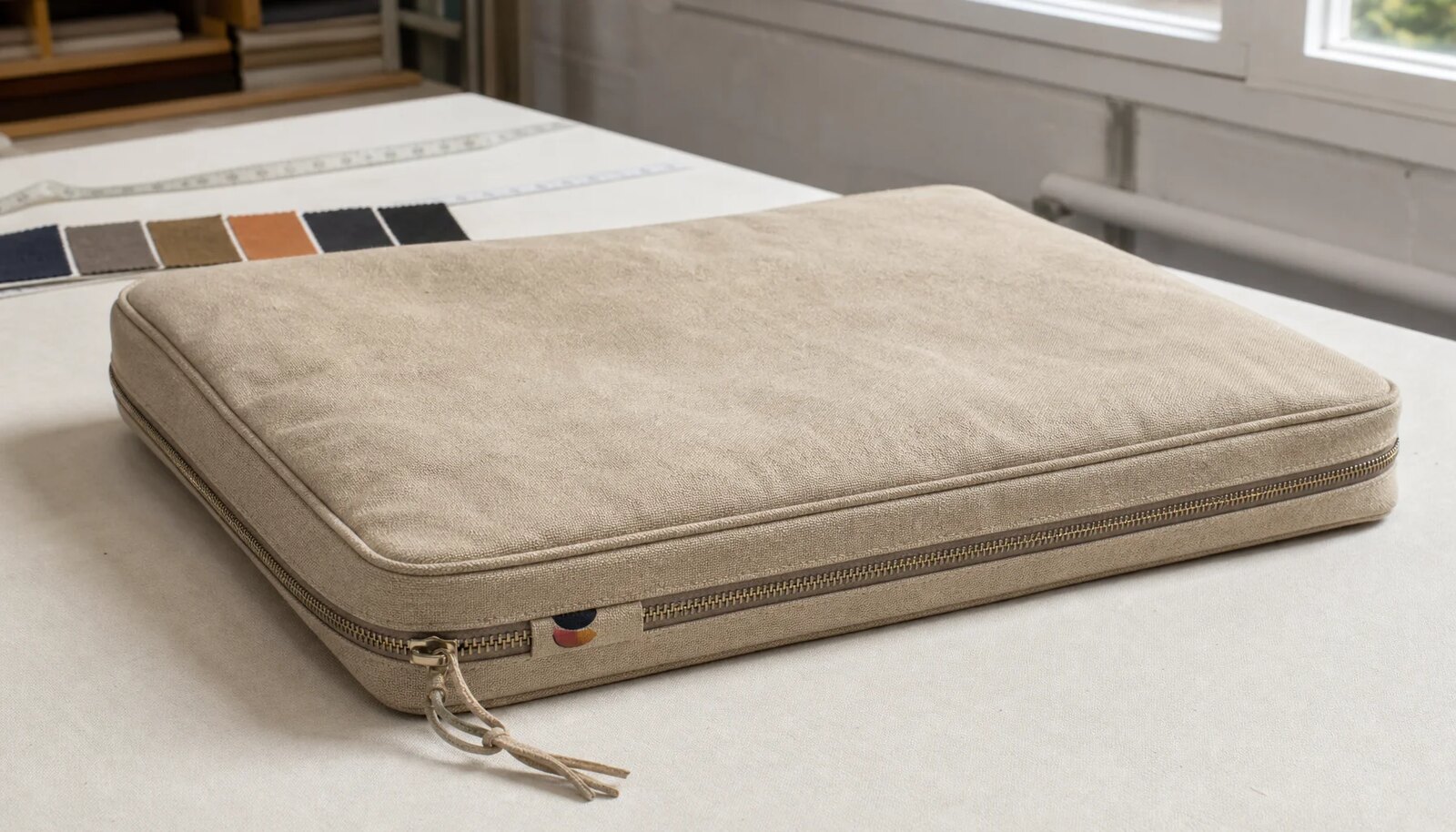
Why this portfolio is a procurement item, not a simple promo bag
A custom canvas zipper portfolio for farmers market vendors is usually bought for a job: carry order sheets, menus, tablets, invoices, price cards, or brand collateral in one piece that looks organized at the point of sale. That means the buying decision is not only about print quality. The real issue is whether the item can survive frequent opening, repeated stuffing into totes, and enough handling to stay presentable through a whole market season.
For procurement teams, the mistake is treating it like a low-complexity giveaway. Once a zipper is added, the portfolio becomes a sewn product with hardware, panel alignment, print placement, and packing consequences. If the spec is loose, quotes will be hard to compare and the factory will fill gaps with assumptions that may not match the buyer's use case.
- Define the portfolio's role before requesting quotes: presentation folder, document carrier, or tablet sleeve.
- Set the expected service life upfront; a weekend giveaway and a weekly market tool are different products.
- Treat zipper quality, panel stiffness, and print durability as functional requirements, not decoration.
Start with the fabric, because it drives the whole quote
Canvas weight is the first decision that shapes price, hand-feel, and print appearance. For most wholesale buyers, 12 oz or about 340 gsm is the practical starting point. It gives enough body for a zipper portfolio without becoming stiff or overbuilt. If the buyer wants a more premium retail look, or the portfolio needs to hold heavier contents without sagging, 14 oz or about 400 gsm is a better option. Lower weights can work for soft document sleeves, but they tend to show wrinkles and may not hold a sharp printed logo as well.
Do not leave the fabric description as 'cotton canvas' only. Ask the supplier to state yarn count, fabric weight, weave density, and finish. Pre-shrunk, washed, or enzyme-finished canvas behaves differently in sewing and in print. If the factory quotes one fabric and substitutes another with the same name but a different surface, the unit price may look good while the finished product loses shape or print clarity.
- Use 12 oz / 340 gsm for standard wholesale use.
- Use 14 oz / 400 gsm when structure and shelf presence matter more than unit cost.
- Request the measured fabric weight on the quote, not only a marketing description.
Pick the zipper and construction for daily handling
The zipper is the failure point buyers remember. For wholesale portfolios, a nylon coil zipper is usually the safest default because it slides smoothly, costs less than metal hardware, and is easier to source consistently across repeat orders. A medium-size puller is enough for most market use. Oversized decorative pulls can look attractive in a sample but are easier to bend or snag during transport.
Construction matters as much as the zipper itself. Topstitching at both ends of the zipper, reinforced seam allowances, and clean internal binding reduce the chance of edge fray and seam opening. If the design includes an inner sleeve or pen holder, each added seam increases the labor content. Buyers should only pay for those additions when they support real sales use, not just decoration.
- Choose nylon coil zipper for reliability and easier sourcing.
- Ask for reinforced stitch points at zipper ends and corners.
- Avoid extra pockets unless they improve function and justify the added labor.
How print method changes MOQ, price, and appearance
For a simple logo or one-color mark, screen printing usually gives the best balance of unit cost and legibility. It is the right route when the artwork is bold, the run is not tiny, and the buyer wants repeatability. Screen print also works well on rough canvas because it sits visibly on the surface instead of disappearing into the fabric texture. The tradeoff is setup cost: each color usually needs its own screen, and small-text artwork can break down if the canvas weave is too open.
Embroidery can raise perceived value, but it changes the price structure and may distort very fine details. Heat transfer is useful for short runs or multi-color artwork, but it needs proper adhesion testing on canvas, especially near a zipper where the panel may flex. When comparing quotes, make sure all suppliers are quoting the same decoration method on the same imprint size. A cheap transfer quote and a screen-print quote are not interchangeable.
- Screen print for simple logos and larger quantities.
- Embroidery for a stitched retail feel and controlled artwork detail.
- Heat transfer only when the artwork or order size makes screen setup inefficient.
Read MOQ logic before you compare unit prices
MOQ on a zipper portfolio is usually not a single number. It is the sum of fabric setup, print setup, zipper procurement, and sewing efficiency. A supplier may offer a low headline MOQ for one-color natural canvas but increase it when the buyer wants dyed fabric, a custom zipper color, or multiple logo positions. The real comparison is whether the supplier can hold the spec cleanly at the quantity you need without forcing hidden changes.
Buyers should ask for MOQ by color, by artwork version, and by packaging type. A quote that supports 500 pieces in one natural color is not the same as a quote that supports 500 pieces split across three body colors. If the buyer is ordering for multiple farmers market accounts or regional distributors, ask whether the factory can combine variants into one production run or whether each variant becomes a separate line item.
- Separate MOQ for fabric color, print version, and packing style.
- Watch for surcharges on multiple artwork placements or custom zipper pulls.
- Confirm whether the MOQ applies before or after sample approval.
Compare sourcing routes with the same evaluation rules
The best route depends on how much control the buyer needs. A direct factory is usually the right answer for custom canvas zipper portfolios because it gives better control over fabric weight, print alignment, and packing. Trading companies can be useful when a buyer wants one point of contact across multiple product types, but they may add a margin layer and reduce visibility into the actual sewing process. For a simple repeatable portfolio program, direct factory sourcing is usually easier to manage once the spec is set.
The wrong comparison is to treat all suppliers as if they are selling the same thing. One quote may include in-house printing, another may outsource print, and a third may bundle packing but not inspection. That changes both risk and lead time. Compare not just the price, but who actually touches the product at each step and where responsibility sits if the print shifts, the zipper fails, or the carton count is wrong.
- Direct factory: best control, clearer QC responsibility, better for repeat orders.
- Trading company: useful for mixed-category sourcing, less transparent on production details.
- In-house printing and sewing are easier to audit than split production across multiple vendors.
Use sample approval to catch the expensive mistakes early
A sample is not only for visual approval. It is the easiest time to verify zipper glide, logo placement, panel symmetry, stitch density, and the true feel of the canvas. Ask for a pre-production sample or at least a photo sample that shows the actual production material. A digital artwork proof can confirm placement dimensions, but it cannot tell you whether a 12 oz canvas will feel too soft or whether the print sits too heavily on the weave.
Good sample review starts with acceptance criteria. Measure the finished size flat, test the zipper several times, rub the print lightly, and inspect the inside seams. If a zipper drag, crooked print, or loose thread is visible in the sample, it will not improve in bulk production. Fixing it after the main run starts is expensive because the factory has already bought materials and locked labor.
- Approve the exact canvas, zipper, and decoration method before mass production.
- Measure the sample against the agreed finished dimensions and placement window.
- Reject samples that look acceptable at a distance but fail at zipper operation or seam finish.
Packing and carton planning affect landed cost more than buyers expect
Packing is often where the quote looks clean but the freight bill changes. Bulk polybag packing is efficient for distributors and B2B resellers because it keeps carton volume lower and minimizes handling labor. Individual polybag packing with barcode stickers is more suitable for retail programs, but it adds labor, plastic, and carton cube. The buyer should decide this early because the packing method affects not only labor but also how the goods survive transit and warehouse handling.
Ask the factory to quote carton dimensions and units per carton, not only total quantity. A larger carton may reduce packing labor but increase dimensional weight and freight cost. If the portfolios are going into farmers market kits or retail shelves, cartons should also be labeled with size, color, and carton count so warehouse teams can receive them without opening every box. That is basic, but it is often omitted from a fast RFQ.
- Bulk pack for distributor orders when unit handling is not needed.
- Individual polybag with barcode for retail and e-commerce workflows.
- Confirm carton dimensions because freight cost is often cube-driven.
Use a landed-cost view, not just a unit price
The real buying decision is landed cost by usable unit. A lower factory price can disappear once the buyer adds sample fees, extra print screens, packing upgrades, inland freight, and longer lead time. For example, a quote that looks cheaper by a small margin may require a second approval round or a reprint because the first proof missed the print placement. That cost is not on the quote line, but it still hits the margin.
When comparing offers, line up the assumptions. Use the same canvas weight, same zipper type, same print method, same packing method, and same carton count. Then compare what is still different: lead time, QC support, and whether the supplier can repeat the order without changing the spec. Buyers sourcing for farmers market vendors need consistency more than one-time novelty because the same bag may be reordered across seasons.
- Compare freight basis, carton cube, and packing method alongside unit price.
- Include sample cost and rework risk in the sourcing decision.
- Favor repeatability if the item will be reordered across seasonal programs.
A practical RFQ structure that gets cleaner quotes
A good RFQ for custom canvas zipper portfolios should read like a production brief, not a marketing request. Start with the product purpose, then define the size, canvas weight, zipper type, print method, and pack method. Add artwork files, color references, and a note on whether the buyer needs a retail-ready or bulk-packed product. This level of detail prevents the supplier from filling gaps with assumptions that are hard to unwind later.
Keep the wording exact and measurable. Instead of 'good quality canvas,' specify 12 oz / 340 gsm natural cotton canvas with a nylon coil zipper, one-color screen print, and bulk packing of 50 pieces per carton. When the quote comes back, the buyer can actually compare it. That is the difference between a procurement document and a casual inquiry.
- State size, weight, decoration method, zipper type, and packing in one spec block.
- Provide vector artwork and a maximum print area.
- Request sample timing, production timing, and carton details in the first round.
Specification comparison for buyers
| Spec decision | Recommended option | When it fits | Buyer risk to check |
|---|---|---|---|
| Canvas weight | 12 oz / 340 gsm for standard use; 14 oz / 400 gsm for premium feel | Use 12 oz when the portfolio only carries papers, menus, or a tablet sleeve; move to 14 oz when the buyer wants a stiffer hand, better print flatness, or a more retail-ready finish | Too-light cloth can wrinkle after printing and feel cheap in photos; too-heavy cloth can increase unit cost and make the portfolio bulky in a tote |
| Zipper style | Nylon coil zipper with matching tape and medium-size puller | Best for high-volume wholesale because it runs smoothly, is easier to source consistently, and tolerates frequent opening at market booths | Metal zippers look premium but add cost, can scratch contents, and may create color mismatch if the supplier mixes hardware lots |
| Print route | Screen print for one to three spot colors; heat transfer or embroidery for smaller runs or detailed logos | Use screen print for clear, bold branding at scale; use embroidery for a stitched retail look; use transfer only when artwork is detailed or MOQ is too low for screens | Thin lines, gradients, and small text often fail on rough canvas; insist on a proof that reflects cloth texture rather than a clean digital mockup only |
| Construction method | Binding or turned edge with reinforced stress points; topstitching at zipper ends | Choose reinforced construction when portfolios will be used daily, carried in bags, or packed with sample sheets, invoices, and pens | Poor stitch density or skipped bartacks at the zipper ends causes early seam failure and returns |
| Internal layout | One main compartment plus pocket sleeves for cards, pens, or a phone | Good for vendors who need a clean presentation piece without making the item too complex to sew | Every extra pocket raises sewing time and can push MOQ or lead time upward; avoid decorative pockets that do not support the sales use case |
| Supplier route | Direct factory with sampling and production control | Best for buyers who need custom specs, repeat orders, and predictable QC across multiple seasons | Confirm whether the factory handles printing in-house or outsources it; split production can hide responsibility when color or alignment drifts |
| Order quantity logic | MOQ based on print setup, fabric color, and hardware availability | Works when the buyer can commit to one artwork set and a narrow color range across the batch | A low headline MOQ may still carry hidden surcharges for multiple logo positions, mixed canvas colors, or custom zipper pulls |
| Packing method | Bulk polybag with carton count labels, or individual polybag with barcode sticker for retail | Bulk packing suits B2B distribution; individual retail packing suits marketplace resale and e-commerce fulfillment | Overpacking increases carton volume and freight cost; underpacking can lead to scuffed print, bent corners, or zipper damage |
| Lead time model | Sample in 7 to 14 days; production in 25 to 40 days after approval | Use this structure when the artwork is final and the fabric, zipper, and print method are already decided | Delays usually come from slow sample approval, missing artwork dimensions, or late color confirmation rather than the sewing line itself |
Buyer checklist before sampling
- Lock the intended use case first: paperwork carrier, menu folder, tablet sleeve, or event giveaway; do not price the bag before the use case is fixed.
- Specify canvas weight in gsm or oz, not just 'heavy canvas.'
- State the zipper type, puller style, and whether the zipper tape should match the body color.
- Attach artwork in vector format and note the maximum print area in millimeters.
- Define color tolerance for body fabric, zipper tape, thread, and print ink.
- Decide whether the order needs retail-ready individual packing or master-carton bulk packing.
- Ask for a pre-production sample or photo approval of print placement before bulk sewing starts.
- Confirm carton size, carton count, and whether cartons must pass drop testing for your route.
Factory quote questions to send
- What canvas weight, yarn count, and finish are you quoting, and is the weight measured before or after finishing?
- Is the zipper coil nylon or polyester, and what brand or equivalent standard are you sourcing?
- How many print colors are included in the unit price, and what is the surcharge for extra colors or a second print location?
- What is the exact MOQ by color and by artwork version?
- What sample fee applies, and is it deductible from the bulk order after approval?
- Which steps are done in-house and which are outsourced: cutting, printing, sewing, inspection, and packing?
- What carton dimensions and unit packing method are assumed in the quote?
- What is the production lead time after sample approval, and what events trigger schedule slippage?
- What quality standard do you inspect to for stitch length, zipper function, and print alignment?
- Can you share actual photos of a similar portfolio or the production process rather than only a render?
Quality-control points to confirm
- Fabric weight tolerance: hold the canvas within an agreed range, typically plus or minus 5 percent of the quoted gsm or oz.
- Zipper function: the pull should run smoothly across the full length without snagging, separating, or catching on seam tape.
- Stitch quality: no skipped stitches, loose thread nests, or weak bar tacks at zipper ends and corners.
- Print alignment: the logo must sit within the agreed placement window and remain centered relative to the body panel.
- Color consistency: body fabric, thread, and zipper tape should match the approved shade reference or lab dip within the accepted tolerance.
- Dimension control: finished size should be measured flat and meet the agreed tolerance on width, height, and gusset depth if any.
- Packing accuracy: each carton should match the declared unit count, carton marks, and inner packing method.