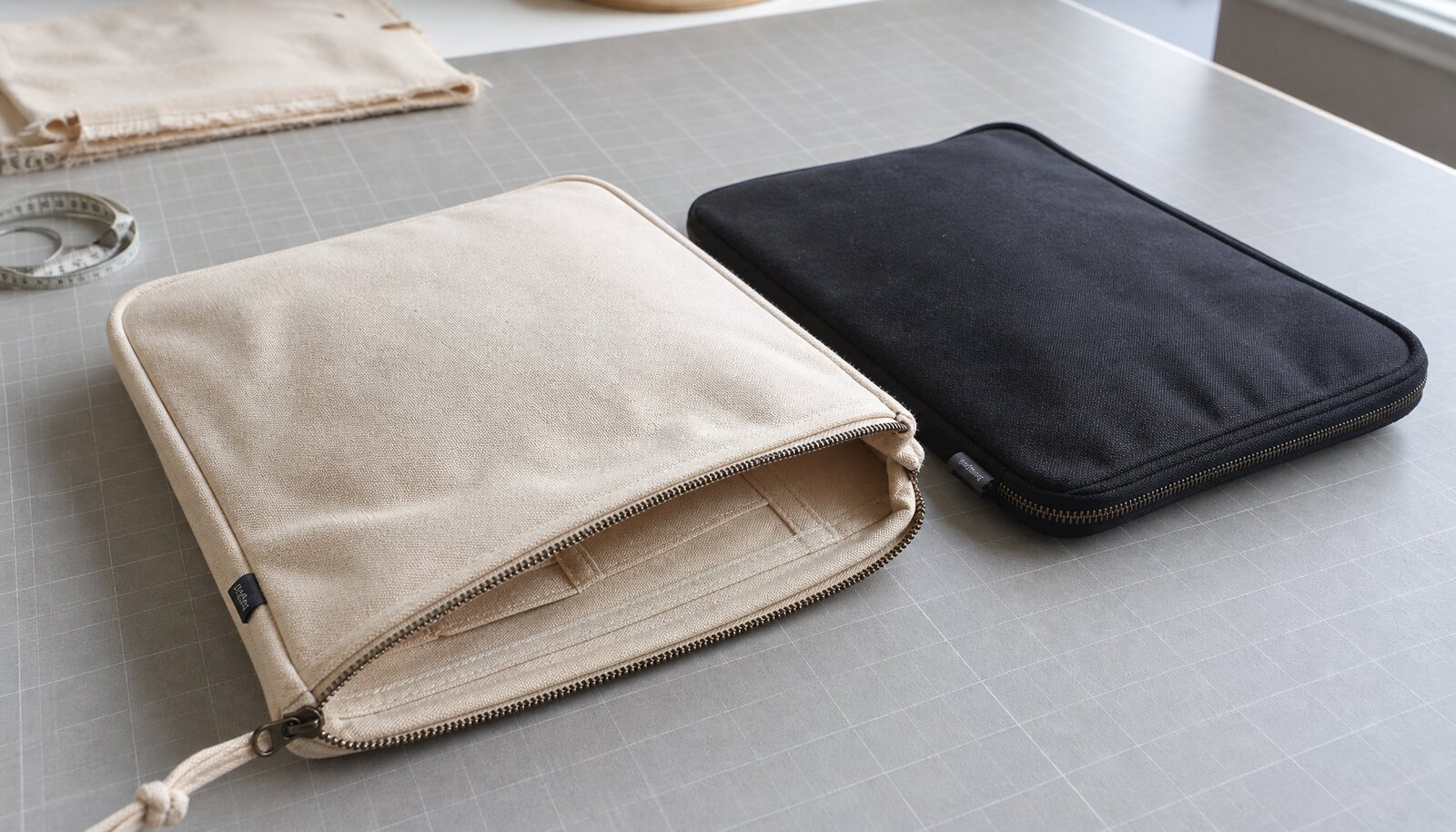
Why gift shop buyers should spec zipper portfolios differently from ordinary canvas pouches
A canvas zipper portfolio sits in a different part of the buying process than a basic pouch. Gift shop buyers are selling presentation as much as function, so the item has to look balanced on a shelf, open cleanly for the end customer, and survive handling without warping, staining, or zipper drag. If the product is intended for stationery, museum retail, travel accessories, or a branded gift set, the visual finish matters as much as the material cost.
That is why the cheapest quote is rarely the best comparison point. Two portfolios can share the same size and still perform very differently if the zipper gauge, seam allowance, fabric finish, or packing method changes. For procurement, the real question is not just what the unit price is. It is what arrives in the carton, what can be verified before shipment, and how much of the supplier's promise is backed by a material spec or inspection record.
- Use this checklist for retail gift shops, museum stores, stationery assortments, and boutique chains.
- Treat the zipper, seam build, and packing method as product-defining features, not afterthoughts.
- Compare suppliers on the same spec sheet or the price gap will be misleading.
Define the use case before you request a quote
The right portfolio spec depends on how the item will be sold and used. A document sleeve for office customers needs reliable dimensions and a smooth zipper opening. A gift-shop portfolio may need a firmer body, a more deliberate hand feel, and a print area that stays visually centered on the front panel. If the item is part of a gift set, it may also need an insert card, barcode sticker, or retail-ready polybag that opens cleanly at store level.
Before you send an RFQ, write the use case in plain terms. State whether the portfolio must carry a notebook, loose papers, travel documents, pens, or only light flat items. That one decision affects not only size but also whether you need lining, interfacing, reinforced corners, or a heavier zipper. If the supplier does not know the load, they cannot make a sensible recommendation on structure.
- Document holder: prioritize size accuracy, zipper reliability, and a flat profile.
- Gift-set insert: prioritize print quality, clean surface appearance, and shelf presentation.
- Retail display item: prioritize body structure, seam consistency, and a premium hand feel.
- Souvenir line: prioritize simple branding and stable landed cost.
Build the product around fabric, zipper, stitch density, and structure
For custom canvas zipper portfolios wholesale, fabric weight is one of the first choices that changes both perception and cost. A 12 oz canvas is usually a workable starting point for lower-priced gift shop assortments because it gives enough body without making freight or sewing complexity jump too quickly. A 16 oz canvas creates a firmer and often more premium feel, but it can require stronger thread, better zipper alignment, and tighter sewing control. If the supplier quotes in GSM instead of ounces, that is fine as long as the conversion is consistent and the same spec is used in sampling and bulk.
Structure matters just as much as weight. Pre-shrunk or washed canvas is easier to control because it reduces the chance that the body will change shape after printing, packing, or humidity exposure. Stitch density should be named in the spec, not guessed from the sample. For this kind of portfolio, many buyers start around 8-10 stitches per inch on the main seams, with reinforced stitching at zipper ends and corners. If the product needs more shape, light interfacing or a thin lining can help, but too much structure creates bulk and can make the zipper curve harder to sew cleanly.
- Write the canvas weight in the quote as a spec, not a marketing description.
- Name whether the fabric is raw, washed, pre-shrunk, or stabilized.
- Ask for the stitch density and seam allowance in the production drawing.
- Confirm whether the zipper end area will use bartacks or another reinforcement method.
Choose branding that survives folds, seams, and retail handling
The branding method should match the artwork, not the other way around. Screen print is usually the strongest choice when the logo is simple, the color count is low, and the buyer expects repeat orders. Heat transfer or digital print is more suitable when the art includes gradients, small text, or multiple colors that would become muddy in screen print. A woven or sewn label can also be a cleaner option if the brand wants a less printed surface and a more subdued premium look.
What often gets missed in sourcing is placement logic. A logo that looks fine in a digital mockup may land too close to a seam, zipper tape, or fold line once it is translated to a production pattern. Ask the supplier to show a layout with safe margins marked clearly. If your logo includes thin typography, ask how they will prevent blur or edge break-up on canvas texture. The same is true for color matching. Pantone references are useful, but only if the factory can show how it will apply them to the actual print method you selected.
- Use screen print for simple, repeatable logos and stable reorders.
- Use transfer or digital print when detail matters more than setup efficiency.
- Use a woven label when the goal is a cleaner surface and less ink on the fabric.
- Require a placement drawing showing the logo's distance from seams and zipper tape.
Read a factory quote like a procurement document, not a marketing sheet
A usable quote should tell you exactly what the factory is selling. For this product, the quote should name the canvas spec, zipper spec, print method, packaging format, MOQ, sample fee policy, and lead time after approval. If those items are missing, the quote is not comparable. A low unit price can hide a weaker zipper, a thinner canvas, or separate fees for artwork setup, polybags, labels, and carton marks.
The cleanest way to compare suppliers is to force the same assumptions. Ask each factory to quote the same body color, zipper color, print method, pack-out, and approval route. If one quote includes pre-production sampling and another excludes it, the comparison is already distorted. A good procurement sheet should let you identify where the price is being spent, not just what number the supplier wants you to notice first.
- Reject quotes that do not identify the zipper type and fabric weight.
- Check whether sample fees are refundable or credited against bulk.
- Ask for a line item if the quote excludes packaging labor or label application.
- Make sure the MOQ is tied to one clear spec version, not a moving target.
Verify supplier claims with sample evidence and factory documents
For this category, photo approvals are weak evidence. You want a pre-production sample made with the same fabric, zipper, thread, print method, and packing as the bulk order. If the supplier says the bulk will be the same as the sample, ask for the supporting documents. That can include a fabric spec sheet, a zipper component photo, a production drawing, and a sample approval record that names the revision number.
The sample should also be measured, not just looked at. Check finished dimensions after pressing, inspect the zipper run, verify the print placement, and look for puckering at the corners or zipper ends. If the supplier provides an inspection report later, review whether it names the inspection method, defect categories, and count by carton or lot. A report that only says "passed" is not very useful when you need to know what was checked and what failed.
- Ask for a fabric swatch card or mill specification before bulk approval.
- Keep the approved sample, the quote, and the production drawing tied to one revision number.
- Request close-up photos of the zipper ends, seam corners, and printed area on the actual sample.
- Ask for the final inspection format before production starts, not after shipment is ready.
MOQ, setup cost, and lead time are connected, so read them together
MOQ is not just a quantity requirement. It is a reflection of how much setup the factory has to absorb for cutting, sewing, printing, zipper sourcing, and packing. A one-color body with one logo version is usually easier to run than multiple body colors or several artwork variants. If you need more than one SKU, ask the supplier to separate setup charges from the unit price so you can see the real break-even point across variants.
Lead time should be read the same way. A simple portfolio made from stock canvas and a standard nylon coil zipper can move faster than a version that requires special dyeing, new hardware, or custom packing. The most common delay is not sewing capacity. It is late artwork approval or a missing component. If your buying calendar is tied to seasonal gift-shop demand, build in approval time for samples, corrections, and re-inspection.
- Use one body color and one zipper family when you need the cleanest MOQ.
- Expect multiple logo versions to add setup cost even if the bag body is unchanged.
- Ask what part of the lead time is factory-controlled and what part depends on material sourcing.
- Do not treat sample approval as the end of the schedule; it is usually the point where production risk becomes visible.
Packing decisions affect damage rate, freight cost, and shelf readiness
Packing is one of the most overlooked cost drivers in wholesale gift shop supply. A simple individual polybag can protect the canvas surface from dust and handling during transit, while a barcode sticker or insert card may be required if the product is going straight into retail systems. The master carton should be sized to protect the zipper pull and corners without wasting freight volume. If the carton is too loose, the portfolios can shift and crease. If it is too tight, the zipper pull or corner structure can get compressed.
Ask the supplier for the carton plan before production starts: units per carton, carton dimensions, gross weight, and carton marks. That lets you estimate landed cost more accurately and also tells you whether the receiving warehouse can handle the load. If you are mixing SKUs, standardize the pack format as much as possible so the receiving team does not have to sort inconsistent cartons or relabel product on arrival.
- Confirm whether each piece ships in a polybag and whether the bag needs a suffocation warning or retail opening notch.
- Verify the barcode label position if your warehouse scans on intake.
- Ask whether carton compression or drop protection has been considered for the zipper area.
- Get carton dimensions before you compare freight quotes.
Use a real QC plan, not a generic promise of good workmanship
Quality control for a canvas zipper portfolio should be tied to the exact failure modes that matter in retail. The most visible issues are crooked zippers, uneven stitching, poor print alignment, and damaged corners. The most expensive issues are size drift, zipper failure, and carton damage that makes the item unsellable or unattractive at receipt. That is why the inspection standard should be written before production begins, not after the first batch is already packed.
For a retail-facing order, many buyers start with zero critical defects and a pre-agreed AQL for major and minor defects. The exact threshold is less important than consistency. What matters is that the supplier knows which defects count as critical, which ones are major, and how they will be counted. If the front panel has visible stains, if the zipper fails to close smoothly, or if the logo is off-center beyond the agreed tolerance, those items should be separated before shipment and documented in the inspection report.
- Check a measured sample of finished units, not just a single approval piece.
- Review defect counts by type, not a vague pass/fail summary.
- Confirm whether the supplier performs in-line checks, final inspection, or both.
- Ask for carton photos so you can verify the packing state before balance payment.
Use a go, pause, or reject decision before you place the bulk order
The goal of this checklist is to make the buying decision harder to game. If the supplier can show the exact canvas spec, zipper spec, print method, measured sample, packing plan, and inspection standard, the order is in a manageable state. If one or two items are missing, pause and ask for the documents before approving production. If the quote is vague, the sample is built from different materials, or the supplier refuses to define tolerances, the safest move is to reject the offer and re-bid on the same spec.
A strong procurement process for custom canvas zipper portfolios wholesale is simple: define the use case, force the same quote assumptions, verify the sample against documents, and inspect the lot against a named defect standard. That sequence is what turns a promotional product into a controlled retail item. It is also what keeps the conversation focused on measurable quality instead of repeated discussion about price alone.
- Go when the quote, sample, and inspection plan all match the same revision.
- Pause when the supplier is missing one material or packing detail that affects cost or quality.
- Reject when the factory will not name the zipper spec, fabric spec, or defect standard.
- Rebid when quotes are not comparable because each supplier used different assumptions.
Specification comparison for buyers
| Spec decision | Buyer target | Verify on sample or documents | Escalate if |
|---|---|---|---|
| Fabric weight and finish | 12 oz canvas for cost-sensitive gift shop lines; 16 oz canvas for a firmer, more premium retail feel. Prefer pre-shrunk, washed, or otherwise stabilized fabric. | Ask for the mill spec, fabric swatch card, and a cut-and-weigh check. Confirm the approved sample and bulk lot use the same finish and dye lot. | Sample and bulk feel different, basis weight drifts by more than about 5 percent, or the fabric shrinks enough to change pocket fit or zipper alignment. |
| Stitching and seam build | Target 8-10 stitches per inch on main seams, with a consistent seam allowance and bartacks or reinforced lockstitch at zipper ends and stress points. | Inspect close-up photos, measure stitch density with a ruler, and review the pre-production sample for seam wandering, skipped stitches, and loose thread tails. | Seam deviation exceeds about 3 mm from the approved line, thread tails are left long, or stress points do not show reinforcement. |
| Zipper specification | A nylon coil zipper is usually the safest default. Use #3 for lighter-use portfolios and #5 when the buyer wants a sturdier feel or more frequent retail handling. | Request the exact zipper gauge, tape color, puller style, and stop method. Test opening and closing through at least 20 cycles on the sample. | The zipper catches at corners, the puller sits off-center, the coil twists, or the top stop feels weak. |
| Finished size tolerance | Set a clear finished dimension and allow only a tight tolerance: about +/- 3 mm for smaller bodies and +/- 5 mm for larger A4 or letter-size portfolios. | Measure multiple samples after pressing and packing, not only before finishing. Check whether the zipper opening and internal capacity still match the use case. | Samples vary enough that a notebook, document set, or insert card no longer fits cleanly across the lot. |
| Print and branding method | Screen print for simple logos and repeat orders; heat transfer or digital print for multicolor art; woven or sewn labels for a cleaner low-ink look. | Ask for a production layout showing placement, safe margins, and the exact color method. Review a printed strike-off or sample using the final artwork. | Small type bleeds, color shifts on folds, or the logo crosses a seam without enough margin. |
| Structure and lining | Unlined for simple low-cost lines; light interfacing or a thin lining for better shape retention and a more giftable feel. | Check the sample for sagging, corner bulk, and whether added structure interferes with the zipper bend or makes the body too stiff. | The portfolio collapses flat in display, or added interfacing creates zipper drag and corner puckering. |
| Packing and labeling | One piece per polybag, then bulk carton packing with clear carton marks. Add barcode stickers or insert cards only if the retail channel needs them. | Review carton dimensions, units per carton, gross weight, and all label artwork before production starts. | Cartons are too heavy to handle efficiently, labels do not match the PO, or zipper pulls are exposed to compression damage. |
| Defect threshold | Zero critical defects. For retail-facing orders, many buyers start at AQL 2.5 for major defects and tighter if the item is highly visible. | Require the supplier's inspection standard in writing and ask to see the final inspection report with defect counts by type. | The supplier will not name an inspection standard, or major cosmetic defects are allowed in the front-panel display area. |
Buyer checklist before sampling
- Define the end use first: document sleeve, stationery holder, gift-set insert, souvenir item, or premium retail portfolio. The use case determines size, zipper gauge, and how much structure the body needs.
- Lock the finished dimensions, opening width, and any internal capacity requirement before pricing. A portfolio that must hold A4 paper is not the same as a slim accessory pouch.
- Specify the exact canvas basis weight, finish state, and whether the fabric is raw, washed, pre-shrunk, or stabilized. Ask the supplier to name the source spec, not just the color.
- Choose the zipper gauge, tape color, puller finish, and stop style in writing. If the zipper line is a visible design element, the component choice matters as much as the fabric.
- Ask for a production drawing or tech pack that shows logo placement, safe margins from seams and zipper tape, stitch allowances, and the approved finished size tolerance.
- Request a pre-production sample made with the real fabric, real zipper, real print method, and real packaging. A photo approval or partial sample is not enough for a retail item.
- Ask the supplier to show how the order will be inspected: stitch density, seam strength, zipper function, print registration, size checks, and carton count verification.
- Compare quotes only after confirming the same pack-out: individual polybag, barcode sticker, insert card, carton mark, and any special retail labeling. Hidden packing labor changes the landed cost.
Factory quote questions to send
- What is the exact canvas specification in basis weight, weave, and finish, and can you share a mill spec or fabric card for the approved lot?
- Which zipper gauge, tape width, puller style, and stop method are included in the quote, and can you send a close-up photo of the current component?
- What stitch density, seam allowance, and reinforcement method will you use at the zipper ends and corners, and can you show the production drawing?
- What are the finished dimensions and tolerance after pressing and packing, and how do you measure them during production?
- Which print method are you quoting, what is the safe edge margin, and how do you handle fine text, seam crossings, and Pantone or CMYK matching?
- What is the MOQ per color, per design, and per logo version, and what setup charges apply if we change only the artwork?
- Is the pre-production sample made on the same line with the same materials as bulk production, and what is the approval timeline?
- What packaging is included in the unit price: polybag, insert card, barcode sticker, master carton mark, or pallet wrap?
- What inspection standard do you use for this item, and can you provide the final inspection report with defect counts and carton photos before shipment?
- What could delay the schedule after approval: fabric dyeing, zipper sourcing, printing queue, or packing changes?
Quality-control points to confirm
- Fabric basis weight matches the approved spec, and the buyer can verify it through a supplier mill document or a cut-and-weigh check rather than visual feel alone.
- Finished size stays within the agreed tolerance after pressing and packing, with no drift that affects document fit, insert cards, or retail presentation.
- Zipper opens and closes smoothly through repeated cycles, the puller sits centered, and the top stop or end finish does not feel loose or crooked.
- Main seams show even stitch density, no skipped stitches, and no wandering seam line beyond the allowed tolerance at corners and zipper ends.
- Print placement stays inside the approved safe margin, with no blur, cracking, or visible color shift on fold lines and seam crossings.
- No visible oil stains, holes, frayed thread tails, broken needle marks, or front-panel blemishes appear in the display area.
- If the order is retail-facing, use a clear inspection standard such as zero critical defects and a pre-agreed AQL for major and minor defects, then insist on a written inspection report.
- Cartons are clean, dry, and correctly marked, with the correct quantity, no crushed zipper pulls, and no compression damage to the corners or printed surface.