Start With the Event Job
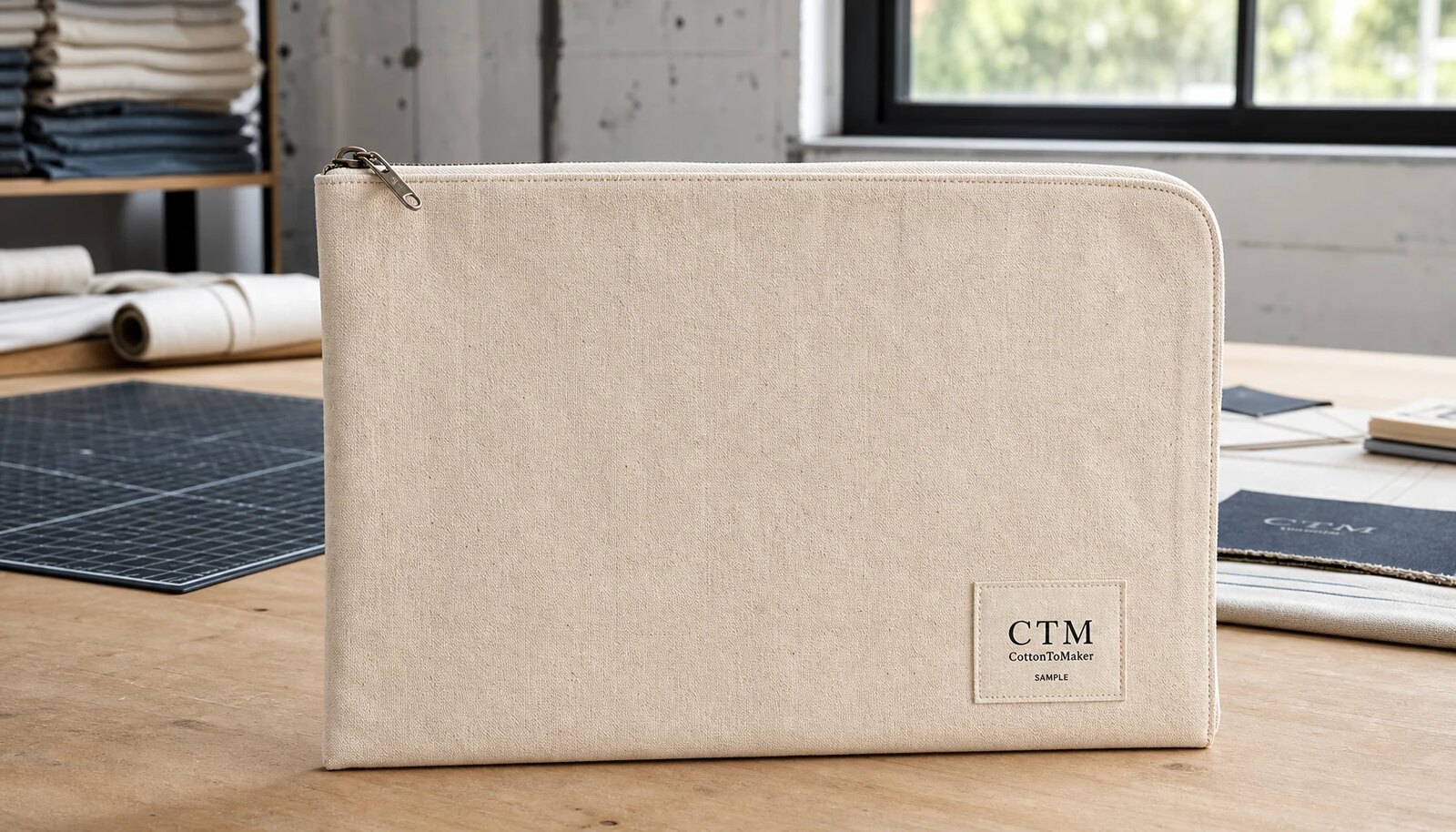
A custom canvas zipper portfolio is not only a promotional bag with a logo. For an event team, it is often a working container. It may hold agendas, badges, speaker notes, training handouts, sponsor inserts, workbooks, notebooks, pens, tablets, chargers, contracts, or confidential session material. It may sit at registration, arrive on seats before doors open, ship inside a larger welcome kit, or move through a third-party kitting warehouse. Those details should shape the product before anyone talks about color or decoration.
Procurement buyers get better quotes when they describe the job clearly. A 3,000-piece attendee handout needs efficient packing, reliable counting, moderate cost, and a carton plan that venue staff can process quickly. A 250-piece executive sponsor portfolio may need lining, smoother trim, quieter branding, and a more giftable hand feel. A staff operations pouch may need durability, easy sorting, and fast access more than premium presentation. All three can be called canvas zipper portfolios, but they should not share the same sourcing brief.
Before sending an RFQ, write one plain-language operating note. Say who receives the item, what it carries, how long it should last, where it ships, who packs it, and when it must be ready for use. That turns the keyword goal of a custom canvas zipper portfolios wholesale buying checklist for event planners into a real purchasing tool: a spec that suppliers can quote, sample, inspect, and deliver against.
- Identify the event type: conference, trade show, training seminar, sponsor summit, sales meeting, campus program, board retreat, or staff program.
- Define the recipient tier: general attendee, paid participant, speaker, sponsor, VIP, employee, reseller, press guest, or operations staff.
- Tell the supplier whether the portfolio ships empty, pre-packed with inserts, packed inside another kit, or carton-sorted by event city or attendee group.
- Decide whether the item should feel promotional, work-ready, premium, retail-adjacent, or reusable after the event.
- Put the required arrival date, venue receiving window, and contingency time directly in the RFQ.
Measure What Goes Inside
Many portfolio problems begin with a vague size request. A buyer asks for something that fits letter or A4 documents, then discovers that the zipper opening is tight, the corners bend the papers, or the pouch cannot accept the full packet once a notebook and sponsor insert are added. Finished outer dimensions are not the same as usable internal dimensions. Seam allowance, zipper tape, lining, binding, corner shape, and gusset construction all take space.
Start with the actual contents. Letter paper is 8.5 x 11 inches. A4 is 210 x 297 mm. Those numbers are only the floor. Add clearance for loading, page count, brochure thickness, notebook spirals, tab dividers, pen loops, charger bulk, or a tablet sleeve. If staff will pre-pack hundreds or thousands of portfolios, the opening matters almost as much as the internal size. A tight zipper may save a few millimeters on paper and cost real labor on the loading table.
Ask suppliers to quote finished outer dimensions and minimum usable internal dimensions as separate lines. Also ask for zipper opening length, pocket dimensions, and the measurement points they will use during inspection. Sewn products need tolerances. Depending on construction, a buyer might agree to a tighter tolerance for logo placement than for a large finished dimension, but the tolerance has to be written before production. A sample that feels acceptable on one desk should become a measurable standard for the production floor.
- Provide the size of every major content item, including document format, page count, notebook thickness, tablet model, pen, badge, charger, and sponsor insert bundle.
- Specify finished outer length and width, minimum internal usable length and width, gusset depth, zipper opening, and pocket dimensions.
- Use measured values instead of terms such as standard, roomy, laptop friendly, or premium size.
- Require the pre-production sample to pass a real loading test with the final insert set or a same-thickness dummy pack.
- Ask the factory to provide a simple measurement sheet with inspection points and agreed tolerances.
Specify Canvas Clearly
Canvas weight influences structure, hand feel, sewing difficulty, decoration quality, and freight cost. For event portfolios, 10 oz canvas is often considered for light-use or cost-sensitive programs. A 12 oz canvas, commonly around 407 GSM depending on weave and finishing, is a practical starting point for many standard event portfolios. A 14 oz canvas, commonly around 475 GSM, can feel more substantial for VIP or sponsor gifts, though it can raise material cost, carton weight, and sewing resistance.
Ounce weight alone is not enough. Buyers should ask for fiber content, weave, finish, color method, shrinkage concerns, and tolerance. Natural cotton canvas may show flecks, seed marks, and slubs. Dyed canvas needs shade approval and may vary by dye lot. Washed canvas can feel softer but may relax the structure and introduce more shade variation. Coated or treated canvas may add stiffness or stain resistance, but it can also affect print adhesion and the way the portfolio feels in the hand.
Clarify what the quoted weight describes. One supplier may quote shell fabric only. Another may talk about overall feel because lining or backing is included. For apples-to-apples comparison, lock the shell fabric weight, lining material, reinforcement material, and any interlining. A small GSM difference may be acceptable when disclosed. It becomes a sourcing problem when it appears after bulk goods arrive.
- State canvas weight in both oz and GSM, with an agreed tolerance range or supplier-confirmed production tolerance.
- Specify cotton, cotton blend, recycled cotton blend, polyester-cotton, or other composition if material content matters for the program.
- Approve fabric color with a physical swatch or lab dip when color consistency matters more than natural variation.
- Confirm whether the canvas is natural, dyed, washed, brushed, coated, laminated, or unwashed greige-style fabric.
- Ask whether the supplier will test or confirm shrinkage, colorfastness, odor, and fabric weight before cutting bulk material.
Choose the Right Zipper
The zipper is the part attendees touch first and use most. It can make a canvas portfolio feel dependable, or it can make the whole item feel cheap even when the fabric is good. Nylon coil zippers are common for canvas portfolios because they are flexible, relatively smooth, and practical at wholesale quantities. Metal teeth can look more premium, but they add weight and may be less forgiving around corners or under compression. Plastic molded teeth can work for casual programs, though they may not suit a more formal conference kit.
A purchase order should say more than zipper included. Specify zipper type, gauge, tape color, slider material, puller shape, puller finish, end treatment, and reinforcement. For many document portfolios, a No. 5 zipper is a common starting point. Larger gusseted builds or heavier contents may call for a different gauge. The factory should recommend a zipper based on actual size and load, then state exactly what is included in the quote.
Trim decisions can quietly move the calendar. Custom zipper tape, branded metal pulls, woven labels, plated finishes, and nonstandard hardware may carry separate MOQs, tooling costs, or sampling steps. If the event date cannot move, ask for a stock-trim backup at the same time you request the premium option. Procurement can then make a time-based decision instead of discovering the risk after artwork approval.
- Lock zipper type, gauge, tape color, slider color, puller material, puller shape, and metal finish before quote comparison.
- Ask whether the zipper is a stock item or custom dyed, and whether custom tape has a higher MOQ or longer lead time.
- Require zipper-end reinforcement, especially where the slider stops or where contents push against the closure.
- Check puller edges for burrs or sharp points that could catch fabric, scratch devices, or create a safety concern.
- Confirm tooling cost, sample timing, and ownership terms for branded metal pulls or molded zipper pulls.
Match Branding to the Fabric
Decoration should be chosen for the artwork, canvas texture, quantity, schedule, and event tier. Screen printing is often efficient for simple one-color or spot-color logos on canvas, especially when the logo has clean shapes and enough open space. Embroidery adds texture and a more tactile feel, but fine lettering, gradients, thin lines, and dense fills can lose clarity or create puckering. Woven labels and sewn patches are useful when the brand should feel durable, understated, and repeatable across several event items.
Transfers can be helpful for multi-color logos, sponsor versioning, or late artwork. They still need careful approval. Heat transfer, digital transfer, and similar methods depend on film type, adhesive, press conditions, canvas finish, folding, abrasion, and stacked packing pressure. Ask the supplier how they test adhesion and whether the decoration may crack, lift, shine, or transfer ink when packed face-to-face.
Control artwork with fixed references. Provide vector files, Pantone or brand color guidance, logo size, placement from finished edges, and orientation. If several sponsors or cities need different versions, build a version matrix that shows quantity by logo, portfolio color, carton label, and destination. Placement should be measured from a seam, zipper line, center point, or finished edge, not judged from a product photo.
- Use screen print for simple logos when clean edges, cost control, and repeatability are priorities.
- Use embroidery only after confirming minimum letter height, stitch density, backing, thread colors, and puckering risk.
- Use woven labels or patches for repeat programs where a durable brand detail may be reused across several product types.
- Use transfer methods for multi-color art or late sponsor versions, but ask for rub, fold, adhesion, and stacking performance details.
- Approve a decorated physical sample on the actual or production-equivalent canvas, not only a digital mockup.
Write an RFQ Suppliers Can Price
A strong RFQ reduces guessing. Without a complete spec, suppliers will fill gaps in different ways. One may quote 10 oz canvas while another assumes 12 oz. One may include lining while another leaves seams exposed. One may quote a one-color screen print, another a transfer. One may include individual bags and labeled cartons, while another assumes bulk packing. The prices will not mean much until the product assumptions match.
Your RFQ should include quantity, price tiers, event date, required arrival date, delivery destination, finished size, internal usable size, canvas specification, zipper specification, lining, pockets, labels, decoration, sample requirements, packing, carton marks, inspection expectations, payment terms, and trade term. Ask suppliers to list exclusions and substitutions clearly. A supplier can still be useful for simple stock goods with fewer details, but a controlled custom order needs written answers.
Request line-item pricing. Setup charges, screen fees, embroidery digitizing, transfer films, woven label setup, custom pull tooling, carton upgrades, barcode labels, individual polybags, palletization, sample freight, inspection, and export documents may all be legitimate costs. They should appear before supplier selection. The lowest unit price is not the lowest program cost if the missing lines arrive after sample approval.
- Attach one clean spec sheet, artwork files, packing instructions, destination details, and required arrival date with the RFQ.
- Request pricing at realistic tiers such as 500, 1,000, 2,500, and 5,000 units when those quantities match the event calendar.
- Ask for separate pricing by artwork version, colorway, zipper color, lining color, label version, and packing method.
- Require the quote to show sample lead time, production lead time after written approval, quote validity, payment terms, and freight term.
- Ask suppliers to identify any assumption, substitution, exclusion, or component that is not final at the time of quotation.
Compare MOQ and Split Orders
MOQ is rarely just a supplier preference. It may come from fabric dye lots, zipper purchases, cutting efficiency, sewing line setup, print screens, label weaving, puller tooling, or carton sorting. A 2,000-piece order in one color with one logo is much simpler than 2,000 units split across four sponsor logos, two zipper colors, three destinations, and different carton labels. Buyers should ask for MOQ by variable, not only total order quantity.
The sourcing route also changes control. A direct factory can be strong when you need consistent construction, repeat production, and clear sample reference. A trading company can help when one purchase order includes several product categories, but you need visibility into which factory makes the portfolios and who signs off final QC. A domestic decorator using imported blanks can save a late program, but the blank inventory may not match a fully custom production run in fabric shade, zipper, or size.
For recurring events, dual sourcing can be useful when managed carefully. A primary factory can produce the planned volume while a regional finisher handles late add-ons. The risk is inconsistency. Both sources need the same control sample, measurement sheet, swatch, artwork placement guide, carton label format, and defect definitions. Otherwise, goods shipped to different cities may look close in a spreadsheet and feel different on the registration table.
- Ask MOQ separately for canvas color, zipper color, lining color, artwork version, label, branded pull, and packing group.
- Confirm whether split shipments, split destinations, or mixed carton versions add handling cost or extend lead time.
- Use direct factories for controlled construction and repeat orders; use trading companies when consolidated category management matters more.
- Use stock blanks and local decoration for urgent or small runs, but check lot consistency before approving appearance-critical orders.
- Document any supplier substitution for fabric, zipper, trim, lining, decoration, or packing before production begins.
Approve Samples With Discipline
A sample is the physical contract for a custom sewn product. Photos are helpful for progress checks, but they cannot fully show canvas hand feel, zipper behavior, internal capacity, lining quality, seam bulk, or decoration texture. For custom canvas zipper portfolios, request a pre-production sample made with final or production-equivalent materials. If a temporary zipper, label, or lining is used during sampling, the supplier should state that clearly and provide a final trim approval step before bulk production.
Test the sample the way the event team will use it. Load the real inserts or a same-thickness dummy set. Open and close the zipper several times. Lay the portfolio flat and check twist, bulge, corner distortion, and zipper strain. Measure outer size, internal usable area, gusset depth, pocket placement, zipper opening, logo size, and logo placement. Review color in daylight and indoor light because natural canvas and dyed fabrics can change under venue lighting.
Tolerances keep approval from becoming a matter of taste. Agree on acceptable variation for dimensions, placement, color, stitching, decoration, zipper function, and packing. Zero variation is not realistic in sewn goods. Undefined variation is the real problem. The approved sample, written measurement sheet, and QC checklist should move together through production, final inspection, and incoming receiving.
- Request a physical pre-production sample for custom size, lining, pockets, branded trim, special decoration, or event-specific packing.
- Measure the sample with a ruler or caliper where useful, and record values against the agreed measurement sheet.
- Approve fabric, zipper, lining, logo, label, stitching, and packing separately so later substitutions cannot hide inside general approval.
- Keep one signed control sample with the buyer or inspector and one matching reference sample with the factory.
- Do not release bulk production until artwork, material swatches, trim, tolerances, carton labels, and packing instructions are approved in writing.
Set QC Before Cutting
Quality control works best when the standard is known before fabric is cut. A practical QC plan for wholesale canvas zipper portfolios should cover incoming material inspection, first-piece review, in-line checks, decoration inspection, final inspection, and carton verification. The buyer does not need a long manual for every order, but the purchase order should name the defects that matter for this event program.
Classify defects by severity. Critical defects can include unsafe sharp metal, mold, severe contamination, wrong logo, wrong event version, missing zipper, or a zipper that cannot close. Major defects can include dimensions outside tolerance, incorrect canvas shade, poor logo placement, broken stitches at stress points, missing pockets, wrong zipper color, visible stains, or failed print adhesion. Minor defects may include small loose threads, slight natural canvas slubs within the approved standard, or minor cosmetic variation that does not affect use.
Ask how the supplier samples for inspection. Many factories use AQL-based inspection methods, but the exact level should be agreed when the order is important. For event buyers, version control deserves special attention. A carton with the wrong sponsor logo or city label can be unusable even if every unit inside is well made. Final inspection should cover both product quality and sorting accuracy.
- Define critical, major, and minor defects in the PO or inspection checklist before production starts.
- Require first finished unit review before the factory completes the entire run, especially for new size, new logo, or new trim.
- Inspect fabric shade, weight, odor, stains, dimensions, zipper function, stitching, logo placement, decoration quality, lining, and cleanliness.
- Ask for production photos showing body fabric, zipper, logo, interior, label, carton marks, and packed cartons before shipment approval.
- Treat wrong artwork version, wrong carton label, incorrect destination sorting, and missing carton numbers as serious event-program defects.
Control Packing and Receiving
Packing is part of the sourcing specification. A well-made portfolio can still arrive wrinkled, dirty, crushed, damp, or hard to distribute if the packing plan is loose. Decide whether units ship flat, folded, tissue-wrapped, individually polybagged, bundled, barcode-labeled, retail-ready, or pre-packed with inserts. Premium sponsor portfolios may justify individual protection. Large registration handouts may prioritize fast counting and efficient carton handling.
Cartons affect cost, labor, and receiving accuracy. Ask for carton dimensions, gross weight, net weight if needed, units per carton, carton material, and carton marks. Overweight cartons slow venue teams and increase handling risk. Underfilled cartons raise freight cost and let goods shift. If the goods ship to a hotel, convention center, event warehouse, or kitting facility, carton labels should show event name, item name, SKU or style, color, quantity, carton number, total cartons, and destination instructions.
Cotton canvas needs protection from moisture, dust, abrasion, and ink transfer. Goods should be packed dry and clean. Metal pulls should not rub directly against visible canvas in a way that leaves marks. Printed panels should not be compressed face-to-face if the ink could transfer. For international freight, confirm export carton strength and whether pallets, courier limits, or warehouse rules apply. The final inspection is only useful if the approved goods survive the last part of the trip.
- Specify flat, folded, individual bag, tissue wrap, bundle quantity, barcode label, hangtag, or retail-ready packing in the PO.
- Approve carton dimensions, carton strength, unit count per carton, gross weight, and maximum carton weight before packing begins.
- Use carton labels that show event name, SKU, color, logo version, quantity, carton number, total cartons, and destination.
- Ask how the supplier prevents moisture, dust, crushing, zipper abrasion, print transfer, and mixed-version packing.
- Match the packing list, carton labels, final inspection report, and venue receiving instructions before approving shipment.
Specification comparison for buyers
| Sourcing route | Best use case | Specification controls to lock | Main procurement risk |
|---|---|---|---|
| Direct cut-and-sew factory with decoration capability | Repeat conferences, custom sizes, private-label trim, and controlled construction | Finished size, usable internal size, canvas GSM or oz, zipper gauge, lining, logo placement, thread color, packing, and AQL level | The factory may still subcontract printing, embroidery, labels, or zipper pulls; confirm who owns final approval and defect responsibility |
| Trading company coordinating several factories | Programs that combine portfolios with totes, badge wallets, pouches, lanyards, or other event merchandise | Factory name, sample approval process, bill of materials, carton plan, inspection location, and shipment consolidation rules | Quotes can hide different factory assumptions unless every material, trim, decoration, and packing line is defined |
| Stock blank portfolio plus local decoration | Rush events, small sponsor runs, late artwork, or regional replenishment | Blank inventory lot, outer dimensions, zipper color, canvas shade, decoration area, and repacking requirements | Stock lots can vary in shade, fabric weight, zipper pull, and size; confirm all blanks come from the same lot when appearance matters |
| Regional cut-and-sew converter | Domestic or nearshore events with shorter communication loops and tight receiving windows | Material availability, decoration method, sample timing, carton size, and delivered cost to venue or warehouse | Unit price may be higher and trim choices narrower; custom dyed fabric or zipper tape may not be practical |
| Marketplace supplier for early benchmarking | Initial research before issuing a formal RFQ or tech pack | Canvas weight, exact size, zipper type, lining, decoration method, packing, trade term, and sample availability | Low quotes are often based on lighter fabric, simpler sewing, no lining, cheaper zipper, or bulk packing that is not suitable for event handling |
| Integrated offshore supplier with sampling and QC records | Premium sponsor kits, executive conferences, reseller packs, and multi-event procurement calendars | Pre-production sample, material swatches, inspection checklist, carton marks, production photos, and shipment documents | Lead time can stretch if custom zipper tape, metal pull tooling, woven labels, lining colors, or packaging are revised after sample approval |
| Dual-source program | Planned volume from one supplier plus domestic backup for late add-ons | Shared measurement sheet, approved control sample, logo placement guide, color standard, and packing label format | Color drift, size mismatch, and logo placement differences are likely unless both sources work from the same physical and written standard |
| Blank import plus domestic finishing | Base stock purchased early while sponsor logos or regional versions remain open | Unbranded base cost, import duty, local decoration cost, unpacking, waste allowance, repacking labor, and final inspection | The apparent unit-price saving can disappear after freight, duty, handling, local decoration, repacking, and rejected blanks |
| Premium build with lining, pockets, and branded trim | VIP, sponsor, board, sales leadership, or retail-adjacent gifting where hand feel and retention matter | Lining material, inner pocket dimensions, branded pull tooling, metal finish, edge binding, seam reinforcement, and final sample approval | Each premium detail adds approval time and QC points; late trim changes can delay the entire production calendar |
Buyer checklist before sampling
- Define the event use: general attendee handout, speaker kit, training document pouch, staff organizer, sponsor portfolio, VIP gift, or reseller pack.
- List the exact contents the portfolio must hold, including document size, page count, notebook thickness, tablet model, badge, pen, charger, insert set, or sponsor materials.
- State finished outer dimensions and minimum usable internal dimensions, with tolerances for length, width, gusset depth, zipper opening, and pocket placement.
- Specify canvas by both oz and GSM, composition, weave, finish, color, shrinkage concern, and whether the stated weight applies to the outer shell only.
- Lock the zipper specification: zipper type, gauge, tape color, slider material, puller style, puller branding, metal finish, end stops, and zipper-end reinforcement.
- Choose the logo method based on artwork and fabric: screen print, embroidery, woven label, patch, heat transfer, or digital transfer, plus a backup method for fine detail or late sponsor versions.
- Provide vector artwork, Pantone or brand color references, logo size, placement from fixed edges, orientation, and acceptable placement tolerance.
- Request a physical pre-production sample made with final or production-equivalent canvas, zipper, lining, logo, label, stitching, and packing method.
- Ask the quote to separate base portfolio cost, decoration cost, setup charges, tooling, sample fee, sample freight, packing, carton cost, labels, inspection, export documents, and freight term.
- Confirm MOQ by style, canvas color, zipper color, lining color, artwork version, label design, packing configuration, and delivery destination.
Factory quote questions to send
- What exact canvas composition, weave, weight in GSM and oz, color, finish, and tolerance are you quoting, and does the stated weight include lining or only the outer shell?
- What are the finished outer dimensions, minimum usable internal dimensions, gusset depth, zipper opening length, and measurement tolerances for each point?
- What zipper type and gauge are included, what is the tape color, what material is the slider and puller, and are zipper ends reinforced with bartacks, extra stitching, or binding?
- Is the zipper tape, lining, thread, label, or puller a stock item or custom sourced, and what MOQ and lead time apply to each custom component?
- Which decoration method are you quoting, and what are the setup costs for screens, embroidery digitizing, transfer films, woven labels, patches, deboss plates, or metal pull tooling?
- What is the minimum readable letter height or line thickness for the proposed decoration method on the selected canvas, and can you show a similar production sample?
- What is the MOQ by portfolio color, artwork version, zipper color, lining color, label design, and packing group if the order is split by sponsor, city, or attendee tier?
- Can you itemize base bag cost, decoration cost, setup, sample fee, sample freight, carton charges, inner packing, labeling, inspection, export documents, and freight terms?
- What is the sample lead time, production lead time after written sample approval, and latest date for approving artwork, fabric, zipper, labels, and carton marks?
- How do you inspect fabric weight, shade, finished dimensions, seam strength, zipper operation, logo placement, print adhesion, cleanliness, odor, carton count, and carton labels before shipment?
Quality-control points to confirm
- Canvas weight should match the approved specification within the stated GSM or oz tolerance, and shade should match the approved swatch under daylight and normal indoor light.
- Finished dimensions must meet the measurement sheet tolerance for length, width, gusset depth, zipper opening, internal usable area, pocket size, and logo placement.
- Zipper function must be checked on random finished units; the slider should move smoothly without snagging, broken teeth, tape waviness, open ends, sharp burrs, or loose stops.
- Zipper tape stitching should be straight and secure, with reinforced ends where the puller stops or where contents create stress at corners.
- Logo size, color, opacity, orientation, and placement should be measured from fixed finished edges rather than judged by eye.
- Screen print or transfer decoration should show clean edges, no pinholes, no ghosting, no ink transfer, no peeling, and acceptable adhesion after light rub and fold handling.
- Embroidery, woven labels, and patches should be straight, securely sewn, trimmed cleanly, and free from puckering, loose threads, backing exposure, or distorted letters.
- Stitching should have even tension, no skipped stitches, no broken thread, no raw loose seams, no needle damage, and reinforced corners or pocket openings where required.
- The portfolio should lie flat enough for professional presentation without twisting, buckling, uneven gusset collapse, distorted corners, or visible asymmetry outside tolerance.
- Inner lining and pockets should be cleanly cut and sewn, with no holes, stains, loose debris, puckering, trapped threads, or pocket openings that catch inserts.