Start With the Use Case, Not the Fabric Name
A custom canvas zipper portfolio for a university bookstore can be a document holder, graduation gift, alumni merchandise item, conference folder, or tablet sleeve. The material selection changes depending on that use. If the RFQ only says canvas zipper portfolio, suppliers may quote the cheapest construction that matches the shape, not the performance your bookstore channel needs.
The first buying decision is what the portfolio must safely carry and how it will be sold. A shelf-ready retail item needs better shape, cleaner corners, and stronger logo presentation than a one-day event giveaway. A product bundled with notebooks or diploma covers needs more internal structure and more careful packing. Write this into the RFQ before selecting canvas weight.
- For document storage, define whether it must fit A4, US letter, legal paper, or a school-issued workbook.
- For tablet use, state target device size and whether padding is required or only scratch protection.
- For campus retail, include shelf display method, barcode needs, hangtag needs, and expected retail handling.
- For gift sets, specify the inserted products and total packed weight before approving seam construction.
Choose Canvas Weight by Structure and Print Result
Canvas weight is often quoted as ounces in the US market and GSM in many factories. For zipper portfolios, 12 oz to 16 oz cotton canvas is a practical range. Lighter canvas can reduce cost and carton weight, but it may collapse on the shelf and show wrinkles after packing. Heavier canvas feels more substantial, but it can make zipper corners bulky and increase sewing difficulty.
Do not compare a 12 oz washed canvas quote with a 16 oz unwashed canvas quote as if the difference is only price. Washed canvas gives a softer handfeel and a casual bookstore look, but it may have more shade variation and a less sharp print edge. Unwashed canvas is usually better for formal university marks, especially when the logo has small lettering, fine lines, or strict brand-color requirements.
- 10 oz canvas: possible for budget folders, but usually too soft unless reinforced with lining or interlining.
- 12 oz canvas: good entry point for retail portfolios with moderate structure and manageable sewing cost.
- 14 oz canvas: strong balance for custom bookstore programs that need a premium handfeel.
- 16 oz canvas: suitable for higher-end merchandise, but review zipper corner thickness and carton volume.
- Dyed canvas: better for school colors, but needs lot control and bulk fabric approval before cutting.
Lining and Interlining Decide the Real Grade
Many price gaps come from the inside of the portfolio, not the outside canvas. An unlined canvas portfolio can look acceptable in photos but feel unfinished when opened. A thin polyester lining improves appearance and protects documents from raw seams. A cotton twill lining creates a better retail feel, but it raises material cost, sewing time, and weight.
Interlining is different from lining. It is used to add stiffness, padding, or shape between fabric layers. A light non-woven layer may be enough for a document portfolio. Foam can help tablet protection but makes edges thicker. PE board can help a portfolio stand flat and neat, but it can create hard corners, higher defect risk, and larger cartons. The supplier should not add stiffener everywhere by default; use it only where the product needs structure.
- Use 210D polyester lining for cost-controlled campus merchandise that still needs a finished interior.
- Use 300D polyester lining where pockets will take more handling or where the bookstore expects repeat use.
- Use cotton twill lining when the retail price point supports a softer, more premium interior.
- Use foam only when scratch protection or light cushioning is required.
- Use PE board selectively for front and back panels if shelf shape is more important than soft handfeel.
Zipper Selection Is a Return-Risk Decision
The zipper is the first moving part a customer touches, so it drives perceived quality. For most canvas zipper portfolios, a No. 5 nylon coil zipper is the safest default. It bends around fabric corners better than many metal zippers, keeps weight under control, and can be color-matched to the canvas or contrast trimmed for a school-color effect.
A low-price zipper may pass a photo review but fail in use. Common failures include sliders catching at the corner, zipper tape twisting during sewing, weak end stops, and pullers breaking after repeated opening. Buyers should define zipper size, tape color, slider finish, puller style, and zipper length. If the product is positioned as premium bookstore merchandise, a custom puller or debossed tab can improve presentation without changing the full bag construction.
- No. 5 nylon coil zipper is usually the best fit for canvas portfolio flexibility.
- Metal zipper can look premium but may scratch contents and increase weight.
- Plastic molded zipper is durable but less refined for document portfolios.
- Plain puller controls cost and lead time for first orders.
- Custom puller improves branding but adds tooling cost, MOQ, and approval time.
Logo Method Must Match Canvas Texture
University bookstore buyers often focus on the artwork approval process, but the factory must first confirm whether the artwork is suitable for canvas. Canvas has texture. Fine serif text, thin crest details, small registration marks, and tight multi-color elements can lose clarity, especially on washed or coarse fabric. A print strike-off on the actual fabric is more useful than a digital mockup.
Screen printing is the most common choice for flat logos and larger marks. It gives good cost control at bookstore order quantities, but each color may need a screen. Heat transfer can handle more detailed graphics, but the film edge and handfeel must be reviewed. Embroidery works for smaller logos and premium positioning, but heavy stitch counts can pucker canvas. Woven labels are useful when one base portfolio is sold under multiple school, department, or event versions.
- Use screen print for bold university names, block logos, and one- to three-color marks.
- Use embroidery for small premium marks, but avoid very large filled areas on stiff canvas.
- Use woven labels for repeat programs where the base bag stays the same and branding changes.
- Use debossed leather or PU patches only after confirming campus licensing accepts the patch material.
- Require Pantone references, logo size, print position, and artwork file format in the RFQ.
MOQ Logic: Separate Fabric, Color, Logo, and Packing
MOQ problems usually come from treating the whole portfolio as one minimum. In practice, a factory may have one MOQ for canvas color, another for lining color, another for zipper tape, another for logo setup, and another for custom packing. A quote for 500 pieces can be realistic if the fabric is stock natural canvas and the logo is a simple screen print. The same 500 pieces may be unrealistic if the buyer wants a custom-dyed school color, custom puller, custom lining, and retail box.
For university bookstores, the most practical strategy is often a common base material with controlled variation in logo or label. If one bookstore program needs several departments or events, the buyer can request one production run using the same canvas, lining, zipper, and size, then split the decoration. This may keep the material MOQ reasonable while allowing multiple SKUs.
- Stock natural canvas usually supports lower MOQ and faster sampling.
- Custom dyed canvas may require a mill minimum and extra lab dip approval time.
- Multiple logo versions may add screen fees even when the bag construction is identical.
- Custom zipper tape color may trigger a separate zipper MOQ.
- Retail sleeves, barcode labels, and hangtags can carry their own printing MOQ.
Quote Data Needed for Clean Supplier Comparison
A useful quote for custom canvas zipper portfolios should show more than a unit price. Procurement teams need the assumptions behind the price, otherwise a low quote may be built on lighter fabric, cheaper zipper, no reinforcement, thinner lining, or bulk packing that will not work for bookstore receiving. The RFQ should force each supplier to price the same construction.
For comparison, ask suppliers to separate base product cost from decoration, sample, setup, packing, and logistics assumptions. This makes it easier to see whether the cost difference is real manufacturing efficiency or just a different spec. It also helps importers and distributors calculate landed cost more accurately before presenting to a bookstore buyer.
- Outer fabric: ounce weight, GSM, finish, color method, and fabric source type.
- Interior: lining material, pocket count, reinforcement, pen loop, card slot, or divider details.
- Decoration: method, color count, setup charge, artwork limitation, and approval sample cost.
- Hardware: zipper size, slider material, puller type, zipper tape color, and brand grade if applicable.
- Packing: pieces per carton, carton size, gross weight, polybag or paper sleeve, labels, and barcode service.
- Schedule: sample lead time, bulk lead time after approval, inspection window, and export handover date.
Sample Approval Should Test Function, Not Just Appearance
A sample photo cannot prove whether the portfolio will open smoothly, sit flat, hold documents, or survive bookstore handling. The approval sample should include actual or production-equivalent fabric, zipper, lining, print method, pocket layout, and packing method. If the sample uses substitute materials, the supplier should state what will change in bulk.
For a first order, approve at least one physical sample before bulk production. For repeat orders, a retained pre-production sample is useful for shade, logo placement, and sewing comparison. The sample should be reviewed by the buying team and, where needed, by the licensing or brand office before the factory purchases bulk materials.
- Load the sample with the intended documents, notebook, or tablet and zip it closed several times.
- Check whether the zipper corner catches when the portfolio is full.
- Measure finished size and compare it with the RFQ drawing or approved layout.
- Inspect print clarity on actual canvas texture, especially small letters and crest details.
- Open the lining and pocket areas to inspect loose threads, raw edges, and weak stress points.
- Review how the item looks after being packed flat for several days.
Packing Choices Affect Shelf Condition and Landed Cost
Canvas zipper portfolios are easy to crease if packed too tightly. They are also bulky when built with foam or board. A supplier can reduce the unit price by increasing pieces per carton, but that may create compressed corners, distorted zipper lines, or high carton weights that are difficult for bookstore receiving teams. Packing should be treated as part of the product specification, not an afterthought.
Flat packing is usually preferred for retail portfolios. Individual polybags protect against dust and moisture, but some bookstores prefer paper sleeves or reduced-plastic packing. If barcodes are required, the buyer should define whether labels go on the bag, sleeve, hangtag, or master carton. For importers, carton dimensions and gross weight are essential for freight costing; a heavier canvas or stiffer interlining can change landed cost even when the unit price looks stable.
- Set maximum carton weight so cartons are practical for warehouse and bookstore receiving.
- Use carton dividers or controlled stacking if the portfolio has stiff panels or raised decoration.
- Require silica gel where humidity risk is high, especially for long ocean shipments.
- Define barcode placement before printing hangtags or sleeves.
- Request carton drop-risk review if the product includes hard board corners or premium retail packaging.
Lead Time Risks for Bookstore Selling Seasons
University bookstore demand often clusters around orientation, back-to-school, homecoming, graduation, and alumni events. Missing the selling window can be more expensive than paying slightly more for a safer material route. Custom dyed fabric, custom zipper pullers, complex artwork approvals, and retail packaging all add time before bulk sewing even starts.
A realistic schedule separates design approval, material approval, sample making, bulk material preparation, sewing, printing, inspection, packing, and export handling. Procurement teams should avoid approving a production timeline that starts only from the purchase order date. Most factories count bulk lead time after sample approval and deposit, not from the first quote.
- Stock canvas plus screen print is usually the lowest schedule risk.
- Custom dyed canvas adds lab dip approval and bulk dyeing time.
- Custom pullers or patches add tooling and material approval steps.
- Multi-color campus artwork may need licensing approval before production can proceed.
- Retail packaging and barcode labeling should be finalized before the packing line starts.
Specification comparison for buyers
| Spec decision | Recommended option | When it fits | Buyer risk to check |
|---|---|---|---|
| Outer canvas weight | 12 oz to 16 oz cotton canvas, roughly 380-540 GSM depending on finish | Best balance for bookstore portfolios that need structure without becoming too bulky for shelf display | Quotes using only GSM may hide loose weave; require fabric swatch, weight tolerance, and shrinkage data |
| Fabric finish | Washed cotton canvas for softer handfeel, or unwashed canvas for cleaner print edges | Washed works for lifestyle bookstore ranges; unwashed works for crisp logos and formal alumni merchandise | Washed fabric can vary shade lot to lot; set color tolerance and approve bulk fabric before cutting |
| Lining material | 210D or 300D polyester lining, or cotton twill lining for premium positioning | Polyester lining controls cost and improves cleanability; cotton twill feels better but adds weight | Thin lining can tear around pockets; inspect pocket stress points and require seam reinforcement |
| Zipper type | No. 5 nylon coil zipper with branded or plain metal puller | Suitable for document portfolios, graduation gift sets, campus retail, and bulk bookstore replenishment | Low-grade sliders cause returns; test zipper smoothness, pull strength, and color rubbing before approval |
| Interlining and structure | Light foam, non-woven, or PE board only where stiffness is needed | Useful when the portfolio must hold shape on shelves or protect papers during shipping | Too much board makes sewing corners rough and raises carton volume; review folded edge samples |
| Logo decoration | Screen print for flat logos, embroidery for premium small marks, woven label for repeat bookstore programs | Screen print fits most university marks; woven label helps avoid large print minimums across colorways | Fine crests may fill in on canvas; require artwork size test and wash/rub check before bulk printing |
| MOQ structure | One base material MOQ with flexible logo/color split if fabric is common stock | Works for bookstores ordering several department, alumni, or event versions under one program | Suppliers may quote low MOQ but charge hidden setup per artwork; request all print, label, and zipper setup fees |
| Packing format | Individual polybag or paper sleeve, then flat-packed in export carton with silica gel where needed | Flat packing protects shape and makes bookstore receiving easier than bulk stuffing loose items | Over-compressed cartons can crease canvas and bend boards; define carton weight and maximum stack height |
Buyer checklist before sampling
- Define portfolio size by the contents it must carry, such as A4 documents, US letter papers, notebook, tablet, or bookstore gift bundle.
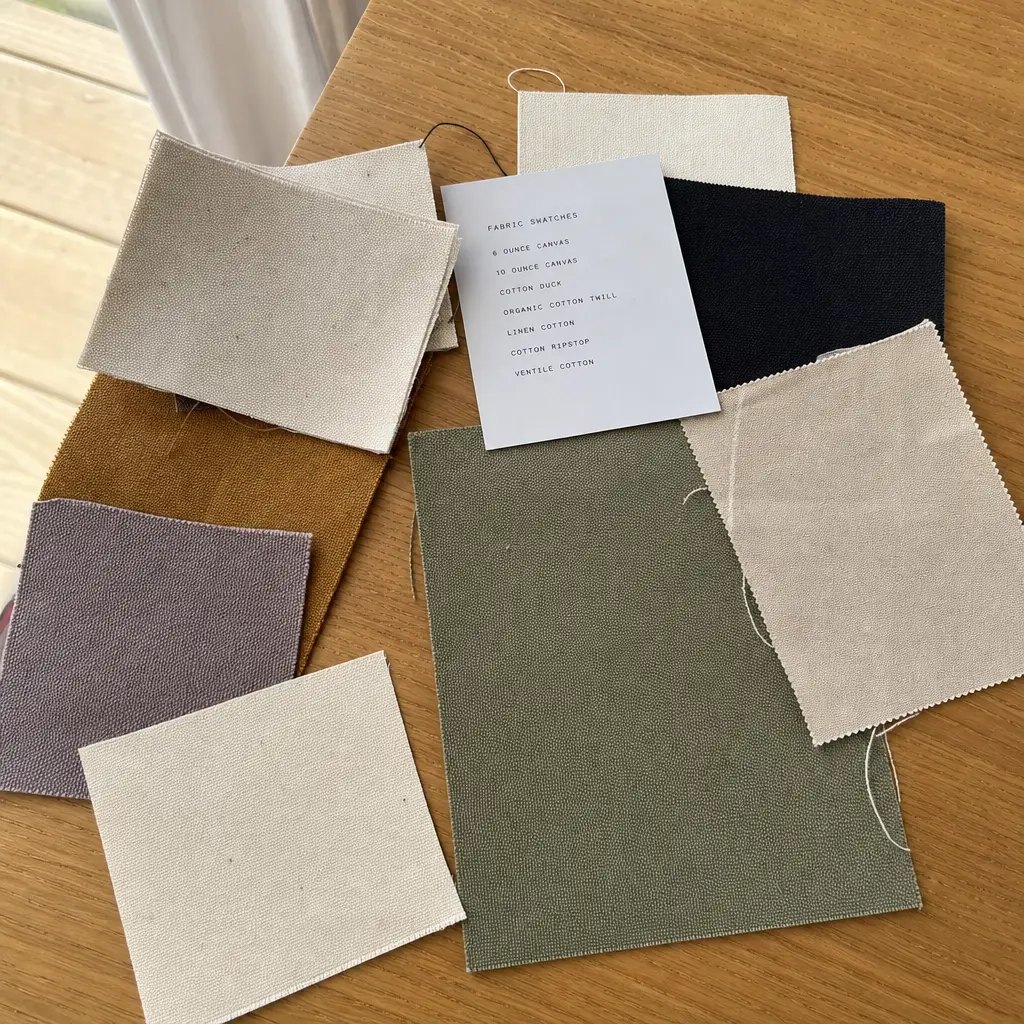
- State outer fabric as both ounce weight and GSM range, and request a physical swatch from the same mill quality planned for production.
- Specify whether the canvas should be natural, dyed, washed, or water-resistant coated, because each option changes print result and lead time.
- Choose lining weight and pocket construction before comparing prices; unlined, thin-lined, and organizer-lined portfolios are not equivalent quotes.
- Require zipper size, zipper tape color, slider material, puller style, and zipper end finishing in the RFQ.
- Send vector artwork with Pantone references, print position, maximum print size, and whether the university mark needs licensing approval.
- Separate sample cost, print screen fee, label setup, bulk unit price, carton packing, and inland freight in the quote format.
- Approve a pre-production sample with actual fabric, actual zipper, actual logo method, actual lining, and final packing where possible.
- Set inspection criteria for fabric defects, zipper function, seam strength, logo placement, color variance, carton labeling, and barcode placement.
- Confirm whether the supplier can support reorder consistency, especially for campus store programs that repeat before orientation or graduation.
Factory quote questions to send
- What exact canvas construction are you quoting: ounce weight, GSM, yarn count if available, weave type, finish, and weight tolerance?
- Is the quoted fabric greige, natural, dyed to order, washed, or coated, and what is the minimum dye lot if we need a custom color?
- Which lining material and GSM are included, and are internal pockets single-stitched, bound, reinforced, or bartacked?
- What zipper brand or quality grade is included, what size is the coil, and what puller material and finish are quoted?
- Which logo method is included in the unit price, and what are the separate screen, embroidery, woven label, embossing, or plate charges?
- What MOQ applies to fabric color, logo artwork, lining color, zipper tape color, and packing style separately?
- How many days are needed for blank sample, printed sample, pre-production sample, bulk fabric preparation, production, inspection, and export packing?
- What carton dimensions, carton weight, pieces per carton, and packing method are assumed in the quote?
- What inspection standard do you use for zipper portfolios, and can you share photos of typical seam, zipper, corner, and logo QC points?
- If the bookstore reorders after the first season, which components can remain consistent and which may need a new approval due to stock changes?
Quality-control points to confirm
- Fabric weight should stay within the agreed tolerance, usually plus or minus 5 percent unless a tighter range is negotiated.
- Canvas shade should match the approved swatch under consistent lighting, with no mixed dye lots inside the same shipment unless labeled and approved.
- Finished size should follow the approved sample with a practical tolerance, commonly plus or minus 5 mm for small portfolios and plus or minus 10 mm for larger items.
- Zipper should open and close smoothly across the full length without skipped teeth, jammed sliders, twisted tape, or weak end stops.
- Logo placement should remain centered or aligned to the approved reference, with position tolerance stated before production.
- Screen print should have no pinholes, heavy bleeding, cracking after basic flexing, or obvious color mismatch against the approved print strike-off.
- Pocket seams, zipper ends, handle tabs if used, and corner folds should be reinforced where stress is concentrated.
- Lining should sit flat without trapped thread, loose panels, exposed raw edges, or puckering around inside pockets.
- Cartons should be strong enough for export handling and marked with SKU, color, quantity, carton number, gross weight, and buyer reference.
- Final inspection should include functional zipper testing, appearance sorting, measurement checks, logo checks, packing verification, and carton drop-risk review.