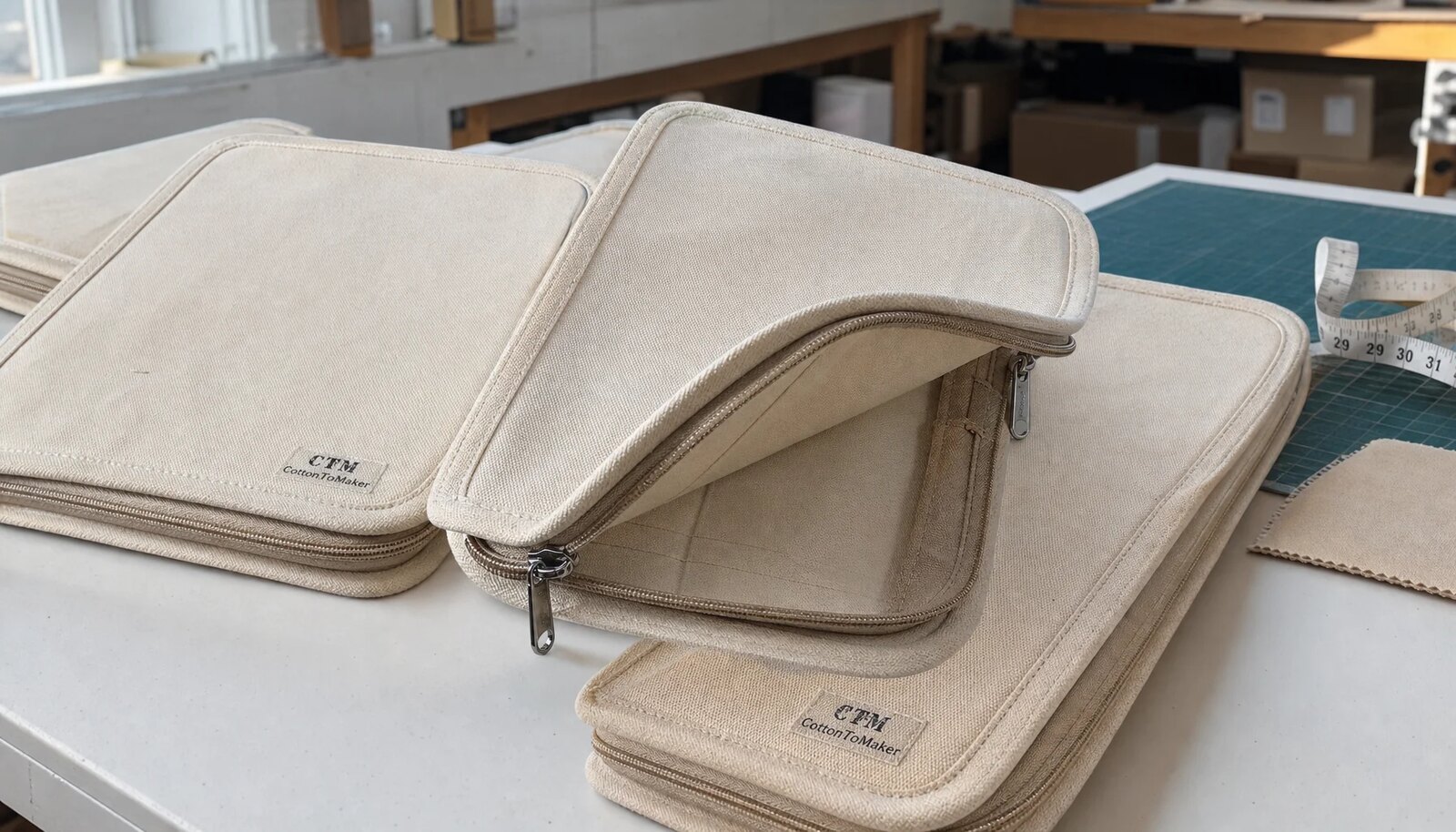
1. Start with the craft-fair job to be done
A custom canvas zipper portfolio for craft fairs is not one product with one correct specification. It may be a flat sleeve for art prints, a document holder for vendor packs, a pouch for workshop tools, a retail SKU at a booth, a branded giveaway, or a reusable carrier for catalogs and price sheets. Those uses create different loads, handling patterns, and inspection priorities.
Craft-fair products are handled in less controlled environments than many warehouse-only promotional items. Cartons may be opened behind a booth, restocked during a busy market day, moved between weekend events, or carried in vehicles with other display supplies. Shoppers also inspect goods at close range. A zipper that catches, a stained natural canvas panel, or a logo that looks visibly off-center can lower perceived value even when the unit price is modest.
The buyer’s first decision should be the insert and handling load, not the catalog name. A slim document portfolio needs flatness, clean branding, and a smooth zipper. An art-print sleeve needs accurate sizing, a clean interior, and packing that prevents bent corners. A workshop kit pouch needs reinforcement at zipper ends, pocket openings, corners, and any gusset seams.
Avoid asking suppliers for a generic canvas zipper portfolio with logo. Make the use case inspectable. List the intended contents, finished dimensions, zipper requirement, decoration method, packing format, and delivery date tied to the fair calendar. When every supplier quotes the same item, the price comparison becomes commercially useful instead of guesswork.
- Booth resale: prioritize front-panel cleanliness, logo alignment, flat stacking, and retail finish.
- Art prints: control insert clearance, smooth zipper opening, clean interior, and corner protection.
- Workshop kits: reinforce zipper ends, pocket openings, gussets, pull points, and tool-load areas.
- Vendor packs: use clear SKU sorting and carton labels for fast event distribution.
- Repeat fairs: confirm fabric, zipper, and logo-color availability before the first purchase order.
2. Convert the idea into an inspectable specification
A strong sourcing file begins with finished dimensions after sewing. Pattern size, approximate size, and “fits A4” language are too loose for procurement control. State finished width, height, gusset depth if any, zipper opening length, internal pocket depth, and minimum clearance around the real insert. If the portfolio must hold letter sheets, A4 handouts, catalogs, menus, 9 x 12 inch prints, 11 x 14 inch prints, matted artwork, or workshop materials, include the insert size and thickness.
Canvas should be described in measurable language. Terms such as premium, sturdy, heavy duty, natural, or eco-style are not QC standards. Specify fiber composition, weight in ounces or GSM, weave, finish, color standard, shrinkage expectation if relevant, and tolerance. Many buyers consider 10 oz to 16 oz cotton canvas for this product family, but the right choice depends on load, brand positioning, sewing complexity, and freight cost.
The zipper also needs a written specification. Confirm coil or molded construction, gauge, tape width, tape color, installed length, slider material, puller style, finish, end-stop method, and reinforcement. For repeatedly handled flat portfolios, a #5 coil zipper is often a practical starting point, while very light giveaways may use smaller options and heavier gusseted pouches may require stronger construction.
Artwork should be controlled with a placement diagram, not only a mockup. Provide vector artwork when possible, list color references, show logo size, and measure placement from fixed points such as top edge, side seam, zipper line, or corner. The PO should also state placement tolerance and require written approval for any material, trim, decoration, or packing substitution.
- Size: body width, height, gusset, zipper opening, pocket depth, and insert clearance.
- Material: composition, weight, weave, finish, color standard, shrinkage note, and tolerance.
- Zipper: type, gauge, tape, slider, puller, finish, end stops, and reinforcement.
- Construction: seam allowance, thread, binding or overlock, lining, pockets, labels, and bar tacks.
- Branding: artwork file, decoration method, logo size, color reference, coordinates, and tolerance.
3. Match material and construction to event handling
Overbuilding every portfolio raises unit cost and freight. Underbuilding creates failed zippers, open seams, visible stains, and last-minute replacement pressure. The practical approach is to match fabric, zipper, and reinforcement to how the portfolio will be used at the craft fair.
For light paper inserts, flatness and smooth zipper travel may matter more than maximum fabric weight. For art prints, the inside surface and packing pressure matter because scuffed or bent corners are visible immediately. For workshop kits, stress concentrates where the user pulls, stuffs, or repeatedly opens the pouch. A reinforcement patch or bar tack at the correct point is often more valuable than simply increasing canvas weight.
Interior finish affects perceived quality because craft-fair customers often unzip the item before buying. Raw seams, thread nests, glue marks, chalk marks, odor, rough zipper tape, or loose pocket stitching can make the item feel unfinished. Decide whether seams are overlocked, bound, or covered by lining, and make that detail part of the approved sample.
For repeat orders, ask the supplier to prepare a trim card. It should include canvas, zipper tape, slider, puller, thread, label, lining if any, binding, patch material, print reference, and packing material. The trim card prevents quiet substitutions and gives inspectors a clear reference when bulk production starts.
- Light documents: specify clean panels, smooth zipper travel, controlled creasing, and simple seams.
- Art prints: inspect finished size, clean interior, corner protection, and packing pressure.
- Tool kits: reinforce zipper ends, pocket openings, gussets, corners, and pull points.
- Retail SKUs: inspect interior and exterior because shoppers handle the product closely.
- Repeat programs: approve a trim card and require written approval for all substitutions.
4. Select the supplier route by control need
The best supplier is not always the lowest unit price. It is the supplier route that matches the buyer’s need for construction control, document support, packing complexity, and delivery certainty. A direct sewing factory can be efficient when the buyer has a clear tech pack and wants quick technical feedback on cutting, zipper installation, reinforcement, and line production. Confirm early whether the factory can also support export documents, carton marks, barcodes, and destination-specific labels.
A trading company or sourcing agent can be useful when the order includes mixed craft-fair items, hangtags, insert cards, kitting, small split quantities, or consolidated shipping. The risk is limited transparency. Ask which factory will sew the goods, who approves materials, who owns the signed sample, who performs in-line checks, and who pays for sorting or rework if inspection fails.
Specialized bag workshops often understand zipper portfolios better than general promotional suppliers. They may be stronger on pocket construction, gussets, binding, and stress-point reinforcement. Their limitation is often capacity, especially before holiday fairs, school fundraising events, and year-end merchandise programs. If the event date is fixed, ask for line-space confirmation before paying a deposit.
Retail-ready suppliers may quote higher prices, but they can reduce labor after arrival. They may handle SKU separation, individual polybags, barcodes, hangtags, insert cards, carton labels, and receiving instructions. Compare their quote against the total landed and handling cost, not only the FOB unit price.
- Identify whether the supplier is the factory, trader, decorator of blanks, or final assembler.
- Request production photos covering fabric rolls, zipper stock, first pieces, sewing line, and packed cartons.
- Test communication during sampling; vague answers usually become larger production delays.
- Check export, labeling, carton-marking, and compliance-document ability before deposit.
- Compare prices only when construction, packing, Incoterm, and inspection scope are the same.
5. Build a quote matrix that exposes downgrades
A useful quotation should describe the exact product behind the price. Require finished size, canvas composition and weight, zipper specification, construction details, logo method, packing, MOQ, sample charge, lead time, Incoterm, payment terms, and quote validity. If an offer says only standard canvas or normal zipper, it is not ready for purchasing approval.
Most price gaps come from fabric, zipper, decoration, packing, and service scope. A lighter canvas can photograph well but feel weak in hand. A cheaper zipper may work on one sample and fail more often in bulk. A low-cost print may not cover textured canvas cleanly. A quote excluding polybags, barcode labels, carton marks, insert boards, SKU sorting, or inspection support may shift cost into the buyer’s warehouse or event team.
Ask for consistent quantity breaks such as 500, 1,000, 3,000, and 5,000 pieces. Separate setup costs for screen printing, heat transfers, woven labels, patches, custom zipper pulls, hangtags, insert cards, and special cartons. If stock materials reduce MOQ or lead time, list them as alternate options rather than mixing them into the main comparison.
Freight assumptions should be visible before supplier selection. EXW, FOB, CIF, DDP, and domestic delivery are not equal. Request carton dimensions, units per carton, gross weight, net weight, and estimated CBM with the quote. Flat packing may protect appearance but increase volume; folding may reduce freight cost but create hard creases that are difficult to remove before a fair.
- Use one written specification and the same quantity breaks for every supplier quote.
- Separate setup, sample, label, patch, custom-puller, hangtag, insert-card, and carton charges.
- Ask whether pricing depends on stock trims, seasonal capacity, exchange rate, or artwork complexity.
- Compare landed cost when freight, relabeling, repacking, inspection, and event labor are material.
- Require written approval for any change to fabric, zipper, decoration, label, or packing.
6. Choose decoration that works on canvas
Decoration is not only a branding choice. Canvas texture, fiber, coating, and color influence ink coverage, edge definition, rubbing, and color accuracy. A digital proof can look perfect while the actual print loses sharpness on woven fabric. Approve decoration on the same canvas color and finish planned for bulk production.
Screen printing is often efficient for simple one-to-three-color logos and repeat programs. It can provide strong coverage on flat panels, but buyers should approve a strike-off rather than relying on a PDF. Check color match, registration, coverage over the canvas texture, bleeding, pinholes, smudges, scuffing, and cracking when the panel flexes.
Heat transfer can work for colorful artwork, gradients, and shorter runs. Inspection should focus on edge lift, bubbles, wrinkles, peeling, scorch marks, cracking, surface feel, and rubbing during packing. If decorated faces touch zipper pulls or other portfolios inside a carton, ask how scuffing will be prevented.
Woven labels, cotton labels, patches, and leather-look patches can create a retail-ready look and avoid heavy ink buildup on textured canvas. They require separate trim approval and sewing control. Embroidery can work for selected designs, but dense stitching may distort a flat panel unless backing, stitch density, and placement are controlled.
- Screen print: strong for simple logos, repeat orders, and efficient branding on flat panels.
- Heat transfer: useful for complex color artwork; inspect edge lift, cracking, rubbing, and feel.
- Woven label or patch: good for retail presentation; control trim MOQ, placement, and stitching.
- Embroidery: use carefully on flat portfolios; control backing, density, and panel distortion.
- Approval rule: review the logo on production canvas, not a digital proof or substitute swatch.
7. Make sampling prove fit, function, and packing
A sample should prove more than appearance. It should confirm fit, zipper function, materials, decoration, labels, packing, and repeatability. Many bulk problems start when a buyer approves a neat sample made from available trims while production uses different canvas, zipper, thread, label, or packing material.
Test the sample with the actual contents. Insert the art prints, catalogs, workshop cards, menus, tool packs, vendor documents, or retail cards. Measure the body, zipper opening, gusset, pocket depth, and logo placement. Open and close the zipper repeatedly, especially around corners and end stops. A slider that catches during sampling will not improve in bulk.
Inspect the inside as closely as the outside. Look for raw edges, skipped stitches, loose threads, thread nests, glue residue, chalk marks, rough zipper tape, weak pocket openings, odor, and uneven lining. For a retail SKU or workshop kit, approve the packed sample too because packing can create creases, pressure marks, print scuffing, or barcode-visibility problems.
When remote approval is necessary, ask for practical evidence: ruler photos, stitching close-ups, zipper-operation video, trim-card photos, logo close-ups, interior photos, and packed-condition photos. Keep one signed sample with the buyer or QC team and one with the supplier. Request first-piece production photos before the line completes too many units.
- Label each sample with supplier, date, revision number, material spec, zipper spec, decoration method, and packing status.
- Use numbered revision comments instead of vague feedback such as make it better.
- Approve packed condition for retail, kitted, individually shipped, or stored event goods.
- Do not approve bulk if the supplier cannot identify the final approved sample version.
- Keep the approved sample, trim card, artwork proof, and tech pack together for inspection.
8. Write QC tolerances before cutting
Quality control should cover material verification, finished dimensions, zipper function, stitching, reinforcement, decoration, cleanliness, packing, labeling, and carton count. Phrases such as good quality or same as sample are not enough unless they are supported by measurable acceptance rules.
For dimensions, inspect finished goods laid flat without stretching. Check body width, height, zipper opening, gusset depth, pocket depth, and insert clearance. A flat portfolio may be controlled to about ±3 mm to ±5 mm depending on construction, while heavier gusseted versions may need a wider tolerance. If the item no longer fits the intended insert, treat the defect as major even if the measurement miss looks small.
Zipper testing should be performed across sampled units. Open and close each inspected zipper several times through the full path. Look for rough travel, teeth separation, slider misalignment, trapped tape, weak end stops, loose pullers, uneven tape exposure, and seam allowance catching. Zipper ends are common stress points and should match the approved reinforcement method.
Classify decoration and cleanliness defects before printing starts. Wrong artwork, wrong logo color, logo outside tolerance, peeling transfer, upside-down label, artwork cut into a seam, severe front-face stain, mildew odor, or wrong size should be major. Small internal thread variations may be minor if they do not affect appearance, fit, or function.
- Critical defects: sharp unsafe hardware, mold, severe contamination, or construction preventing normal use.
- Major defects: broken zipper, open seam, wrong material, wrong artwork, wrong fit, missing label, severe stain, or wrong packing.
- Minor defects: small loose thread, slight internal seam irregularity, tiny non-display mark, or stitch variation within limits.
- Functional checks: zipper full travel, puller security, seam stress, pocket usability, gusset shape, and flatness.
- Packing checks: unit count, inner pack, carton label, SKU separation, barcode visibility, moisture protection, and carton condition.
9. Control packing, labeling, and compliance claims
Packing affects both landed cost and craft-fair readiness. A bulk pack may be acceptable for a low-cost giveaway. Retail resale, workshop kits, museum shops, school programs, and branded merchandise orders usually need individual packing that keeps canvas clean and protects the decorated face. Ask for carton dimensions, units per carton, net weight, gross weight, estimated CBM, packing direction, and whether goods are flat, folded, stacked, or nested.
Event teams often handle cartons differently from retail warehouses. Boxes may be carried through parking lots, opened behind booths, moved between markets, or divided among multiple vendors. Set a practical carton gross-weight limit and use inner packs by SKU, color, artwork version, or destination. This prevents on-site sorting when staff should be setting up displays.
Compliance requirements depend on destination, sales channel, and product claims. Confirm country-of-origin marking, buyer-specific label rules, barcode requirements, warning labels if applicable, and any retailer packaging instructions before production packing starts. For the United States, discuss whether CPSIA could apply if the portfolio is marketed for children, and whether Prop 65 review is relevant for California distribution. For other destinations, ask the importer or compliance advisor which textile, packaging, and labeling rules apply.
Restricted-substance testing should be defined before production if required. State the standard, lab, sample-selection method, timing, and cost responsibility. If the supplier mentions recycled cotton, organic cotton, recycled PET, low-impact dyeing, or other sustainability attributes, request evidence tied to the actual ordered material before using the claim on hangtags, booth signage, product pages, or sales sheets. Do not rely on generic certificates that do not connect to the order.
- Approve carton marks before packing: PO, style, color, quantity, carton number, gross weight, and origin where required.
- Use inner packs for mixed SKUs so teams can replenish booths quickly.
- Confirm moisture protection for light canvas, humid storage, or long ocean transit.
- Ask for order-specific proof before using recycled, organic, or sustainability claims.
- Keep compliance requests realistic: material declarations, test reports when needed, origin support, packing list, inspection report, and shipment records.
10. Keep traceability simple but real
Traceability does not need to be complex for every craft-fair order, but it must be practical. The supplier should be able to connect the PO to fabric purchases, zipper lots, decoration records, production dates, inspection results, and carton numbers. This matters when a retailer asks for documentation, when a reorder must match the first batch, or when a defect appears close to an event date.
A retained sample, approved trim card, production photos, carton numbering, packing list, and inspection report are often enough for a straightforward zipper portfolio order. For retail or regulated channels, add the material composition declaration, test reports where required, country-of-origin support, and claim evidence. Store these documents with the purchase order so the buyer is not rebuilding the file after goods ship.
The most important rule is no undocumented substitution. Canvas weight, shade, zipper gauge, slider finish, thread, label, print method, polybag, carton, and packing layout should not change without written buyer approval. If a supplier needs to use stock fabric, alternate zipper tape, or a different packing method to meet the event date, the change should be priced, sampled if necessary, and documented before production continues.
A concise compliance file protects both the buyer and the supplier. It clarifies what was ordered, what was approved, what was inspected, and what was shipped. For custom canvas zipper portfolios supplier compliance checklist for craft fairs, that discipline is what turns a simple event product into a repeatable procurement program.
- Connect the PO to fabric records, zipper records, decoration approval, production dates, inspection results, and carton numbers.
- Keep signed samples, trim cards, inspection reports, packing lists, shipping records, and supplier documents in one file.
- Document any approved deviation with date, reason, revised cost, revised lead time, and buyer signoff.
- Use first-piece photos before full production and final open-carton photos before shipment.
- Treat undocumented material, label, decoration, or packing changes as a major supplier-control issue.
Specification comparison for buyers
| Supplier option | What to verify | Commercial advantage | Buyer risk to control |
|---|---|---|---|
| Direct sewing factory | zipper source record, production-line zipper test photos, approved trim card, cutting marker photos, and final open-carton count | Better sample-to-bulk control and faster production feedback | May be weaker on export paperwork or branded packing unless checked early |
| Trading company | Factory name, production photos, trim-source proof, and who owns QC decisions | Can coordinate small mixed orders and extra services | Markup can hide real factory capability and slow defect decisions |
| Specialized bag workshop | zipper gauge, zipper tape width, puller finish, binding tape, corner reinforcement, seam allowance, and document-size tolerance | More practical for detailed construction, trims, and repeat programs | Capacity may be limited during peak seasons |
| Low-price general supplier | 300D-600D polyester, 10-12 oz canvas, or recycled PET with backing stiffness matched to document weight | Useful for simple promotional runs with loose specs | Material downgrades, weak packing, and vague inspection scope can erase savings |
| Retail-ready supplier | flat packing, insert board if needed, SKU bundles, carton weight limit, moisture protection, and barcode visibility | Can handle labels, SKU separation, carton marks, and receiving rules | Higher unit cost must be compared against reduced warehouse work |
| Compliance-focused supplier | Fabric records, labeling review, test plan, and production traceability | Safer for retail programs and repeat brand orders | Documentation claims need evidence, not only sales language |
| Local sample room plus bulk factory | Signed sample, bulk factory handoff, first-piece photos, and deviation owner | Good for complex branding before large production | Sample room quality may not match bulk line unless handoff is controlled |
Buyer checklist before sampling
- Define the craft-fair use case: art-print sleeve, workshop kit pouch, vendor welcome pack, document holder, booth retail SKU, menu carrier, catalog sleeve, or promotional giveaway.
- Specify finished dimensions after sewing: width, height, gusset depth, zipper opening length, pocket depth, and minimum clearance for A4, letter, 9 x 12 inch, 11 x 14 inch, catalog, art-pad, or kit inserts.
- Quote canvas in measurable terms: fiber composition, 10 oz, 12 oz, 14 oz, 16 oz, or GSM equivalent, weave, finish, color standard, and fabric-weight tolerance such as ±5% when appropriate.
- Define the zipper: coil or molded, gauge, tape width, tape color, installed length, slider material, puller style, finish, end-stop method, and reinforcement at both zipper ends.
- Lock construction details: seam allowance, stitch density target if needed, thread color and fiber, overlock or binding, lining, divider, internal pocket shape, label placement, bar-tack positions, and corner reinforcement.
- Provide vector artwork and a placement diagram with logo size, decoration method, color reference, distance from fixed edges, clearance from zipper and seams, and placement tolerance such as ±3 mm to ±5 mm.
- Request a pre-production sample using production canvas, zipper, thread, decoration, label, and packing. Mark any substitute-material sample as visual only.
- Compare quotes at the same quantity, Incoterm, packing method, decoration method, compliance requirement, and inspection scope. Ask for quantity breaks at 500, 1,000, 3,000, and 5,000 pieces if relevant.
- Confirm packing before the PO: units per carton, inner-pack plan, carton dimensions, net weight, gross weight, estimated CBM, maximum carton weight, moisture protection, barcode position, and carton-label format.
- Write acceptance rules before cutting: fabric tolerance, size tolerance, zipper function, stitching defects, logo placement, stains, shade variation, label accuracy, carton count, and substitution approval rules.
Factory quote questions to send
- What exact canvas is included: fiber composition, ounce weight or GSM, weave, finish, color method, shrinkage expectation, and fabric-weight tolerance? Can you provide a bulk-source swatch?
- Is the canvas weight measured before washing, after finishing, or from finished goods? If the PO states 12 oz canvas, what GSM range will your QC accept and how will it be checked?
- Which zipper is quoted: coil or molded, gauge, tape width, tape color, installed length, slider material, puller shape, slider finish, end-stop method, and zipper-end reinforcement?
- What construction is included in the price: lining, binding, overlock, internal pocket, divider, gusset, bar tack, reinforcement patch, woven label, care label, origin label, hangtag, and individual polybag?
- What is the MOQ by style, canvas color, artwork version, label version, and packing version? Please quote 500, 1,000, 3,000, and 5,000 pieces with setup charges listed separately.
- Will the pre-production sample use the same fabric lot, zipper, thread, decoration method, label, and packing planned for bulk? If not, which items are substitutes and when will final materials be approved?
- What are the sample cost, sample lead time, revision cost, courier cost, and sample approval cutoff date needed to meet the craft-fair delivery window? Is any sample fee deductible from the bulk order?
- Which branding method is included: screen print, heat transfer, embroidery, woven label, patch, debossed label, or custom zipper pull? What are the setup fees, color limits, artwork requirements, and placement tolerance?
- What are the carton dimensions, units per carton, net weight, gross weight, estimated CBM, inner-pack arrangement, carton strength if known, and maximum carton weight? Are goods packed flat, folded, stacked, or nested?
- Which compliance documents can you provide for this order: material composition declaration, country-of-origin support, restricted-substance test report if required, recycled or organic claim evidence, packing list, inspection report, and shipment records?
Quality-control points to confirm
- Canvas weight should be checked against the PO using the agreed measurement basis. A practical tolerance is often ±5% on quoted GSM or ounce weight, but the exact range must be written because finishing and moisture content can affect readings.
- Finished dimensions should be measured on finished goods laid flat without stretching. Check width, height, zipper opening, pocket depth, gusset depth if any, and insert clearance for the intended document, print, catalog, or kit contents.
- Zipper function must be tested across sampled units, not only on the approved sample. Open and close the zipper several times through the full path, checking rough travel, slider misalignment, trapped tape, weak end stops, loose pullers, and teeth separation.
- Zipper installation should be straight and balanced. Inspect zipper tape exposure, stitching distance from teeth, seam allowance catching, reinforcement at start and end points, and whether the mouth opens enough for the intended insert.
- Stitching should show secure thread tension with no skipped stitches, broken stitches, open seams, needle cuts, excessive puckering, thread nests, front-face backtracking errors, or untrimmed thread tails beyond the agreed limit.
- Stress points should match the approved sample and tech pack. Check corners, zipper ends, pocket openings, pull tabs, gusset seams, handle tabs if any, and all bar-tack or box-stitch locations.
- Logo placement should be measured from fixed points such as top edge, side edge, zipper line, or seam. Reject artwork cut into seams, distorted by stitching, hidden by folds, upside down, or outside the written tolerance.
- Screen print quality should be checked for color match, registration, ink coverage on canvas texture, bleeding, pinholes, cracking, scuffing, smudges, and contamination. Heat transfers should be checked for edge lift, bubbles, wrinkles, peeling, scorch marks, and cracking.
- Color and shade should be compared against the approved swatch, lab dip, or signed sample under daylight-equivalent and typical indoor lighting. Record whether variation appears within a carton, between cartons, or between production batches.
- Cleanliness standards should be strict for visible canvas faces. Reject major oil marks, dirt, mildew odor, chalk marks that do not brush off, glue residue, ink transfer, rust marks near zipper hardware, and stains on primary retail surfaces.