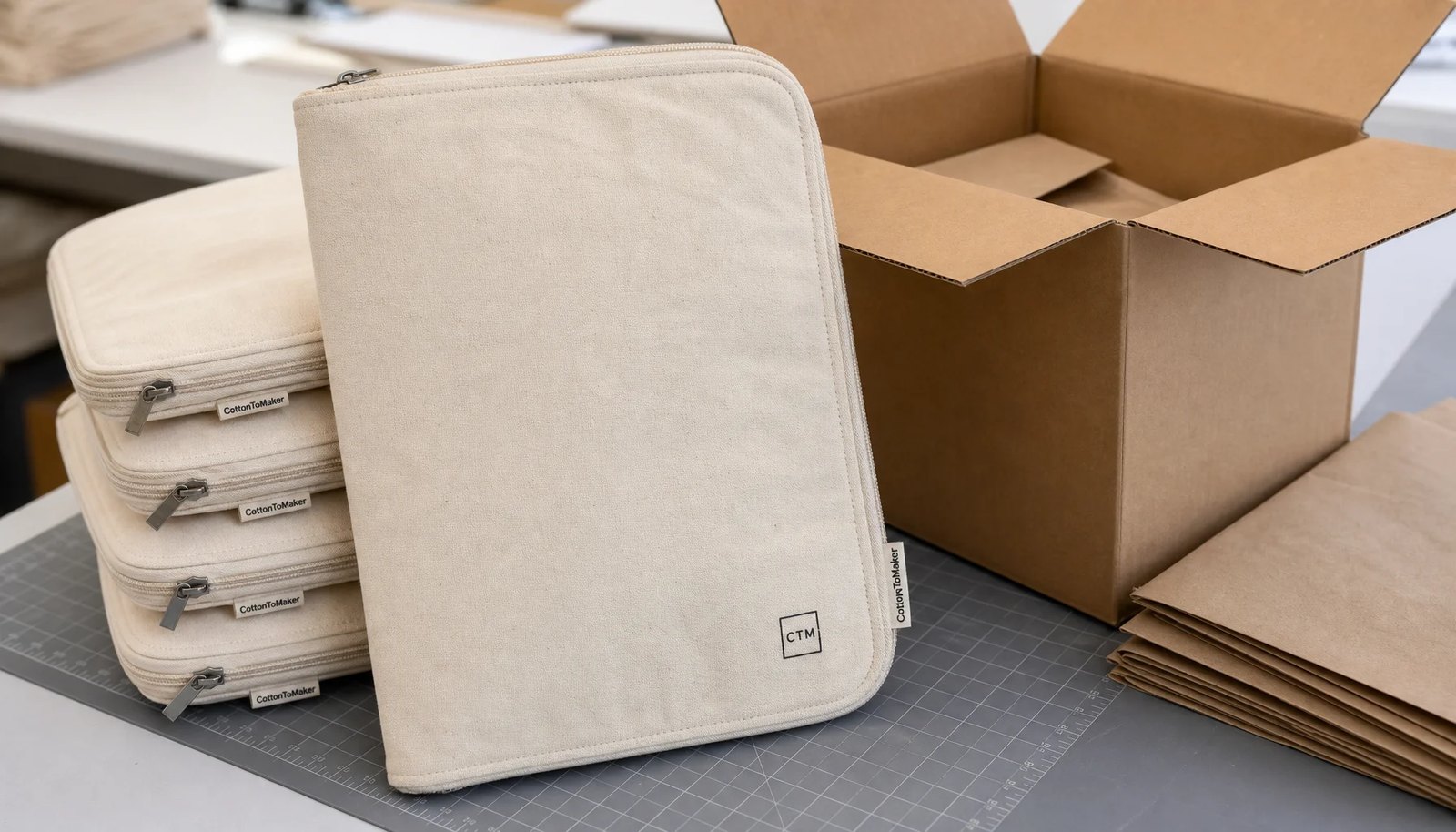
Why carton planning belongs in the portfolio RFQ
For custom canvas zipper portfolios, carton planning is not a warehouse detail to finish after the bag is produced. The portfolio is a flat product, but fabric weight, zipper bulk, padding, stiffener use, individual sleeves, and stack height all change the final carton size. University bookstore programs often involve multiple campus logos, department allocations, retail barcodes, and tight receiving windows before orientation or semester opening. If carton information is missing from the RFQ, every supplier may quote a different packing method, making unit price comparisons misleading.
A low bag price can disappear when the carton is too large for the piece count, too heavy for manual handling, or too weak for LCL movement. Procurement teams should treat carton planning as part of the product specification. The useful target is not only cost per portfolio, but cost per sellable, clean, easy-to-receive portfolio landed at the bookstore or distributor warehouse.
- Request pieces per carton, carton dimensions, net weight, gross weight, and CBM with the first formal quote.
- State whether cartons ship to one importer warehouse, multiple campus stores, or a distributor doing break-bulk allocation.
- Set maximum carton weight before suppliers calculate packing, not after the first production run is finished.
- Require carton marks and SKU labels that match the buyer receiving file, especially for multi-campus or multi-logo orders.
Start with usable size, not only outside dimensions
Many RFQs describe a canvas zipper portfolio as 13 x 10 inches or A4 size without explaining what must fit inside. That creates trouble because zipper seam allowance, fabric thickness, and corner curve reduce the usable internal space. A portfolio designed for letter documents may not fit a tablet in a protective sleeve. A portfolio that fits a course packet may become bulky in carton stacks and reduce pieces per carton.
The better approach is to define the item the portfolio must hold, then give both outside and usable inside dimensions. For example, a bookstore orientation portfolio may need to hold letter documents, a campus map, a pen insert, and a thin brochure pack. A merchandising portfolio may only need to hold a notebook and receipt documents. These two uses can look similar in photos but require different seam allowance, zipper opening length, and carton height.
- For letter paper, allow enough internal width and height so documents do not curl at the zipper seam.
- For A4 markets, do not reuse a U.S. letter pattern without checking the vertical allowance.
- For tablet use, provide the tablet model or maximum device size including any sleeve or case.
- For retail shelf display, define whether the portfolio must stand, hang, or stack flat in a bin.
Choose canvas weight with carton weight in mind
Canvas weight affects perceived value, sewing stability, print result, and freight. For zipper business bags in bookstore programs, 10 oz to 12 oz canvas is common when the goal is a practical retail item with a clean print surface. In GSM terms, buyers usually see roughly 320 to 420 GSM depending on yarn, weave, and finishing. An 8 oz fabric may reduce cost and carton weight, but it can feel limp and show wrinkles after compression. A 16 oz fabric can feel premium, but it increases sewing difficulty, zipper edge bulk, and gross carton weight.
The RFQ should not say only cotton canvas because suppliers may quote different weights. A quote based on 8 oz canvas and another based on 12 oz canvas are not equivalent, even if the finished size looks the same. If color matching matters, dyed canvas should be discussed together with shrinkage and crocking risk. Natural canvas can vary from batch to batch, so buyers should approve a physical swatch or reference range instead of relying only on a screen image.
- Use 10 oz canvas when budget and lighter freight are more important than a rigid hand feel.
- Use 12 oz canvas when the portfolio needs better structure for bookstore retail presentation.
- Use 14 oz or heavier only after testing zipper sewing, corner bulk, and carton gross weight.
- Record both oz and GSM in the purchase order to avoid substitutions during fabric sourcing.
Match the print method to campus artwork and handling
University bookstore artwork often includes a school name, crest, department mark, mascot, or campaign slogan. For solid color logos on canvas, screen printing is usually the most stable choice. It gives good opacity, predictable setup cost, and reasonable durability on flat panels. The print should be placed away from zipper seams and hard fold lines because thick ink can crack if the panel bends sharply during packing or use.
Heat transfer or digital transfer may be useful for full-color artwork, gradients, or small batch logo versions, but it needs more approval discipline. Transfers can look sharp on a sample and still fail later if adhesion, edge lifting, or heat press marks are not controlled. Embroidery is possible, but it adds thread cost, may pucker canvas, and can create pressure marks when portfolios are stacked tightly in cartons. The print method should be tied to the packing plan because fresh ink, raised transfers, and embroidered areas all need protection during stacking.
- For one to three solid colors, quote screen print with Pantone references and print size.
- For full-color marks, request transfer testing for adhesion, rub, and edge lifting before bulk approval.
- For embroidery, review backing, stitch count, puckering, and stack pressure marks in the packed sample.
- Set placement tolerance, commonly within a few millimeters, and approve it on the pre-production sample.
Build MOQ logic around real production constraints
MOQ for custom canvas zipper portfolios is not driven by sewing alone. The real minimum often comes from fabric purchasing, dye lot, zipper tape color, print setup, cutting efficiency, label production, and carton mark changes. A buyer may want 300 pieces each for six campus departments, but the factory sees six artworks, six screens or transfer setups, six label versions, and possibly six carton mark versions. That can be more expensive and slower than one 1,800-piece run.
Procurement teams can reduce cost by separating fixed and variable customization. One common structure is to keep the same fabric, zipper, size, and inner packing across all versions, then change only the front print and barcode label. Another option is a shared master carton with inner SKU bundles, but this must be planned carefully so receiving teams can count and allocate without opening every carton. The RFQ should state whether the buyer wants the lowest unit price, the cleanest retail allocation, or the fastest replenishment path.
- Ask for MOQ per total order and MOQ per logo version because they are different numbers.
- Keep fabric color and zipper color common across departments when possible to reduce setup complexity.
- Limit carton mark versions unless the warehouse truly needs separate receiving by department or store.
- Request price breaks at realistic quantities, such as 500, 1,000, 2,500, and 5,000 pieces per design.
Define carton quantity by weight, volume, and handling
Flat canvas portfolios can tempt suppliers to pack too many pieces in one carton. The carton may look efficient on paper, but a 25 kg carton is not friendly for campus receiving, parcel movement, or manual repacking. Heavy cartons also compress the lower portfolios, which can create zipper imprinting, fabric creases, and corner distortion. For most bookstore and distributor handling, a gross weight target around 12 to 18 kg is easier to manage, though the exact limit depends on the buyer warehouse and carrier rules.
Carton volume matters as much as weight. If the portfolio is lightly padded, uses a thick zipper, or includes paper sleeves, the stack height increases quickly. Empty headspace is also a problem because cartons can crush during LCL or domestic trucking. The best carton plan balances piece count, stack stability, protection, and freight calculation. Buyers should compare quotes using carton CBM, not only unit price, because the same portfolio can have different landed cost depending on packing density.
- Set a maximum gross carton weight in the RFQ so all suppliers quote against the same handling target.
- Request a carton loading calculation showing pieces per layer and layers per carton.
- Avoid overfilled cartons that bulge at the top or sides because they fail more easily in transit.
- Avoid underfilled cartons unless void fill or internal support is specified and costed.
Plan inner packing for retail receiving and damage prevention
Inner packing should match how the bookstore receives and sells the product. If portfolios are sold as individual retail items, one unit per recyclable polybag, paper sleeve, or kraft band can protect the print and keep the item clean. If the bookstore removes all packaging before display, a simpler sleeve may be enough. If the portfolio goes into course kits or welcome packs, barcode position and bundle count may matter more than retail presentation.
Loose bulk packing may reduce material cost, but it often creates hidden costs. Zipper pullers can rub the print on the next unit, natural canvas can pick up carton dust, and counting disputes become harder to resolve. For printed portfolios, the packing sample should show the direction of each unit, whether print faces print or back faces print, and where the zipper puller sits. Small details in packing direction can prevent a large number of cosmetic defects.
- Use individual sleeves when canvas is light colored, print is large, or retail cleanliness is important.
- Use tissue or paper separators when raised print, embroidery, or metal pullers could mark adjacent units.
- Position zipper pullers consistently so they do not press into the printed face during carton compression.
- Specify barcode, SKU label, or hangtag placement before mass packing begins.
Approve samples with the carton plan included
A beautiful loose sample does not prove the bulk shipment will arrive clean. Sample approval should include the portfolio itself and the packing method. For a serious order, the buyer should review fabric swatch, print strike-off, pre-production sample, and at least a packing photo or mini carton trial. The sample should be measured after sewing and pressing, not only after cutting, because canvas can shrink or distort at seams.
The pre-production sample should represent the approved construction: fabric weight, zipper type, print method, label, stitch color, inner packing, and carton orientation. If the sample uses a substitute zipper or a different fabric weight, the approval should be marked as conditional. A common mistake is approving artwork on one fabric and producing bulk on another. Print color, ink absorption, and edge sharpness can change when the canvas weave or finish changes.
- Measure outside size, usable inside size, zipper opening length, and corner shape on the approved sample.
- Rub the print with a dry white cloth and review any transfer, smearing, or surface cracking.
- Open and close the zipper repeatedly to find catching at seam allowance or weak corner stitching.
- Review a packed stack sample to see whether pullers, labels, or embroidery create pressure marks.
Use quote data that supports landed-cost comparison
A useful factory quote for custom canvas zipper portfolios should separate product specification, packing specification, and commercial terms. The buyer needs enough detail to compare suppliers on the same basis. If Supplier A includes individual sleeves and export cartons while Supplier B quotes loose bulk packing, the lower unit price is not a real saving. The same applies to print setup, sample charges, barcode labels, and carton marks.
For landed-cost planning, the most important packing data are carton dimensions, pieces per carton, gross weight, net weight, and total CBM. These numbers affect ocean freight, air freight, courier cost, warehouse receiving, and domestic distribution. Buyers should also request Incoterms, estimated production lead time, sample lead time, payment terms, and quantity tolerance. A quote that omits carton data should be treated as incomplete for import costing.
- Compare unit price together with CBM per 1,000 pieces and gross weight per 1,000 pieces.
- Record whether the quote includes screen charges, print setup, sampling, barcode labels, and inner packing.
- Request separate costs for optional upgrades such as heavier canvas, metal zipper, paper sleeve, or reinforced carton.
- Keep one quote comparison sheet so changes in fabric, print, or carton quantity are visible to all stakeholders.
Protect the semester schedule with realistic lead-time buffers
University bookstore orders often have fixed deadlines tied to orientation, admissions events, alumni weekends, or semester opening. A zipper portfolio may look simple, but the schedule includes fabric sourcing, cutting, printing, drying or curing, sewing, trimming, packing, inspection, export booking, and transit. If the artwork is late or the sample is revised twice, the production window can become tight very quickly.
The lead time in a quote should state what approval event starts the clock. Some factories count from deposit, while others count from final artwork approval or pre-production sample approval. For printed canvas portfolios, production should not start until fabric, print color, zipper, and packing are approved. The buyer should also reserve time for final inspection and possible rework, especially when cartons are marked by store or department and cannot be easily rearranged after packing.
- Allow separate time for artwork proof, print strike-off, pre-production sample, and bulk production.
- Avoid changing carton marks or barcode files after packing materials are printed.
- Book final inspection before the cargo-ready date, not on the same day the forwarder wants pickup.
- For event-driven bookstore programs, build a fallback plan for partial shipment or priority SKUs if timing becomes tight.
Specification comparison for buyers
| Spec decision | Recommended option | When it fits | Buyer risk to check |
|---|---|---|---|
| Canvas body fabric | 12 oz canvas, roughly 380 to 420 GSM, pre-shrunk if tight dimensions matter | Good balance for university bookstore portfolios that need structure without making cartons too heavy | Light 8 oz fabric can collapse in display bins; heavy 16 oz fabric may increase carton weight and zipper stress |
| Portfolio size | A4 or letter document size plus 15 to 25 mm working allowance on each side | Fits course packets, admissions papers, tablets, or orientation materials without forcing the zipper curve | Oversized specs reduce carton count per CBM; undersized specs cause zipper tension and higher returns |
| Zipper construction | No. 5 nylon coil zipper with fabric tape matching the bag or contrast school color | Works for flat canvas portfolios shipped in stacks and opened repeatedly at retail counters | Metal zippers add weight and can mark adjacent pieces unless each unit has protection |
| Print method | Screen print for solid university marks; heat transfer only for full-color artwork with controlled testing | Screen print gives stable cost and good opacity on natural or dyed canvas for bookstore replenishment runs | Thick ink can crack at fold points; full-color transfer needs wash, rub, and adhesion review before bulk |
| Inner packing | One portfolio per recyclable polybag or paper sleeve, with zipper closed and puller positioned consistently | Suitable for retail receiving, SKU labeling, and protection from carton dust during ocean shipment | Loose bulk packing saves material but increases abrasion, zipper puller marks, and counting disputes |
| Carton style | 5-ply export carton with flat stack packing, moisture-resistant tape, and clear carton marks | Best for importers using LCL, mixed containers, or domestic redistribution to campus stores | Weak cartons bow under stacked weight; unclear marks slow warehouse receiving and allocation |
| Carton quantity | Pack by target carton weight first, usually 12 to 18 kg gross, then optimize pieces per carton | Keeps manual handling practical and reduces carton breakage during bookstore or distributor receiving | Packing only by piece count can create cartons that are cheap to quote but costly to handle |
| Master carton dimensions | Keep one dimension under common parcel or warehouse handling limits and avoid excessive empty headspace | Helps buyers compare air, courier, LCL, and FCL freight using realistic carton CBM | Cartons that are too large may be billed by volume and arrive crushed at the corners |
| MOQ logic | Base MOQ on fabric dye lot, zipper color, print setup, and carton mark variation, not only total units | Useful when several campus departments share one portfolio style with different logos or labels | Splitting many small logo versions can multiply screens, samples, carton labels, and inspection work |
Buyer checklist before sampling
- Define the usable inner size, not only the outside portfolio size, and state the document or tablet it must hold.
- Specify fabric weight in oz and approximate GSM so suppliers do not quote different canvas qualities under the same product name.
- Confirm whether the portfolio ships flat, lightly padded, or with a stiffener because this changes carton height and CBM.
- Set a maximum gross carton weight, normally 12 to 18 kg for manual handling, before approving pieces per carton.
- Require carton dimensions, gross weight, net weight, and pieces per carton in every quotation.
- Approve a packing sample or packing photo showing unit bag, stack direction, zipper puller position, separator material, and carton closure.
- Decide whether retail barcode labels, carton side marks, department codes, or mixed SKU labels are applied at factory or after import.
- Use one approved artwork file with print size, Pantone reference, placement tolerance, and fabric color reference.
- Include zipper function, stitching strength, print rub resistance, carton drop condition, and quantity tolerance in the QC plan.
- Check whether the quoted lead time starts after deposit, artwork approval, fabric approval, or pre-production sample approval.
Factory quote questions to send
- What canvas weight are you quoting in oz and GSM, and is the fabric greige, bleached, dyed, or pre-shrunk?
- What are the outside dimensions, usable inside dimensions, and expected tolerance after sewing and pressing?
- Which zipper size, zipper tape material, puller style, and zipper color are included in the quote?
- Which print method is quoted, how many colors are included, and what is the maximum print area before extra screen or setup charges apply?
- What is the MOQ per design, per fabric color, per zipper color, and per carton mark version?
- How many pieces fit per carton, and what are the estimated carton length, width, height, net weight, gross weight, and CBM?
- What unit packing is included: individual polybag, paper sleeve, tissue separator, barcode sticker, hangtag, or no inner packing?
- Can you provide a packed sample carton photo or carton layout before mass production packing begins?
- What inspection standard do you use for zipper function, stitching defects, print defects, stains, odor, and carton damage?
- What is the production lead time after sample approval, and how many days should be allowed for fabric sourcing, printing, sewing, packing, and final inspection?
Quality-control points to confirm
- Fabric GSM should match the approved swatch within a practical tolerance, commonly plus or minus 5 percent unless a stricter standard is agreed.
- Finished size should stay within the approved tolerance, often plus or minus 5 mm for flat portfolios where documents must fit cleanly.
- Zipper should open and close smoothly across the full length without catching the canvas seam allowance or twisting at the corners.
- Print placement should match the approved sample, with color checked against Pantone or approved physical swatch under consistent light.
- Stitching should be even, with no skipped stitches, loose thread nests, open seams, or weak corner reinforcement.
- Canvas surface should be free from oil marks, heavy slubs, mildew odor, water stains, and visible dirt from handling.
- Each unit should be packed in the approved direction with zipper closed and puller protected from rubbing the next portfolio.
- Cartons should meet approved dimensions and weight, with strong tape closure, correct marks, no bulging, and no crushed corners before loading.