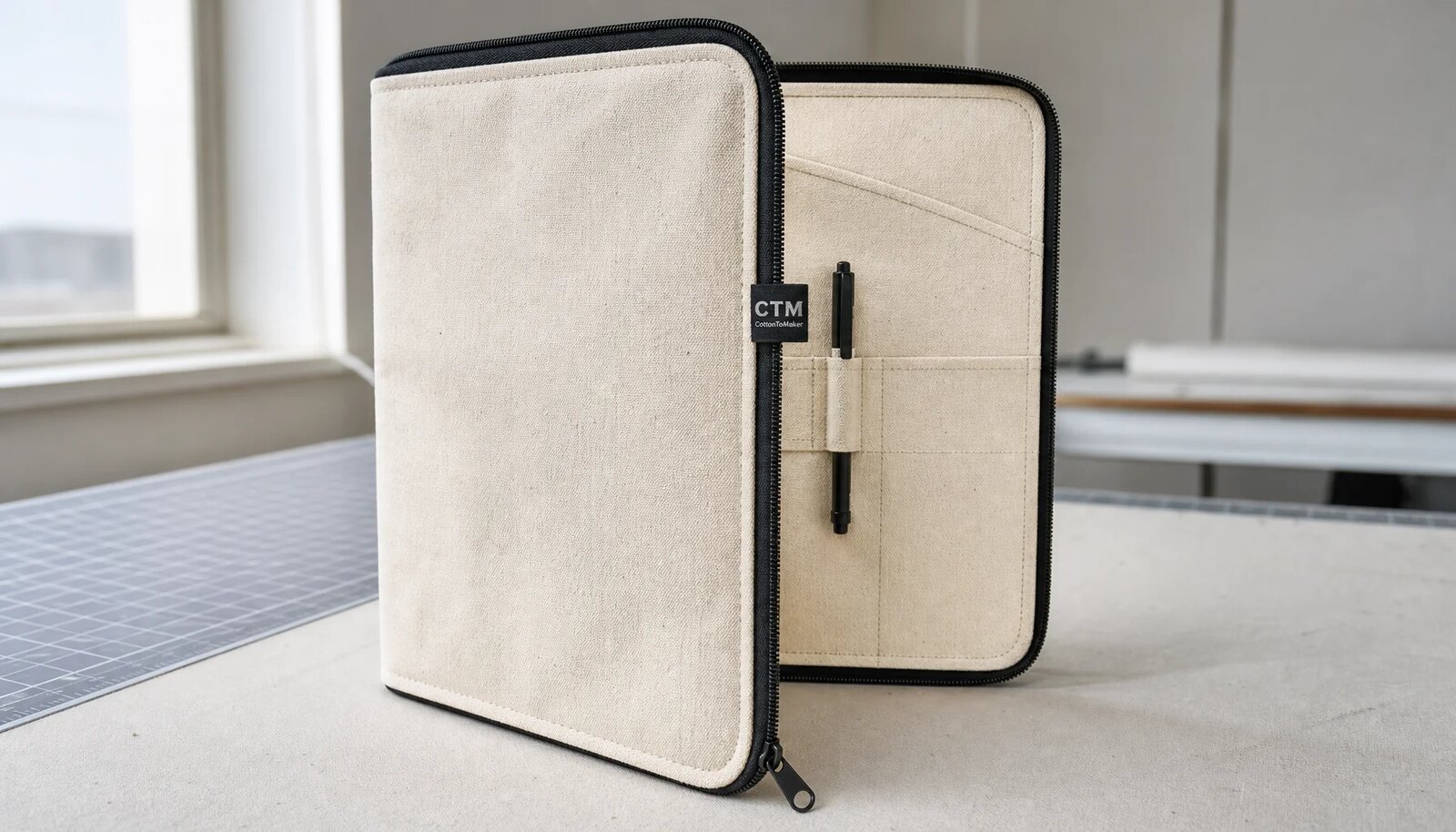
Plan the carton before approving the sample
A custom canvas zipper portfolio may look like a simple event item: canvas body, zipper closure, logo, document pocket, maybe a pen loop or card slot. For procurement, it is also a freight unit, a warehouse count, a venue receiving task, and a piece of inventory that may be sorted by sponsor, city, meeting room, attendee tier, or shipment destination.
That is why carton planning belongs at the start of sourcing, not after production. A thicker gusset, heavier canvas, stiff insert board, raised patch, metal zipper pull, or extra interior pocket can reduce the number of pieces that fit safely in a master carton. Those design choices may be worth paying for, but they should be visible in the quote and sample approval process.
For event planners and B2B buyers, the lowest sewn-piece price is not always the lowest usable cost. A quote without master carton dimensions, pieces per carton, net weight, gross weight, and total carton count is incomplete. It leaves freight, warehouse labor, receiving speed, and damage risk outside the comparison.
Use the exact keyword idea carefully: shipping carton planning for event planners is a practical procurement task, not a phrase to force into every paragraph. The goal is simple. The portfolios should arrive clean, countable, undamaged, correctly marked, and easy for event staff or fulfillment teams to distribute.
- Treat carton size, pieces per carton, gross weight, carton marks, and pack pattern as part of the product specification.
- Ask for a repeatable production pack count, not the highest count reached in an over-compressed test carton.
- Decide early whether cartons need to be sorted by city, sponsor, room, session, attendee group, warehouse, or final destination.
Build the RFQ from the event use
Good specifications begin with what the portfolio must hold. Is it designed for US letter documents, A4 papers, a notebook, sponsor inserts, contracts, badges, tablet accessories, or a complete attendee packet? Outside dimensions alone do not prove fit. Binding, seam allowance, zipper tape, pocket stitching, gusset depth, and corner radius all reduce usable internal space.
State finished outside dimensions and usable document dimensions separately. Then define folded thickness, gusset depth, zipper path, pocket layout, card slots, pen loop, handle decision, binding width, corner radius, and any insert board. A supplier cannot quote accurately if the buyer only sends a photo and a logo file.
Canvas weight should be specific but not treated as the only quality signal. A 12 oz canvas can work for light document sleeves and short-use meetings. A 14 oz to 16 oz canvas often gives a stronger hand feel for conference portfolios and sponsor gifts. A 16 oz to 18 oz canvas may suit premium programs, but it can increase corner bulk, zipper resistance, folded thickness, and carton weight.
Ask what the stated weight means. Some suppliers quote greige fabric weight before dyeing or washing. Others quote finished fabric after dyeing, coating, lamination, or other finishing. Two fabrics described with the same ounce weight can feel different and pack differently. Keep an approved swatch and approved pre-production sample as physical references.
- Specify the item the portfolio must hold and the usable internal dimensions needed for that item.
- List construction details before price comparison: gusset, zipper path, pockets, binding, corner radius, handle, pen loop, card slots, and insert board.
- Ask whether canvas weight is measured before dyeing, after dyeing, after washing, after coating, or on finished goods.
Specify the zipper like a functional component
The zipper is one of the most visible failure points in a canvas portfolio. Many event portfolios use a No. 5 nylon coil zipper because it is flexible, moderate in cost, and generally suitable for curves. Still, the quote should name zipper size, tape color, slider material, puller style, opening direction, end-stop construction, and stitching method.
If the zipper travels around rounded corners, the sample must be tested around the entire path. Corners reveal tight radius issues, bulky binding, uneven zipper tape, and poor stitch control. For square corners, ask how the supplier will manage the turn so users do not need to force the slider.
Hardware affects packing as well as use. A flat fabric puller stacks differently from a metal puller. A decorative puller may look strong in a sample photo but become the thickest pressure point inside the carton. If all pullers face the same direction in a stack, they can leave lines or dents on the canvas above them.
Ask the factory to include the final zipper puller in the packed-carton test. Substitute hardware can make the carton look better than the real production pack. During QC, zipper checks should include full open-close movement, slider attachment, end stops, zipper tape stitching, corner travel, and whether pullers press into nearby pieces after packing.
- Name zipper type, size, tape color, slider material, puller style, opening direction, and end-stop construction.
- Test zipper movement across straight areas, corners, and end points on the approved sample.
- Check carton pressure marks with the final puller, not a temporary sample puller.
Use measured tolerances, not vague approvals
Words such as sturdy, premium, centered, clean, and straight help people talk about a product, but they do not control production. Sewn canvas goods have normal variation. The purchase order should define which variation is acceptable for finished dimensions, usable opening, pocket placement, logo placement, fabric weight, zipper function, and carton count.
For many sewn canvas portfolios, a practical starting example is plus or minus 5 mm for smaller details such as pocket position, label placement, zipper-end alignment, and pen-loop location. Larger outside dimensions may allow plus or minus 8 to 10 mm if the usable document area remains acceptable. The final tolerance should be agreed with the supplier before production starts.
Logo placement should be tied to reference edges. For example, specify the distance from the top edge and left seam, with a tolerance appropriate to the decoration method. A photo with ruler marks is especially useful when the logo is near a zipper path, pocket, fold, patch, or binding edge.
Fabric weight tolerance also belongs in writing. A range around plus or minus 5 to 8 percent may be discussed for canvas goods depending on mill lot and finishing, but it should not be assumed. If hand feel is important, the approved fabric swatch and pre-production sample should carry as much authority as the number in the spec sheet.
- Convert subjective approval language into measured tolerances where possible.
- Use separate tolerances for body size, usable opening, pocket location, zipper alignment, logo placement, and carton count.
- Keep artwork proofs, measured photos, fabric swatches, and approved samples in one approval file.
Choose the sourcing route deliberately
A direct sewing factory is often the strongest route for repeat programs, imported shipments, distributor orders, and custom runs above 500 pieces. When sewing, trimming, final inspection, carton purchasing, carton marking, and pack-out happen under one production plan, it is easier to hold the supplier to the approved sample and packing method.
A trading company can be useful when the portfolio is one item in a larger event kit. One coordinator may simplify communication across notebooks, badges, lanyards, apparel, pouches, or drinkware. The buyer still needs the actual factory name, packing location, and inspection access. If final consolidation happens at a separate warehouse, carton inspection should happen there.
Domestic decorators and stock resellers can make sense for rush programs, small pilots, and replenishment orders. They may decorate existing portfolios quickly. The tradeoff is less control over fabric weight, zipper color, pocket layout, and carton efficiency. That can be acceptable when speed is the main priority.
The key is to compare the level of control, not only the unit price. One supplier may include measured cartons, custom carton marks, stable pack count, and inspection support. Another may offer a lower item price while leaving packing vague. A strong RFQ makes those differences visible.
- Use direct factory sourcing when construction details and carton repeatability matter.
- Use trading companies only after confirming factory name, packing location, carton control, and inspection access.
- Use stock decoration for speed while accepting fewer choices in materials, hardware, layout, and carton optimization.
Compare quotes by delivered usable cost
A complete quote should include unit price by quantity, sample fee, setup fee, decoration fee, individual packaging cost, master carton dimensions, pieces per carton, net weight, gross weight, total carton count, MOQ rules, lead time after sample approval, payment terms, and shipping terms. Missing fields create false savings.
Carton data can change order economics. One supplier may pack 20 pieces per carton because the bag is oversized and all zipper pullers face the same direction. Another may pack 28 pieces by alternating orientation, using a better carton size, or right-sizing the bag. Higher density is not automatically better; aggressive compression can damage corners, flatten raised decoration, and push zipper heads into the canvas.
Ask for price breaks at practical volumes such as 500, 1,000, and 3,000 pieces. Also request separate pricing for split canvas colors, split zipper colors, split logos, split packaging versions, and split destinations. Event orders often change after the first quote, and those changes can affect MOQ, scheduling, and cartons.
Early carton numbers may be estimates before the sample is approved. That is acceptable if they are labeled as estimates. Before mass production, require a measured carton test using the approved portfolio, approved packaging, insert card, desiccant decision, and intended carton. Freight and receiving plans should be based on measured data.
- Compare unit price, setup fees, packaging cost, carton cube, carton count, gross weight, and expected usable yield together.
- Ask whether carton dimensions and weights are estimated, tested, or based on a similar order.
- Require updated quote data when fabric, zipper hardware, decoration, insert card, bag, or carton count changes.
Select branding that can survive packing
Branding has to look right at handout, but it also has to survive production, packing, storage, and transport. Screen printing is often practical for simple event logos and sponsor marks because it is flat and scalable. Buyers should approve ink opacity, curing, color tolerance, rub resistance, hand feel, and whether the logo crosses a fold or tight bend.
Woven labels, stitched tabs, and embroidered patches can create a more premium look. They are useful when branding should feel durable without covering a large panel. The tradeoff is thickness. Raised branding can mark adjacent pieces when cartons are tightly filled or palletized. If a patch sits on the front panel, the carton test should show where that patch lands in the stack.
Heat transfer or digital transfer can help with full-color sponsor artwork, gradients, and logos that do not screen print cleanly. Test the transfer on the actual canvas finish. Washed canvas, coated canvas, textured canvas, and water-repellent finishes can behave differently under heat and pressure.
Placement should be approved on a physical sample whenever possible. A mark that looks centered on a digital mockup may shift visually after binding, zipper installation, pocket stitching, or gusset shaping. If alignment matters, provide measured references instead of asking the factory to judge by eye.
- Use screen print for simple flat branding, with tests for opacity, curing, rub resistance, and fold behavior.
- Use labels, tabs, or patches for premium branding, with carton checks for pressure marks.
- Approve logo placement with ruler photos from the physical sample, especially near seams, pockets, folds, and zipper paths.
Design the master carton around the final packed item
The master carton should be designed around the finished packed product, not a flat drawing. Once the zipper, binding, pockets, patch, insert card, and individual bag are added, the portfolio has uneven thickness. The thickest areas control the real carton count.
A usable carton plan defines orientation, number of pieces per stack, number of stacks per carton, layer pattern, zipper pull direction, carton board, closure method, carton marks, and acceptable top-layer condition. Workers should be able to repeat the pattern without improvising during pack-out.
The carton should close naturally. If workers have to lean on the flaps, force tape over a bulging seam, or compress the goods until the top layer bows, the pack count is too aggressive or the carton is wrong. Underfilled cartons create a different problem: they can collapse during stacking and waste freight cube.
Gross weight matters before the shipment leaves. Event venues, hotels, convention centers, and fulfillment warehouses may have carton weight limits, pallet height limits, appointment rules, liftgate requirements, or receiving windows. Even without a formal limit, very heavy cartons slow temporary staff and increase handling risk.
- Approve photos showing layer pattern, zipper pull orientation, top-layer condition, sealed carton shape, and carton marks.
- Reject forced closure, bulging sides, bowed products, crushed corners, or visible zipper-puller pressure marks.
- Match carton marks to receiving needs: PO, item code, color, logo version, quantity, destination, and carton sequence.
Decide packaging and moisture control early
Individual polybags can protect canvas portfolios from dust, moisture, scuffing, and warehouse handling. They are useful when goods will be stored, redistributed, kitted, or handled by several teams before the event. The bag should be sized to the folded portfolio; oversized bags trap air, create slippery stacks, and reduce carton efficiency.
Polybags are not always the right choice. They add cost, plastic use, and volume. Buyers with sustainability requirements may prefer paper bands, tissue, glassine-style wraps, or bulk-lined cartons. Those options can work when the receiving environment is controlled, but lightly wrapped canvas needs clean cartons and dry storage.
Insert cards, stiffeners, and paperboard supports must be included in the packing test. A board insert can improve presentation and protect shape, but it adds weight and may reduce pieces per carton. A small branded insert may seem minor, yet over hundreds or thousands of pieces it can change stack height and carton count.
Cotton canvas needs sensible moisture control. Desiccants may be useful for humid routes, longer storage, or sea freight, but they cannot fix damp production or poor warehouse conditions. Finished goods should be dry before packing, and cartons should be stored off the floor in a clean, dry area.
- Use polybags when portfolios will be stored, redistributed, kitted, or handled by multiple parties.
- Right-size bags, bands, and wraps so they protect the product without wasting carton space.
- Confirm insert cards, stiffeners, desiccants, warning labels, and carton liners before the packed-carton test.
Inspect loose product and packed cartons
A table inspection is not enough. A portfolio can pass loose-product checks and still arrive with crushed zipper pulls, dented corners, print transfer, hard fold marks, or pressure lines from raised decoration. Event buyers need the product to survive the approved packing method.
For product QC, inspectors should measure finished dimensions, usable document opening, pocket position, binding width, zipper path, logo placement, and visible sewing quality. Zippers should be opened and closed through the full path, including corners and ends. Stitching around zipper tape, binding, pocket edges, and reinforced corners deserves close attention.
Canvas surface inspection should happen under normal white light. Look for stains, oil marks, dye streaks, mildew smell, excessive lint, hard creases, broken yarns, shade variation between panels, and color variation between production lots. Odor matters because event goods may be opened in a closed meeting room or hotel storage area shortly before distribution.
For carton QC, confirm pieces per carton, carton dimensions, net weight, gross weight, carton marks, inner packaging, and product condition after unpacking. Inspectors should open representative cartons rather than relying only on sealed-carton counts. If the order is sorted by sponsor, city, room, or attendee group, carton marks, packing list, and actual contents must match.
- Inspect both loose portfolios and packed cartons because event readiness depends on both conditions.
- Check zipper movement, stitching, decoration, fabric surface, odor, cleanliness, dimensions, and usable opening.
- Open representative cartons to verify count, marks, inner packaging, and product condition after compression.
Specification comparison for buyers
| Supplier or spec choice | Best-fit use case | Quote details to request | QC or carton risk to control |
|---|---|---|---|
| Direct sewing factory | Repeat event programs, distributor orders, imported shipments, and 500+ pc custom runs | Finished dimensions, canvas weight basis, zipper spec, decoration method, packaging format, carton size, pieces per carton, net and gross weight | Confirm the same facility controls sewing, trimming, inspection, carton purchase, carton marking, and final pack-out |
| Trading company with named factory | Multi-item event kits where portfolios ship with notebooks, badges, lanyards, apparel, pouches, or inserts | Factory name, production location, consolidation location, inspection access, packed-carton photos, and shipment split rules | If final packing happens away from the sewing factory, inspect the packed cartons at the consolidation point |
| Domestic decorator or stock reseller | Rush events, small pilots, replenishment orders, and programs where speed matters more than custom construction | Available stock dimensions, decoration limits, fixed carton counts, lead time, and replacement stock availability | Expect less control over canvas weight, zipper color, pocket layout, and carton optimization |
| 12 oz canvas, typically around 400 gsm depending on weave and finish | Light document holders, short-use meetings, lower-weight handouts, and budget-sensitive distribution | Ask whether weight is greige, dyed, washed, coated, laminated, or finished fabric weight | Check hand feel, opacity, dimensional stability, and whether the product collapses when filled |
| 14 oz to 16 oz canvas, typically around 475 to 540 gsm depending on mill standard | Conference portfolios, sponsor gifts, meeting kits, and document organizers needing more structure | Request approved swatch, finished sample, folded thickness, and carton yield estimate | Heavier fabric can reduce pieces per carton and increase corner bulk |
| No. 5 nylon coil zipper | Most canvas zipper portfolios needing smooth travel around corners at moderate cost | Zipper size, tape color, slider material, puller style, opening direction, end stop, and stitch method | Test full open-close movement, especially at corners and zipper ends |
| Screen print branding | Simple event logos, sponsor marks, 1 to 3 spot colors, and larger runs | Logo size, Pantone references, placement from edges, ink opacity, curing, rub resistance, and setup fees | Heavy ink near folds or seams can crack, rub, or distort visually |
| Woven label, stitched tab, or patch | Subtle premium branding and programs where durability matters more than a large print area | Label size, edge finish, stitch color, placement, stitch density, and sample approval photos | Raised details can dent adjacent pieces if carton pressure is too high |
Buyer checklist before sampling
- Define finished outside size, usable document size, folded thickness, gusset depth, zipper path, corner radius, binding width, pocket layout, pen loop, card slots, handle decision, and any insert board before asking for price.
- State canvas weight in oz and approximate gsm, and require the supplier to identify whether the figure is greige fabric, dyed fabric, washed fabric, coated fabric, laminated fabric, or finished-goods weight.
- Specify zipper type, size, tape color, slider material, puller style, opening direction, end stop, and whether the zipper must travel around square or rounded corners without catching.
- List decoration method, logo size, artwork colors, Pantone references when needed, placement from edges or seams, print hand-feel target, and whether decoration may cross a fold, seam, zipper path, or raised pocket area.
- Request unit price, sample fee, setup fee, decoration fee, individual packaging cost, master carton size, pieces per carton, net weight, gross weight, carton count, and production lead time on every supplier quote.
- Ask for price breaks at practical order volumes such as 500, 1,000, and 3,000 pcs, plus separate pricing for split colors, split logos, split destinations, and revised packaging formats.
- Require a pre-production sample measured against the spec sheet, plus a packed sample or measured carton test using the approved portfolio, approved bag or band, insert card, desiccant decision, and intended carton board.
- Confirm whether the carton count is a stable production count or only a maximum test count reached by heavy compression; reject carton plans that require forced flap closure or leave products visibly bowed.
- Set measurable QC tolerances for fabric weight, finished dimensions, usable document opening, logo placement, zipper operation, stitch defects, stains, odor, loose threads, carton count, carton marks, and carton strength.
- Clarify venue receiving rules, pallet height limits, maximum carton weight, carton mark format, delivery windows, appointment requirements, and whether cartons must be sorted by event city, sponsor, room, session, or attendee group.
Factory quote questions to send
- What exact canvas weight in oz and gsm are you quoting, and is the weight measured before dyeing, after dyeing, after washing, after coating, or on finished goods?
- What are the finished outside dimensions, usable document dimensions, folded thickness, gusset depth, pocket dimensions, binding width, corner radius, and sewing tolerance included in the quote?
- Which zipper type, zipper size, zipper tape color, slider material, puller style, opening direction, end stop construction, and zipper stitching method are included?
- How many zipper open-close cycles do you test during QC, and do you inspect zipper movement around corners separately from straight-line movement?
- Which decoration method are you quoting, what is the maximum logo size, what placement tolerance do you hold, and what setup, screen, plate, transfer, label, or embroidery digitizing fees apply?
- What are the MOQ and surcharge rules by canvas color, zipper color, logo version, label version, pocket layout, packaging version, and destination split?
- How many pieces fit in one master carton using the approved product, approved polybag or paper band, insert card, desiccant decision, and final folded orientation?
- What are the master carton dimensions in length, width, and height, carton board specification if available, net weight, gross weight, and total carton count for 500, 1,000, and 3,000 pcs?
- Can you provide photos or short video of the packed carton showing layer pattern, zipper pull orientation, top-layer condition, carton closure, carton marks, and inner packaging?
- If palletized, how many cartons fit per pallet, what is the loaded pallet height, what is the estimated pallet gross weight, and will lower cartons resist compression during storage and multi-hub handling?
Quality-control points to confirm
- Fabric weight tolerance should be written into the PO. A range around plus or minus 5 to 8 percent is a common example for canvas goods, depending on mill lot, weave, and finishing method, but the approved tolerance should match the order and fabric source.
- Finished dimensions should be measured on a laid-flat product after sewing, trimming, binding, and zipper installation. Use separate tolerances for outside size, usable document opening, gusset depth, pocket position, and logo placement.
- For many sewn canvas goods, a practical finished size tolerance may be around plus or minus 5 mm on small details and plus or minus 8 to 10 mm on larger outside dimensions. These should be treated as starting examples, not universal standards.
- Zipper operation should be tested across the full opening and closing path, including corners and zipper ends. Reject sharp teeth, jammed sliders, loose pullers, skipped zipper stitching, wavy zipper tape, missing end stops, or pullers that press visibly into canvas after packing.
- Stitching should be checked for even seam allowance, secure back-tacks, consistent binding, no open seams, no unraveling at corners, no skipped stitches on zipper tape, no broken needles left in seams, and no loose thread clusters.
- Decoration should match the approved proof for size, color, position, and orientation. Inspect printing near seams, folded edges, zipper paths, raised labels, patch corners, and any area that may shift during sewing or compression.
- Canvas surface should be checked under normal white light for stains, oil marks, dye streaks, mildew smell, excessive lint, hard creases, broken yarns, shade variation between panels, and color variation between production lots.
- Individual packaging should match the approved format, with correct bag or band size, warning text if required, insert card orientation, paper band placement, desiccant decision, and no trapped moisture or inflated air that wastes carton space.
- Carton count should match the approved packing plan exactly. Overfilled cartons can distort zipper heads and corners, while underfilled cartons can collapse during stacking and create freight inefficiency.
- Master cartons should suit the shipment route and handling pattern. For export or multi-hub domestic movement, require checks for carton closure, corner integrity, compression, strapping if used, and product condition after cartons are moved.