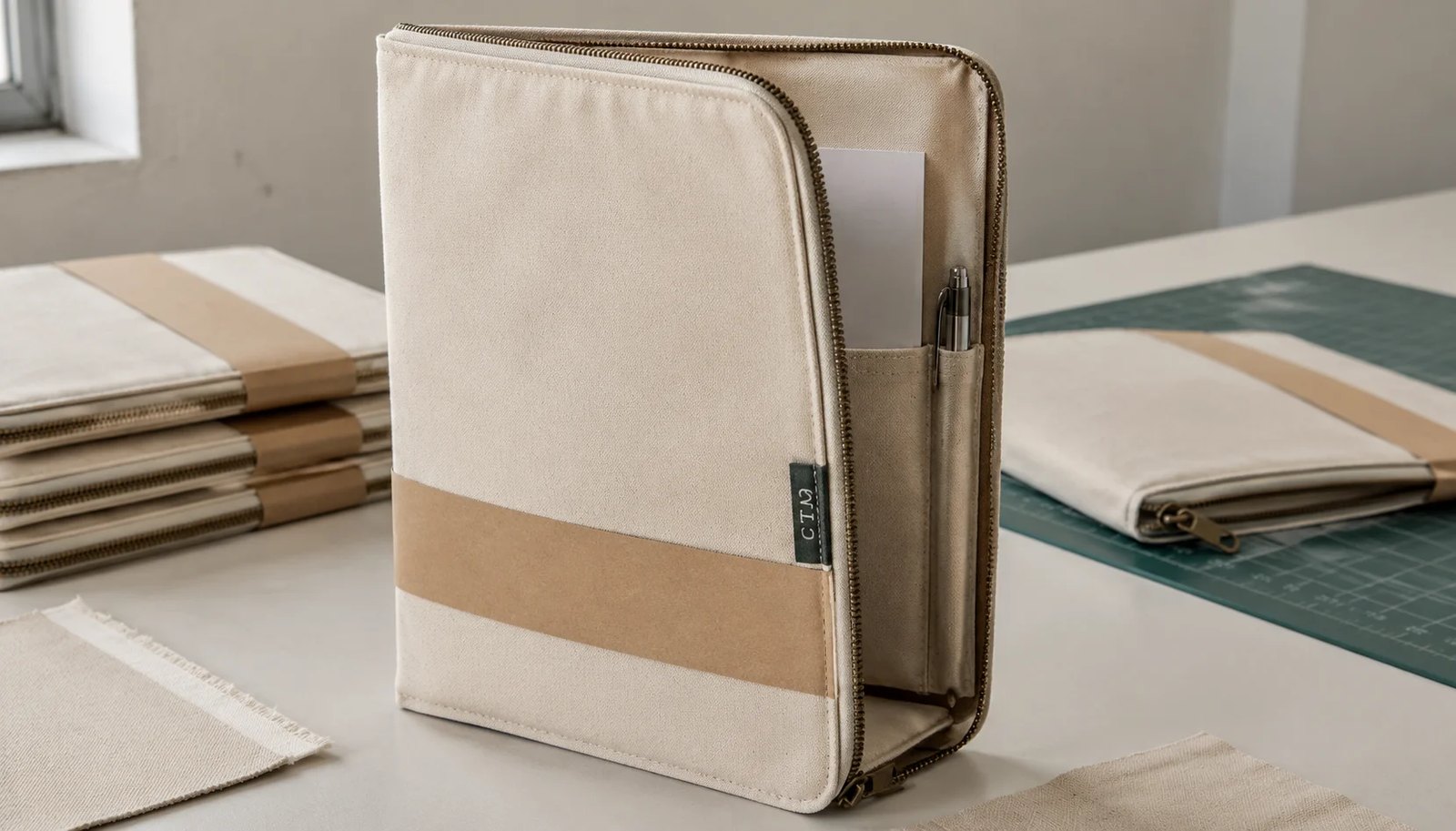
Procurement Brief
A clear RFQ for custom canvas zipper portfolios should make the finished product visible before a supplier gives a price. For natural grocers, the item is usually not a fashion accessory. It is a work tool used in vendor onboarding, category reviews, staff training, product education, loyalty programs, or regional store rollouts. That means the RFQ has to cover document fit, zipper reliability, brand presentation, sustainability documentation, and distribution handling.
The common weak RFQ says only “canvas zipper portfolio with logo.” That invites each supplier to quote a different fabric weight, zipper grade, internal pocket layout, print method, and packing plan. The quote that looks cheapest may exclude the details that make the item usable in stores or acceptable at a retail distribution center. A stronger RFQ separates required features from optional upgrades, states measurable acceptance points, and asks every supplier to price the same construction.
- Anchor the RFQ to the actual business use and document load.
- Require inside usable dimensions, not only outside dimensions.
- State brand, sustainability, and retail DC requirements before pricing.
- Ask for quantity breaks on one controlled specification.
- Keep optional features separate so suppliers do not overbuild or underquote.
Fill-In RFQ Template
Use a line-item RFQ format rather than a paragraph description. The factory should be able to price, sample, and inspect from the same document. The fields below are written for a natural grocery buyer, but they can be adjusted for distributor folders, supplier presentation kits, employee onboarding packs, or store education materials.
Do not leave retail handling details until after the PO. Store allocation, carton labels, plastic-reduction rules, and sustainability documents can change cost and lead time. If those requirements are unknown, mark them as pending and ask the supplier to show the cost difference between standard bulk packing and the expected retail distribution packout.
- Program name: [vendor kit / staff onboarding / loyalty pack / supplier meeting / store rollout].
- Order quantities to quote: [500] [1,000] [3,000] [5,000] pieces, same specification.
- Required document fit: [US letter / A4 / custom size] plus [stack thickness] and [10-15 mm clearance].
- Finished outside size target: [width x height x depth if any], with internal usable size confirmed on sample.
- Outer fabric: [12 oz / 14 oz / 16 oz] cotton canvas, approximate finished GSM [value], color [natural / dyed Pantone / bleached].
- Material claim: [conventional / organic / recycled blend], documentation required [yes/no; specify type if known].
- Closure: No. 5 nylon coil zipper, tape color [natural/black/match], slider finish [standard/matte/other], puller [metal/fabric tab].
- Interior: [document sleeve] [flat pocket] [pen loop] [business card slot] [other], with pocket dimensions listed.
- Branding: [screen print / woven label / cotton patch], artwork file [vector], colors [Pantone], placement [measured from edges].
- Packing: [bulk pack / recycled polybag / paper band / store bundle], pieces per inner pack [value], pieces per master carton [value].
- Carton marks: PO, item code, color, quantity, carton number, destination, barcode, store or region if required.
- Quality standard: size tolerance, zipper function, print tolerance, stitching, stains, loose threads, packing damage, and approved sample match.
- Commercial terms: incoterm, sample fee, setup fees, tooling, payment terms, production lead time after sample approval, and shipment mode.
Product Specification
Start with what the portfolio must carry. US letter and A4 are close, but a zipper case loses usable space to seam allowance, binding, and pocket stitching. If the portfolio must hold supplier contracts, price sheets, product spec pages, ingredient education cards, category review decks, or recipe inserts, state the exact paper size and stack thickness. The sample should be tested with the real paper stack, not an empty case.
A practical construction for grocery programs is a flat canvas body with a three-side zipper, one internal document sleeve, one flat insert pocket, and one pen loop. That layout gives enough function for meetings and store use without turning the item into a complex office organizer. Extra pockets, gussets, elastic grids, or padded tech sections should be added only when the program has a real need for them because each feature adds sewing time and inspection risk.
- Recommended clearance: 10-15 mm beyond document width and height for easy insertion.
- Default construction: flat body, three-side zipper, document sleeve, flat pocket, pen loop.
- Useful add-on: business card slot for supplier meetings or regional sales teams.
- Use caution with: padded laptop panels, heavy metal hardware, elastic grids, and multiple gussets.
- Approval check: load the sample, zip it closed, lay it flat, and confirm papers do not curl or bind.
Canvas And Claims
For custom canvas zipper portfolios, 12 oz to 16 oz cotton canvas is a practical range for many B2B grocery programs. A lighter 10 oz to 12 oz fabric can work for short campaigns or light paperwork, but it may feel limp with a catalog or training packet inside. A 12 oz to 14 oz canvas is often the balanced option for repeated staff or vendor use. A 16 oz canvas can feel more substantial, but it can also create bulky corners and slower sewing around the zipper.
Natural canvas fits many natural grocery brand standards because it has a less processed look. It also shows cotton seed flecks, slubs, and shade variation. Those characteristics may be acceptable, but they should be approved against a sample so the inspection team does not reject normal fabric character later. If the brand requires a cleaner look, ask about bleached canvas or dyed canvas and include the added MOQ and lead time in the comparison.
If the portfolio supports a plastic-reduction or sustainability program, keep claims precise. Organic cotton, recycled cotton, undyed canvas, recycled packaging, and plastic-free packing are different claims with different proof requirements. The RFQ should ask what documentation is available and when it can be reviewed. Marketing, packaging, and store teams should not rely on a casual supplier statement if the claim will appear in customer-facing material.
- Budget path: 10 oz to 12 oz canvas for light, short-use document packs.
- Balanced path: 12 oz to 14 oz canvas for supplier kits and staff folders.
- Premium path: 16 oz canvas with sample review for corner bulk and zipper curve.
- Natural canvas approval: define acceptable flecks, shade range, slubs, and minor weave variation.
- Claim control: require documentation before using organic, recycled, plastic-free, or similar language.
Zipper, Sewing, Branding
The zipper is the part users notice first when it fails. A No. 5 nylon coil zipper is a strong default for a soft canvas portfolio because it bends around corners more smoothly than many metal options. Metal zippers can look premium, but they add stiffness and weight. For store teams, category managers, and vendor representatives who open the portfolio repeatedly, smooth function is usually more important than decorative hardware.
Canvas also reveals sewing problems. Uneven tension, twisted binding, bulky corners, and wavy zipper tape are easy to see on a flat portfolio. The RFQ should state how seams are finished inside and where reinforcement is required. If a pen loop or sleeve sits too close to the zipper path, the slider can catch even when the outside looks clean.
Branding should match both the grocery brand standard and the product’s expected life. Screen print is efficient for simple one- to three-color marks, but textured canvas can soften fine lines. Woven labels and cotton patches are useful when the logo is small, detailed, or intended to survive repeated handling. For low-impact natural branding, a woven side label, unbleached patch, or muted ink may be more appropriate than a large high-contrast print.
- Specify zipper size, tape color, slider finish, and puller type.
- Test zipper movement on a loaded sample, especially around corners.
- Measure logo placement from fixed edges instead of approving by eye.
- For screen print, check opacity, edge sharpness, rub, and light folding behavior.
- For labels, confirm MOQ, thread colors, fold type, sewing position, and leftover label handling.
MOQ And Costing
MOQ is driven by more than factory preference. Fabric purchasing, dyeing, cutting efficiency, zipper sourcing, print setup, label production, sewing line changeover, packing material, and carton allocation can each create a minimum. A plain natural canvas portfolio with a stock zipper may be available at a lower MOQ than a custom dyed version with matching zipper tape and a woven label.
Ask for 500, 1,000, 3,000, and 5,000 pieces using the same spec. This shows whether the price changes because of labor efficiency, material minimums, or fixed setup charges. Keep unit price separate from sample fees, screen setup, label setup, cutting dies, artwork adjustment, and special carton marking. If a woven label MOQ is 1,000 pieces and the bag order is 500 pieces, the quote should show the cost and plan for unused labels.
Landed cost matters more than the factory unit price. A heavy canvas portfolio may look close in unit price but increase carton weight and freight. Store allocation can also change economics. If cartons must be split by region or store, that labor should be quoted at the factory when possible instead of being discovered later in a domestic warehouse.
- Main material drivers: canvas weight, dyeing, washing, shrinkage allowance, fabric width, zipper color, and label MOQ.
- Main labor drivers: zipper installation, curved corners, binding, pocket count, reinforcement, and inspection level.
- Main branding drivers: print colors, print area, curing, patch sewing, label setup, and artwork changes.
- Main packing drivers: individual protection, paper bands, barcodes, inner packs, carton strength, and allocation sorting.
- Commercial rule: compare quotes only after normalizing incoterm, packing, setup fees, carton data, and inspection scope.
Sample Approval
The pre-production sample is the control point for the purchase order. A development mockup can help confirm shape and logo location, but final approval should use the actual canvas, zipper, thread, print ink, label, pocket layout, and intended packing. If the bulk order depends on fabric handfeel, print opacity, material claim, or zipper smoothness, a substitute sample is not enough.
Review the sample like the end user and the receiving team will handle it. Put the intended documents inside. Open and close the zipper several times. Check whether the sleeve is deep enough, whether the pen loop interferes with the zipper, whether the logo rubs, and whether the case lies flat. If individual paper bands or recycled polybags are part of the program, review those too. Packing can change appearance if the portfolio is compressed too tightly in the carton.
Approval notes should be written, dated, and attached to the PO. Photos are useful, but they should not replace measurements and pass/fail comments. If the buyer approves a sample with exceptions, list exactly what must change before production and require confirmation before bulk cutting.
- Measure outside size and internal usable document space.
- Load the real paper stack and confirm easy insertion and removal.
- Run a simple zipper open-close cycle on the loaded sample.
- Compare canvas shade and logo color against the approved reference.
- Check print, label, seams, corners, sleeve depth, odor, stains, and loose threads.
- Record sample weight to help estimate carton weight and freight.
- Approve packing method, carton quantity, and carton marks before production starts.
Packing And Retail DC Needs
Natural grocers often have stronger packaging preferences than general office buyers. Some programs avoid unnecessary plastic, some require recycled-content bags, and some prefer paper bands. Each option has a tradeoff. Individual polybags protect canvas from moisture and carton dust, while paper bands reduce plastic but provide less protection. Bulk packing reduces packaging material but can increase sorting labor and product soiling if cartons are opened repeatedly.
Distribution rules should be built into the RFQ. A central DC shipment, a regional allocation, and direct-to-store bundles are different jobs. If each store receives a fixed number of portfolios for a training rollout, the factory may need inner cartons, store labels, or region-specific carton marks. If the portfolios are part of vendor kits assembled later, the buyer may prefer master cartons with consistent count and barcode labels for warehouse scanning.
Retail receiving teams care about predictable cartons. Ask for carton dimensions, gross weight, pieces per carton, carton strength, and marks. Avoid over-tight packing that bends zipper corners or leaves hard creases in canvas. For sea shipments or humid storage, discuss desiccant and moisture control, especially when using natural canvas and paper packing together.
- Plastic-reduction option: paper band or bulk pack, with added review for dust and moisture exposure.
- Protection option: recycled polybag or recyclable bag, especially for longer transit or retail handling.
- Allocation option: inner carton or store bundle by store count, region, or PO line.
- Receiving fields: PO, item code, color, quantity, carton number, destination, barcode, and gross weight.
- Risk control: confirm carton compression, corner protection, desiccant use, and maximum carton weight.
Lead Time And QC Plan
Lead time depends on the slowest material and the speed of approval. Stock natural canvas and standard zipper colors are usually faster than custom dyed canvas, dyed-to-match zipper tape, and custom woven labels. A useful schedule separates artwork approval, sample making, material booking, fabric inspection, cutting, printing, sewing, inline QC, final inspection, packing, and export booking.
The buyer should give the in-warehouse need date, not just the desired ship date. Seasonal promotions, supplier fairs, new store openings, category resets, and annual vendor meetings all have fixed dates. Late artwork, revised logo size, delayed material documentation, or store allocation changes can break the schedule even if the sewing factory is ready.
QC should be agreed before production. Define critical defects such as unusable zipper, wrong logo, wrong size, major stains, incorrect material claim, and carton mislabeling. Define major defects such as visible print defects, skipped stitches, dirty canvas, sleeve fit failure, or crushed corners. Define minor defects such as trimable loose threads or small variations within the approved natural canvas range. This shared language makes inspection results easier to act on.
- Fastest path: stock natural canvas, standard zipper, simple pockets, screen print, standard carton pack.
- Slower path: custom dye, certified material claim, woven labels, special packout, or store-level allocation.
- Schedule inputs: artwork approval date, sample approval date, material booking date, production days, inspection date, and transit time.
- QC checkpoints: incoming fabric, print approval, first sewing output, inline inspection, final AQL inspection, and packed carton review.
- PO attachment: approved quote sheet, approved sample notes, artwork, packing plan, carton marks, and inspection criteria.
Specification comparison for buyers
| Sourcing route or spec path | Best fit | What to request in the RFQ | Procurement risk to control |
|---|---|---|---|
| Stock natural canvas with standard zipper | Fastest route for vendor kits, store training packs, supplier folders, and internal category review binders | 12 oz to 14 oz natural cotton canvas, No. 5 nylon coil zipper, screen print or woven side label, standard carton pack | Natural shade variation, seed flecks, and stock fabric availability should be approved before bulk cutting |
| Custom dyed canvas program | Brand-standard color programs or regional store launches where the portfolio must match a defined palette | Pantone target, lab dip approval, dye lot tolerance, fabric MOQ, shrinkage allowance, and extra sample time | Color approval can delay production; different dye lots may not match if orders are split |
| Organic or recycled cotton canvas claim | Plastic-reduction or sustainability-positioned natural grocery programs that need claim support | Material composition, available certificates or transaction documents, label wording, and whether claims appear on packaging | Do not use sustainability language in store materials until documentation is reviewed and approved internally |
| Screen printed logo | Simple store brand marks, program names, or vendor kit branding in one to three colors | Vector artwork, Pantone references, print size, placement tolerance, ink type, curing control, and rub check | Fine lines may lose clarity on textured canvas; opacity and dry rub should be checked on the production fabric |
| Woven label or cotton patch | Longer-use portfolios, premium supplier meeting kits, or subtle natural grocery branding | Label size, fold type, thread colors, sewing position, label MOQ, and leftover label handling | Label MOQ can exceed bag quantity; placement drift is visible on small labels |
| Direct bag factory | Repeat programs with custom construction, defined QC, and carton allocation rules | Pattern ownership, sample process, sewing line capacity, inspection standard, carton marking, and production photos | Factory must be able to control cutting, printing, sewing, QC, and packing without vague subcontracting |
| Trading company or mixed-category supplier | Buyers consolidating portfolios with totes, aprons, pouches, or other retail support items | Factory name or capability summary, technical sample owner, QC responsibility, and itemized quote by product | Convenience can hide weak technical control unless samples and inspections are managed tightly |
| Store allocation packout | Orders shipping to retail DCs, regions, or direct-to-store bundles | Pieces per store, inner carton or bundle rules, carton labels, barcode needs, ship-to codes, and overage plan | Late allocation instructions can force domestic repacking and damage the landed-cost advantage |
Buyer checklist before sampling
- Define the business use: vendor onboarding folder, product education kit, staff training portfolio, loyalty member pack, supplier meeting folder, or retail gift-with-purchase.
- State the exact document size and stack thickness the portfolio must hold, including whether US letter, A4, catalogs, recipe cards, or clipped forms are included.
- Specify internal usable space, not only outside dimensions, and include clearance for zipper binding and seam allowance.
- List canvas weight in oz and approximate GSM, and clarify whether the quoted weight is greige, finished, dyed, washed, organic, recycled, or conventional cotton.
- Define acceptable natural canvas character, including seed flecks, slubs, shade range, and whether a cleaner bleached or dyed look is required.
- Specify zipper size, tape color, slider finish, puller style, and whether the zipper must pass an open-close cycle check on a loaded sample.
- Provide vector logo artwork, Pantone references, print size, label size, and measured placement from portfolio edges.
- Ask for quotes at 500, 1,000, 3,000, and 5,000 pieces using the same construction, logo method, packing, and incoterm.
- Require a pre-production sample using actual canvas, zipper, thread, print ink, label, and intended packing before bulk fabric cutting.
- State plastic-reduction preferences early: recycled polybag, paper band, no individual bag, or other approved packaging route.
Factory quote questions to send
- What canvas weight, yarn count, weave, and finished GSM are included in the quoted price?
- Is the fabric stock natural canvas, dyed canvas, bleached canvas, organic cotton, recycled cotton blend, or another composition?
- What documentation can be provided for organic, recycled, or other sustainability claims, and when will it be available for review?
- What are the finished outside dimensions and the internal usable document dimensions after zipper binding and seam allowance?
- What zipper size, zipper tape material, slider material, puller type, and zipper color are included in the quote?
- What logo method is quoted, and are screen setup, label MOQ, patch cutting, artwork adjustment, or color matching charged separately?
- Will the pre-production sample use the same canvas, zipper, thread, ink, label, and packing as mass production?
- What MOQ applies to the portfolio body, custom dyed fabric, custom zipper tape, woven labels, and special packing materials?
- Can you quote 500, 1,000, 3,000, and 5,000 pieces on the same specification and separate unit price from setup charges?
- How many pieces are packed per inner carton and master carton, what are the estimated carton dimensions, and what is the gross weight?
Quality-control points to confirm
- Finished outside size should normally stay within plus or minus 5 mm for a flat non-padded portfolio unless the approved sample or PO sets another tolerance.
- Internal sleeve and main compartment must hold the stated document size and stack thickness after sewing, not only in the paper pattern.
- Zipper must open and close smoothly around corners on a loaded sample without skipped teeth, slider catching, tape distortion, or fabric trapped in the seam.
- Logo placement should be measured from agreed portfolio edges, with a tolerance such as plus or minus 3 mm when the construction allows it.
- Screen print should be checked for opacity, edge sharpness, dry rub, light scratch resistance, and obvious cracking after gentle folding.
- Woven labels and patches should be checked for correct color, spelling, fold direction, placement, and secure stitching.
- Seams should have even allowance at corners, consistent stitch density, no broken stitches, no exposed raw edges unless approved, and reinforcement at stress points.
- Canvas should be checked against the approved sample for shade range, stains, oil marks, heavy slubs, odor, and unacceptable dirt pickup.
- Loose threads, needle holes, skipped stitches, print transfer, zipper waviness, and carton crushing should be classified before inspection so the buyer and factory use the same defect language.
- Cartons should protect corners, avoid permanent zipper deformation, meet weight limits, and match the approved allocation and marking plan.