Define the Buying Problem Before the RFQ
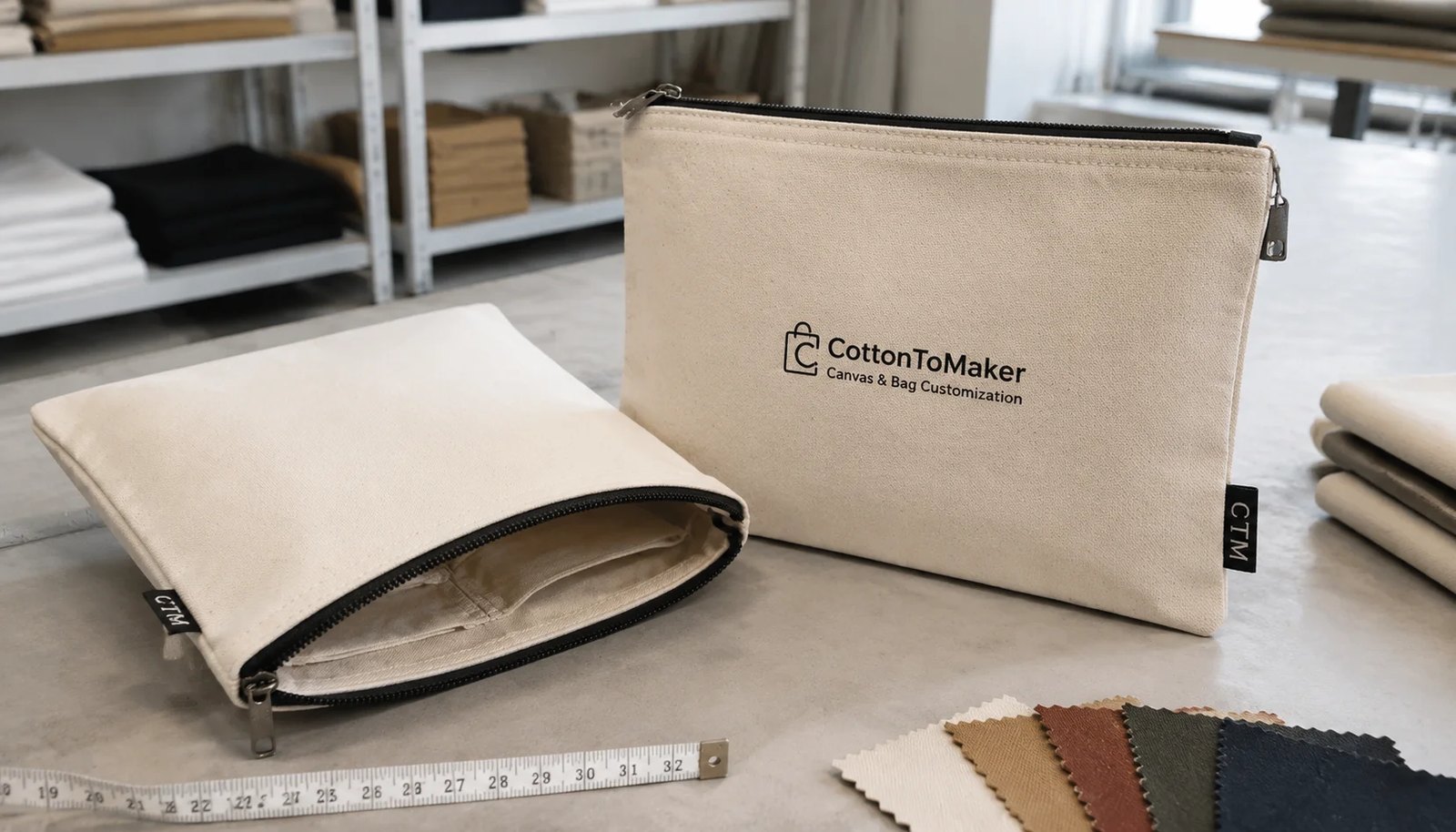
A custom canvas zipper portfolio for liquor retail is not the same as a flat document pouch. It is usually handled by store managers, distributor reps, category buyers, supplier partners, or event staff who carry price sheets, tasting notes, contracts, shelf talkers, and training documents. The buying risk is not only whether the logo looks good. The portfolio must stay flat enough for documents, zip smoothly when filled, and survive repeated handling without looking cheap after two weeks.
The RFQ should describe the working situation, because that drives the material and construction choices. A portfolio for internal store documents can be simple and cost controlled. A supplier presentation kit used by a premium spirits brand may need a heavier fabric, cleaner branding, better zipper hardware, and a more organized interior. If the factory only receives a size and logo file, it will quote the easiest version, not necessarily the version your retail team can use.
- For store operations: prioritize document fit, durability, and easy carton distribution.
- For supplier presentations: prioritize outside appearance, zipper feel, and logo execution.
- For tasting events: prioritize wipe-clean lining, label pockets, and fast access to printed sheets.
- For distributor kits: prioritize repeat handling, reinforced seams, and controlled carton weight.
Set the Portfolio Size From the Documents Inside
Many quote problems start with the wrong dimension. Buyers often write the outside size only, then discover the finished sample cannot hold letter-size papers, A4 sheets, or a small tablet without bending the corners. For zipper portfolios, the usable internal space is smaller than the outside panel because zipper tape, seam allowance, binding, and internal pockets all consume room. A 10 x 13 inch outside size does not automatically mean it holds a 9 x 12 inch document cleanly.
Build the RFQ around the largest item that must fit inside. For US liquor retailers, letter-size sheets are common. For international distributors, A4 may be required. If the portfolio will hold price books or supplier forms in plastic sleeves, add extra depth. For tablet use, state the exact device size and whether a case will remain on it. The factory should produce the sample around the usable internal requirement, not only the outside silhouette.
- State closed outside size and open size separately.
- State usable internal document area after zipper and seam allowance.
- Allow extra width if papers are inserted in sleeves or folders.
- For tablet sleeves, include device model, case thickness, and elastic band requirement.
- For zipper around three sides, allow more corner clearance than a single top zipper pouch.
Choose Canvas Weight Without Overbuilding
For this product category, 12 oz canvas can work for a light document case, but it may feel soft and show wrinkles quickly. A practical range for custom canvas zipper portfolios is usually 14 oz to 16 oz cotton canvas, roughly 475-540 GSM depending on weave and finishing. This gives enough body for repeated handling while still allowing clean turning at the zipper corners. If the design includes padding, lining, or multiple pockets, the outside canvas does not always need to be heavier.
Overbuilding the fabric is a common sourcing mistake. An 18 oz or 20 oz canvas may sound more durable, but it can create bulky corners, higher sewing difficulty, slower output, and higher freight weight. It can also make the zipper path stiff. For liquor retailers that need a practical branded portfolio, fabric handfeel and construction balance matter more than quoting the highest possible ounce weight.
- 12 oz canvas: lower cost, lighter feel, suitable for short campaign use or simple document storage.
- 14 oz canvas: good middle option for retail teams needing structure without heavy bulk.
- 16 oz canvas: stronger handfeel for presentation kits and repeated distributor use.
- 18 oz plus canvas: only useful when the design is intentionally rugged and the factory can sew clean zipper corners.
- Dyed canvas: better brand color control, but MOQ and shade variation need tighter management.
Specify Zipper Construction Like a Functional Part
The zipper is the part users judge every day. A portfolio may look acceptable in photos and still fail because the slider drags, the corner radius is too tight, or the zipper tape waves after sewing. For canvas portfolios, nylon coil zippers are often the practical choice because they run smoothly around corners and are less scratch-prone than some metal zipper chains. Metal pullers can still be used for a stronger handfeel and a more retail-ready appearance.
The RFQ should define zipper direction and opening style. A top zipper is simpler and cheaper, but it gives less access. A two-side or three-side zipper makes documents easier to load, but it adds sewing time and corner risk. If the portfolio will be opened frequently in store offices or supplier meetings, pay attention to the corner radius and slider quality during sample review. This is not a small trim decision; it directly affects complaint rates.
- Use a nylon coil zipper for smoother movement around curved or folded corners.
- Request zipper tape color that matches or intentionally contrasts the canvas and brand print.
- State whether one slider or two sliders are required.
- Avoid very sharp zipper corners unless the factory shows a clean working sample.
- Require a functional zipper test on pre-shipment inspection, not only a visual check.
Match Print Method to Liquor Retail Branding
Screen printing remains the most practical method for many cotton canvas zipper portfolios. It works well for bold store logos, supplier program marks, distributor names, and simple campaign artwork. It is cost efficient at volume and can handle strong color blocks. The limitation is fine detail: small legal lines, thin serif fonts, tiny bottle illustrations, and metallic effects may not print cleanly on textured canvas.
For a quieter premium portfolio, a woven label, cotton label, leather patch, PU patch, or debossed badge may be better than a large print. This matters for liquor retailers because some portfolios are used in trade meetings where the item should feel like work equipment, not a giveaway bag. The RFQ should include artwork size, color references, placement, and whether the logo may sit across a seam or pocket. Printing across uneven surfaces should be avoided unless the factory has proven results.
- Screen print: best for simple logos, strong color, and controlled unit cost.
- Heat transfer: useful for detailed art, but adhesion on heavy canvas needs testing.
- Embroidery: durable, but can pucker canvas and is not ideal for very large filled logos.
- Woven label: clean for subtle retail or distributor branding.
- Patch branding: good for premium kits, but adds material, sewing, and approval steps.
Build the Interior Around Real Retail Use
A canvas zipper portfolio can become expensive quickly if every internal pocket is added without a purpose. Each pocket means extra material cutting, edge finishing, sewing time, alignment risk, and inspection work. A practical liquor retail layout often includes one large document sleeve, one business card pocket, and one pen loop. If the portfolio is for supplier meetings, a tablet sleeve or price-book sleeve may be useful, but it should be sized around actual contents.
The factory needs a clear pocket map. A rough instruction such as 'inside pockets as needed' will produce inconsistent quotes. Pocket height, opening direction, elastic use, lining fabric, and reinforcement all affect cost and usability. For retail buyers comparing quotes, a supplier with a detailed pocket diagram and material breakdown is usually more reliable than one that quotes from a single exterior photo.
- Document sleeve should allow easy insertion without scraping the zipper teeth.
- Business card pocket should hold standard cards without disappearing too deep inside.
- Pen loop should match the pen diameter used by the team, not a generic narrow loop.
- Tablet sleeve should include padding only when the product will actually carry electronics.
- Internal lining can be cotton, polyester, or nonwoven depending on durability and budget.
Understand MOQ and Cost Drivers
MOQ for custom canvas zipper portfolios is driven less by sewing alone and more by material sourcing, dyeing, printing, zipper color, and interior complexity. A simple natural canvas portfolio with one-color print may be realistic from a few hundred pieces, depending on the factory schedule and fabric stock. A custom dyed canvas, branded zipper puller, special lining, multiple pockets, and patch branding can push the efficient MOQ higher because suppliers must buy or process materials in larger lots.
When comparing quotes, separate the cost drivers instead of focusing only on the final unit price. One supplier may include a stronger zipper and better packing, while another may quote a thin fabric and minimal inspection. A low unit price is not useful if it creates zipper failures, document fit problems, or carton repacking at destination. Ask for a costed option table: base construction, upgraded fabric, upgraded zipper, additional pocket, and branding method.
- Fabric weight and finish affect both material cost and sewing speed.
- Custom dyeing adds MOQ, lab dip approval, and shade control risk.
- More pockets increase labor cost more than many buyers expect.
- Patch, metal plate, or custom zipper puller may require tooling or mold charges.
- Individual packing protects the product but adds material cost and carton volume.
- Supplier quote validity should be tied to material price and exchange rate timing.
Use Samples to Approve More Than Appearance
A sample for this product should be treated as a working prototype, not a photo prop. Put the actual documents, price sheets, tasting forms, or tablet inside. Zip and unzip it repeatedly. Place it on a desk and check whether it lies reasonably flat. Look at the corners after filling it, because this is where poor pattern making becomes visible. If the zipper becomes tight only when the portfolio is loaded, the pattern needs adjustment before bulk production.
The approved sample should also lock the factory into specific materials. Keep a record of fabric weight, fabric color, zipper tape, slider type, lining, logo size, print color, stitch color, and pocket dimensions. For repeat liquor retail programs, this sample record becomes the easiest way to reorder without restarting the whole development process. Photos are useful, but they are not enough; written sample comments prevent later disputes.
- Measure outside size and internal usable size on the physical sample.
- Compare print color under normal office light and warehouse light if color matters.
- Check zipper operation with the portfolio empty and fully loaded.
- Review stitching at the zipper ends, corner turns, pocket mouths, and handle or tab points if included.
- Approve carton packing only after seeing how the logo surface and zipper pull are protected.
Set Practical QC Thresholds
Inspection criteria should be specific enough for the factory and third-party inspector to apply. 'Good quality' is not a QC standard. For canvas zipper portfolios, important thresholds include size tolerance, print placement tolerance, zipper function, seam strength, pocket fit, and fabric appearance. Because canvas is a natural textile, small slubs may be acceptable, but stains, oil marks, severe shade mismatch, and obvious weaving defects should not pass.
For most orders, an AQL inspection can be combined with product-specific tests. Zippers should be cycled several times on randomly selected units. Seams at pocket openings and zipper ends should be pulled by hand to identify weak back-tacking. Printed logos should be checked for rubbing, cracking, or heavy ink buildup. If the portfolio has metal parts, pack tests should confirm the hardware does not mark the canvas or scratch the printed area.
- Finished size: usually plus or minus 5 mm for standard portfolios.
- Print placement: usually plus or minus 3 mm for front-panel logos.
- Stitching: no skipped stitches, loose thread nests, open seams, or missing back-tacks at stress points.
- Zipper: smooth movement across full opening with no catching, split teeth, or loose slider.
- Fabric: no visible oil stains, large dirt marks, severe shade bands, or needle damage outside seams.
- Packing: carton count, carton mark, polybag position, and anti-rub protection must match approval.
Plan Packing and Carton Data Early
Packing is part of the product cost, not an afterthought. A canvas zipper portfolio with a printed front panel and metal zipper pull can rub during ocean freight or warehouse handling. Individual bags protect the surface, but they increase material use and carton volume. For some retail buyers, a recyclable paper sleeve or glassine-style bag may be preferred, but it must still protect the print and hardware during shipment.
Carton planning affects landed cost. Too few pieces per carton increases carton count and handling cost. Too many pieces can create heavy cartons, crushed corners, and rubbed print. The RFQ should request carton dimensions, pieces per carton, gross weight, net weight, and carton marks before bulk approval. For distributor and retail warehouse receiving, consistent carton data prevents delays and avoids repacking.
- Use interleaving or protected zipper pull positioning if metal parts touch printed panels.
- Keep carton gross weight within the buyer's warehouse handling limit.
- Avoid forcing portfolios into tight cartons that bend the corners or compress the zipper path.
- Request packing photos before shipment, including open carton, inner arrangement, and carton marks.
- For mixed store distribution, discuss master carton and inner carton quantities before production.
Specification comparison for buyers
| Spec decision | Recommended option | When it fits | Buyer risk to check |
|---|---|---|---|
| Canvas body fabric | 14 oz to 16 oz cotton canvas, about 475-540 GSM, preshrunk if possible | Best for reusable liquor retailer sales kits, supplier binders, tasting notes, and trade account documents | Very light canvas may wrinkle and collapse; very heavy canvas can increase freight and make corners bulky |
| Zipper route | Nylon coil zipper for smooth use, metal puller with branded or plain finish | Suitable for daily store, distributor, and sales team handling where smooth opening matters more than decorative hardware | Cheap zipper tape, weak sliders, or tight corner sewing can cause snagging before shipment leaves the warehouse |
| Branding method | Screen print for bold retail logos; woven label or debossed leather patch for a quieter premium look | Screen print works for campaign volume; label or patch works for portfolios reused by managers and trade reps | Small serif text, metallic inks, or print across seams need sample proof before bulk approval |
| Internal layout | One document sleeve, one business card pocket, one pen loop, optional tablet sleeve with elastic retaining band | Useful for liquor store chain managers carrying price lists, event forms, tasting notes, and account sheets | Too many internal pockets increase labor cost and can distort the outside panel if not balanced |
| Sourcing route | Direct factory for custom construction; trading company only when consolidating several bag categories in one shipment | Direct factory fits repeat programs and tighter QC control; trader route fits mixed SKU seasonal buying | A low quote may hide subcontracted sewing, unclear material origin, or no pre-production sample discipline |
| MOQ logic | 300-500 pieces for simple print and stock fabric; 800-1,000 pieces for dyed fabric, custom zipper color, or complex interior | Good planning range for liquor retail promotional runs, regional distributor kits, or private-label store operations | Forcing too many custom parts into a small order can raise unit cost more than expected |
| Packing format | Individual polybag or glassine bag, 10-20 pieces per export carton depending on size and hardware | Protects print surface and zipper pulls during ocean freight, retail warehouse transfer, and sales rep distribution | Oversized cartons lower handling stability; tight packing can crease corners and rub printed logos |
| Inspection standard | AQL-based inspection plus functional zipper test, seam stress check, print rub check, and finished size tolerance | Needed when portfolios will be issued to store teams, buyers, distributors, or supplier partners | General visual inspection alone may miss zipper drag, warped panels, and uneven internal pocket placement |
Buyer checklist before sampling
- State the intended use: store manager binder, liquor supplier presentation kit, distributor sales portfolio, event tasting folder, or retail staff document case.
- Define closed size and usable internal document size separately; do not quote only the outside dimensions.
- Specify canvas weight in oz and GSM range, and note whether natural, dyed, washed, or laminated fabric is required.
- Choose zipper type, zipper tape color, puller finish, and whether the zipper must open around two sides or three sides.
- Provide logo artwork with size, print position, Pantone references, and minimum line thickness for factory review.
- List internal pocket requirements with quantities, dimensions, orientation, and whether each pocket must hold paper, cards, pens, tablet, or price booklet.
- Set sample approval checkpoints for fabric handfeel, zipper function, print color, pocket fit, seam allowance, and packed appearance.
- Require carton dimensions, gross weight, net weight, pieces per carton, and packing photos before approving shipment.
- Ask the factory to separate tooling, sample, material surcharge, and bulk unit cost so quotes can be compared fairly.
- Include tolerance requirements for size, print position, zipper smoothness, and visible sewing defects.
Factory quote questions to send
- Which canvas weight and GSM are you quoting, and is the fabric greige, bleached, dyed, washed, or treated after weaving?
- Is the zipper YKK, SBS, local branded, or unbranded, and what test do you use for slider smoothness and pull strength?
- Can the quoted construction hold A4, letter-size, or custom liquor price sheets without curling the paper corners?
- What is the minimum order quantity for this exact fabric, zipper color, lining fabric, print method, and internal pocket layout?
- Which parts of the portfolio are sewn in-house and which, if any, are subcontracted to another workshop?
- What is included in the sample charge: pattern making, print screen, material purchase, courier fee, or sample revision?
- What is the normal bulk lead time after final sample approval and deposit, and what steps are on the critical path?
- Can you provide pre-production sample photos showing zipper corners, inside pockets, logo print, carton packing, and side seam thickness?
- What finished size tolerance, print placement tolerance, and carton weight limit are you willing to write on the proforma invoice or order confirmation?
- How will you pack the portfolios so zipper pulls, metal hardware, and printed panels do not rub during transport?
Quality-control points to confirm
- Finished closed size within plus or minus 5 mm unless the portfolio has bulky padding or a three-side zipper, where the tolerance should be agreed before sampling.
- Zipper must open and close across the full path at least five cycles during inspection without catching at the corners.
- Logo print position within plus or minus 3 mm for simple front-panel prints, with no obvious ghosting, pinholes, cracking, or ink bleeding.
- Main seams should show even stitch density, typically 7-9 stitches per inch for medium-heavy canvas, with back-tacking at stress points.
- Internal pockets must fit the stated document, card, pen, or tablet item without forcing, curling, or tearing the seam.
- Canvas panels should be free from large stains, oil marks, needle holes outside the seam line, and severe shade variation within the same carton.
- Metal zipper pulls or rivets should not scratch the front logo area when packed in the approved carton format.
- Cartons should meet the approved piece count, gross weight, carton mark, and drop-resistant packing arrangement agreed before shipment.