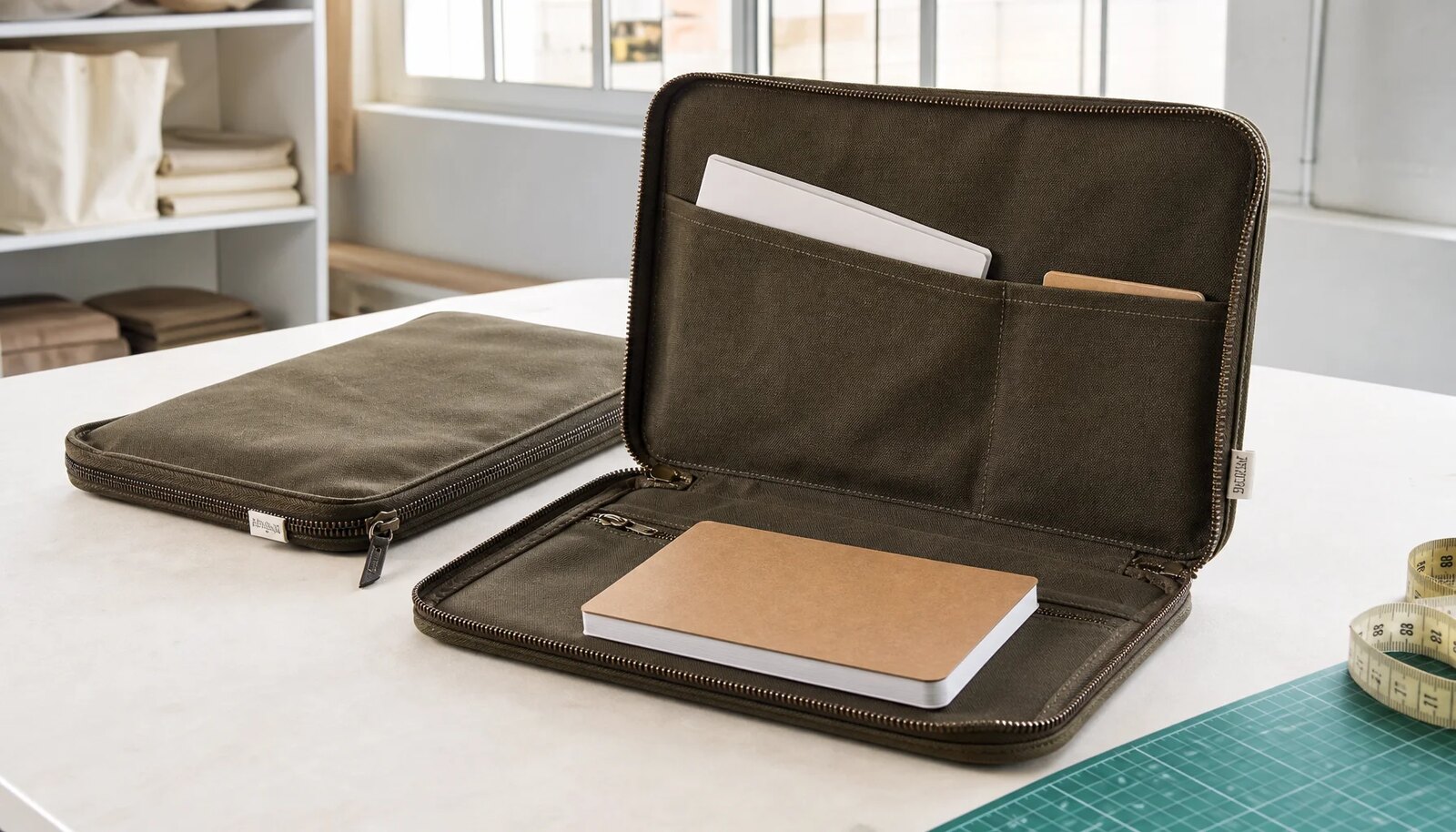
Start With the Use Case, Not the Logo
A custom canvas zipper portfolio is not one fixed product. For event planners, it might hold agendas, speaker notes, badge holders, brochures, a tablet, or a sales deck. That means the RFQ has to start with what the buyer is actually putting inside the portfolio, not with the artwork file. If the factory only gets a logo and a target quantity, it will quote from the nearest generic pouch pattern, and the result is usually a size mismatch or a quote that looks cheaper than the real build. A clear use case gives the factory a reason to price the right fabric weight, gusset depth, zipper size, and internal organization from the start.
The best RFQ describes the content load in practical terms. State whether the portfolio must fit A4 or US letter, how many sheets it needs to hold, whether it must sit flat on a table, and whether it needs to carry a tablet or charger. If the portfolio will be handed out at an event, say so. If it is for a VIP welcome kit or a resale channel, say that too, because those uses create different expectations on finish, packaging, and durability. This is the simplest way to stop suppliers from quoting the wrong product and then defending the wrong spec later.
- Define the contents before the decoration.
- Include finished size, content thickness, and intended use case.
- State whether the portfolio must remain flat, stand upright, or fit inside a kit box.
- Identify if the product is for one-time event use or repeated daily handling.
Choose the Canvas Weight and Construction
Canvas weight drives both cost and perception. A light 10 oz, roughly 340 GSM, can work for a basic event handout, but it wrinkles more easily and feels less structured. A 12 oz canvas, around 400 to 420 GSM, is usually the most practical middle ground for portfolios because it balances body, printability, and cost. If the order is for premium gifting, retail, or repeated field use, a heavier 16 oz canvas, often around 500 to 540 GSM, gives better stiffness and a stronger hand feel. The right answer depends on the contents and the expected life of the product, not on a generic premium label.
Construction matters just as much as weight. Ask whether the canvas is raw, dyed, washed, or pre-shrunk, because each option affects color consistency, shrinkage, and print result. For a zipper portfolio, the gusset is often more important than the face fabric: a 25 to 40 mm gusset can make the difference between a flat document sleeve and a usable carry piece. The zipper should also be specified as a real component, not a vague closure. A #5 or #8 nylon coil zipper is common for smooth opening, while a metal puller or self-lock slider can improve feel if the portfolio is handled frequently.
- Use 12 oz or about 400 to 420 GSM as the default starting point for most event portfolios.
- Move to heavier canvas when the portfolio must keep shape or survive repeated use.
- Specify gusset depth and whether the portfolio needs reinforcement at the zipper ends.
- Do not accept a quote that leaves zipper size, tape color, or puller style undefined.
Define the Layout and Closure Like a Product Engineer
Most quote spread comes from layout decisions, not just material choice. A portfolio with one main compartment is simple to sew and usually holds a better margin of safety on quality. Add one document pocket, a pen loop, a card slot, a zip pocket, or a tablet sleeve, and the production time changes fast. Every extra panel introduces another stitch path, more alignment risk, and more chance of a crooked pocket or a pulled seam. For event use, the simplest workable layout is often the best buying decision because it is easier to approve, easier to pack, and less likely to go out of tolerance in bulk.
Closure design also needs to be explicit. If the zipper runs across the top only, the supplier should show the opening length and the end finish. If the design uses a wraparound zipper or an expandable gusset, the RFQ should include a sketch that shows seam allowance and the position of the zipper tape relative to the finished edge. Buyers should also ask for the expected stuffed thickness, because a portfolio can measure correctly when empty and still fail when filled with printed materials. The supplier should be quoting a real user condition, not a flat empty shell.
- Specify pocket count, pocket depth, pen loop placement, and whether the inner lining must be visible or hidden.
- Attach or request a simple technical sketch with measurements from edge to logo and edge to pocket.
- Call out the required filled thickness, not only the empty size.
- Ask for a stitch or seam detail if the portfolio uses a wraparound or corner zipper path.
Pick the Branding Method That Matches the Run Size
For canvas zipper portfolios, screen print is usually the best value when the logo is flat, bold, and limited to one to four colors. It gives strong color coverage and is generally more durable than quick local decoration when the print area is large. If the logo has fine detail, gradients, or several small elements, heat transfer or digital transfer can be more practical, but the buyer should ask for a rub test and a visual check under daylight before bulk approval. Embroidery can look premium on heavy canvas, but it is not the default choice for thin or lightly structured portfolios because it can distort the face panel and add unwanted bulk at the front.
A woven label or sewn patch is often the safest branding choice when the buyer wants a stable result across lots and does not want to manage print variation. It also works well when the canvas texture is rough or the logo has a very small wordmark that would lose clarity in print. Whatever the method, the RFQ should specify the logo size in millimeters, the position from the top and side edges, the exact Pantone target if color matters, and the acceptable shift in registration. If the portfolio will be used in a visible customer-facing setting, approval should be tied to the actual approval sample, not a digital proof alone.
- Use screen print for simple logos and repeat runs.
- Use transfer methods only if the art needs detail that print cannot hold cleanly.
- Use a woven label or sewn patch when fabric texture or batch consistency matters more than a printed effect.
- Require the same artwork placement on the preproduction sample and the bulk run.
Build the RFQ Around Cost Drivers, Not a Lump Sum
A flat unit price tells procurement almost nothing unless the spec is frozen. Factories price portfolios from a stack of variables: canvas GSM, zipper type, zipper color, lining, number of pockets, decoration method, packaging, and quantity breakpoints. If the buyer only asks for one number, the factory may quietly simplify the build and protect the margin with cheaper inputs. That is why the RFQ should be written as a base spec plus optional upgrades. This makes the quote easier to compare and gives you a way to see which features are actually moving the price.
The cleanest structure is to quote one base version first, then ask for alternates. For example, request pricing for a 12 oz canvas body, one-color screen print, and bulk pack, then ask for a second line with lining, a third with a woven side label, and a fourth with individual polybag plus insert card. That format helps a procurement team compare suppliers on the same basis and avoid paying for features that do not matter to the event. It also exposes hidden assumptions, such as whether artwork setup, zipper color change, or carton mark printing is included or billed separately.
- Request separate line items for fabric, zipper, print, label, packing, and carton work.
- Ask for price breaks by quantity, not only one total quote.
- Confirm whether sample fees and tooling fees are deductible from bulk.
- Make sure the quote states the same Incoterm and the same packing basis across suppliers.
Compare Supplier Routes Before You Compare Price
The sourcing route changes the risks as much as the unit price. A direct factory with in-house sewing and decoration gives the best control if the buyer needs a custom size, a special gusset, or consistent repeat production. A factory that outsources print or label work can still be a good source, but the quote should clearly identify which steps are internal and which are subcontracted. That matters because the longest delay and the widest color variation often sit in the outsourced part, not in the sewing line. A trading company can simplify communication for a buyer handling multiple items in one event kit, but then the buyer has to protect the spec more carefully because the real production site is one step removed.
For urgent events, the route that looks cheapest is not always the route that ships cleanly. A local decorator using stock portfolios can turn a job quickly if the buyer only needs logo branding and can accept standard sizes. The same route becomes weak if the buyer needs a custom gusset, a fixed tablet pocket, or a specific zipper color. Use the route that matches the product complexity and the deadline. If you compare only unit cost, you will miss the risk of rework, the risk of an awkward fit, and the risk of needing a second shipment to recover a missed event date.
- Direct factory: best for control and custom construction.
- Trading company: useful for mixed programs, but verify the actual factory and QC ownership.
- Stock-plus-branding route: useful for speed, but only if the size and layout already fit the contents.
- Pick the route based on fit risk, not just quote price.
Approve Samples Against Measurable QC Thresholds
A sample only has value if the buyer knows what it is supposed to prove. Measure the finished width, height, gusset, opening length, and pocket placement directly on the sample, then compare those numbers to the approved drawing. For a simple canvas portfolio, a practical tolerance is usually around 5 to 10 mm on overall size and 2 to 3 mm on print placement, but the buyer should state the actual tolerance in the RFQ and not leave it to interpretation. The same logic applies to zipper performance: the zipper should run smoothly without snagging the seam allowance, and the slider should not bind at the end stops. If the sample passes only visually, it is too easy for bulk to drift.
The preproduction sample should be built from the same fabric roll, zipper type, thread color, and label method planned for bulk. If the factory swaps those materials later, the buyer is no longer approving the same product. Inspect the stress points where the zipper ends meet the body, the corner seams, and the edge binding if present. For printed portfolios, check color density, bleeding, and rubbing. For sewn labels or patches, check the stitch edge and the lie of the label on the fabric. A good sample is not just attractive; it is a controlled reference for the full run.
- Measure size, gusset, zipper length, and logo position on the physical sample.
- Test the zipper with the expected fill weight, not only when empty.
- Inspect stitch density, thread tension, and corner reinforcement.
- Treat material substitutions after sample approval as a change request.
Specify Packing, Cartons, and Retail Readiness
Packing affects warehouse handling, shipping cost, and the likelihood of damage before the event. Individual polybags keep the canvas clean, but they add labor, plastic, and carton volume. For retail-ready or premium gifting programs, that may be acceptable because presentation matters. For event handouts or conference kits, flat bulk packing is usually better because the product is not being sold as a shelf item and the buyer is trying to protect the cube. If the portfolio has a printed surface, make sure the packing plan will not trap moisture or create surface transfer before the ink is fully cured.
The RFQ should ask for the number of units per inner pack, units per master carton, carton dimensions, and gross weight. Those numbers matter because they feed freight planning and warehouse receiving. If the buyer needs barcodes, inserts, tissue wrap, or a side label, those items should be called out as separate lines so the factory does not assume a different retail standard. Carton marks should be readable and consistent, especially if the order will move through a distributor or a fulfillment center. A clean product can still become a logistics problem if the packing spec is vague.
- Choose bulk packing for event use unless the product is being resold or gifted as a finished retail item.
- Confirm whether individual polybags are required, optional, or prohibited.
- Request carton size and gross weight before approving the shipment plan.
- Add barcode, insert, or tissue requirements only when they serve a real channel need.
Plan Lead Time and Landed Cost Around the Event Date
The schedule risk on a custom portfolio is rarely only the sewing time. Artwork approval, sample roundtrips, fabric sourcing, zipper color matching, and packing signoff all consume calendar days, and they tend to happen one after another instead of in parallel if the RFQ is incomplete. For event planners with a fixed date, the real question is how much correction time exists before production starts. A rush order is only realistic when the spec stays close to stock materials and the decoration is simple. Once the buyer asks for custom size, custom zipper color, multiple pockets, and retail packaging, the schedule can move quickly from manageable to fragile.
Landed cost should be compared on the same build, not on a vague factory quote. The real number includes unit price, sample fees, tooling, packaging, inland freight, export carton cost, and the shipping method the order actually needs. A cheaper ex-factory quote can become the expensive option if the supplier is using heavier carton packaging, larger volume, or a slower sample path that forces air freight to recover time. Procurement teams should ask every supplier to quote on the same Incoterm, the same material grade, and the same packing basis so that the comparison is commercially valid.
- Build in time for at least one correction cycle on artwork or sample details.
- Compare quotes on the same Incoterm and the same carton plan.
- Ask whether sample and tooling fees are one-time or repeat charges.
- Plan freight based on carton cube, not only on unit price.
Specification comparison for buyers
| Spec decision | Recommended option | When it fits | Buyer risk to check |
|---|---|---|---|
| Direct factory with in-house sewing and printing | Use one supplier that controls cutting, stitching, and branding | Best for repeat programs, custom sizing, and tighter spec control | Verify the decoration is truly in-house and not moved to a subcontractor after sample approval |
| Factory with outsourced decoration | Use when the sewing plant is strong but print or label work is external | Works for simple logos and moderate timelines | Confirm which steps are internal, who owns rework, and whether decoration lead time is included in the quote |
| Trading company or sourcing agent | Use for mixed-product programs or buyers who need one contact across several SKUs | Helpful when procurement wants convenience more than factory-level control | Check the real factory name, QC ownership, and whether the markup hides material upgrades or tooling fees |
| Local decorator on imported stock portfolios | Use stock portfolios and add branding locally | Good for urgent events, small runs, and simple logo placement | Stock size may not fit your contents, and the base quality may vary by lot |
| Fully custom size and layout | Specify your own dimensions, pocket map, zipper path, and gusset | Best for branded kits, executive packs, and resale programs | Expect higher MOQ, extra sampling, and more chances for alignment or fit issues |
| Stock size with custom logo only | Keep the body spec standard and change only decoration | Good for first-time buys and pilot orders | The product may look generic if the color, label, and packaging do not carry the brand well |
| Pilot order below normal MOQ | Use a small validation run before the full program | Fits new concepts or uncertain event demand | Price may rise, fabric lots may vary, and color matching may be looser than on a full run |
| Retail-ready individually packed | Add polybag, insert card, barcode, and carton marks | For resale, premium gifting, or distributor channels | Check carton cube, plastic compliance, and whether extra packing slows the line or raises damage risk |
Buyer checklist before sampling
- State the exact use case: agenda holder, proposal pack, tablet sleeve, speaker kit, or retail portfolio.
- Lock finished size, gusset depth, and the max content thickness in millimeters or inches.
- Choose canvas weight in GSM or oz, then note whether the fabric is raw, dyed, or washed.
- Specify zipper size, zipper tape color, puller type, and whether the zipper must run smoothly around the corners.
- Define decoration method, logo size, placement, Pantone target, and acceptable register tolerance.
- Set the required packaging format: bulk pack, individual polybag, tissue wrap, insert card, or retail barcode label.
- Request a preproduction sample from the same fabric, zipper, and label method intended for bulk.
- Ask for carton size, units per carton, gross weight, and shipping mode assumptions before accepting the quote.
Factory quote questions to send
- What canvas weight, weave type, and finish are you quoting, and can you confirm the GSM tolerance?
- Is the zipper in-house sourced, and what size, color, and puller style is included in the quote?
- Which decoration method are you pricing, how many colors or stitch paths are included, and what setup fee applies?
- What is the MOQ by fabric color, print color, and packaging style, not only the total order quantity?
- What sample fee, tooling fee, and artwork correction charge apply, and are any of them deductible from bulk?
- What is the lead time for sample, preproduction approval, and bulk production separately?
- What carton size, units per carton, and master carton weight are you planning for this order?
- What tolerance do you allow for size, print placement, stitch quality, and zipper function on bulk goods?
- Can you show the same spec on a recent production photo, not only a sample room image?
- Which steps are internal and which are subcontracted, especially printing, labels, packing, and carton marking?
Quality-control points to confirm
- Finished size matches the approved sample within an agreed tolerance, with the gusset and pocket placement aligned to the drawing.
- Canvas weight, color, and surface finish match the approved reference, with no obvious lot variation across cartons.
- Zipper opens and closes smoothly, stays aligned at the ends, and does not snag the seam allowance or binding.
- Stitching is even, thread color matches the spec, and stress points at corners and zipper ends are reinforced cleanly.
- Logo placement is centered or positioned as approved, with no blur, ghosting, heat marks, or color shift outside tolerance.
- Print or label adhesion holds under normal handling, with no peeling, puckering, or frayed edge on patches and woven labels.
- Interior finish is clean, with trimmed threads, no oil marks, no loose fibers, and no sharp edges on hardware.
- Carton pack-out matches the approved packing list, with the correct count, barcode, and master carton mark on every case.