Start with the Job the Portfolio Must Do
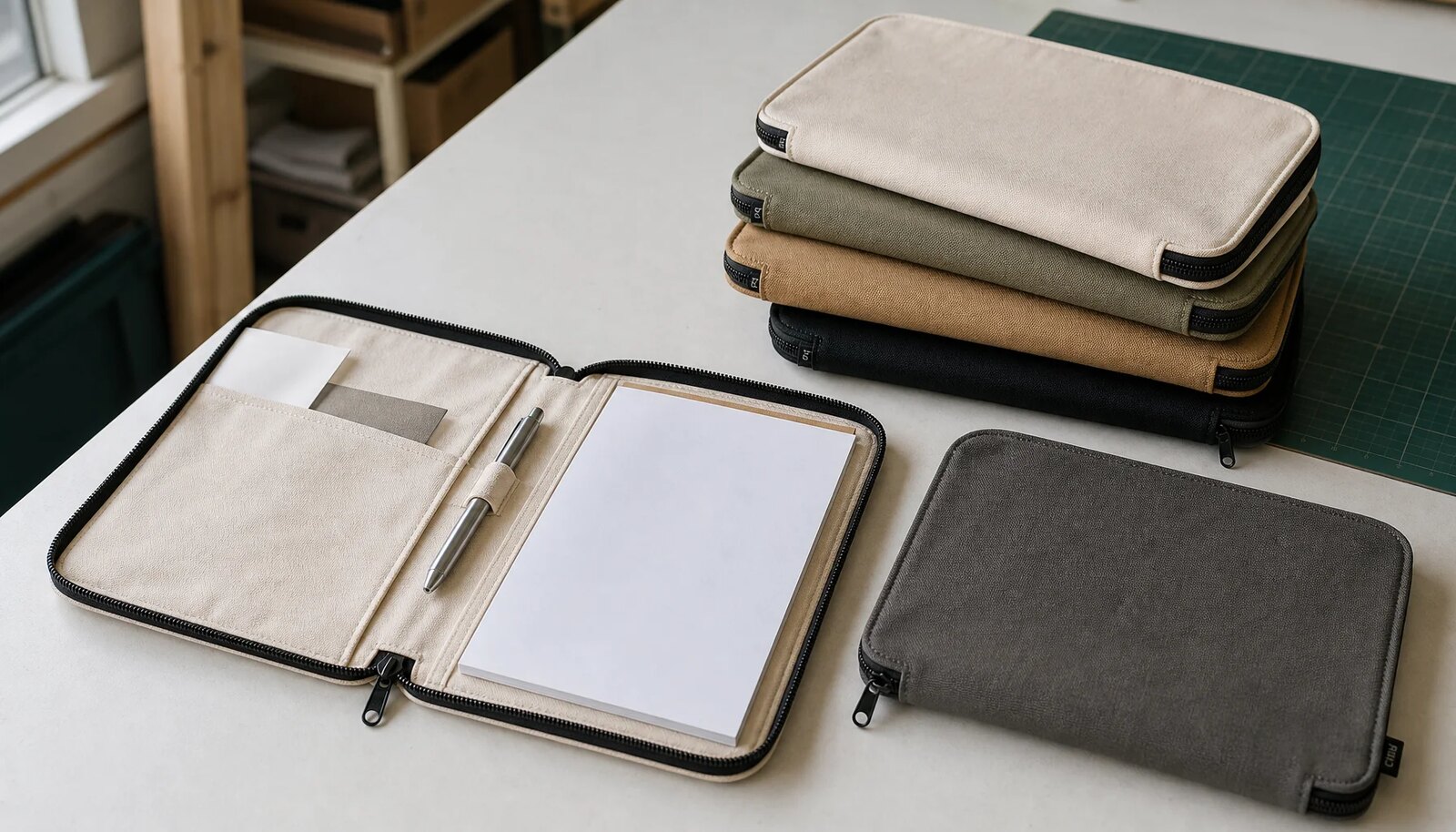
A useful RFQ for custom canvas zipper portfolios does not begin with a product photo. It begins with the work the item has to handle at the craft fair. The same flat zipper portfolio can become a low-cost giveaway, a reusable buyer document wallet, a retail product, a wholesale catalog holder, a tablet sleeve, or a kit pouch for small craft supplies. Those uses may look similar in a mockup, but they need different fabric weight, zipper path, pocket layout, logo testing, and packing protection.
Give the factory a short use statement before asking for price. For example: this portfolio must hold US letter order forms, a 16-page catalog, two sample cards, and a pen; it will be sold at craft fairs and shipped in export cartons; zipper pulls must not mark the printed front panel during transit; finished goods must arrive before a fixed event date. That one paragraph gives the supplier context that a reference image cannot provide.
Craft fair products are handled more than many office accessories. Booth staff open and close zippers throughout the day. Customers pick up, stack, and flip items on display tables. Distributors may split cartons by region or by event. Those movements affect zipper strength, print rub resistance, carton packing, barcode labeling, and cosmetic standards. A portfolio sold at retail usually needs a cleaner surface and tighter finishing than a portfolio used inside a vendor welcome kit.
Also state what cannot change. If the program requires natural unbleached canvas, a No. 5 black zipper, a woven side label, and paper belly band packing, put those points in the RFQ as fixed requirements. If you can accept substitutions to protect an event deadline, name the acceptable alternatives and require written approval before the supplier uses them.
- Identify the use case as giveaway, retail resale, vendor kit, buyer document pack, tablet sleeve, catalog wallet, or flat craft kit.
- List real contents by size, thickness, stiffness, and quantity instead of writing only documents or samples.
- State the event date, warehouse arrival date, and latest acceptable inspection date.
- Rank the buying priority: lowest unit cost, retail appearance, fast lead time, lower plastic packing, or long-term reuse.
- Separate fixed specifications from optional alternatives so the supplier knows where it may optimize.
Specify Size, Fit, and Construction Precisely
Canvas zipper portfolios should be quoted by two sizes: the finished external size and the usable internal clearance. A line such as fits A4 or fits US letter is not enough. Seam allowance, zipper tape, binding, lining, and pocket layers all reduce the space available inside. If documents must slide in without bent corners, state the paper size and the clearance required after sewing.
Use millimeters as the control unit. Inches can be included for internal teams, but millimeters reduce ambiguity with overseas factories and inspectors. For many flat canvas portfolios, a workable starting tolerance is +/-5 mm for smaller sizes and +/-8 mm for larger document portfolios. Washed canvas, padded construction, and very soft unstructured fabric may need a wider approved tolerance. If fit is critical, close the approved sample with the actual contents inside.
Construction words need measurable meaning. State whether the portfolio is flat, gusseted, padded, lined, unlined, bound-edge, turned-seam, square-corner, or rounded-corner. A straight top zipper is usually simpler to sew and inspect. An L-shape or three-side zipper gives better access to catalogs, tablets, sample boards, and craft kits, but it raises the risk at corners if the radius is too tight or the canvas is too heavy.
If the portfolio needs to hold a tablet, hardcover catalog, rigid sample board, or craft kit, send a dimensioned dummy or physical sample during development. Thickness changes how the zipper closes, how the corners sit, and how the carton compresses. A factory can estimate from drawings, but a fit sample with real contents is much safer when capacity is a critical requirement.
- State finished external length and width, usable internal length and width, and gusset depth if any.
- Define tolerance in millimeters and mark which dimensions are critical to fit.
- Specify flat, gusseted, padded, lined, unlined, bound-edge, or turned-seam construction.
- Provide corner radius for rounded designs, especially when the zipper turns around the corner.
- Test the fit sample with the real contents inserted and the zipper fully closed.
Choose Canvas by Weight, Handfeel, and Finish
Canvas affects cost, handfeel, sewing difficulty, appearance, and freight weight. For many custom canvas zipper portfolios used as craft fair buyer packets or retail business bags, 10 oz to 12 oz cotton canvas is a practical range. That is roughly 270-340 GSM depending on weave. It has more body than lightweight tote fabric but usually avoids the worst zipper seam bulk of very heavy canvas.
Do not let the word premium carry the specification. Ask the supplier to quote fabric in both oz and GSM, confirm composition, and say whether the weight is measured before or after washing, dyeing, coating, or finishing. Two fabrics can share a GSM and still feel different because the weave, yarn count, finishing, or washing process is different. A physical swatch remains the best way to approve handfeel.
Natural canvas fits many maker and craft-market brands, but it often includes yarn variation and slubs. That character should be approved before cutting. A small slub outside the logo area may be acceptable; a dark fiber through the brand mark, an oil mark, mildew odor, hole, or handling stain is not the same thing. Bleached canvas gives a cleaner print base but can show dirt more quickly. Dyed canvas supports brand color programs, yet it needs lab dip approval, shade-lot control, and dye transfer review.
Heavyweight canvas, such as 14 oz and above, can look substantial, but it is not automatically better. It can make seams thick, corners stiff, zipper curves harder to sew, and cartons heavier. If the design calls for a heavier build, sample the zipper path, corner radius, stitch quality, and packed carton before committing to bulk production.
- Request canvas weight in oz and GSM, plus composition, weave, and finish.
- Approve natural, bleached, dyed, washed, recycled blend, or organic cotton as separate specifications.
- For dyed canvas, require lab dip approval and confirm whether bulk cutting waits for shade approval.
- For washed canvas, confirm shrinkage control and whether finished-size tolerance changes.
- Define acceptable slubs separately from rejectable stains, contamination, holes, and handling marks.
Lock the Zipper Before Comparing Price
The zipper is not a minor trim. It is the part the buyer, booth staff, and end customer will use most often. A No. 5 nylon coil zipper is a common baseline for canvas zipper portfolios because it balances flexibility, strength, and cost. It can work across a straight top opening and, when sewn correctly, around a moderate radius. Smaller zippers may save cost but can feel weak on heavier canvas. Metal zippers add weight and may scratch documents or printed panels.
Write the zipper specification in full: zipper size, coil or metal type, tape width, tape color, teeth color, slider finish, puller style, pull direction, end stop, and reinforcement. If you want a branded pull tab, cotton cord, leather tab, custom metal puller, or color-matched tape, ask whether it changes MOQ, sample timing, tooling, or component lead time.
Zipper path changes cost and production risk. A straight top zipper is efficient and easier to inspect. An L-shape or three-side zipper makes the portfolio easier to open wide, which helps with catalogs, tablet inserts, sample cards, and flat kits. The tradeoff is corner control. On heavy canvas, a tight turn can cause slider drag, puckering, skipped stitches, and uneven teeth alignment.
Inspection should test use, not just appearance. Open and close samples repeatedly. Check for catching, rough slider movement, tape twisting, teeth gaps, puller weakness, and zipper-end reinforcement. If the packed cartons will be compressed, ask the supplier to check whether the slider or puller leaves pressure marks on the printed panel.
- Use No. 5 nylon coil zipper as a practical baseline unless the design requires another zipper type.
- Specify tape color, teeth color, slider finish, puller material, pull direction, and zipper path.
- Require zipper-end reinforcement or secure back-tacks at stress points.
- Confirm MOQ and lead time for custom tape colors, special pullers, or branded tabs.
- Inspect zipper operation with real contents inserted, not only on an empty sample.
Match Logo Method to the Artwork
Logo method should match the artwork, fabric color, order quantity, and desired handfeel. Screen printing is usually efficient for solid artwork, event logos, and one to three color graphics on cotton canvas. It still needs control: ink type, opacity, curing, placement, and rub resistance. Natural canvas texture will show through more than it would on coated paper, so a physical strike-off tells you more than a digital mockup.
Dark or dyed canvas often needs an underbase for light artwork. The underbase can improve opacity, but it may raise cost and create a heavier print hand. Thick ink coverage near folds, zipper seams, or areas compressed in packing should be tested. Poor curing or excessive ink thickness can lead to cracking, tackiness, or rub failure.
Woven labels are useful when the buyer wants consistent branding across several bag styles or a quieter premium look. The label has its own specification: yarn colors, size, fold type, edge finish, back coating, sewing placement, and MOQ. Embroidery can work for simple marks, but small lettering on coarse canvas can lose clarity and dense embroidery can pucker the panel. Heat transfer can support gradients and fine detail, but adhesion and handfeel must be tested on the selected canvas.
The RFQ should include vector artwork, Pantone or brand color references, finished logo dimensions, placement from fixed edges or seams, and approval criteria. Avoid vague notes such as place logo like mockup. The mockup shows design intent; production needs measured placement.
- Provide vector artwork and Pantone references with each RFQ.
- State logo size and placement from fixed edges, zipper seams, or centerlines.
- Keep artwork at least 20-30 mm from zipper seams unless a sample proves closer placement works.
- For screen print, approve strike-off color, opacity, curing, dry rub, and tape adhesion.
- For woven labels, specify label size, fold type, yarn colors, position, and label MOQ.
Design Interior Features Around Real Use
Interior layout should help craft fair workflows without turning the portfolio into an overbuilt organizer. A practical layout is often one main compartment, one flat slip pocket, and an optional pen loop or card slot. That can cover order forms, price sheets, wholesale catalogs, business cards, receipts, swatches, vendor passes, or workshop notes. Every extra pocket adds cutting, sewing, alignment, inspection time, and bulk near the zipper.
Pocket dimensions should be written as finished sizes, not rough descriptions. A slip pocket must be deep enough to hold papers but not so deep that the user struggles to retrieve them. A card slot should fit the actual card size and still allow finger access. A pen loop should be tested with the specified pen diameter and placed where it will not press into the zipper teeth or create a visible bump under the front logo panel.
Lining is another procurement choice. An unlined portfolio is lighter, simpler, and often suitable for event use. A lined portfolio can feel more finished and hide interior seams, but it adds material cost, sewing time, and the possibility of twisting if the outer canvas and lining behave differently. Cotton lining supports a natural material story. Polyester lining may reduce friction and improve wipeability.
For retail resale, interior finishing becomes part of perceived value. Binding, folded pocket edges, label alignment, thread trimming, and seam cleanliness all matter. For giveaways, a simpler interior may protect budget and lead time. Ask suppliers to quote required features and optional alternates separately so buyers can see the cost impact.
- Define each pocket by finished size, depth, opening direction, and placement.
- Specify whether the portfolio is unlined, cotton lined, polyester lined, or bound-edge.
- Approve pen loop size using a real pen diameter or named standard.
- Avoid bulky pocket layers under zipper corners or front-logo areas.
- Request an alternate quote with fewer pockets if cost or lead time is tight.
Separate MOQ, Price Breaks, and Assumptions
MOQ is rarely set by the sewing line alone. Fabric mills, dye houses, zipper suppliers, label makers, print shops, and packing suppliers can each have their own minimums. A supplier may offer 500 pieces when the order uses stock natural canvas, stock black zipper tape, standard thread, one-color screen print, and plain packing. The same design with dyed canvas, custom zipper tape, branded puller, woven label, and retail sleeve may need a higher commitment.
Ask for MOQ by component, not only by finished portfolio. This shows which customization choices create the largest cost or quantity jump. For a first craft fair launch, a stock canvas body with a stock zipper and a strong print or label may be the best balance. Once demand is proven, the next run can add dyed fabric, custom pullers, or more developed retail packing.
Price breaks should be tied to realistic quantities. Ask at 500, 1000, 3000, and 5000 pieces, or ask the factory to provide its most efficient production ladder. Cutting, print setup, sewing line setup, QC, and packing all include fixed costs. Sometimes a small quantity increase does nothing. Other times, reaching a component MOQ or a better cutting batch can lower the unit price.
When comparing factories, review every assumption behind the quote. A low unit price may exclude screen charges, sample freight, barcode labels, custom cartons, inspection support, or inland delivery to port. It may also rely on lighter canvas, a smaller zipper, fewer stitches per inch, or looser packing. A clear custom canvas zipper portfolios RFQ template makes those differences visible before the purchase order is approved.
- Request MOQ for fabric color, zipper tape, puller, logo, woven label, hangtag, barcode label, and packing.
- Ask whether mixed colorways, mixed artworks, or split shipments can share one production run.
- Require price breaks and identify which breakpoints are material-driven versus labor-driven.
- Clarify whether leftover custom components must be purchased by the buyer.
- Ask suppliers to list exclusions so setup and packing costs are not hidden.
Use a Quote Sheet Built for Landed Cost
A quote-ready RFQ should make every supplier answer in the same structure. Unit price alone is not enough for B2B procurement. Buyers also need sample cost, setup cost, MOQ, price ladder, production lead time, material lead time, packing method, carton quantity, carton dimensions, gross weight, payment terms, quote validity, and trade term. Without those fields, a team can easily compare EXW pricing with FOB pricing or overlook carton volume that affects freight.
Canvas zipper portfolios are not especially dense products. Larger dimensions, heavier canvas, individual retail sleeves, rigid inserts, and low carton quantities can increase freight and warehouse handling costs. A supplier with a slightly higher unit price may still be a better landed-cost option if packing protects the print, carton data is accurate, and defect risk is lower.
Timing should be broken into stages. Ask for component sourcing time, first sample time, revision time, pre-production sample timing, bulk production after approval, inspection window, and export handover timing. Craft fair orders usually have fixed event dates, so the calendar must include sampling and inspection buffers, not only the bulk sewing days.
Trade terms must be controlled. EXW, FOB, CIF, DDP, and delivered warehouse prices are not interchangeable. If internal approval is based on landed cost, request the preferred term and allow optional terms in separate fields. Record quote validity and clarify when the price becomes firm, such as after artwork approval, deposit, or bulk material booking.
- Require unit price, setup charges, sample charges, packing cost, carton data, gross weight, and trade term.
- Ask whether print screens, label development, hangtags, barcodes, carton marks, and export cartons are included.
- Separate EXW, FOB, CIF, DDP, or delivered warehouse assumptions.
- Request lead time by sample, material booking, bulk production, inspection, and export handover.
- Record quote validity and the condition that locks the price.
Approve Samples Before Bulk Cutting
Sampling is the best time to catch problems while they are still inexpensive to fix. A fit sample should confirm size, usable internal clearance, zipper path, corner behavior, pocket layout, seam bulk, and handfeel. It does not always need final artwork, but it should use a fabric weight and construction close enough to expose sewing and fit issues.
Artwork should be approved through a strike-off or printed sample when color, opacity, placement, or fine detail matters. A digital mockup cannot show ink absorption, curing, rub resistance, texture interaction, or how the print looks after the portfolio is folded and packed. For woven labels, approve label artwork, yarn colors, fold type, edge finish, and sewing position before bulk label production.
The pre-production sample should become the final control sample. It should use the same canvas, zipper, thread, logo method, label, pocket layout, and packing planned for the order. If any component is substituted during sampling, the supplier should state it in writing and provide a final confirmation before bulk cutting. A hand-selected sample made with non-bulk components is not a reliable inspection standard.
Sample comments should be measurable. Instead of move logo slightly higher, write move logo center 15 mm upward and maintain 30 mm clearance from the zipper seam. Instead of zipper feels poor, write slider resistance is high at the left radius and zipper tape waves after closing. Specific comments reduce revision cycles and protect the event schedule.
- Approve a fit sample for size, clearance, zipper path, pocket layout, and construction.
- Approve fabric swatch or lab dip before cutting dyed or washed fabric.
- Approve print strike-off for color, opacity, curing, adhesion, and placement.
- Approve a pre-production sample made with final bulk components.
- Approve unit packing or packed-carton test when logo protection or retail presentation matters.
Write QC Criteria Inspectors Can Apply
Quality standards should be written in production language, not broad phrases such as good quality or export standard. For custom canvas zipper portfolios, critical defects may include a broken zipper, wrong item, wrong artwork, severe stain, mold odor, unsafe sharp hardware, missing components, or incorrect quantity. Major defects may include zipper jamming, open seams, loose back-tacks, wrong fabric color, visible print misplacement, heavy shade variation, pocket misplacement, or twisted lining. Minor defects may include small thread ends, slight wrinkles, or approved natural slubs outside logo zones.
AQL inspection can be used, but the defect list needs to match this product. The inspector should check finished dimensions, usable internal clearance, zipper function, seam integrity, stitch consistency, logo placement, print adhesion, pocket dimensions, label placement, unit packing, carton marks, and carton weight. If the product is for retail resale, cosmetic standards should be tighter than for an internal event giveaway.
Print QC should happen after curing. Basic dry rub and tape adhesion checks help identify weak curing or poor adhesion. Color should be compared with the approved strike-off under consistent lighting. Placement should be measured from fixed edges, seams, centerlines, or approved templates. For embroidery, inspect thread color, stitch density, backing, puckering, and legibility of small text.
Packing QC matters because canvas can absorb dust, odor, and humidity. Zipper sliders and pullers can emboss or scratch printed panels when cartons are compressed. Random cartons should be opened after packing to check abrasion, folding marks, odor, moisture, barcode accuracy, carton count, and packing sequence. Carton gross weight should also match the buyer's warehouse handling rules.
- Define critical, major, and minor defects before inspection day.
- Measure size, logo placement, pocket placement, and label placement against written tolerances.
- Open and close zippers repeatedly, especially at corners and zipper ends.
- Reject oil marks, mildew odor, holes, open seams, broken stitches, and severe shade mismatch.
- Use the approved pre-production sample as the control for handfeel, construction, print, and packing.
Specification comparison for buyers
| RFQ decision | Recommended specification | Best-fit buying scenario | Procurement risk to confirm |
|---|---|---|---|
| Finished size | Quote by finished external size and usable internal clearance; state tolerance, commonly +/-5 mm for small flat portfolios and +/-8 mm for larger document sizes unless approved otherwise | A4 or US letter document wallets, buyer order packs, catalog holders, tablet sleeves, flat craft kits, or retail zipper portfolios | A portfolio sized only to the paper dimension may become too tight after seam allowance, zipper tape, lining, and pocket bulk reduce usable space |
| Canvas weight | 10 oz to 12 oz cotton canvas, about 270-340 GSM depending on weave; approve handfeel and thickness on a physical swatch | Reusable craft fair portfolios, wholesale buyer packs, booth documents, and retail-ready business bags | Below about 260 GSM can feel limp; above about 380 GSM can increase seam bulk, corner puckering, needle damage, and freight weight |
| Canvas finish | Natural, bleached, dyed, washed, recycled cotton blend, or organic cotton only if stated; record shade standard, shrinkage target, and allowable slubs | Natural canvas suits maker brands; dyed canvas supports brand color programs; washed canvas gives a softer handfeel | Uncontrolled shade lots, fabric slubs in print areas, post-wash shrinkage, or dye transfer can cause bulk rejection disputes |
| Zipper construction | No. 5 nylon coil zipper as a common default; specify tape width, tape color, teeth color, slider finish, puller type, and end reinforcement | Repeated opening at craft fairs, catalog access, retail use, and flat export packing | Low-grade zippers may wave, jam at corners, split under tension, catch canvas fibers, or emboss printed panels during carton compression |
| Zipper path | Straight top zipper for economy; L-shape or three-side zipper with tested corner radius for full access | Straight opening for simple document sleeves; three-side opening for catalogs, tablet inserts, sample cards, or craft kits | Tight zipper corners on heavy canvas can create puckering, skipped stitches, slider resistance, and higher inspection rejects |
| Logo method | Screen print for solid artwork; woven label for reusable branding; embroidery or heat transfer only after sample testing | Screen print for event merchandise and wholesale packs; labels for multi-style brand programs; embroidery for simple premium marks | Under-cured ink can crack or fail rub tests; embroidery can distort small type; label MOQ may differ from sewing MOQ |
| Internal layout | One main compartment, one flat slip pocket, optional card slot or pen loop; define finished pocket dimensions and placement | Order forms, price sheets, swatches, business cards, vendor passes, receipts, or stationery sets | Too many pockets raise labor cost, create uneven thickness, reduce internal clearance, and cause zipper pressure points |
| MOQ structure | Request MOQ by body fabric, dyed fabric color, zipper tape color, puller, logo method, woven label, hangtag, barcode label, and retail packing | Helps buyers compare a stock-material launch order against a fully customized retail program | A low headline MOQ may depend on stock materials; custom fabric, labels, or packing can trigger separate minimums and overage charges |
| Packing method | Individual polybag, recycled polybag, glassine bag, paper belly band, retail sleeve, or carton bulk pack; define abrasion, moisture, and odor control | Polybag protects print; paper band supports plastic-reduction goals; retail sleeve supports shelf presentation and barcode needs | Natural canvas can absorb dust, odor, and humidity; zipper sliders can mark printed panels if units are compressed without protection |
Buyer checklist before sampling
- Define the commercial use: giveaway, retail resale, buyer document wallet, vendor welcome kit, catalog holder, tablet accessory sleeve, workshop kit, or flat craft merchandise set.
- State finished external dimensions, usable internal dimensions, gusset depth if any, corner radius, zipper path, and dimensional tolerance in millimeters.
- List the exact contents to be inserted, including paper size, catalog thickness, sample card stiffness, pen diameter, tablet model with case, or craft kit component thickness.
- Specify canvas composition, oz, GSM, weave, finish, shade standard, shrinkage expectation, handfeel sample, and whether slubs are acceptable on logo-facing panels.
- Lock zipper details: size, coil or metal type, tape width, tape color, teeth color, slider finish, puller style, pull direction, end stops, and reinforcement at zipper ends.
- Provide vector artwork, Pantone or brand references, print size, placement from fixed seams or edges, maximum printable area, and rules for artwork near folds, pockets, or zipper zones.
- Define logo testing: strike-off approval, dry rub check, tape adhesion check, curing confirmation, embroidery legibility review, or woven label color approval as applicable.
- Break sample stages into fit sample, fabric swatch or lab dip, print strike-off, pre-production sample, packed sample, and final approval deadline before bulk cutting.
- Ask for MOQ and price ladders by component, including fabric color, zipper tape, slider, puller, print, woven label, hangtag, barcode label, belly band, and retail packing.
- Require a quote sheet with unit price, setup charges, sample charges, sample freight, carton quantity, carton dimensions, gross weight, lead time, payment terms, quote validity, and trade term.
Factory quote questions to send
- What exact canvas is included in the quote, in oz and GSM, and is that weight measured before or after washing, dyeing, coating, or finishing?
- Can you confirm fabric composition, weave, finish, stock availability, shrinkage control method, color lot control, and whether the fabric is already in-house or must be ordered?
- If certified organic cotton, recycled cotton, or other claimed material is requested, which certificates, transaction documents, or scope documents can you provide before bulk production?
- What finished external size and usable internal size do you recommend for our stated contents, and what tolerance can your line hold in normal bulk production?
- What seam allowance, stitch density, thread type, edge finish, corner radius, lining construction, and reinforcement points are included in this quotation?
- What zipper size, coil type, tape width, slider grade, puller style, pull direction, end stop, and zipper path are included, and which changes trigger separate MOQ?
- Can your sewing line run the requested zipper corner radius smoothly on the selected canvas weight, and can the sample be tested with our intended contents inserted?
- Which logo method do you recommend for our artwork and fabric color, and what tests do you perform for curing, rub resistance, adhesion, opacity, color matching, or embroidery clarity?
- What is the MOQ by body fabric color, zipper tape color, puller, printed artwork, woven label, hangtag, barcode label, belly band, and retail packing method?
- Please quote price breaks at 500, 1000, 3000, and 5000 pieces, or provide your closest efficient production price ladder with the assumptions behind each break.
Quality-control points to confirm
- Finished external size should stay within the written tolerance, commonly +/-5 mm for smaller flat portfolios and +/-8 mm for larger document portfolios unless washed fabric or padded construction is approved with a wider range.
- Usable internal clearance must be checked with the buyer's actual intended contents inserted because zipper tape, seam allowance, lining, binding, and inner pockets reduce practical capacity.
- Zipper operation should be checked repeatedly, for example 5-10 open-close cycles on inspection samples, with attention to slider resistance, catching, teeth gaps, tape twisting, and corner drag.
- Zipper ends and pull areas should have secure back-tacks or reinforcement, with no loose stops, sharp burrs, puller detachment, or fabric fraying near stress points.
- Seams should show even stitch density, balanced tension, no broken threads, no skipped stitches, no open seams, no needle cuts, and secure thread trimming.
- Print should match the approved strike-off for size, placement, color direction, opacity, edge sharpness, and handfeel, and should pass agreed dry rub and tape adhesion checks after curing.
- Logo placement should be measured from fixed edges, zipper seams, centerlines, or approved templates, not judged only by eye from a product photo.
- Canvas panels should be free from oil marks, mildew odor, heavy contamination, holes, needle damage, dye streaks, excessive shade variation, and dark fibers that interrupt logo readability.
- Natural canvas character must be defined before cutting; acceptable yarn variation should be separated from stains, weaving faults, foreign fibers, or handling marks.
- Inner pockets, pen loops, card slots, document sleeves, and labels must match approved finished dimensions and placement so contents do not bend, slide out, or press into the zipper.