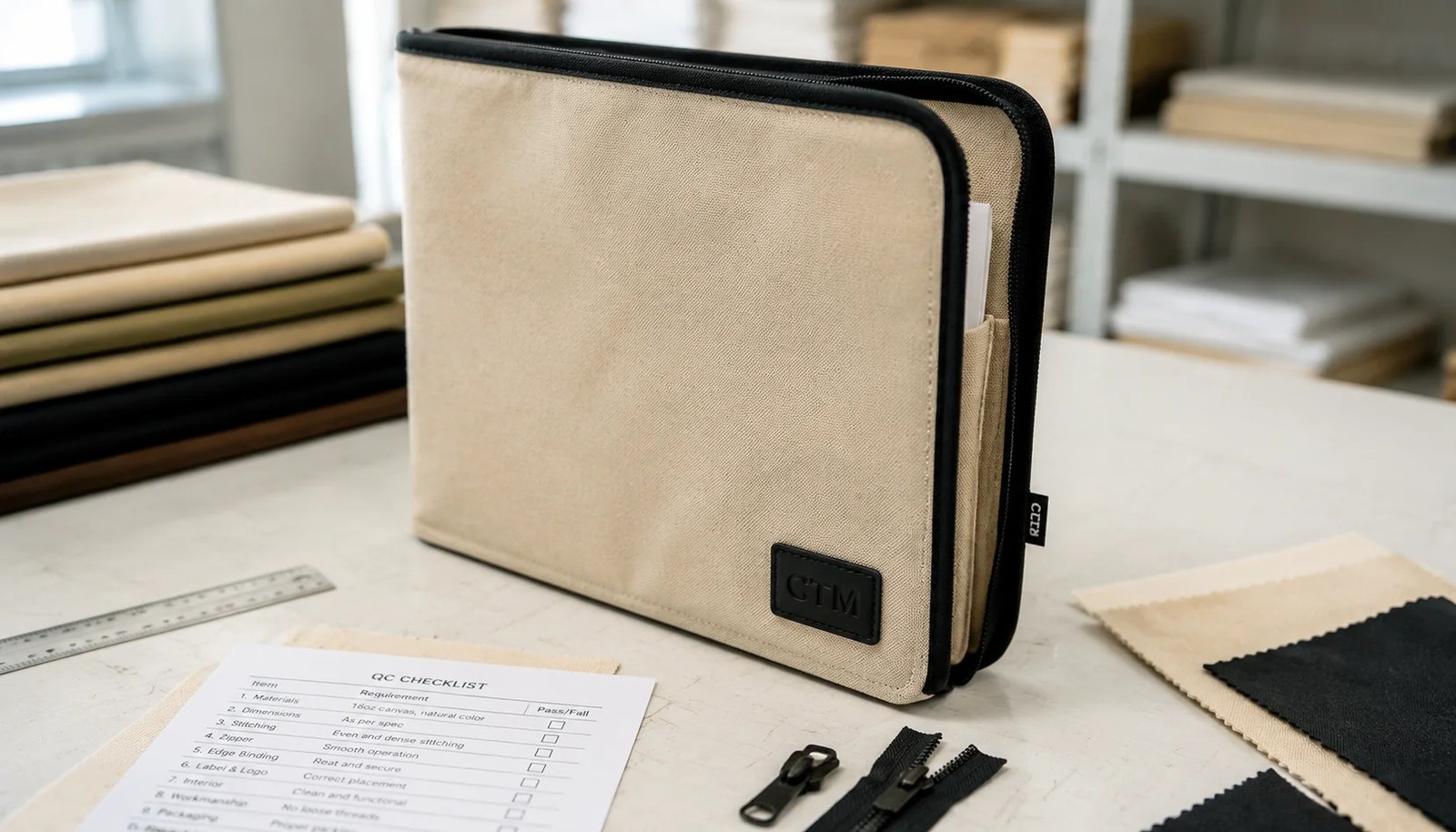
Why this product fails inspection more often than buyers expect
A custom canvas zipper portfolio looks simple on a quote sheet: two canvas panels, one zipper, some internal sleeves, and a logo. In production, it is less forgiving than a tote bag because shape, edge tension, zipper curve, and panel stability all have to work together. Skincare brands usually use these portfolios for training materials, launch documents, treatment menus, distributor packs, or premium gifting inserts. That means the product gets opened repeatedly, handled in front of clients, and judged as a brand object, not just a utility pouch.
The main buying problem is that many quotations hide construction shortcuts that only appear after sewing starts or after shipment arrives. A factory may price a light canvas, a weak slider, or a loose lining attachment to win the order. The portfolio can still pass a quick visual review at first glance, but then corners wrinkle, prints crack on fold points, or zipper action becomes rough after a few uses. A proper QC checklist has to start before production, with a specification package built around failure points rather than broad design language.
- High-risk areas: zipper corner shaping, panel squareness, lining bunching, logo placement, and inside pocket depth
- Most hidden cost drivers: fabric weight, zipper grade, interior complexity, logo method, and retail packing
- Most common quote mismatch: supplier prices a file folder style while buyer intended a structured portfolio with lining and pockets
Set the right base specification before comparing quotes
For skincare buyers, the first decision is the use environment. If the portfolio carries printed treatment menus, training leaflets, and sales order forms, a soft 12 oz canvas may be enough. If it is intended for premium distributor presentations or should hold a tablet, catalogues, or sample sachets, a stronger 14 oz to 16 oz canvas gives better edge stability. In GSM terms, that means roughly 407 GSM at 12 oz, 475 GSM at 14 oz, and 542 GSM at 16 oz. These ranges matter because zipper portfolios need enough body to stay square when opened and closed.
Lining also affects quality more than buyers expect. A 210D polyester lining is practical for skincare use because it wipes clean and adds less bulk. An 8 oz cotton lining can support a natural or eco-led brand story, but it increases seam thickness and can shift more during sewing. If the product includes internal pockets, document sleeves, card slots, or elastic holders, each extra feature adds stitch points and tolerance issues. A clean internal layout often gives a better retail result than trying to duplicate every office organizer feature.
- Practical outer fabric range: 12 oz to 16 oz canvas for most zipper portfolios
- Light-duty economy builds below 10 oz are more likely to collapse and print poorly
- Useful interior setup: document sleeve, one zip pocket, pen loop, simple card slot only if actually used
- State finished dimensions in millimeters or inches plus tolerance, for example 260 x 340 x 25 mm, tolerance +/-5 mm
How logo method changes quality risk and unit cost
Skincare brands often want a clean premium look, but the best logo method depends on both artwork and canvas texture. Screen printing works well for solid logos and medium to large graphics, especially on natural or dyed canvas. It is usually the most efficient option at volume because setup cost is spread across production and print speed is high. On textured canvas, however, very fine lines can break up, especially if the canvas surface is irregular or washed after printing.
A woven label or sewn side label is a safer option for small brand marks, batch programs, or multi-market labeling. A debossed PU patch can look more premium for PR kits or field teams, but it adds material, labor, and another attachment step. Embroidery looks durable but can distort lighter fabric and show thread backing inside unless the construction is planned from the start. Buyers should compare quotes based on the exact logo method, logo size, placement, and number of print colors. Otherwise one supplier may quote a one-color screen print while another includes a sewn patch and the unit prices become impossible to benchmark.
- Screen print: best for solid artwork and volume efficiency
- Woven label: best for smaller marks and lower visual risk on textured canvas
- Debossed patch: best for premium branded kits with higher budget tolerance
- Embroidery: use carefully on heavier canvas or reinforced panels only
- Critical sample approval item: logo placement tolerance, often +/-3 mm to +/-5 mm depending on size
MOQ logic and why low-volume custom orders get expensive fast
Buyers often assume a zipper portfolio is just a variation of a tote bag and should carry the same MOQ flexibility. In practice, MOQ rises because there are more cut parts, more trim combinations, and more sample variables. A factory may accept 300 pieces, but the price can increase sharply if the order requires custom-dyed canvas, matching zipper tape, custom pullers, multiple interior compartments, or branded labels. For many importers, the more efficient MOQ range is 500 to 1000 pieces per colorway when using a standard construction and one logo method.
The reason is simple: setup costs do not disappear on small runs. Screen preparation, cutting markers, interior pocket templates, operator handling time, and packing standards all remain. If a buyer wants two colorways at 250 pieces each, the factory may either charge a high unit price or substitute stock materials to keep the order workable. For quote comparison, always ask for price breaks at 500, 1000, 2000, and 5000 pieces and list what changes at each tier. The difference between stock natural canvas and custom dyed canvas alone can change both MOQ and lead time.
- Typical custom MOQ: 500-1000 pcs per colorway for efficient production
- Lower MOQ often means stock fabric, fewer trim options, or higher setup allocation per piece
- Price break review should separate sample charges, print setup, mold or patch setup, and bulk unit price
- If multiple SKUs share the same body and only the label changes, ask whether MOQ can be combined
Pre-production samples: what must be approved before bulk starts
A lab dip or fabric swatch is not enough for this category. Buyers need a full pre-production sample made with bulk-equivalent materials, or the main failure points remain hidden. The sample should include the exact zipper size, the intended lining, all internal components, approved logo method, and final packing method if the shape could be affected by compression. If the factory sends a sample in substitute stock fabric because bulk fabric has not arrived yet, treat it only as a shape reference, not a final approval standard.
The most useful sample review combines function, measurement, and cosmetic review. Open and close the zipper repeatedly. Place real inserts inside: treatment manuals, A4 or letter-size sheets, cards, sample sachets, or the intended catalogues. Stand the item upright, lay it flat, and check if the corners twist. Then compare every visible seam path to the artwork and dimensions. A portfolio that looks acceptable empty can become visibly distorted once loaded with paper or product inserts.
- Approve against real use load, not only empty sample appearance
- Run at least 20 zipper cycles during review
- Measure overall size, spine width, pocket opening, and logo position
- Review odor, ink feel, rubbing risk, and interior thread cleanliness
- Keep one sealed approved sample as the shipment inspection standard
Quality inspection thresholds that matter at factory and before shipment
The most effective QC plan for custom canvas zipper portfolios uses measurable acceptance criteria. Visual comments like 'nice finish' or 'good quality' do not help an inspector reject weak workmanship. Buyers should define size tolerance, zipper performance, logo placement tolerance, seam condition, and cleanliness standard in advance. The product is handled closely, so thread trimming, stain control, and edge neatness matter as much as major construction points.
For practical inspection, separate major defects from minor defects. A jammed zipper, wrong size, severe skew, missing pocket, wrong logo color, or contaminated fabric should be major. Small thread tails, a slight interior stitch wobble not visible in normal use, or a tiny shade variation inside a hidden pocket may be minor if still within agreed tolerance. This distinction helps importers align factory quality control with third-party inspection if they use AQL methods.
- Suggested zipper test: smooth open-close function for 20 cycles with no tooth skip or slider jam
- Suggested size tolerance: usually +/-5 mm for body dimensions unless structure is very rigid
- Suggested logo placement tolerance: +/-3 mm to +/-5 mm depending on logo scale and method
- No visible oil marks, mildew smell, transfer staining, or print rub-off on outer panels
- Corner binding or seam finishing should be continuous with no skipped stitches or raw edge exposure
- Interior pockets must fit approved insert size without excessive tightness or shallow opening
Packing details that protect shape and prevent arrival claims
Packing is one of the most overlooked causes of claims on zipper portfolios. If the product is tightly flattened to save carton space, zipper edges can distort, corners can crease, and printed surfaces may transfer color under pressure in humid conditions. This matters for darker dyed canvas and larger printed logos. A portfolio intended for retail presentation or executive gifting may need shape support such as a simple recycled paper insert, tissue separator, or internal board to keep the front panel smooth during transit.
For standard B2B shipment, the goal is efficient packing without crushing the structure. One piece per polybag is common, but the bag gauge, venting, suffocation warning, and barcode placement should be specified if the goods go to retail or fulfillment centers. Carton count should reflect both labor efficiency and gross weight control. Overpacked cartons increase the risk of corner pressure marks and make warehouse handling harder.
- Individual polybag is standard; add tissue or insert board if front panel finish must stay flat
- Separate dark printed items from light canvas where ink transfer is possible
- State carton quantity, target carton dimensions, and maximum gross weight in the PO
- Require outer carton marks for SKU, color, PO number, quantity, carton sequence, and country of origin if needed
- If shipping by sea in humid season, discuss desiccant only when necessary to avoid overpacking cost
Lead time planning: where schedule risk usually enters
Many delays in this category do not happen during final sewing; they happen earlier in material booking and sample revision. Custom-dyed canvas, custom zipper tape color, and branded pullers usually carry longer upstream timing than the sewing line itself. If the project also includes patch development, woven labels, or multi-color prints, artwork approval can add another cycle. Buyers working with seasonal skincare launches should build the schedule around the longest trim path, not around a generic tote bag lead time.
A realistic plan often breaks down into sample development, material booking, pre-production sample approval, cutting and printing, sewing and in-line QC, final packing, and ex-factory release. During peak periods, printing queues and zipper trim supply can be more limiting than assembly capacity. The safest way to reduce schedule risk is to freeze key specs early and avoid changing logo size or pocket layout after sample approval. Small revisions at that stage can force recutting or relaying print screens.
- Example planning ranges only: 5-10 days for sample revision, 7-15 days for custom material readiness, 20-35 days for bulk after approval depending on volume
- Peak season can extend trim and print timing beyond normal sewing lead time
- Highest delay risks: waiting on dyed fabric, revised artwork, branded metal pullers, and late packing instructions
- Keep approval chain short: artwork, sample, carton marks, and barcode file should not sit in separate teams too long
How to compare landed cost instead of only ex-factory price
A cheaper unit price is not cheaper if the product arrives distorted, misses retail compliance details, or takes extra labor to rework before distribution. Buyers should compare landed cost by looking at ex-factory price plus packing efficiency, defect exposure, inspection cost, and freight cube. For example, a very soft portfolio may save fabric cost but can require more protective packing or generate more retailer complaints due to poor presentation. Similarly, a heavier 16 oz build may cost more per piece yet reduce damage claims and improve perceived value for premium skincare kits.
Quote analysis works best when each supplier prices the same spec matrix. Break the quote into outer fabric, lining, zipper and puller, internal organization, logo application, sample and setup charges, packing, and carton data. Then compare the resulting carton utilization and estimated freight impact. Portfolios with thick inserts or rigid boards can increase carton cube enough to offset a low sewing price. The buyer who understands both factory cost and shipping geometry usually makes the better sourcing decision.
- Compare ex-factory price at matched specifications only
- Collect carton dimensions and pieces per carton from every supplier for freight modeling
- Note added cost items: custom puller mold, patch mold, print screens, sample courier, barcode labeling, and reinforced packing
- Factor expected defect risk into true cost, especially for premium launches with low tolerance for presentation issues
Common production mistakes skincare buyers can prevent in the RFQ
Most preventable defects start with vague RFQs. Phrases like 'premium canvas,' 'high-quality zipper,' or 'same as sample photo' do not hold up in bulk production. The supplier fills in the gap with whatever is easiest to source or already in stock. For this category, the RFQ should describe how the product must perform, not just how it should look. If the portfolio must hold A4 documents without catching on the zipper, say so. If it must fit a product sheet plus pen loop without bulging, include that requirement.
Another frequent mistake is approving a beautiful sample that used non-bulk materials. Factories sometimes build development samples with whichever canvas is available. The shape can look perfect, but the bulk lot behaves differently after cutting and printing. Buyers should also avoid overcomplicating the interior. Every extra holder, elastic loop, transparent sleeve, or gusset pocket increases labor and defect exposure. A cleaner construction usually gives better repeatability and easier inspection.
- Write performance notes into the RFQ: document size fit, opening angle, and intended load
- Require bulk-equivalent materials in pre-production sample approval
- Do not leave zipper size or slider finish open to supplier interpretation
- Keep internal features to what the user will actually need
- Add packing instructions early; late changes often cause avoidable delays
Specification comparison for buyers
| Spec decision | Recommended option | When it fits | Buyer risk to check |
|---|---|---|---|
| Outer fabric weight | 12 oz to 16 oz canvas, about 407-542 GSM | Best for skincare training kits, sales portfolios, launch gift sets, and retail-ready brand presentation packs | Below 10 oz often collapses at zipper corners and prints can show fabric grin after repeated opening |
| Canvas type | Pre-shrunk cotton canvas with consistent weave and mill lot control | Suitable when logo position, panel size, and fit around zip need stable dimensions | Unstable canvas can shrink after print curing or humid storage, causing warped panels and zipper wave |
| Lining choice | 210D recycled polyester or 8 oz cotton lining depending brand positioning | Poly lining fits wipe-clean cosmetic use; cotton lining fits natural brand story | Loose lining attachment creates bunching near zipper tape and catches documents during use |
| Zipper grade | Nylon coil #5 for standard portfolios; #8 when portfolio holds catalogues, tablets, or heavy inserts | Use #5 for lighter presentation folders and #8 for field sales kits with weight | Cheap sliders fail first; require smooth 20-cycle run test and matching top stop installation |
| Logo application | Screen print for solid logos, woven label for small marks, debossed PU patch for premium look | Screen print fits volume and clean art; labels fit small logos; patch fits gift or executive use | Overly large prints on textured canvas can blur edges; woven labels can fray if not edge-finished |
| Interior organization | One document sleeve, one zipper mesh or lining pocket, pen loop, card slot only if truly used | Fits skincare trainer packs, distributor materials, treatment menus, and price sheets | Too many compartments slow sewing, increase defect points, and make quote comparisons misleading |
| MOQ structure | 500-1000 pcs per colorway for custom dye, print screens, and efficient cutting yield | Works for importers balancing custom branding with factory line efficiency | Very low MOQ raises unit price sharply and may force use of stock fabric or limited trim choices |
| Retail packing | Individual polybag with desiccant only if needed, then export carton with shape support | Fits B2B distribution, online fulfillment, and retail launch kits needing clean arrival | Tight packing can crush zipper shape and transfer ink from dark prints onto light canvas |
Buyer checklist before sampling
- Define the real use case first: sales portfolio, PR kit sleeve, training folder, gift-with-purchase organizer, or distributor document case; internal layout should follow use, not decoration.
- Specify outer canvas weight in oz and GSM, not only 'thick canvas'; for most zipper portfolios, 12 oz to 16 oz canvas is the practical range.
- State whether the canvas must be dyed, natural, enzyme washed, or treated for water repellency; finish changes print result, hand feel, and shrink behavior.
- Lock zipper specification by tape color, tooth type, size number, slider finish, and puller style; generic 'metal zipper' invites quote mismatch.
- Approve logo application by actual production method: screen print, heat transfer, embroidery, woven label, or debossed patch; each changes cost and tolerance.
- Request a pre-production sample showing full construction, not just logo strike-off; corner shape, panel alignment, and inside stitching cannot be judged from flat artwork.
- Include dimensional tolerances in the PO, especially overall size, spine width, pocket depth, and logo placement tolerance.
- Set an inspection standard for zipper run, seam strength, print adhesion, stain control, thread trimming, and carton marking before bulk starts.
- Define packing level clearly: flat packed or shape-supported, barcode label location, inner bag suffocation warning requirement, and carton drop orientation if needed.
- Require mill or internal test data for fabric GSM consistency and colorfastness when the product will be handled frequently in salons, stores, or events.
Factory quote questions to send
- What exact canvas weight and weave are you quoting, in both oz and GSM, and is it stock greige fabric or custom dyed fabric?
- Does the quoted unit price include lining, inner pockets, pen loop, zipper pull customization, logo setup, and sample revision, or are these separate charges?
- Which zipper brand or equivalent quality level are you using, and what slider and puller metal finish is included?
- What is your MOQ by color, by logo, and by artwork change, and how does the unit price move at 500, 1000, 2000, and 5000 pieces?
- Will the print be done before or after cutting, and what registration tolerance can you hold on textured canvas?
- What is your normal fabric shrinkage allowance and how do you control panel size before zipper assembly?
- Can you provide a pre-production sample using bulk-equivalent canvas, zipper, and lining rather than substitute stock materials?
- What in-line inspections do you run for zipper alignment, seam allowance, logo placement, and pocket construction during sewing?
- How many pieces per export carton are you recommending, what carton size and gross weight will result, and how do you prevent corner crushing in transit?
- What is your realistic lead time split for sample, material booking, printing, cutting, sewing, packing, and ex-factory release during peak season?
Quality-control points to confirm
- Fabric weight within agreed tolerance, with no obvious slub concentration, holes, oil marks, bowing, or shade variation across visible panels.
- Finished size within approved tolerance and portfolio lying square when zipped and unzipped on a flat table.
- Zipper runs smoothly for repeated open-close cycles with no tape twisting, tooth skipping, or slider jam at corners.
- Front and back panels aligned, with zipper seam following an even path and corner radius matching the approved sample.
- Print color, position, and edge definition matching approved standard; no ghosting, pinholes, offset marks, or rub-off.
- Embroidery, patch, or label attachment secured without puckering, skew, loose edges, or backside damage to lining.
- Inside pockets sized correctly for intended inserts, with no shallow openings, exposed raw edges, or distorted top stitching.
- Binding or seam finishing neat and continuous, especially around curved corners where skipped stitches are common.
- Thread ends trimmed, no needle damage, no contamination, and no strong odor from inks, glue, or finishing chemicals.
- Packing clean and consistent, barcode or carton marks accurate, and no compression damage to zipper shape after carton loading.