Start With the Gift Use, Not the Product Name
A canvas zipper portfolio can mean different things to different suppliers. One factory may quote a soft document pouch, another may quote a structured padfolio, and a decorator may offer a stock bag with a logo added. For corporate gifting, those differences affect presentation, durability, packing, and landed cost. The brief should begin with the recipient experience: what the item must hold, how it will be presented, and how it will move through the supply chain.
Define the contents before requesting price. A portfolio for A4 paper needs a different clearance than one for US letter documents. A tablet sleeve needs corner protection and a zipper opening that does not scrape the device. A welcome kit may need room for a notebook, pen, brochure, card, and badge without bulging. This detail prevents suppliers from quoting a visually similar product that fails when real contents are inserted.
The business context also matters. A conference handout may prioritize cost and fast production. An executive gift or distributor program should prioritize cleaner construction, consistent decoration, and re-orderable materials. A multi-location campaign may need carton labels and SKU separation that are just as important as the bag itself.
- State the exact use: document holder, tablet sleeve, notebook kit, onboarding pack, event giveaway, or executive gift.
- List intended contents with approximate dimensions, thickness, and quantity.
- Specify whether the finished item should feel soft, structured, casual, or premium.
- Identify the delivery model: one warehouse, split destinations, kit assembly, or direct-to-event shipping.
Turn the Idea Into Measurable Specifications
A useful specification gives the factory numbers it can quote, cut, sew, and inspect. Finished width and height are only the starting point. Include zipper opening length, pocket depth, gusset depth if any, seam allowance target, corner shape, and logo position from fixed edges. If the portfolio must hold a specific notebook or tablet, send the actual dimensions and leave reasonable clearance.
Canvas weight should be stated in both oz and gsm where possible. For many corporate gifting orders, 12-14 oz cotton canvas, roughly 400-475 gsm, is a practical range. A 12 oz canvas can work for event volume and lighter inserts. A 14 oz canvas feels more substantial but can add corner bulk, sewing difficulty, and freight weight. The best choice depends on the gift tier, not on weight alone.
Fabric behavior should be part of the same spec. Cotton canvas can shrink, crease, and vary between dye lots. If the fabric is washed, coated, or water-resistant, decoration adhesion may change. If the product will be pressed after sewing, the factory should check that the zipper line and front panel do not distort.
- Set finished dimensions plus tolerances for body, pocket, zipper opening, and logo position.
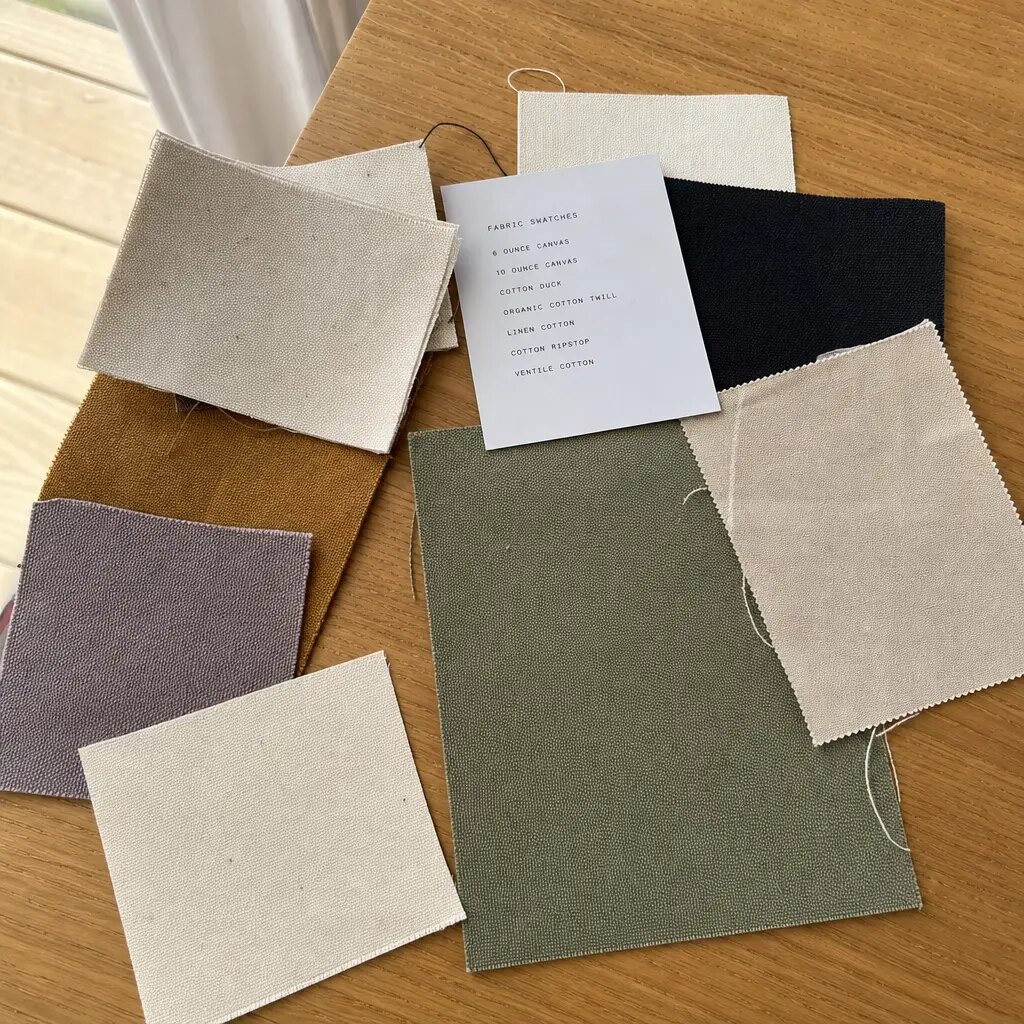
- Approve a physical canvas swatch before sample production.
- Clarify natural, dyed, washed, coated, or water-resistant finish requirements.
- Include thread color, stitch density target, seam finish, and reinforcement points in the spec sheet.
- Use the approved sample as the standard for hand feel and surface texture when words are not enough.
Choose Construction for the Right Gift Tier
Construction details create many of the real quote differences. Two portfolios can use the same canvas weight but feel different because of lining, binding, reinforcement, zipper setting, and pocket structure. Procurement should decide these points before comparing prices, because suppliers will otherwise fill gaps with their own cost assumptions.
Unlined construction can be acceptable for value-driven programs if the internal seams are clean and the product opens neatly. Lining improves perceived value and hides internal construction, but it adds labor, can reduce usable space, and introduces puckering risk if sewing tension is poor. If lining is chosen, specify material, color, attachment method, and whether the lining should be loose, bonded, or stitched into the seam.
Reinforcement should follow the way the item will be used. Zipper ends, corners, pocket openings, wrist loops, and handles are common stress points. A portfolio carrying a notebook and brochures needs stronger construction than a flat document sleeve. Ask the supplier to show reinforcement clearly on the pre-production sample so the bulk inspector knows what to check.
- Choose unlined construction only when the interior still looks clean when opened.
- Use lining for premium programs, but specify lining weight, color, and workmanship expectations.
- Reinforce zipper ends, pocket edges, loops, handles, and corners when contents add weight.
- Avoid extra pockets or loops unless they have a real use, because every feature adds alignment and QC points.
- Confirm pocket edge stability so the front panel does not wave after packing.
Treat the Zipper as a Functional Component
The zipper is one of the first parts the recipient touches, so it cannot be treated as generic trim. For most canvas portfolios, nylon coil zippers are practical because they are flexible, smooth, and easier to sew around corners than metal teeth. The quote should name zipper tape color, coil size or equivalent grade, slider finish, puller style, and top-stop method.
A good zipper should move smoothly from end to end without catching, splitting, or pulling the fabric out of shape. Tight corners, heavy canvas, and poor tape tension can create a wavy zipper line. Even a straight zipper can look poor if the ends are uneven or the slider does not park neatly.
The puller affects both usability and perceived value. A standard puller may be fine for a large event order. A cord pull, fabric tab, matte metal puller, or branded puller can make the gift feel more finished, but it may add MOQ, mold cost, color risk, and lead time. Include those costs separately in the quote.
- Specify zipper type, size or equivalent grade, tape color, slider finish, puller type, and top stops.
- Test sample zippers through repeated open-close cycles and note catching, splitting, or wave.
- Approve trim colors under neutral light, especially when zipper, thread, lining, and canvas are tonal.
- Ask whether custom pullers require mold cost, MOQ, plating approval, or longer production time.
- Class zipper failure, broken pullers, and splitting as major or critical defects depending on severity.
Match Decoration to Canvas and Artwork
Branding is the point of many corporate gifts, but canvas is not a smooth label surface. Its weave, color, and finish affect how artwork prints or stitches. Screen printing is often the most practical option for bold logos, solid shapes, and controlled cost. Fine text, thin lines, and tight registration should be checked on the actual canvas, not only in a PDF proof.
Embroidery adds texture but can pucker soft canvas or make one area stiff. It works best for simple marks designed for thread. Woven labels and sewn patches are useful when the brand wants a premium detail that can be repeated across colorways. Patches also move the decoration away from the canvas weave, but they add their own MOQ, sewing alignment, and backing questions.
Decoration sequencing should be confirmed early. Printing before sewing gives access to a flat panel but requires accurate allowance for final placement. Printing after sewing may reduce placement drift but can be harder on a shaped product. Patches and labels need clean stitching and a neat back side if visible.
- Use screen print for bold flat logos and verify fine details on the final canvas.
- Use woven labels or sewn patches for tactile branding and repeat programs.
- Use embroidery only when artwork tolerates thread thickness and the panel can resist puckering.
- Require a strike-off or decorated sample before bulk decoration.
- State logo placement tolerance, color target, size, and rejection criteria for ghosting, peeling, bleed, or crooked sewing.
Use Sampling as a Production Gate
A sample should prove how bulk goods will be made. A sales sample made with substitute canvas, a better zipper, or temporary decoration is useful for concept review, but it should not be treated as production approval. For a custom order, the pre-production sample should use the intended bulk fabric, zipper, lining, thread, decoration, trim, and packing.
Sample review should be measured and documented. Lay the portfolio flat without stretching it and record width, height, zipper opening, pocket depth, logo position, label position, and any loop or handle placement. Insert the real contents and check fit. Open and close the zipper repeatedly. Look at the item in office lighting and natural light to judge color, print contrast, and surface cleanliness.
Once approved, the sample becomes the physical standard. Mark it with date, version, supplier, buyer, and order reference. Keep one buyer-approved sample and require the factory to keep a sealed duplicate. Any later change to fabric, trim, logo, or packing should be recorded as a revision.
- Request a pre-production sample made from bulk materials and final production methods.
- Measure the sample and record actual values before approval.
- Test the sample with real documents, notebook, tablet, or kit contents.
- Approve decoration on the final canvas color and surface finish.
- Keep signed approval samples on both buyer and factory sides.
Set Inspection Parameters Before Bulk Production
A strong inspection plan separates material, workmanship, decoration, function, and packing checks. This keeps quality decisions from becoming subjective. For corporate gifts, defects should be judged against recipient experience as well as technical construction. A crooked logo, stained canvas, broken zipper, or crushed carton can damage the program even if the item is inexpensive.
Define defect classes before production. Critical defects include unsafe sharp trim, severe contamination, mold, or any issue that makes the product unusable. Major defects include broken zippers, open seams, wrong color, visibly crooked logos, incorrect dimensions that affect fit, or wrong packing. Minor defects may include small thread ends, slight shade variation within the approved range, or small cosmetic marks that are not visible in normal use.
Use an agreed sampling plan. Many buyers use ANSI/ASQ Z1.4 or ISO 2859-1, General Inspection Level II, with AQL 0.0 for critical, 2.5 for major, and 4.0 for minor defects, though the buyer can set stricter levels for premium programs. The inspection report should show lot size, sample size, defect count, measurements, function tests, and photos of failures.
Add realistic tolerances. For sewn canvas goods, common examples are finished body dimensions within +/-5 mm, logo placement within +/-3 mm to +/-5 mm depending on design, pocket depth within +/-5 mm, and zipper opening within +/-5 mm. If a tablet or rigid insert must fit, the tolerance may need to be tighter around opening and internal clearance.
- Confirm AQL level, defect classes, inspection lot, and sample size approach before production starts.
- Measure sampled goods and record actual values, not only pass or fail comments.
- Cycle-test zippers on sampled units, with at least 20 smooth open-close cycles for practical function review.
- Check colorfastness or shrinkage references when dark canvas, washed finishes, or pressing may affect performance.
- Inspect incoming materials, first article, in-line production, and final packed goods when order value or deadline risk is high.
Control Packing and Carton Details
Packing determines whether the gift arrives ready to present. A clean portfolio can be made to look careless by a tight polybag, crushed carton, dusty packing table, or zipper pull pressed into the front panel. The packing specification should be quoted with the product, not added after unit price approval.
Individual packing options include no bag, polybag, tissue wrap, paper sleeve, insert card, belly band, barcode sticker, or gift box. The right choice depends on whether the portfolio ships directly to recipients, goes to a warehouse, or will be assembled into a larger kit. Printed surfaces must be fully cured before stacking or bagging, and light canvas should be protected from dust and carton abrasion.
Carton control is part of quality control. Confirm units per carton, carton dimensions, gross weight, net weight, carton strength, carton marks, SKU label, purchase order number, destination label, and barcode requirements. If multiple colors or logos are ordered, state whether cartons are single-SKU, mixed-SKU, or packed by destination. Mixed cartons can save space but create receiving errors if labels are weak.
For shipment-sensitive programs, ask for carton drop or transit checks based on the delivery route and buyer requirement. The goal is not to over-engineer the carton, but to make sure corners do not crush, polybags do not tear, and the receiving team can identify every SKU without opening random cartons.
- Define individual packing and carton packing in the RFQ.
- Confirm decorated surfaces are cured and protected before stacking.
- Position zipper pulls so they do not dent the front panel during transit.
- Require carton marks, SKU labels, quantity labels, and destination labels where needed.
- Check carton condition, count, assortment, weight, and drop-test requirement during final inspection.
Compare Quotes by Options, Not Just Unit Price
A low price is only useful when suppliers are quoting the same product. One supplier may include 14 oz canvas, lining, screen print, individual polybag, barcode label, and export cartons. Another may include lighter canvas, no lining, a basic zipper, and vague bulk packing. The second quote may look cheaper because important costs are missing.
Normalize each quote into material, construction, decoration, packing, inspection, and logistics. Material includes canvas, lining, zipper, puller, labels, patches, thread, and trim. Construction includes lining, pockets, loops, handles, binding, and reinforcement. Decoration includes setup, strike-off, print cost, embroidery, label MOQ, patch MOQ, and color surcharge. Packing includes unit packing, insert card, barcode, carton, carton mark, and pallet requirement.
MOQ can change the real cost. Ask for MOQ by canvas color, zipper color, logo version, woven label, patch, and packing type. Multi-department or multi-region corporate programs often look simple at total quantity level but become several smaller production runs when each logo or colorway is separated.
Lead time should be defined from a real trigger. A factory may say 30 days, but that could mean after deposit, after fabric arrival, after artwork approval, or after PP sample approval. Build the schedule from artwork proof, strike-off, sample, approval, material booking, cutting, sewing, decoration, packing, inspection, and shipping.
- Request side-by-side pricing for 12 oz versus 14 oz canvas.
- Ask for lined and unlined prices using the same dimensions and logo.
- Compare screen print, woven label, patch, and embroidery as separate options.
- Separate setup charges from unit price so reorders are easier to evaluate.
- Compare Incoterms, carton dimensions, gross weight, and units per carton for freight impact.
Write an RFQ Suppliers Can Answer Cleanly
A strong RFQ makes supplier responses comparable. It should include product purpose, intended contents, finished dimensions, canvas weight, color reference, construction type, lining decision, zipper specification, logo method, artwork size, logo placement, packing, inspection expectation, quantity tiers, delivery location, and target ship date. Reference photos are helpful, but they should support the written specification rather than replace it.
Tell suppliers how to quote. Ask for quantity tiers, sample cost, setup cost, production cost, packing cost, and delivery terms in separate lines. Request options for the main cost drivers instead of asking for one all-in number. For this category, the most useful comparisons are usually 12 oz versus 14 oz canvas, lined versus unlined, standard puller versus custom puller, and screen print versus patch or woven label.
Include quality expectations in the RFQ. State that bulk production will be approved against a pre-production sample made from final materials. Ask the factory to confirm measurement tolerances, zipper function standard, decoration approval process, packing method, and whether third-party inspection is supported. This turns the custom canvas zipper portfolios quality inspection checklist for corporate gifting into a purchasing control, not a last-minute document.
Keep a revision record. If the logo size, zipper color, fabric weight, packing, or destination changes, update the RFQ version and make sure every supplier quotes from the same file. Clear version control prevents disputes that are otherwise blamed on price, timing, or factory interpretation.
- Attach artwork, dimension sheet, packing requirement, and quantity breakdown.
- Ask for option pricing on the decisions that most affect cost and quality.
- Require confirmation of material, zipper, logo method, packing, sample timing, production timing, and Incoterms.
- State AQL, defect classes, and inspection expectations before the supplier confirms price.
- Keep the latest RFQ version, approved sample, and purchase order aligned.
Specification comparison for buyers
| Option to compare | Lower-cost choice | Upgraded choice | Procurement check before approval |
|---|---|---|---|
| Body fabric | 12 oz cotton canvas, about 400 gsm, suitable for event volume and light document use | 14 oz cotton canvas, about 475 gsm, with more body for premium gifts and heavier inserts | Confirm finished weight, shrinkage behavior, corner bulk, and freight effect before choosing only by hand feel |
| Interior finish | Unlined with bound or clean-finished seams | 210D or similar lining with clean turning and stable edge stitching | Open the sample and inspect lint, seam exposure, usable internal space, puckering, and loose threads |
| Logo method | Screen print for bold flat logos and cost control | Woven label, sewn patch, or controlled embroidery for a more tactile brand detail | Approve a strike-off on the exact canvas color; verify fine text, color match, placement, and wash or rub resistance where relevant |
| Zipper pull | Standard metal or plastic slider and puller | Custom puller, cord pull, fabric tab, or branded puller | Ask for MOQ, mold or setup charge, plating color, attachment strength, and added lead time |
| Packing | One piece per polybag, bulk packed in export cartons | Tissue wrap, insert card, barcode label, paper sleeve, or gift-kit packing | Check print curing, zipper-pull position, carton strength, carton marks, mixed-SKU rules, and receiving labels |
| Inspection scope | Final random inspection only | Incoming material check, first-article check, in-line inspection, and final AQL inspection | Define AQL, defect classes, sample size approach, measurement tolerances, function tests, and packing checks before production starts |
| Supplier route | Stock pouch with decoration added | Direct bag factory with cutting, sewing, trim, decoration, packing, and QC control | Confirm whether the quoted product is truly custom-built or a stock base with limited control over fabric and construction |
| Program structure | Single SKU, one logo, one color | Multiple colors, department logos, destination labels, or kit versions | Ask MOQ and setup cost by fabric color, zipper color, logo version, label, and packing variation |
Buyer checklist before sampling
- Define the portfolio use: A4 documents, US letter inserts, tablet sleeve, notebook kit, welcome pack, conference gift, or executive presentation item.
- Confirm finished width, height, gusset if any, zipper opening length, pocket depth, and the maximum contents the portfolio must hold without bending or bulging.
- Specify canvas weight in both oz and gsm, color reference, weave appearance, shrinkage control, and any finish such as washed, dyed, coated, or water-resistant treatment.
- Decide lined versus unlined construction, seam finish, corner reinforcement, pocket structure, handle or wrist-loop details, and pull-tab placement before sampling.
- Specify zipper tape color, coil size or equivalent grade, slider finish, puller type, top stops, end treatment, and smooth operating requirement.
- Approve logo artwork at actual size on the final canvas, including Pantone or brand color target, minimum line width, minimum text height, and placement tolerance.
- List the full BOM: canvas, lining, interlining, zipper, slider, puller, thread, binding, labels, patches, print ink, packaging, insert card, barcode label, and carton.
- Request a pre-production sample made with bulk materials, final decoration, final trim, and proposed packing; keep one signed sample with the buyer and one sealed at the factory.
- Set tolerances for body width, body height, pocket depth, zipper opening, logo position, label position, stitch density, and visible seam alignment.
- Define critical, major, and minor defects, plus the AQL level or inspection standard that will be used for shipment release.
Factory quote questions to send
- What canvas weight, gsm range, weave type, dye method, color standard, and shrinkage control are included in the quoted price?
- Can you quote 12 oz and 14 oz canvas separately, with the same logo, zipper, packing, and Incoterms, so we can compare value clearly?
- Is the fabric stock-dyed, piece-dyed, washed, or custom-dyed, and what MOQ or surcharge applies to each color?
- Will the portfolio be lined or unlined, and how are internal seams finished to prevent fraying, lint, or document snagging?
- Which zipper grade, coil size or equivalent, tape color, slider finish, puller material, and top-stop method are included?
- What reinforcement is used at zipper ends, corners, pocket openings, wrist loops, handles, or label attachment points?
- Which decoration methods can you support on this canvas: screen print, embroidery, woven label, sewn patch, rubber patch, leatherette patch, or heat transfer?
- Can you provide a strike-off or decorated sample on the exact bulk canvas before mass production approval?
- What are the setup charges for print screens, embroidery digitizing, woven labels, patches, custom zipper pulls, insert cards, barcode labels, and carton marks?
- What is the MOQ by fabric color, zipper color, logo version, label, and packing type if several SKUs are ordered under one purchase order?
Quality-control points to confirm
- Use an agreed AQL plan, commonly General Inspection Level II with AQL 0.0 for critical defects, 2.5 for major defects, and 4.0 for minor defects unless the buyer specifies otherwise.
- Measure a representative sample from the inspection lot using the approved method; record width, height, pocket depth, zipper opening, logo position, and label position instead of only marking pass or fail.
- Apply written tolerances, such as finished width and height within +/-5 mm, logo placement within +/-3 mm, pocket depth within +/-5 mm, and stitch density within the approved range or signed sample standard.
- Confirm canvas weight, shade, surface cleanliness, slub level, holes, stains, odor, and contamination against the approved swatch and bulk material standard.
- Check fabric shrinkage or dimensional stability where required; for cotton canvas, request supplier test references such as ISO 6330 or AATCC 135 when washing or pressing could affect size.
- Check colorfastness where the program requires it, using relevant references such as ISO 105 or AATCC crocking and washing tests, especially for dark canvas, contrast lining, or light-colored contents.
- Cycle-test the zipper on inspected units, with a practical expectation of at least 20 smooth open-close cycles on sampled goods and no splitting, catching, broken puller, or distorted zipper line.
- Verify print or decoration adhesion, curing, edge definition, color, registration, and transfer risk; decorated surfaces must not stick to polybags or mark adjacent units after normal packing pressure.
- Inspect stitching for straight seams, balanced tension, no skipped stitches, no broken threads, no loose backstitching, no open seams, and secure reinforcement at stress points.
- Check export cartons for correct quantity, assortment, carton mark, barcode label, gross weight, carton strength, moisture protection if specified, and drop-test performance where required by the shipping program.