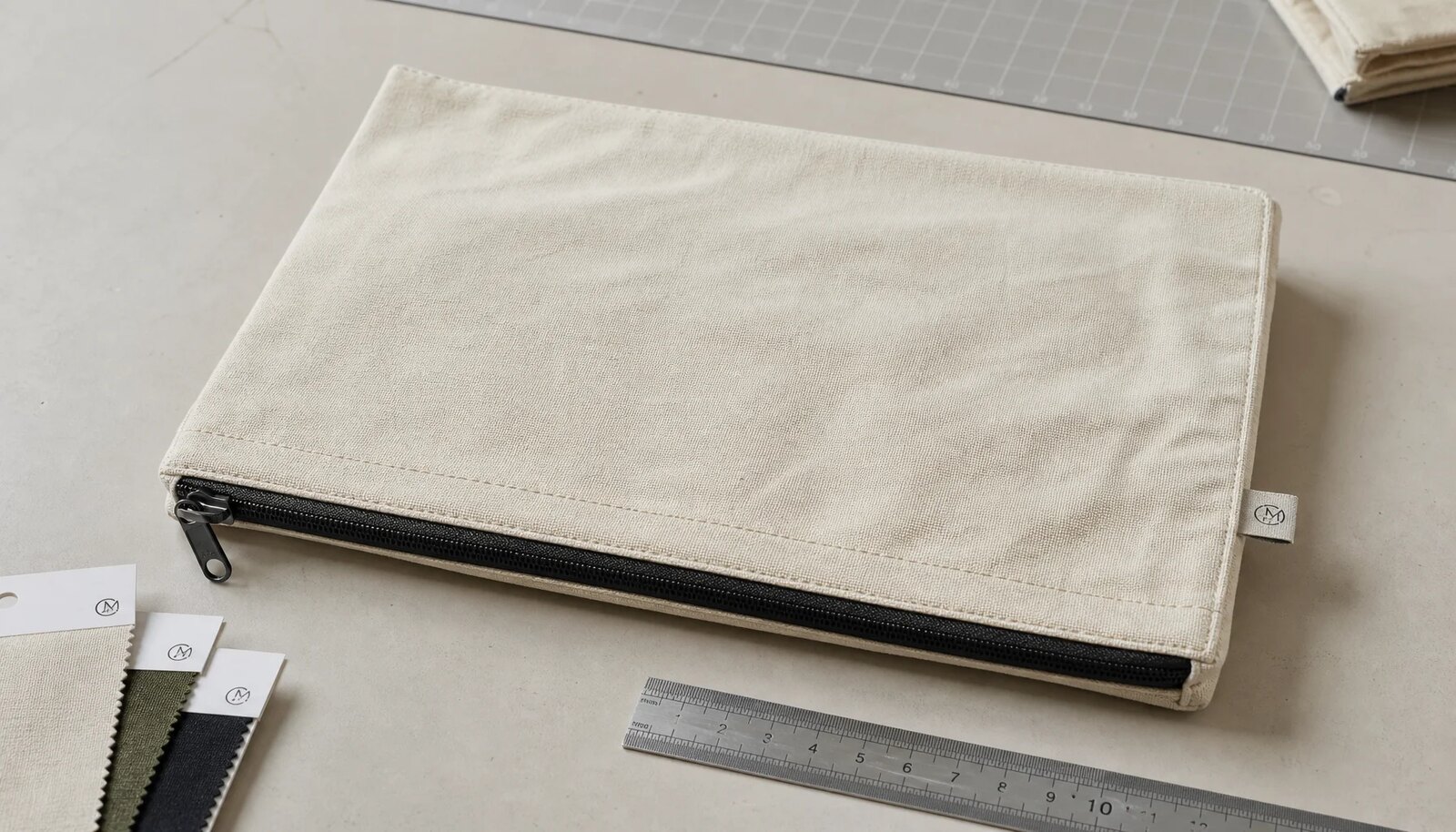
Start With the Event Load, Not the Mockup
Custom canvas zipper portfolios are usually bought because the event team wants something useful, branded, and more durable than a paper folder. The procurement risk is that a digital logo mockup can look finished before the product has been engineered. A portfolio that photographs well may still fail if it cannot hold the agenda, notebook, sponsor insert, tablet sleeve, pen, badge card, or welcome letter without bending the contents or straining the zipper.
The first sourcing step is to define the load profile. A registration-table folder for a one-day conference can be lighter and simpler than an executive retreat portfolio placed in a hotel room. A sponsor kit may need a clean front panel and better zipper feel because it represents multiple brands. An internal training folder may need lower unit cost, fast replenishment, and easy carton handling. Those differences should be visible in the RFQ because they affect canvas weight, zipper opening, pocket layout, print method, packing, and inspection standard.
Separate outside size from usable inside size. A portfolio may measure 34 cm wide externally but lose space to seam allowance, zipper tape, lining, divider seams, or bulky corners. If the largest insert is A4, letter size, or a tablet in a protective sleeve, the supplier needs the actual item dimensions and maximum stack thickness. For event-kit assembly, also specify whether contents are inserted by the factory, by a fulfillment warehouse, or by staff on site. Fast packing may require a wider zipper mouth than a portfolio handed out empty.
- List every item that must fit, including paper size, tablet model, notebook thickness, pen diameter, badge insert, sponsor card, and any gift insert.
- Define maximum loaded thickness and whether the portfolio must close without bulging.
- State whether the item is handed out empty, pre-packed by the factory, or packed later by a warehouse or event team.
- Confirm whether the portfolio must lie flat, stack cleanly, fit into a tote bag, or ship individually to attendees.
- Identify the audience tier: general attendee, sponsor guest, speaker, VIP, executive client, sales prospect, or internal staff.
Convert the Brief Into a Measurable Spec
A strong B2B specification makes supplier quotes comparable. For canvas zipper portfolios, the core spec should cover finished size, usable internal size, fabric weight, fabric finish, zipper construction, stitching, lining, pockets, logo method, labels, packing, carton marks, inspection requirements, and trade term. When those details are missing, each factory fills in the blanks differently. The lowest quote may simply reflect a lighter canvas, smaller zipper, cheaper slider, no lining, or bulk packing instead of a better price for the same product.
The specification should include tolerances before sampling begins. Vague terms such as heavy canvas, smooth zipper, strong sewing, premium print, and accurate logo are hard to inspect. A practical spec might state a target finished size with plus or minus 5 mm on key dimensions, logo placement tolerance of plus or minus 3 mm to 5 mm from a fixed seam, stitch density target agreed with the factory, and no open seams, broken stitches, or skipped stitches in load-bearing areas. Fabric weight tolerance should also be written because cotton canvas varies by weave, finishing, moisture, and washing.
Version control matters more than many event buyers expect. Sponsor artwork may change, the zipper pull may be upgraded, the packing may shift from bulk cartons to individual bags, or the event date may require air freight instead of ocean freight. Each change should update the spec sheet and quote version. Procurement, marketing, supplier sales, production, packing, and inspection should all work from the same revision so the final shipment is judged against the correct file.
- Attach a drawing or annotated photo showing finished size, zipper path, logo position, pocket placement, label position, and seam references.
- Write canvas weight in oz and gsm, and specify whether the weight refers to unfinished or finished fabric when the supplier can confirm it.
- Define whether the zipper opens along one long edge, one short edge, three sides, or around corners.
- State lining material, lining color, divider size, pocket quantity, card-sleeve size, and pen-loop position if used.
- Give every spec revision a date, file name, and version number so the approved sample matches the final purchase order.
Choose Canvas by Weight, Finish, and Tolerance
Canvas weight affects perceived value, sewing difficulty, carton weight, and zipper performance. For many event portfolios, 12 oz cotton canvas is suitable for paper, agenda packs, and light accessories. It keeps cost and shipment weight under control. A 14 oz canvas gives a firmer hand and usually feels more substantial. A 16 oz canvas can work for premium portfolios or repeat-use programs, but heavier fabric can create bulky corners, harder zipper turns, and more variation if the pattern is not designed for the thickness. Ask the supplier to state the corresponding gsm because ounce ratings can be interpreted differently by market and finishing method.
Fabric finish should be decided before price comparison. Natural unbleached canvas has visible cotton specks and shade character; that can be attractive, but it is not the same as a uniform dyed panel. Piece-dyed canvas gives stronger brand-color options, but shade control must be managed by lot. Washed canvas feels softer and more relaxed, but shrinkage and distortion should be handled before cutting. Coated or water-repellent canvas can improve handling resistance, but it may change print adhesion, odor, stiffness, and recyclability claims. Avoid broad words like eco, premium, or waterproof unless the supplier can define the material and testing basis.
For bulk orders, shade variation is a real operational issue. If VIP and attendee kits are unpacked in the same room, noticeably different natural-canvas tones can make a shipment look mixed. Ask for a physical swatch or lab dip where color matters, and keep the approved swatch with the master sample. For repeat annual events, record the fabric lot, supplier fabric code, color reference, and any finish. If exact continuity is important, request a new approval swatch before each reorder instead of relying on last year’s photo.
- Use 12 oz canvas for lighter handouts where unit cost, carton weight, and simple document carry are the priorities.
- Use 14 oz canvas when the portfolio should feel more structured without becoming difficult to sew.
- Use 16 oz canvas only when the pattern, zipper, and corner construction are tested with the thicker fabric.
- Ask whether the fabric is natural, dyed, washed, softened, coated, water-repellent, or untreated.
- Review the approved fabric under daylight and indoor event lighting, especially for natural, black, navy, and brand-color canvas.
Specify the Zipper as a Functional Component
The zipper is not a minor trim on a canvas portfolio. It is the part every attendee touches first, and it often reveals whether the product was engineered or merely decorated. For most custom canvas zipper portfolios, a No. 5 nylon coil zipper is a practical starting point because it is flexible, smooth, and more forgiving around fabric movement than many metal zippers. Metal zippers can look premium, but they add weight and may feel stiff on tight corners or thick seam stacks. If the event brief calls for metal, test it early with the final fabric weight.
A complete zipper specification includes type, size, tape color, slider finish, puller style, puller length, end-stop method, opening direction, and opening path. Tape color matters on natural canvas because contrast can look either intentional or mismatched. Puller style matters because small pullers can be frustrating when attendees open the portfolio while standing at registration. The opening path matters because a long-edge zipper is efficient for document access, while a three-side zipper improves access to thicker contents but needs better corner sewing and may increase cost.
Zipper checks should be functional, not only visual. In sample review, load the portfolio with the intended paper stack or tablet sleeve and cycle the zipper repeatedly. The slider should pass corners without force, the coil should not separate, and the fabric should not roll into the teeth. In final inspection, test units from different cartons because zipper problems often appear as production variation: uneven tape tension, loose sliders, misaligned stops, or pullers that fail after only a few cycles.
- Specify nylon coil, metal, or another zipper type; do not let the supplier choose only on cost.
- Name the zipper size, commonly No. 5 for many portfolios, and confirm suitability with the final fabric and load.
- Define tape color, slider finish, puller shape, puller length, and whether a custom puller is required.
- Check zipper clearance with the actual contents, especially tablets, notebooks, and thick sponsor inserts.
- Inspect for rough sliding, fabric catching, slider wobble, tooth separation, uneven tape sewing, and weak end stops.
Match Branding to Canvas Texture
Canvas decoration must work with the weave. A one-color or two-color screen print is often the best option for bold event logos, sponsor marks, and conference names because it stays flat, reads clearly, and can be cost-effective at event quantities. The buyer should define artwork size, print location, ink color reference, and placement tolerance. Placement should be measured from fixed construction points such as zipper edge, side seam, or bottom seam, not from a soft visual center that may shift after sewing.
Transfers, including DTF or heat transfer, can reproduce gradients, full-color art, and small details that are difficult in screen print. The tradeoff is hand feel and adhesion risk. On textured or heavy canvas, transfers may feel stiffer, show a visible edge, or lift if pressing conditions are weak. Embroidery, woven labels, and patches can create a premium detail, but large embroidery on a flat portfolio panel can pucker the fabric and make stacking less clean. For a corporate event portfolio, the best solution is usually the method that makes the logo look intentional without weakening the panel or delaying production.
Procurement should require physical approval for any branding method. A digital proof confirms layout, not ink behavior on canvas. Ask for a strike-off or PP sample with final fabric and final decoration. Check color in real lighting, rub the print lightly after curing, flex the panel, and confirm that the branding method in bulk will not change without written approval. If multiple sponsor logos are used, ask whether screens, setup fees, or minimums apply per logo, per print position, and per color.
- Use screen print for bold logos, simple sponsor marks, and cost-controlled event quantities.
- Use transfer only when artwork detail or full color justifies the hand-feel and adhesion tradeoff.
- Use woven labels, patches, or small embroidery for subtle premium identity details.
- Measure logo placement from seams or zipper edges and define a realistic tolerance before production.
- Approve a real decorated sample or strike-off, not only a digital artwork proof.
Build an RFQ That Prevents Quote Drift
A good RFQ protects the buyer from comparing unlike products. One supplier may quote 12 oz canvas, no lining, a basic zipper, and bulk cartons; another may quote 14 oz canvas, lining, individual polybags, and third-party inspection support. Both may call the item a custom canvas zipper portfolio, but the cost basis is different. The RFQ should make every bidder price the same base construction and then list optional upgrades separately.
Separate required specifications from add-ons. Required items include quantity, size, canvas, zipper, lining, logo method, color count, print position, packing, carton labels, inspection access, and trade term. Optional upgrades may include custom zipper puller, woven label, inner divider, pen loop, card sleeve, insert card, retail hangtag, tissue, barcode sticker, moisture-control packing, palletization, or destination-specific carton marks. This structure lets procurement choose the right spec instead of accepting a blended unit price that hides tradeoffs.
Timing should be quoted by milestone. A lead time that says 25 days may exclude artwork confirmation, sample making, sample shipping, revision time, fabric booking, inspection scheduling, export documents, vessel booking, air freight cutoff, customs clearance, warehouse receiving, and event-kit assembly. Work backward from the required warehouse delivery date, not only from the event date. If the product is needed for a fixed conference, late approval can turn a low unit price into an expensive freight problem.
- Ask every supplier to quote the same size, fabric weight, zipper, branding, lining, packing, quantity, and trade term.
- Request base price plus line-item upgrade prices for custom puller, pockets, labels, insert cards, special packing, and barcode work.
- Require clarity on EXW, FOB, CIF, DAP, DDP, or domestic delivered pricing and what each term includes.
- Ask whether sample fees, screen fees, artwork revisions, setup charges, and carton upgrades are included or separate.
- Request a milestone timeline covering artwork, sample, PP sample, bulk production, inspection, packing, shipment, and delivery.
Approve Samples in the Right Order
Sampling should move from decision-making to control. Early development samples are useful for comparing canvas weights, zipper feel, pocket layout, and finished size. They may be made with available fabric or approximate trims, so they should not automatically become the bulk approval reference. The pre-production sample, or PP sample, is the control sample for mass production. It should use final canvas, final zipper, final lining, final thread, final logo method, final labels, and final packing.
PP sample review should be practical. Load it with the actual event materials, then check whether the zipper closes without pressure and whether the contents can be inserted quickly. Open the zipper several times while the portfolio is full. Check if the corners are too bulky, the lining catches, the pockets reduce usable space, or the logo distorts when the portfolio is loaded. Measure the external size, internal usable size, logo position, pocket dimensions, and zipper opening. Photograph the front, back, inside, zipper ends, label, and packing.
Once approved, lock the master sample. The buyer should keep one approved sample and ask the supplier to retain one identical sample. Attach or record the PO number, approval date, fabric spec, zipper spec, artwork code, thread color, lining, packing method, and approved dimensions. If the factory later proposes a substitute zipper, different canvas lot, alternate print method, or changed packing, request a written deviation and, when the change affects appearance or function, a new approval sample.
- Use development samples to choose construction and materials; use the PP sample to approve bulk production.
- Approve the PP sample only when final fabric, zipper, lining, thread, decoration, labels, and packing are present.
- Test the sample with the actual event contents, not only empty on a desk.
- Photograph and measure the approved sample before signing off.
- Reject undocumented substitutions, even when the replacement is described as similar or upgraded.
Use a Product-Specific Inspection Checklist
A general soft-goods inspection checklist is not enough for event portfolios. The most common issues are often small but costly: a zipper that catches at a corner, a logo shifted visibly off center, a transfer that feels too stiff, a lining pocket that reduces the internal width, or a carton that mixes sponsor versions. These defects can create sorting work at the venue or warehouse when there is no time left for rework.
Use an AQL sampling framework such as ANSI/ASQ Z1.4 or ISO 2859-1 if that matches your company policy, but add product-specific checks. Define critical, major, and minor defects before inspection. Critical or major defects may include wrong logo, wrong artwork version, unusable zipper, incorrect size, severe stains, mildew odor, wrong packing, mixed SKUs, or missing required labels. Minor defects may include trimable loose threads or small cosmetic issues within agreed limits. The classification depends on the event risk, but it should not be invented during the inspection.
The inspection should include visual, dimensional, functional, and packing checks. Visual checks cover fabric flaws, shade, stains, print defects, and workmanship. Dimensional checks cover outside size, internal usable size, pocket dimensions, logo placement, and zipper opening. Functional checks cover zipper cycling, loaded fit, seam security, and pocket use. Packing checks cover carton counts, carton marks, SKU separation, polybags, barcode labels, moisture protection, and carton condition.
- Check loaded fit on sampled units using the actual paper stack, notebook, or tablet sleeve whenever possible.
- Measure logo placement from fixed seams and compare against the approved master sample.
- Cycle sampled zippers several times, including corners and end stops, and reject units with snagging or separation.
- Inspect inside pockets, dividers, lining seams, and pen loops for loose threads, raw edges, and restricted usable space.
- Verify carton labels, inner counts, SKU separation, barcode accuracy, packing list, and country-of-origin marks before shipment release.
Control Packing and Receiving Requirements
Packing is part of event readiness. A portfolio can pass sewing inspection and still cause problems if it arrives creased, damp, dusty, mislabeled, or packed in cartons that are too heavy for temporary staff to move. Decide packing before the final quote because individual polybags, tissue wrap, insert cards, barcode labels, hangtags, carton upgrades, pallet rules, and moisture protection all affect cost and timeline.
For basic attendee handouts, bulk packing or a simple individual polybag may be enough. For premium client events, the buyer may want tissue, a clean insert card, zipper-pull protection, or a fold direction that avoids creasing the front logo. Light natural canvas needs extra attention because zipper pulls, dark cartons, and dust can mark the surface. If the portfolio is going into a larger welcome kit, confirm whether it should arrive flat, lightly folded, packed inside another bag, or shipped separately.
Warehouse and venue requirements should be included in the RFQ. Fulfillment centers and corporate receiving docks may require PO numbers, SKU codes, barcodes, destination labels, country-of-origin labels, maximum carton weights, pallet heights, delivery appointments, or advance shipment notices. If those rules appear after production, relabeling and repacking can delay delivery. Ask for a carton-mark proof and packing photos before shipment, especially when the order includes multiple sponsor versions or regional destinations.
- Define individual packing: none, polybag, paper wrap, tissue, insert card, hangtag, barcode sticker, or retail-style presentation.
- Set maximum carton weight when cartons will be handled at venues, hotels, or temporary event spaces.
- Require consistent folding direction and protection for decorated panels and zipper pulls.
- Approve carton dimensions, pieces per carton, gross weight, net weight, and carton marks before final packing.
- Confirm PO, SKU, barcode, destination, country-of-origin, and pallet requirements before production is complete.
Manage Lead Time, Cost, and Reorders
For event procurement, time risk can be more expensive than unit-price risk. A realistic schedule includes artwork confirmation, material sourcing, development sample, PP sample, approval time, bulk fabric preparation, cutting, printing or embroidery, sewing, inline QC, final inspection, packing, export booking, freight, customs, warehouse receiving, and kit assembly. Each step needs a responsible party and a deadline. If the event date is fixed, build a buffer for sample shipping, artwork revisions, inspection booking, and freight disruption.
Cost should be compared on a landed basis. The relevant number is not only the unit price from the factory. Include sample fees, setup charges, artwork changes, screens, custom pullers, packing upgrades, inland freight, export fees, inspection cost, international freight, duty, customs brokerage, warehouse receiving, relabeling, sorting, and emergency air freight. A cheaper quote can become more expensive if it uses poor packing, misses the sample schedule, or requires rework before the event.
Repeat orders need their own controls. Many event teams reorder similar portfolios annually with a new year, sponsor mark, or color. Quality can drift if the BOM is not locked. Keep the approved master sample, artwork files, fabric reference, zipper specification, thread color, lining material, packing configuration, carton marks, and inspection checklist. Before each reorder, ask the supplier to confirm whether any material, zipper, print method, factory line, or packing method has changed. If a change affects look or function, request a new confirmation sample.
- Work backward from the required warehouse receiving date, not only from the event date.
- Build buffer for sample revisions, PP approval, inspection scheduling, customs clearance, and kit assembly.
- Compare total landed cost instead of factory unit price alone.
- Ask whether repeat-order pricing assumes the same fabric, zipper, logo method, packing, and MOQ.
- Keep the master sample, BOM, and inspection checklist active so annual programs do not drift in quality.
Specification comparison for buyers
| Spec decision | Recommended option | When it fits | Buyer risk to check |
|---|---|---|---|
| Canvas body fabric | 12 oz to 16 oz cotton canvas, stated in both oz and gsm with tolerance | Conference portfolios carrying agendas, notebooks, sponsor inserts, tablet sleeves, welcome letters, or registration documents | Confirm finished fabric weight tolerance, shrinkage after washing or dyeing, shade band, weave defects, and whether the quote uses greige, dyed, washed, or coated canvas |
| Zipper construction | No. 5 nylon coil zipper for most portfolios; define tape color, slider finish, puller, end stops, and opening path | Most custom canvas zipper portfolios because coil zippers are flexible, smooth, and suitable for corners | Check zipper smoothness under load, slider retention, tape waviness, corner resistance, tooth separation, and whether bulk uses the approved zipper code or an equivalent substitute |
| Branding method | Screen print for bold logos; woven label, patch, or embroidery for small identity marks; transfer only when artwork requires it | Corporate events, sponsor kits, executive retreats, trade shows, and training programs with logo consistency requirements | Confirm artwork scale, placement tolerance, Pantone or physical color standard, ink cure, transfer adhesion, embroidery puckering, and whether the bulk method matches the PP sample |
| Interior layout | Lined main compartment with optional divider, flat pocket, business-card sleeve, pen loop, or document sleeve | Events where the portfolio must hold paper plus small accessories without becoming bulky | Measure usable internal dimensions after lining and pockets are sewn in, not only the external finished size |
| Supplier route | Direct factory for engineered repeat orders; sourcing partner for multi-SKU event kits or tight consolidation work | Direct factory fits repeat programs with stable specs; sourcing partner fits programs with several bags, inserts, and packaging SKUs | Clarify who owns the BOM, master sample, artwork approval, inspection booking, carton labeling, substitution approval, and shipment consolidation |
| MOQ structure | MOQ stated by total quantity, size, fabric color, logo version, print position, lining color, and packaging version | Useful when event planners need sponsor variants, VIP batches, regional versions, or separate registration-table SKUs | Ask whether small splits require extra dye lots, screen setup, digital print minimums, cutting loss, special carton marks, or line-change charges |
| Inspection standard | ANSI/ASQ Z1.4 or ISO 2859-1 style AQL sampling plus product-specific functional checks | Premium events, executive gifting, trade show programs, repeat procurement, and any order where rework time is limited | Do not rely only on cosmetic checks; include zipper cycle checks, loaded-fit checks, seam review, measurement checks, odor review, carton-count verification, and SKU separation |
| Packing method | Flat pack or light fold with logo protection, clean polybag or paper wrap, and controlled carton weight | Programs where portfolios must arrive clean, uncreased, and ready for venue tables, welcome kits, or warehouse assembly | Check fold direction, zipper-pull protection, moisture control, carton burst strength, carton gross weight, barcode labels, and whether zipper hardware can mark light canvas |
| Landed cost basis | Compare EXW, FOB, CIF, DAP, or DDP using the same spec sheet and the same packing assumptions | Any B2B buyer comparing more than one supplier, country of origin, or freight route | Separate unit price from sampling, setup, inland freight, export charges, inspection, duty, warehousing, relabeling, and emergency air-freight risk |
Buyer checklist before sampling
- Define the event use case before requesting prices: attendee handout, VIP gift, sponsor kit, onboarding pack, executive retreat portfolio, internal training folder, or merchandise item.
- List the exact contents the portfolio must hold, including paper size, notebook thickness, tablet model, pen, badge insert, cable pouch, gift card, sponsor brochure, or welcome letter.
- Specify finished external dimensions, usable internal dimensions, gusset depth if any, zipper opening length, zipper path, and whether the product must lie flat when loaded.
- Choose canvas weight in both oz and gsm; for example, 12 oz is often used for lighter event handouts, while 14 oz to 16 oz gives more structure.
- State fabric treatment requirements such as unbleached natural canvas, piece-dyed canvas, washed canvas, water-repellent finish, softener, coating, or no added finish.
- Lock the zipper specification: nylon coil or metal, zipper size such as No. 5, tape color, slider finish, puller shape, puller length, end-stop method, and opening direction.
- Confirm thread color, stitch density target such as 7 to 9 stitches per inch if suitable for the construction, seam allowance, corner reinforcement, and bar tacks at stress points.
- Define branding method, logo size, placement distance from seams, Pantone or physical color reference, print edge tolerance, and accepted placement tolerance such as plus or minus 3 mm to 5 mm where feasible.
- Request a pre-production sample made with final fabric, zipper, thread, lining, labels, print method, and packing; do not approve bulk from a sample with substitute materials unless the substitutions are documented and later re-sampled.
- Test the sample with actual event contents, cycle the zipper, measure key points, photograph both sides and the interior, and keep an approved master sample before releasing bulk production.
Factory quote questions to send
- What is the exact canvas weight in gsm and oz, what fabric composition is included, and what tolerance will you allow on bulk fabric weight?
- Is the canvas greige, yarn-dyed, piece-dyed, washed, unbleached, coated, or treated after weaving, and what shrinkage or shade variation should we expect?
- What zipper type, zipper size, tape color, slider finish, puller style, puller length, and end-stop construction are included in the quoted price?
- Is the quoted price EXW, FOB, CIF, DAP, DDP, or domestic delivered, and exactly which charges are included and excluded?
- Which branding method is included, how many print colors or embroidery stitches are covered, and what setup fees apply for extra colors, positions, labels, or patches?
- Can the pre-production sample be made with final bulk materials, final trims, final artwork, and final packing, or will any component be substituted?
- What is the MOQ by size, fabric color, logo artwork, print position, zipper color, lining color, label type, and packaging version?
- What are the sample fee, artwork proof fee, courier cost, sample lead time, revision fee, and sample fee refund policy against the bulk order?
- What tolerances do you use for finished size, usable internal size, zipper placement, logo placement, stitch density, shade difference, and carton quantity?
- What inspection standard can you support, which AQL levels do you recommend, and can a third-party inspector access finished goods, cartons, and the approved master sample before shipment?
Quality-control points to confirm
- Canvas weight should match the approved specification within the written tolerance, with consistent hand feel, weave density, shade, and finish across inspected cartons.
- Finished external size, usable internal size, gusset depth, pocket size, and zipper opening should stay within the approved tolerance so event contents fit without forcing the closure.
- Zipper should open and close smoothly across repeated cycles, including corners and end stops, without snagging, tooth separation, slider looseness, tape waviness, puller detachment, or fabric rolling into the coil.
- Main seams should be straight, secure, and reinforced at stress points such as zipper ends, corners, pocket openings, divider seams, side tabs, and handle attachment points if included.
- Stitch density should be even across panels, with no skipped stitches, broken thread, loose thread nests, needle cuts, open seams, insecure backstitching, or exposed raw edges unless deliberately bound.
- Logo placement, print registration, ink density, print edge sharpness, label position, embroidery tension, and color should match the approved pre-production sample and artwork proof.
- Print, transfer, or coating should pass reasonable adhesion and rub checks for the intended event use, with no cracking, peeling, uncured ink odor, excessive stiffness, dye migration, or tacky surface.
- Lining, dividers, pockets, card sleeves, and pen loops should sit flat, be securely sewn, and should not reduce usable internal space beyond the approved sample.
- Canvas surface should be free from visible oil marks, glue marks, heavy slubs outside the agreed fabric character, water stains, mildew odor, shade bands, dirty fingerprints, and unacceptable crease marks.
- Packing should protect against moisture, zipper impressions, crushed corners, logo abrasion, incorrect carton counts, mixed SKUs, missing barcode labels, wrong carton marks, and warehouse receiving errors.