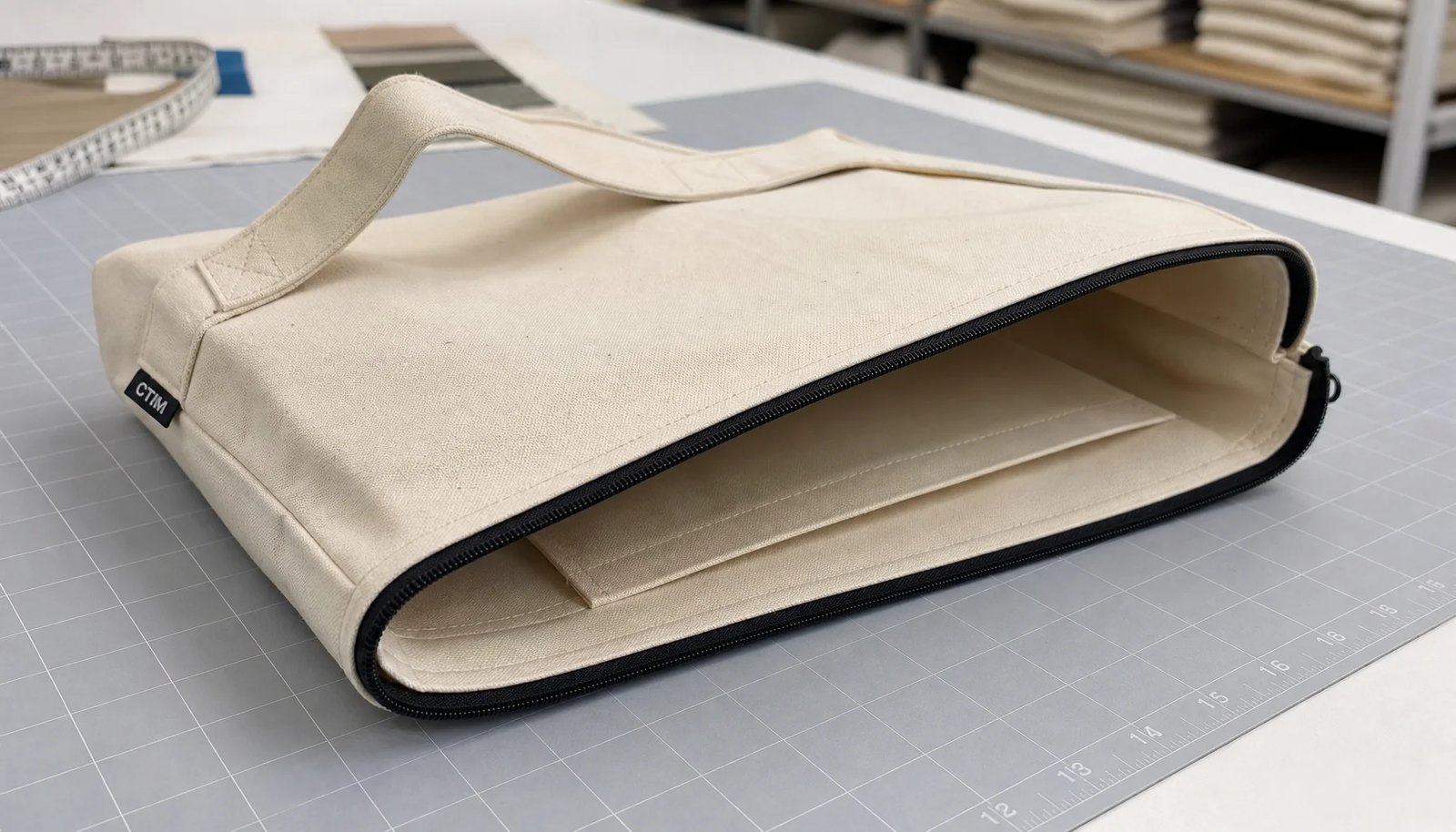
Start With the Bookstore Use Case
A custom canvas zipper portfolio for a university bookstore is not just a flat pouch with a campus logo. It may sit on a retail shelf, arrive inside an admissions welcome kit, be handed out during alumni weekend, support a graduation bundle, or serve as a faculty conference pack. Those uses sound similar, but they push the specification in different directions. Retail needs clean presentation and barcode accuracy. Admissions needs document fit and a dependable event date. Alumni gifting may justify lining, a stronger puller, or a woven patch that feels more permanent.
Procurement problems usually begin when the RFQ leaves too much to interpretation. If the request only says canvas zipper portfolio with logo, suppliers may quote different canvas weights, zipper sizes, lining methods, decoration types, carton counts, and inspection assumptions. The cheapest offer may be based on thinner fabric, a shorter zipper opening, bulk packing, or a basic print that will not match the buyer's shelf expectation. At that point, price comparison is not really price comparison.
A strong RFQ turns the bookstore requirement into measurable details. Define the target contents, size, canvas weight, zipper grade, logo method, placement tolerance, packing style, labeling needs, and inspection standard. This is not over-specifying a simple product. It is making sure the sample, purchase order, production lot, and final inspection are all judging the same item.
- Define the channel first: retail shelf, admissions kit, alumni event, graduation gift, faculty conference, or department order.
- Connect the channel to specs: canvas weight, lining, zipper feel, internal layout, logo method, and retail packaging.
- Separate required features from optional upgrades so suppliers can quote comparable base and premium options.
- Treat clean canvas, smooth zipper function, and accurate university branding as critical retail requirements.
- Keep the approved sample, spec sheet, artwork sheet, and packing photo attached to the PO for inspection and reorders.
Canvas Weight, Finish, and Shade Control
Canvas weight drives much of the buyer's first impression. It affects handfeel, sewing difficulty, print appearance, carton volume, and how the portfolio holds its shape after packing. For university bookstore portfolios, 12 oz cotton canvas, often around 380-410 GSM depending on yarn and weave, is a practical starting point. It gives a substantial document-case feel without making zipper corners overly bulky. A 10 oz canvas can work for a lower-cost orientation or giveaway program, but it may crease more readily and show zipper waves. Heavier 14 oz or 16 oz canvas can look rugged, yet it may add cost, corner thickness, and more variation after turning.
Finish matters as much as weight. Natural canvas can range from cream to beige and may show seed flecks, slubs, or yarn variation. That can be part of the look, especially for campus heritage merchandise, but the buyer should approve a physical shade range so normal variation is not confused with a defect. Dyed canvas is the better route when the bookstore needs navy, maroon, black, forest green, or another school-color base. It also brings extra steps: lab dip approval, fabric minimums, shrinkage checks, and colorfastness review.
Do not rely on the ounce rating alone. Two fabrics marked 12 oz can feel different because yarn count, weave density, finishing, coating, and washing differ. Ask for both ounces and GSM, then approve a swatch for handfeel, shade, slub level, thickness, and print behavior. If the item will be reordered, retain that swatch and decide whether future lots must match tightly or remain within a commercial shade band.
- Budget option: 10 oz canvas, unlined body, bound seams, standard No. 5 zipper, one-color screen print, and simple individual packing.
- Balanced option: 12 oz canvas, clean seam finishing, No. 5 nylon coil zipper, one internal pocket, screen print or label, and flat carton packing.
- Premium option: 12-14 oz canvas or 12 oz canvas with lining, reinforced stress points, upgraded puller, woven patch, and controlled retail packaging.
- Shade-control rule: approve a physical shade range for natural canvas and a lab dip or strike-off for dyed school colors before bulk fabric booking.
- Cutting rule: reject front panels with severe stains, holes, dye streaks, harsh crease lines, or slubs that interfere with the logo area.
Size, Fit, and Internal Layout
Portfolio sizing should begin with the contents, not a generic pouch dimension. A letter-size document portfolio may have an outside size around 13 x 10 inches, but usable capacity depends on seam allowance, zipper tape width, binding, lining thickness, corner radius, and the way the product is turned after sewing. If the item must hold A4 sheets, a tablet, a spiral notebook, a campus catalog, a diploma sleeve, or a preloaded admissions packet, send the exact dimensions and thickness to the factory.
The RFQ should separate three measurements: finished outside size, usable inside size, and zipper opening length. The zipper opening is often the hidden problem. A document can fit inside the body but still bend or catch if the opening is too short or the corner is too tight. For preloaded kits, confirm the total packed thickness as well. One extra catalog, pen, or insert card can distort the portfolio and strain the zipper.
Internal layout should earn its keep. One document pocket is usually enough for a bookstore retail item. Pen loops, business-card slots, mesh pockets, divider panels, and tablet sleeves can be useful in premium programs, but each adds sewing labor, seam bulk, dimensional tolerance, and more inspection points. A complicated inside can reduce usable capacity, create ridges behind the front logo, or make the product feel poorly made even when the outside measurement passes.
- Specify outside dimensions, inside usable dimensions, zipper opening length, pocket dimensions, and tolerance in one technical sheet.
- Use ±5 mm as a practical default for finished size and pocket depth unless fitted inserts require tighter approval.
- Send real inserts or provide length, width, thickness, corner shape, and quantity for documents, tablets, catalogs, or gift-set contents.
- Add clearance for spiral notebook edges, tablet cases, pens, admissions folders, and bookstore receipts rather than designing only around flat paper.
- Keep internal layouts simple for small orders under 500 pcs unless the retail price supports added sewing and inspection cost.
Zipper Components and Sewing Tolerances
The zipper is the part customers touch first and complain about fastest. For most bookstore applications, a No. 5 nylon coil zipper is the safest baseline. It is smoother and more flexible than many low-cost metal zippers, stronger than a No. 3 zipper on a canvas body, and widely available in common tape colors. Metal zippers can look premium, but they need closer checks for burrs, plating defects, sharp edges, and scratching against light canvas or printed panels.
The quote should identify the zipper size, type, tape color, slider material, puller shape, puller finish, opening direction, zipper length, and end-stop construction. If the bookstore wants school-color zipper tape or a branded puller, confirm whether the component is stock, custom dyed, or tooled. Those details can add separate MOQs, extra sampling time, and another approval step. Ask whether zipper cutting, slider attachment, and puller assembly are handled in-house or by a component vendor.
Good zipper sewing comes down to tape tension, corner control, and reinforcement. Uneven tension creates visible waves along the opening. Too much seam bulk near the corners can make the slider catch. Weak back-tacking at the ends can cause early failure. For canvas portfolio seams, 7-9 stitches per inch is a common workable range, but the approved sample should set the final visual benchmark. During inspection, sampled units should be opened and closed through the full run, not just viewed on a table.
- Define zipper details: No. 5 nylon coil, tape color, slider color, puller style, zipper length, opening direction, and end-stop finish.
- Reject No. 3 substitutions unless the buyer intentionally approves a lighter, lower-cost build.
- Require reinforcement or back-tacking at zipper ends, pocket openings, handle seams if used, and other stress points.
- Check for zipper waves, rough slider movement, missing coil sections, loose pullers, exposed raw ends, sharp stops, and uneven tape stitching.
- Test zipper function through the full run, including corners and end stops, during sampling and final inspection.
University Logo Decoration and Brand Accuracy
University bookstore merchandise often carries licensing rules, brand-color expectations, and department-level approval. Decoration should be selected around the artwork, canvas texture, retail price, and order volume. Screen printing is usually the best value for solid marks, large campus names, and one- or two-color graphics. On textured canvas, the result depends on mesh selection, ink type, squeegee pressure, ink deposit, and curing. Heavy ink blocks can show pinholes, cracking, crocking, or uneven coverage if the process is rushed.
Embroidery can support a premium alumni or faculty position, but it is not automatically the better choice. Dense stitching may pucker lighter canvas, distort small text, or leave rough backing inside an unlined portfolio. Woven patches and sewn labels are useful when the design has small text, several colors, or a crest that needs repeatability across reorders. Heat transfer can look sharp, but it should be tested on canvas for adhesion, edge lifting, texture show-through, and storage stability.
Brand accuracy needs physical approval, not only a digital mockup. Provide vector artwork, Pantone references, logo dimensions, placement measurements, and any university brand-guide restrictions. Ink on natural canvas appears warmer than it does on white paper or a screen. Ink on dyed canvas may need opacity adjustment. A decorated strike-off or pre-production sample should be approved before bulk printing, especially when the front panel carries the main licensed mark.
- Provide vector artwork, Pantone targets, logo dimensions, placement from fixed edges, and licensing or brand-guide rules.
- Use screen print for larger solid marks where cost, speed, and repeatability matter; require rub, flex, and curing checks.
- Use embroidery only when the design is suitable for stitching without excessive puckering or loss of small lettering.
- Use woven patches or sewn labels for detailed marks, multi-color crests, small text, and premium retail presentation.
- Set logo placement tolerance at ±3 mm for centered front marks and reject visible tilt, even if one measurement is close.
MOQ, Cost Drivers, and Quote Comparison
A realistic custom canvas zipper portfolio MOQ often starts around 300-500 pcs per color when the order uses stock canvas, standard zipper tape, standard pullers, and a normal decoration method. MOQ rises when the buyer requests custom-dyed canvas, school-color zipper tape, branded metal pullers, custom woven patches, special hangtags, multiple department logos, or several colorways. Procurement teams should separate finished-goods MOQ from component MOQ before the project reaches artwork approval.
Unit price is shaped by more than fabric weight. The important cost drivers include canvas GSM, lining, interlining, zipper grade, internal pocket count, decoration method, print color count, embroidery stitch count, patch size, label type, thread trimming, packing method, carton volume, and inspection requirement. A cheaper quote may have thinner canvas, a shorter zipper opening, a smaller puller, lower stitch density, bulk packing, or no barcode application.
The most useful RFQ format is a base specification with priced options. Ask suppliers to quote the same product at 300, 500, 1,000, and 2,000 pcs if those quantities are realistic. Then request separate lines for lining, internal pocket, woven patch, embroidery, custom puller, paper band, barcode label, upgraded carton, and third-party inspection. This keeps the conversation commercial instead of vague and helps the bookstore protect margin.
- Baseline MOQ: 300-500 pcs per color is often practical with stock canvas, stock zipper tape, standard pullers, and one standard logo method.
- MOQ escalators: custom-dyed fabric, custom zipper tape, branded pullers, woven patches, multiple logos, special packaging, and split assortments.
- Main cost drivers: canvas GSM, lining, internal layout, zipper grade, decoration complexity, packing count, carton volume, and QC requirements.
- Quote rule: ask every supplier to price the same written spec and list optional upgrades separately.
- Inventory rule: limit colorways and logo versions when margin protection matters more than broad assortment.
Sample Approval Before Bulk Cutting
A photo sample is not enough for a bookstore-grade canvas zipper portfolio. The buyer should approve a physical pre-production sample made with bulk-intended canvas, zipper, thread, lining, decoration, labels, hangtags, barcode placement, and packing wherever possible. If any component is substituted, the factory should say exactly what will change in bulk production. Common provisional items include zipper tape shade, lining color, puller finish, label material, and print ink.
The approved sample should become the control sample for production and inspection. Mark it with the date, version number, fabric weight, artwork revision, zipper specification, layout notes, and packing method. Keep one sealed sample with the buyer or importer and one with the factory. For reorders, use the physical sample and written spec together. The sample shows handfeel and texture; the written spec protects tolerances and component details.
Review the sample like a small inspection. Measure outside size, usable inside size, zipper opening, pocket depth, label position, and logo placement. Insert the intended document pack or tablet. Open and close the zipper repeatedly. Flex the printed area lightly. Check whether the puller touches the print during packing. Look inside for loose threads, lining twist, rough embroidery backing, and seam bulk. Approve all changes in writing before mass cutting.
- Request a pre-production sample using bulk-intended fabric, zipper, thread, print method, lining, labels, hangtags, and individual packing.
- Document every sample substitution and require approval of final components before production starts.
- Measure outside size, inside capacity, zipper opening, pocket depth, logo placement, label position, and barcode position.
- Test actual contents: letter paper, A4 documents, catalogs, tablets, notebooks, diploma sleeves, or gift-set inserts.
- Seal the approved sample, artwork sheet, swatch, and packing photo as the reference for inspection and future reorders.
Inspection Checklist and Defect Classification
Final inspection should cover material, measurement, workmanship, function, branding, labeling, and packing. AQL General Inspection Level II is commonly used for consumer-goods inspection, but the buyer still needs to define critical, major, and minor defects before production begins. A wrong school logo or broken zipper cannot be treated the same as a trim-able loose thread. For licensed university merchandise, wrong artwork, missing labels, incorrect barcode data, and mixed SKUs can block receiving even when the sewing quality looks acceptable.
A practical inspection starts with cartons, not individual units. The inspector should confirm PO number, SKU, color, logo version, quantity, carton number, country-of-origin marking where required, and destination if goods are split by store or department. Sampled units should then be checked for fabric defects, finished size, zipper operation, pocket dimensions, seam security, logo placement, print quality, label orientation, barcode scanability, and individual packing condition.
Defect definitions need plain language. Critical defects include wrong artwork, wrong university name, broken zipper, unsafe sharp edge, severe contamination, missing required label, incorrect barcode, or mixed SKU in a carton. Major defects include logo placement beyond tolerance, visible logo tilt, zipper catching, skipped stitches at stress points, front-panel stains, cracked print, wrong pocket size, or damaged retail packing. Minor defects may include trim-able loose threads, small non-front slubs, or slight shade variation within the approved range.
- Material checks: fabric weight, shade, stains, holes, slubs, dye streaks, front-panel cleanliness, and match to approved swatch.
- Measurement checks: outside size, inside usable size, zipper opening length, pocket depth, logo position, label position, and barcode position.
- Function checks: zipper smoothness, puller attachment, document fit, pocket access, corner clearance, and absence of sharp or rough parts.
- Workmanship checks: stitch density, seam straightness, back-tacking, zipper tape alignment, corner symmetry, thread trimming, lining twist, and patch attachment.
- Branding checks: logo color, print coverage, logo tilt, Pantone target, hangtag content, barcode scan, licensing label, and woven-label orientation.
- Packing checks: polybag or tissue condition, carton count, carton strength, carton mark, moisture protection, mixed-style prevention, and corner protection.
Packing, Carton Marks, and Receiving Accuracy
Packing directly affects sellable condition and receiving labor. Flat packing helps protect the front panel, zipper line, and corners, but it may increase carton volume. Light folding can reduce freight cost, yet it may leave a crease through the logo or stress the zipper track. For natural or light-colored canvas, individual protection is usually worthwhile because dirt, moisture marks, and zipper-pull scuffs are easy to see.
The zipper puller should be positioned away from the printed front panel or protected with tissue. Metal or dark plated pullers can mark natural canvas during transit when cartons are compressed. Cartons should not be overloaded. Too much pressure can crush corners, deform the zipper line, and create waves that remain visible on shelf. A practical carton count is often 20-40 pcs depending on portfolio size, lining, and individual packing, but final carton size and gross weight should be confirmed before freight booking.
Bookstore receiving depends on accurate labels and carton marks. Cartons should show PO number, SKU, color, logo version, quantity, carton number, and destination if goods are allocated to multiple stores, departments, or events. Individual barcodes or hangtags should be applied consistently and scanned during inspection. Mixed colors, mixed logo versions, or missing barcodes create avoidable labor and can delay inventory entry.
- Use recyclable polybags, tissue wrap, or paper bands when the bookstore requires clean, shelf-ready natural canvas.
- Pack flat when logo appearance, zipper shape, and corner presentation are more important than minimizing carton volume.
- Position zipper pullers away from printed panels or protect them so they do not scratch the logo area.
- Confirm carton dimensions, gross weight, units per carton, carton strength, moisture protection, and packing orientation before shipment.
- Require carton marks and barcode placement that match the bookstore receiving system for split SKUs and department allocations.
Lead Time, Calendar Risk, and Reorders
Lead time depends on artwork approval, sample revision, material availability, decoration complexity, sewing capacity, inspection scheduling, and export booking. A simple program using stock canvas, stock zipper tape, and one screen print can move faster than an order with custom dyed fabric, branded pullers, embroidery, woven patches, or multiple department logos. Ask the supplier to break lead time into stages instead of giving one broad estimate that hides the risky steps.
University bookstore calendars are rarely flexible. Orientation week, accepted-student events, alumni weekend, faculty conferences, holiday retail, and graduation all create firm dates. If the shipment misses the event, a useful portfolio can become slow-moving inventory. Build time for brand approval, physical sampling, sample shipment, revision, final inspection, and freight handover. Rushing print curing or skipping inspection often creates problems that cost more than the time saved.
Reorders need the same discipline as first orders. Canvas shade, zipper tape, ink color, label material, and puller finish may change when component lots change. The buyer should reference the retained sample and the written spec before approving a reorder. If exact repeatability matters, ask the factory to confirm component availability before accepting the PO. If commercial shade variation is acceptable, approve a new swatch range before mass cutting.
- Ask for staged timing: artwork review, lab dip, sample making, sample delivery, revision, material booking, cutting, decoration, sewing, inspection, packing, and export handover.
- Use stock canvas, standard zipper tape, and existing label options when the bookstore has a firm event deadline.
- Do not rush ink curing; poor curing can cause transfer, cracking, odor, or packing marks.
- Schedule final inspection before pickup or vessel cutoff so the factory has time to sort, repair, or remake failed goods.
- For reorders, compare bulk fabric, zipper tape, print color, labels, pullers, and packing against the retained sample before cutting.
Specification comparison for buyers
| Spec decision | Recommended option | When it fits | Buyer risk to check |
|---|---|---|---|
| Canvas body fabric | 12 oz cotton canvas, typically about 380-410 GSM, approved by physical swatch and production shade range | Most university bookstore retail, admissions kits, alumni gifts, faculty conference packs, and graduation bundles | Quotes based on 8-10 oz canvas can look attractive on paper but may feel limp, wrinkle easily, show zipper waves, and print less evenly |
| Fabric finish | Natural, dyed, washed, or pre-shrunk canvas stated in the RFQ with shrinkage, shade, and colorfastness expectations | Natural canvas suits classic campus merchandise; dyed canvas supports school-color programs | Natural canvas varies by lot; dyed canvas may need lab dips, higher MOQ, and an agreed shade tolerance or approved shade band |
| Lining construction | 210D polyester lining or unlined bound-seam construction, selected by retail price point and internal finish expectations | Lined portfolios suit premium alumni, admissions, graduation, and executive bookstore programs | Poor lining allowance can twist after turning, reduce usable capacity, create corner lumps, and hide loose threads |
| Zipper specification | No. 5 nylon coil zipper with tape color, slider finish, puller style, zipper length, opening direction, and end-stop method specified | Reliable for letter or A4 document portfolios and easier to source in black, navy, natural, grey, and school colors | No. 3 zippers may feel undersized; uncontrolled tape tension causes waves, catching, weak ends, and returns |
| Brand decoration | Screen print for solid marks; embroidery, woven patch, or sewn label for premium, detailed, or multi-color programs | Screen print works for 300-2,000 pcs; woven patch or embroidery can support a higher retail ticket | Large ink areas on textured canvas can pinhole, crack, crock, or look patchy unless ink, mesh, pressure, and curing are controlled |
| Logo placement tolerance | Centered front logo within ±3 mm horizontally and vertically from approved measurement points; visible tilt limit stated separately | Important for shelf display, stacked presentation, licensed university marks, and department reorders | Factories may align by eye unless the artwork sheet defines panel center, edge reference, baseline, and acceptable tilt |
| Finished size tolerance | Outside size ±5 mm; pocket depth ±5 mm; zipper opening length ±5 mm unless fitted inserts require tighter control | Works for letter files, A4 documents, catalogs, notebooks, and most admissions inserts | Correct outside size does not guarantee usable capacity; seam allowance, zipper opening, lining bulk, and corner shape must be measured |
| MOQ planning | 300-500 pcs per color for stock canvas and standard zipper; higher MOQ for dyed fabric, custom zipper tape, branded pullers, or patches | Fits seasonal bookstore buys without forcing excessive inventory across departments | Each component may carry a separate MOQ, so split colors and multiple logos can raise cost and lead time quickly |
| Packing method | Individual recyclable polybag, tissue wrap, or paper band; flat packed; typically 20-40 pcs per export carton depending on size and bulk | Keeps natural canvas clean, reduces scuffs, and supports bookstore receiving and shelf replenishment | Overloaded cartons bend corners; loose bulk packing causes stains, zipper-pull scratches, barcode mix-ups, and compressed shapes |
Buyer checklist before sampling
- Define the product use before quoting: bookstore retail SKU, orientation kit, admissions package, alumni gift, faculty conference item, graduation bundle, or department-sponsored giveaway.
- State the target retail position: budget, balanced retail, or premium; connect that target to canvas weight, lining, zipper grade, decoration method, internal layout, and packing.
- Specify finished outside size, usable inside size, zipper opening length, pocket depth, and whether the item must fit letter paper, A4 documents, catalogs, tablets, notebooks, pens, diploma sleeves, or bundled inserts.
- List canvas weight in both ounces and GSM, fabric color, finish, acceptable handfeel, shrinkage target, shade range, and whether the fabric is natural, dyed, washed, pre-shrunk, stiff, or softened.
- Require a zipper standard: No. 5 nylon coil, tape color, slider finish, puller shape, opening direction, zipper length, end-stop method, and minimum smoothness expectation.
- Attach vector artwork with Pantone references, logo size, placement measurements from fixed edges, print method, approval tolerance, and university brand-guide restrictions.
- Confirm decoration testing by method: screen-print rub and flex check, curing review, embroidery backing review, patch attachment strength, or label seam security.
- Approve one sealed pre-production sample using bulk-intended fabric, zipper, thread, lining, internal layout, labels, hangtags, barcode position, and packing method.
- Set inspection tolerances for stains, weaving defects, zipper waves, skipped stitches, loose threads, corner symmetry, print cracking, logo tilt, pocket size, carton damage, and mixed SKUs.
- Ask for carton size, gross weight, units per carton, carton marks, inner sorting method, barcode or hangtag position, moisture protection, and whether portfolios ship flat or lightly folded.
Factory quote questions to send
- What canvas weight are you quoting in ounces and GSM, and is the fabric greige, natural, dyed, washed, pre-shrunk, softened, or stiff finished?
- Can you provide a fabric swatch, approved shade band, or lab dip before sampling, and what tolerance do you use for natural canvas shade or dyed school-color canvas?
- What shrinkage and colorfastness expectations apply to the quoted fabric, especially if the canvas is dyed, washed, or printed with heavy ink coverage?
- Is the zipper a No. 5 nylon coil zipper, and can you specify tape color, slider material, puller plating, puller shape, end-stop construction, zipper length, opening direction, and zipper grade?
- What finished outside size, inside usable size, zipper opening length, and pocket dimensions are included in your quote, and what tolerance do you normally apply to each?
- Which decoration method do you recommend for our logo size and canvas texture, and what test will you use for ink adhesion, print rub, flexing, embroidery backing, or patch attachment?
- What is the MOQ per canvas color, zipper tape color, print design, patch design, packing style, hangtag version, and barcode version?
- Are there separate MOQs, tooling fees, or setup fees for woven labels, branded pullers, custom hangtags, custom zipper tape, custom dyed fabric, or special carton marks?
- Can you make a pre-production sample using bulk-intended materials before mass cutting, and which sample details may still vary from the final production lot?
- What are your normal tolerances for finished size, logo position, stitch density, fabric color shade, pocket size, zipper length, carton quantity, and carton gross weight?
Quality-control points to confirm
- Fabric weight should match the approved swatch within the agreed commercial tolerance; visibly thin, loosely woven, dirty, excessively slubbed, or unevenly dyed fabric should be rejected before cutting.
- Fabric panels should be checked before sewing for stains, oil marks, holes, shade bands, print contamination, and front-panel defects that will be obvious on bookstore shelves.
- Finished outside size should stay within ±5 mm unless a tighter tolerance is approved for fitted inserts, tablet sleeves, boxed admissions kits, or preloaded gift sets.
- Usable inside dimensions and zipper opening length should be verified with the actual document, catalog, tablet, or insert pack so the buyer does not receive a correct outside size with poor capacity.
- Zipper must open and close smoothly across the full run with no catching, missing coil sections, slider looseness, tape waviness, exposed raw zipper ends, or sharp stops.
- Zipper pullers should be checked for plating defects, burrs, weak attachment, color mismatch, and scratching risk against the printed front panel during packing.
- Stitch density should be consistent, commonly around 7-9 stitches per inch for canvas portfolio seams, with back-tacking at zipper ends, pocket openings, handle attachments, and other stress points.
- Logo placement should follow the artwork sheet within ±3 mm for centered marks and should not tilt visibly on the front panel or vary noticeably across stacked units.
- Screen print should show even ink coverage, no pinholes in critical logo areas, no ink transfer to packing material, no strong residual odor, and no cracking after reasonable flexing of the canvas panel.
- Embroidery, woven patch, or sewn label options should have clean backing, no thread nests, no puckering, no sharp reverse-side irritation, and secure attachment around all edges.