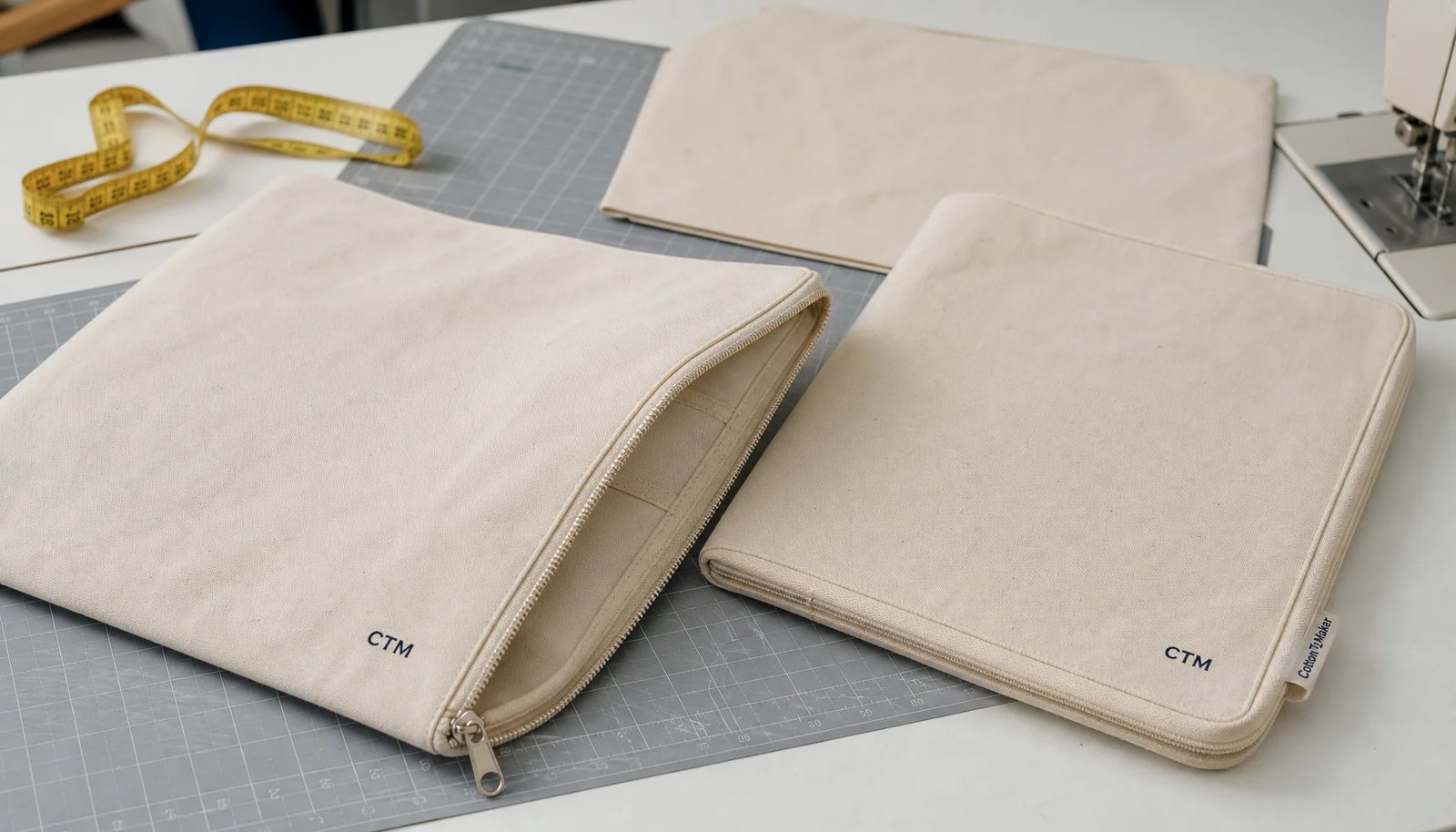
Why Hotel Retail Portfolios Fail in the Field
A custom canvas zipper portfolio looks simple on a quotation sheet, but hotel retail use is demanding. The item may sit in a boutique shop, be handled by guests every day, travel inside luggage, or be sold as part of a stationery set. Failures usually come from small production decisions: canvas that is too thin, zipper tape sewn under tension, print placed too close to the seam, or cartons packed so tightly that the corners arrive crushed.
For procurement teams, the main buying problem is not finding a supplier that can make a canvas pouch with a zipper. The real problem is building an RFQ and inspection checklist that separates a retail-ready portfolio from a low-grade document bag. The buyer needs measurable standards before production starts, because once fabric is cut and logos are printed, corrections become expensive.
- Treat the item as a retail accessory, not just a fabric envelope.
- Define how guests will use it: document holder, amenity kit, travel pouch, spa folder, or gift shop product.
- Control the zipper and corner construction because these areas create most functional complaints.
- Approve final packing during sampling, not after the goods are finished.
Set the Product Specification Before Comparing Quotes
A useful quote for custom canvas zipper portfolios should include more than size and logo. At minimum, the RFQ should define fabric weight, finished dimensions, zipper type, lining, print method, thread color, seam style, packing, and carton data. Without those details, one supplier may quote 8 oz canvas with a basic coil zipper while another quotes 12 oz canvas with lining and a stronger slider. Both prices may look valid, but they are not for the same product.
For hotel retail, common canvas weights usually sit around 10-12 oz, roughly 280-380 GSM depending on yarn, weave, and finishing. An 8 oz canvas can work for a low-cost sleeve, but it may feel weak if the portfolio is sold as a premium accessory. A 14 oz canvas can feel substantial, but it adds bulk at the zipper seam and may push up freight cost. The correct choice depends on the target retail price, intended contents, and display style.
- Use finished outer dimensions and usable inner dimensions, not only document size.
- State fabric weight in oz and GSM where possible to avoid mill-to-mill misunderstanding.
- Define zipper color, tape width, slider finish, and puller shape in the same spec sheet.
- Include seam construction and reinforcement requirements in the drawing or tech pack.
Canvas Weight, Hand Feel, and Shrinkage Control
Canvas is not judged only by weight. Two 12 oz fabrics can feel different if one is tightly woven and the other has a softer washed finish. Natural cotton canvas may show slubs and shade variation, which can be acceptable for a casual hotel retail look but not acceptable for a clean corporate gift shop presentation. Dyed canvas adds color control work, and washed canvas can create dimensional variation if the factory does not stabilize the fabric before cutting.
Buyers should decide whether the portfolio needs a crisp flat look or a softer handmade feel. A crisp canvas shows print cleanly and stacks well in retail displays. A softer canvas feels more relaxed but can wrinkle during packing. If the product must hold menus, welcome letters, or stationery flat, request a sample with the exact fabric treatment and test it after being packed for several days.
- For basic hotel retail: 10 oz canvas is usually a practical starting point.
- For premium portfolios: 12 oz canvas gives better body but needs careful corner sewing.
- For heavily printed designs: tighter weave helps reduce ink bleeding and fuzzy logo edges.
- For natural canvas: approve shade range and slub tolerance so inspection is realistic.
Zipper Construction Is the Main Functional Risk
The zipper is the part guests interact with first, so a rough zipper can make the whole product feel cheap even if the canvas is good. Nylon coil zippers are commonly used for canvas portfolios because they flex well and keep weight under control. Metal zippers can look more premium, but they require careful testing because metal teeth and heavier sliders can scratch contents, increase bulk, and cause uneven pull if the sewing line is not straight.
Inspection should include repeated opening and closing, not only a quick visual check. A practical factory test is to open and close the zipper several times on random units from each carton, then inspect zipper ends for skipped stitches, loose thread, and fabric caught near the coil. Zipper tape should lie flat, with no wave caused by sewing tension. The slider should not wobble, scrape, or stop at the corners.
- Require smooth zipper operation across the full length, especially around corners.
- Set zipper-end reinforcement with backstitching or bartack where the design allows.
- Avoid placing thick labels or patches too close to zipper seams.
- Reject units where lining or loose thread enters the zipper path.
Logo Method and Retail Finish Decisions
Hotel retail branding often needs to feel understated. Screen print works well for simple one-color or two-color logos on flat canvas panels, especially when MOQ and cost need control. For a more boutique look, buyers may use a woven side label, cotton label, leather patch, or debossed patch. Embroidery can work on thicker canvas but may pucker the panel if the backing and stitch density are not controlled.
Logo placement needs a measurable tolerance. A difference of 5 mm may be acceptable on a casual drawstring bag, but it can look wrong on a rectangular portfolio where the eye catches skewed alignment. Print should be tested after bending near the zipper opening if the logo sits close to a fold area. Thick ink layers can crack when the canvas flexes, especially on heavier or washed canvas.
- Use screen print for clean solid artwork and economical repeat orders.
- Use woven labels when the hotel brand wants a subtle retail accessory look.
- Use patches only after confirming seam bulk and needle performance.
- Set logo placement tolerance, such as plus or minus 3 mm for premium retail presentation.
MOQ Logic and Cost Drivers Buyers Should Separate
MOQ is not only one number. A supplier may have one MOQ for the sewn portfolio, another for dyed canvas, another for custom zipper color, and another for woven labels or printed inner bags. If the hotel retail program uses several property logos or colorways, these component MOQs can decide whether the order is commercially practical.
The largest cost drivers are usually fabric weight, zipper quality, lining, logo process, labor time, and packing. A lined portfolio costs more because it adds material and sewing steps. A zipper with a custom puller or antique metal finish adds both component cost and lead time. Retail packing also changes cost because individual bags, tissue inserts, hangtags, barcode stickers, and stronger cartons all require material and handling.
- Separate body MOQ, logo MOQ, label MOQ, zipper MOQ, and packing MOQ in the quote.
- For multi-hotel programs, consider shared blank inventory with property-specific labels only if branding rules allow it.
- Compare unit price together with carton quantity and gross weight because freight can change the landed cost.
- Avoid accepting a low unit price that removes lining, downgrades canvas, or changes zipper without clear notice.
Sample Approval Should Simulate Bulk Production
A sales sample made from available fabric is not enough for approval if the bulk order will use different canvas, zipper, print ink, or packing. The pre-production sample should represent the actual materials and construction planned for mass production. If exact bulk fabric is not ready, the supplier should state what is different and provide a timeline for the true production sample.
The sample should be measured and handled like a finished retail item. Insert the intended hotel documents, stationery, spa menu, or gift components and close the zipper. Leave the sample packed flat for a few days, then inspect creasing, zipper pressure marks, and logo durability. This simple test catches many problems before bulk cutting starts.
- Approve one sealed reference sample for the factory and one for the buyer or inspector.
- Photograph the approved sample from front, back, inside, zipper close-up, logo, and packing view.
- Record sample weight because it helps detect later fabric or lining substitution.
- Do not approve production based only on digital artwork placement.
Inspection Checklist With Practical Acceptance Criteria
The inspection checklist should translate buyer expectations into factory actions. For a hotel retail canvas zipper portfolio, the main categories are material, workmanship, zipper function, logo appearance, dimensions, cleanliness, and packing. Each category should include accept and reject conditions so the QC team does not rely on personal judgment.
A typical final inspection can use an AQL-based sampling plan, but the buyer should still define critical defects that are not acceptable in any sampled unit. Zipper failure, wrong logo, severe dirt, mold smell, sharp metal parts, and unusable size should be treated more seriously than a small loose thread that can be trimmed. Clear severity rules help the supplier sort problems before shipment.
- Finished size tolerance: commonly plus or minus 5 mm unless the insert fit is tight.
- Logo placement tolerance: commonly plus or minus 3-5 mm depending on artwork and panel size.
- Stitching: no skipped stitches, broken thread, open seams, or loose zipper-end sewing.
- Cleanliness: no oil stains, chalk marks, strong odor, loose lint, or fabric dust inside the portfolio.
- Function: zipper must open and close smoothly without catching, skipping, or pulling fabric into the coil.
Packing and Carton Controls for Hotel Retail
Packing is part of the product, not an afterthought. Hotel retail goods often move through import warehouses, distributors, property storage rooms, and shop shelves before reaching the guest. If portfolios are packed too tightly, canvas panels crease and zipper sliders press into adjacent units. If cartons are too weak or too heavy, lower layers can arrive distorted.
For retail-ready presentation, buyers may choose individual polybags, glassine bags, belly bands, hangtags, barcode labels, or tissue inserts. Each option affects cost, sustainability claims, and packing speed. If the hotel has plastic reduction rules, confirm the acceptable material before ordering printed bags. A paper band may look better in a boutique retail setting, but it gives less dust protection during long transit.
- Set units per inner pack and export carton instead of leaving carton packing to the factory.
- Use a thin card or tissue insert if the portfolio must keep a flat rectangular shape.
- Limit carton gross weight so warehouse handling does not crush lower layers.
- Approve carton marks, barcodes, retail labels, and warning text before packing materials are printed.
Lead Time Risks and Quote Data That Prevent Surprises
Lead time for custom canvas zipper portfolios depends on material readiness. Natural canvas in common weights may be faster than dyed canvas, custom zipper colors, custom pullers, woven labels, or retail packaging. The critical path is usually the component that has the longest MOQ or color approval process. Buyers should request a schedule that separates sample making, material purchasing, cutting, printing, sewing, inspection, packing, and export booking.
A complete quote should allow a procurement team to calculate landed cost and reorder timing. Ask for unit price by quantity tier, sample cost, tooling or screen charges, packing cost, carton dimensions, gross weight, units per carton, production days after deposit and sample approval, and validity period. If the supplier cannot provide carton data, the buyer cannot compare air freight, sea freight, or courier options accurately.
- Request quote tiers such as 500, 1,000, 3,000, and 5,000 pieces if demand is not fixed.
- Separate one-time costs, including screens, molds, custom pullers, and label setup.
- Confirm whether lead time starts after deposit, artwork approval, sample approval, or material arrival.
- Use carton dimensions and gross weight to compare landed cost, not only FOB unit price.
Specification comparison for buyers
| Spec decision | Recommended option | When it fits | Buyer risk to check |
|---|---|---|---|
| Canvas fabric weight | 10-12 oz cotton canvas, about 280-380 GSM depending on mill finish | Hotel gift shops and lobby retail where the portfolio must feel durable but still fold cleanly | Very light canvas can wrinkle and collapse; very heavy canvas may raise freight cost and make corners bulky |
| Lining structure | Unlined for simple retail sleeve, or 150D-210D polyester lining for premium hotel stationery sets | Unlined works for price-sensitive merchandise; lined works when pens, cards, and guest documents sit inside | Unlined raw interiors can shed lint; lining must be caught evenly in zipper seams to prevent loose fabric into zipper teeth |
| Zipper type | Nylon coil zipper with smooth slider and matching or contrast puller | Best balance for flexible canvas portfolios in bulk hotel retail orders | Metal zipper looks premium but can increase scratching risk, weight, and slider inconsistency if not tested well |
| Logo decoration | Screen print for flat solid logos; woven label or leather patch for subtle retail branding | Screen print suits hotel brand colors and lower MOQ; labels fit boutique retail styles | Thick ink can crack on folded areas; label placement must not interfere with zipper stitching or corner turning |
| Portfolio size tolerance | Common A4/document fit with agreed tolerance of plus or minus 5 mm | Useful for menus, welcome packs, spa brochures, stationery, or retail travel document kits | If the buyer only states A4 size, the factory may make the outer size too tight for inserted materials |
| Reinforcement | Bartack or backstitch at zipper ends and high-stress side seams | Needed when the portfolio is opened frequently in hotel shops or used as a reusable guest document pouch | Weak zipper-end sewing is a common failure point and should be pull-tested during inline QC |
| Packing method | Individual polybag or glassine bag, flat packed with tissue or thin card insert if shape matters | Retail-ready hotel shop display, amenity sets, or distributor cartons that travel through multiple warehouses | Over-tight packing creates creases; high stack pressure can bend zipper sliders and distort corners |
| Supplier route | Direct manufacturer for custom construction; trading company only if it provides full spec sheets and inspection photos | Direct factory is better for repeat replenishment and engineering changes; trader can help if combining mixed hotel items | A cheap quote without fabric GSM, zipper grade, packing, and inspection criteria is not comparable |
Buyer checklist before sampling
- Define whether the portfolio is a retail product, guest amenity, document holder, or gift-with-purchase item because the acceptable finish level changes with use.
- Specify outer dimensions, usable inner dimensions, canvas weight in oz or GSM, zipper length, zipper color, puller style, lining choice, and seam construction.
- Require a pre-production sample made with the nominated fabric, zipper, thread, print method, label, and final packing instead of approving only a loose material swatch.
- Set dimensional tolerance, logo placement tolerance, stitch-per-inch range, zipper smoothness standard, color tolerance, and carton drop or compression expectations before mass production.
- Separate retail-critical defects from minor defects, especially dirty marks, zipper jamming, logo skew, loose threads, twisted corners, and inconsistent fabric shade.
- Request inline inspection photos before the full batch is packed, including fabric cutting, zipper attachment, logo print, sewing, trimming, and packed carton views.
- Confirm barcode, hangtag, inner bag warning text, carton marks, carton weight limit, and any hotel retail labeling rules before the packing material is printed.
- Compare quotes using the same MOQ, fabric GSM, zipper type, print color count, packing method, inspection level, sample cost, and export carton quantity.
Factory quote questions to send
- What exact canvas weight will be used, and is it greige, dyed, washed, or finished canvas?
- What are the outer dimensions and practical inner document capacity after seams and zipper tape are included?
- Which zipper supplier, zipper type, tape width, slider finish, and puller shape are included in the quoted price?
- Is the logo cost based on screen print, heat transfer, embroidery, woven label, leather patch, or another process?
- How many print colors are included, and what is the charge for extra colors, Pantone matching, and revised screens?
- What MOQ applies to the portfolio body, fabric color, zipper color, lining color, label, and printed packing material separately?
- How many pre-production samples are included, how long do samples take, and can the sample be made with bulk materials?
- What inspection standard is used for fabric defects, sewing defects, zipper function, logo placement, and final packing?
- What is the estimated production lead time after sample approval, and which materials are on the critical path?
- What are the carton dimensions, units per carton, gross weight, and recommended shipping method for this order quantity?
Quality-control points to confirm
- Canvas weight must match the approved sample within the agreed tolerance and should not be substituted without buyer approval.
- Fabric shade should be checked across rolls before cutting because natural, dyed, and washed canvas can show batch variation.
- Zipper should open and close smoothly for repeated cycles without tooth skipping, slider wobble, or fabric caught in the coil.
- Zipper ends need secure backstitching or bartack reinforcement to prevent seam bursting during normal retail handling.
- Logo print should be positioned within the approved tolerance, with no pinholes, smudging, ink bleeding, cracking, or wrong color.
- Stitching should be straight, even, and secure, with no skipped stitches, broken thread, loose bobbin loops, or exposed raw seams.
- Corners should be turned cleanly with no twisted zipper tape, bulky seam allowance, or distorted rectangular shape.
- Finished size should be measured on a flat surface after sewing and trimming, not only checked from the cutting panel.
- Each portfolio should be trimmed, cleaned, and packed flat so threads, chalk marks, lint, and fabric dust do not reach hotel retail shelves.
- Cartons should be strong enough for export handling, with carton weight controlled to avoid crushing lower layers.