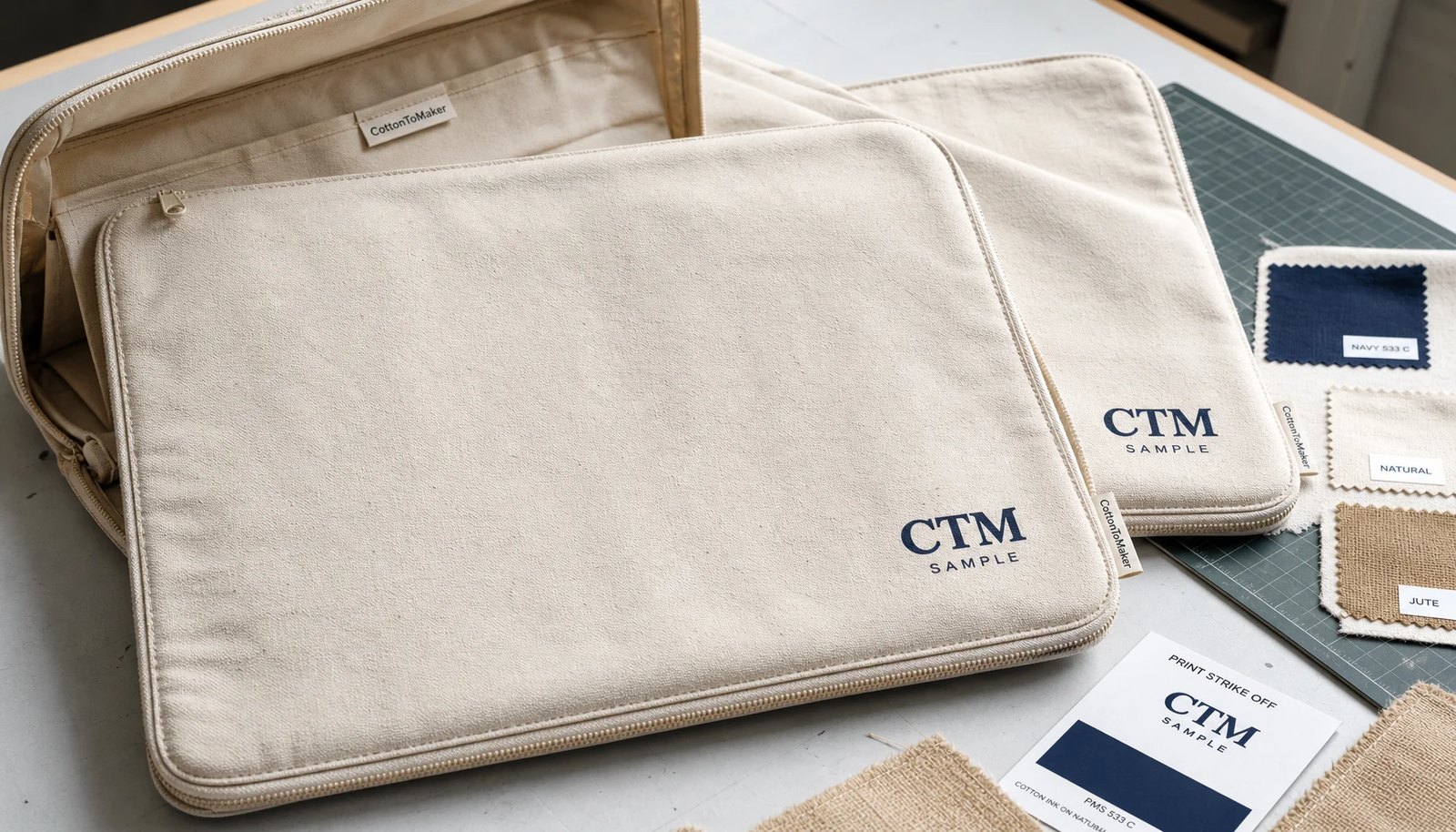
The proofing problem bookstore buyers need to solve
Custom canvas zipper portfolios for university bookstores sit between a stationery item, a soft business bag, and a licensed merchandise product. That makes proofing more demanding than a flat tote bag. The buyer is not only approving a logo; the buyer is approving a fabric structure, zipper behavior, document fit, retail presentation, and campus brand compliance.
Most production disputes start because the RFQ is too simple: size, logo, quantity, and target price. A factory can quote that, but different suppliers may assume different canvas weights, lining materials, zipper grades, packing formats, and print methods. The practical solution is to make the proofing checklist part of the RFQ, not something added after the sample looks wrong.
- Treat the portfolio as a sewn retail product, not only a printed canvas panel.
- Separate logo approval from construction approval so one does not hide the other.
- Use the pre-production sample to freeze fabric, zipper, print, lining, packing, and carton data.
- Compare supplier quotes only after all suppliers are pricing the same technical specification.
Start with finished size and use case
The first specification is not the logo size. It is the finished portfolio size and what the bookstore expects the customer to carry. A portfolio for A4 admission documents is different from one built around US letter folders, a 13 inch tablet, a spiral notebook, or a campus orientation packet with several inserts. A small error in finished size can make the zipper corner tight, distort the document edge, or make the item feel cheap at checkout.
For RFQ purposes, give the finished width and height, the allowed tolerance, and the largest insert dimensions. If the portfolio has a gusset, describe the gusset depth and whether it is functional or only a seam allowance effect. For a flat zipper portfolio, a common buyer mistake is approving an outside dimension without checking usable inside space after seams, zipper tape, and lining are sewn in.
- For US letter documents, allow clearance beyond 216 x 279 mm plus seam and zipper space.
- For A4 documents, allow clearance beyond 210 x 297 mm and confirm orientation.
- For tablet use, specify whether padding is required or whether the item is only a document portfolio.
- For campus kits, test the thickest insert set before approving the final sample.
Choose canvas weight before comparing prices
Canvas weight drives the hand feel, print behavior, sewing difficulty, and freight cost. For custom canvas zipper portfolios, 10 oz canvas can work for a light promotional item, but 12 oz canvas, about 380-400 GSM, usually gives a better bookstore retail feel without becoming too stiff. Heavier 14-16 oz canvas may look premium, but it can create bulky zipper corners and higher needle breakage risk during sewing.
Buyers should ask for both oz and GSM because suppliers in different regions may describe fabric differently. Also clarify whether the canvas is natural, bleached, dyed, washed, or laminated. Natural canvas has seed flecks and shade variation that many buyers like, but those flecks can interfere with fine logo details. Bleached or dyed canvas can improve print contrast, while washed canvas may shrink or soften unless the sample and bulk fabric follow the same process.
- Use 10 oz canvas for budget promotions where structure is less important.
- Use 12 oz canvas for most retail bookstore portfolios and alumni merchandise.
- Use 14 oz or heavier only when the zipper, corner sewing, and freight impact are accepted.
- Approve the exact fabric swatch before approving the print strike-off.
Match print method to campus artwork
University bookstore artwork often includes official seals, mascot graphics, department names, founding years, or sponsor logos. Screen printing is usually the most reliable method for solid spot colors on canvas, especially when order quantity is moderate and the design uses one to three colors. It gives good opacity, predictable cost, and repeatable placement when the artwork is prepared correctly.
Heat transfer can help when the artwork contains gradients, small multicolor details, or low quantity designs that do not justify several screens. The tradeoff is hand feel, edge durability, and surface compatibility with textured canvas. Embroidery can look premium but may pucker a flat portfolio panel and is usually better for small marks or patches than large detailed seals. The factory should not choose the print method silently; it should be written in the quote.
- Send vector files for logos, not low-resolution campus web images.
- Define PMS colors and accept that natural canvas can shift perceived color.
- Set minimum line thickness and minimum text height for textured canvas.
- Approve a physical strike-off before bulk printing, especially for licensed marks.
Proof the zipper like a functional component
A zipper portfolio fails quickly when the zipper is treated as trim instead of hardware. A No. 5 nylon zipper is a practical default for canvas portfolios because it balances strength, smooth operation, and cost. Metal zippers may look premium but can be heavier, less flexible on corners, and more expensive. The zipper tape color should be approved with the fabric, not guessed from a digital image.
The puller is also part of the retail impression. A plain metal puller may be enough for campus store inventory, while a molded, logo-shaped, or cord puller can support a private-label program. Custom pullers add MOQ and tooling or mold cost, so they should be quoted separately. During sample approval, open and close the zipper repeatedly with the portfolio loaded; a zipper that works empty may catch the lining when documents are inside.
- Specify zipper size, tape color, slider finish, puller material, and puller shape.
- Check that zipper ends are reinforced and do not expose sharp edges.
- Test zipper smoothness with the intended insert load inside the sample.
- Avoid custom zipper colors unless the MOQ and lead time are acceptable.
Build a quote that separates real cost drivers
A useful factory quote should show enough detail to explain why one supplier is higher or lower. For canvas zipper portfolios, the main cost drivers are fabric weight, fabric color process, lining, zipper grade, number of pockets, logo method, print color count, labeling, packing, and carton volume. A low quote may simply remove lining, use lighter canvas, downgrade the zipper, or pack too tightly.
MOQ should also be separated by component. The sewing factory may accept 300 pieces, but the fabric mill, dye house, zipper supplier, label supplier, or print screen setup may have their own minimums. When buyers understand these layers, they can decide whether to change trim to stock colors, combine designs, or increase quantity to reduce setup cost per piece.
- Request unit price at at least two quantities, such as 300 pcs and 1000 pcs.
- Ask which charges are one-time setup charges and which are included in unit price.
- Require Incoterms in the quote, such as EXW, FOB, CIF, or DDP if available.
- Ask for estimated packed carton dimensions so freight comparison is not delayed.
Use samples to freeze production, not to browse ideas
Sampling works best when the buyer already knows the target construction. A rough sample is useful for early development, but it should not be treated as a production approval sample. For university bookstore programs, the important sample stages are material swatch, print strike-off, pre-production sample, and packed sample. Each stage controls a different risk.
The pre-production sample should be made with the approved canvas, actual zipper, actual lining, approved label, and approved logo process whenever possible. If any substitute is used, it must be listed clearly. Otherwise, bulk production may be rejected for a detail that was never truly sampled. Photos help, but they do not replace a physical sample when the order involves brand color, canvas hand feel, or zipper operation.
- Material swatch controls fabric shade, weight, and texture.
- Print strike-off controls ink color, coverage, line clarity, and placement.
- Pre-production sample controls construction, dimensions, zipper, pockets, and label.
- Packed sample controls folding, barcode placement, carton fit, and retail presentation.
Set acceptance criteria before inspection
Quality control should not depend on subjective comments such as good quality or premium finish. For a portfolio, measurable points include finished size tolerance, logo position tolerance, zipper function, stitch density, seam strength, color shade, print defects, and cleanliness. These should be written before production so the factory line and the buyer's inspector use the same standard.
A reasonable inspection plan can use general AQL sampling, with critical defects separated from minor appearance issues. For example, a broken zipper, wrong logo, wrong fabric, sharp hardware, or missing label can be treated as major or critical depending on the buyer's policy. A small loose thread may be minor if it can be trimmed and does not affect retail appearance. The key is to define what can be repaired, what must be rejected, and what triggers sorting.
- Logo placement tolerance is commonly set in millimeters from fixed seam references.
- Finished size tolerance should consider fabric shrinkage and sewing variation.
- Print smudges, ghosting, cracking, and wrong color should be classified before inspection.
- Zipper failure should be tested across several open-close cycles, not only one pull.
Control packing before it damages the proof
Packing can ruin an otherwise good portfolio order. Canvas attracts dust, and printed panels can rub against zipper pulls, carton walls, or other printed surfaces. Individual recycled polybags, glassine sleeves, or paper bands can all work, but the choice should match the retail channel. A university bookstore receiving team may prefer barcode-ready individual units, while a distributor may want master cartons sorted by design and size.
Flat packing is usually safer than aggressive folding because it protects the zipper tape and reduces print creasing. However, flat packing increases carton footprint, which can affect ocean freight, air freight, and warehouse handling. The buyer should approve carton size and piece count before production packing starts. Carton weight should be practical for manual handling, especially if the shipment goes through campus receiving docks.
- Keep printed faces separated if ink surface abrasion is possible.
- Use carton liners or inner bags when natural canvas must stay clean.
- Confirm barcode label position before printing retail labels in bulk.
- Avoid overfilled cartons that bend zipper corners or deform the portfolio body.
Plan lead time around approvals, not only sewing days
Bulk lead time often sounds short because the factory is quoting sewing time after all approvals. The real calendar includes artwork checking, fabric sourcing, swatch dispatch, strike-off approval, sample making, sample courier time, sample revision, bulk material purchase, printing, sewing, trimming, inspection, packing, and export booking. For bookstore launches tied to orientation, graduation, homecoming, or back-to-school periods, these approval days matter.
A practical schedule should show decision gates. If the buyer takes five business days to approve artwork and another week to review a physical sample, the factory cannot absorb that time without affecting shipment. For repeat orders, lead time can be shorter if fabric, zipper, label, and artwork remain unchanged. For first orders, protect the schedule by freezing specifications early and avoiding last-minute logo changes after screens are made.
- Add time for university brand office approval if licensed artwork is involved.
- Do not book retail launch dates from an unapproved digital proof.
- Custom dyed fabric, custom zipper tape, and custom pullers can add several weeks.
- Keep a written approval log so the factory knows which proof version is final.
Specification comparison for buyers
| Spec decision | Recommended option | When it fits | Buyer risk to check |
|---|---|---|---|
| Canvas body fabric | 12 oz cotton canvas, about 380-400 GSM, pre-shrunk when possible | Good balance for bookstore retail portfolios, orientation kits, alumni gifts, and conference resale | Too light below 10 oz can collapse around documents; too heavy may raise freight and sewing cost |
| Portfolio structure | Flat zipper portfolio with lined inner face, document sleeve, and optional pen loop | Works for notebooks, admission folders, tablets without heavy padding, and branded welcome packs | Overbuilding with foam padding can make the item bulky and may not fit standard carton counts |
| Zipper specification | No. 5 nylon zipper with metal or molded puller, color matched or contrast dyed | Suitable for repeated retail handling while keeping cost below metal zipper construction | Cheap coil zipper can wave on canvas edges; puller color must match approved trim sample |
| Logo print method | Screen print for solid university marks; heat transfer only for complex gradients or small color runs | Best for 1-3 spot colors, mascots, bookstore names, and department logos | Fine lines can fill on textured canvas; PMS matching needs a strike-off on actual fabric |
| Inside branding | Woven side label or printed care label with school, bookstore, or private-label information | Useful for retail brands and distributors needing repeatable product identity | Label placement can interfere with zipper seam allowance if not shown on the tech pack |
| MOQ logic | 300-500 pcs for standard canvas and stock zipper colors; 800-1000 pcs for custom dyed trim or special lining | Helps buyers separate true factory MOQ from fabric mill or dye lot MOQ | Small orders may carry sample, setup, and print screen charges that distort unit cost |
| Packing method | Individual recycled polybag or paper band, then flat-packed 25-50 pcs per export carton | Protects print surface and keeps portfolios clean for retail shelf or campus store receiving | Tight folding can crease print and zipper tape; carton size affects dimensional freight |
| Proof approval route | Digital artwork proof, material swatch, print strike-off, pre-production sample, then carton drop check | Appropriate when logo compliance and retail presentation matter more than fastest shipment | Skipping strike-off often causes color disputes after bulk printing has already started |
Buyer checklist before sampling
- Define finished size by the largest document, notebook, or tablet insert, not by an old catalog photo.
- Specify canvas weight in oz and approximate GSM, plus whether the fabric must be natural, bleached, dyed, or washed.
- Confirm zipper size, zipper tape color, puller material, puller finish, and whether the puller needs a branded shape.
- Provide vector artwork, PMS references, logo placement dimensions, and minimum clear space required by university brand rules.
- Request print strike-off on the actual bulk fabric or approved fabric swatch before authorizing full production.
- State lining, pocket, pen loop, gusset, and label requirements separately so suppliers do not quote different constructions.
- Set acceptable logo position tolerance, stitch tolerance, zipper function standard, and dirty mark rejection level.
- Require sample photos of front, back, inside, zipper end, side seams, label position, and packed unit before sample dispatch.
- Clarify retail packing, barcode label, carton mark, carton weight limit, and whether mixed designs can share one carton.
- Compare quotes using the same MOQ, fabric weight, print colors, packing method, sample policy, and Incoterms.
Factory quote questions to send
- What exact canvas weight will be used, in both oz and GSM, and is it stock fabric or woven to order?
- Is the quoted fabric greige, natural, bleached, dyed, washed, or pre-shrunk, and what color tolerance applies?
- Which zipper size, zipper tape material, puller type, and slider finish are included in the price?
- Is the logo quoted as screen print, heat transfer, embroidery, woven patch, or debossed leather patch, and how many colors are included?
- Will the print proof be made on the same fabric as bulk production, and is one revised strike-off included?
- What sample lead time, sample charge, and bulk lead time apply after artwork and material approval?
- What is the MOQ for the portfolio body, the print setup, custom zipper color, custom puller, and woven label separately?
- How many pieces per export carton are planned, what is the estimated carton size, and what gross weight limit will be used?
- Are barcode stickers, hangtags, retail bands, silica gel, or master carton marks included or quoted separately?
- Which inspection standard is used for AQL, and can the buyer appoint a third-party inspection before shipment?
Quality-control points to confirm
- Canvas weight should match the approved swatch within the agreed tolerance and should not show excessive slubs, oil marks, or shade panels.
- Finished size should remain within the approved tolerance after sewing, pressing, and packing, especially around zipper corners.
- Logo color should match the approved strike-off under consistent light, not only the digital proof on screen.
- Print edges should not crack, bleed, ghost, or fill in small letter spaces on the canvas texture.
- Zipper should run smoothly across the full opening without catching lining, twisting tape, or leaving sharp puller burrs.
- Stitching should be straight at visible seams, reinforced at zipper ends, and free from skipped stitches or loose threads.
- Inside pockets and pen loops should match the approved position and should hold the intended insert without tearing.
- Individual packing should protect the print face from abrasion, dust, moisture, and carton pressure during export handling.