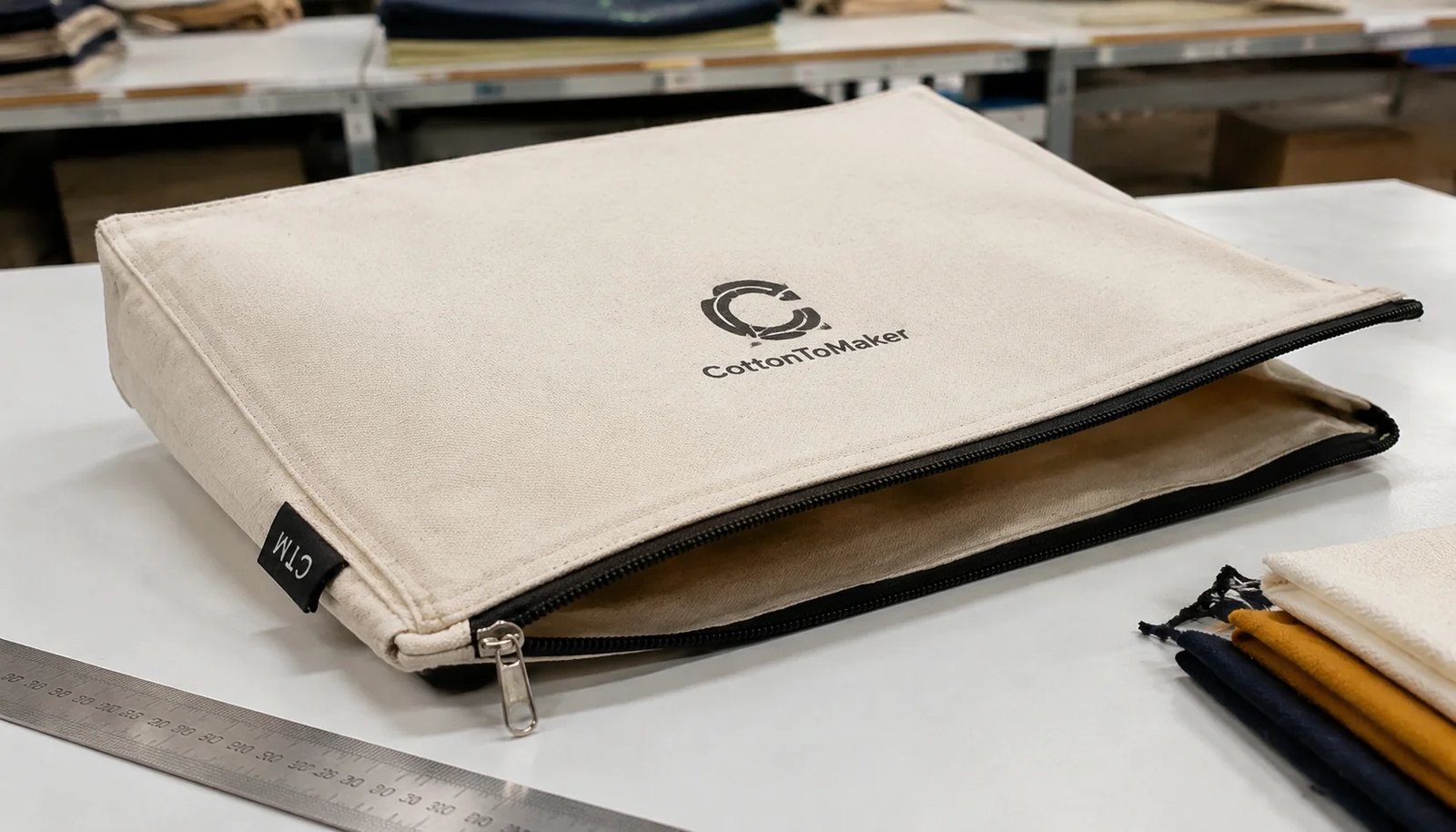
Buying Problem
Custom canvas zipper portfolios for liquor retailers are usually ordered for a practical job: carrying price lists, tasting sheets, training documents, account forms, shelf talker samples, or brand presentation materials. The buying risk is not only whether the bag looks good in a photo. The problem is whether the printed logo, document fit, zipper movement, and flat packing stay consistent across a wholesale run.
For procurement teams, the print proofing stage is where most avoidable disputes can be removed. A liquor retailer or distributor may approve artwork on a PDF, but the final product is canvas, thread, zipper tape, ink, seam allowance, and carton pressure. A good RFQ turns those physical details into measurable requirements before the factory cuts bulk fabric.
- Use the keyword focus as an internal brief: custom canvas zipper portfolios print proofing checklist for liquor retailers.
- Treat the portfolio as a document carrier and brand item, not as a generic pouch.
- Approve the printed proof on the actual canvas whenever logo color and brand presentation matter.
Core Specification
Start with the documents the portfolio must hold. Liquor retail programs often use A4 in export markets and US Letter in North America. Some buyers also need space for laminated tasting cards, pricing folders, coupon sheets, menu inserts, or retail chain compliance forms. If the RFQ only states an outside size, suppliers may quote a cheaper construction that loses internal space after sewing.
A practical RFQ should show finished outside size, usable inside size, zipper opening direction, gusset or flat profile, and the number of internal pockets. Flat portfolios are lower cost and easier to carton pack. A slim gusset gives more capacity but can make the front print less flat and increase sewing difficulty at the corners.
- For A4, specify usable inside clearance for 210 x 297 mm documents plus folder thickness if needed.
- For US Letter, specify usable inside clearance for 8.5 x 11 inch sheets and any insert folder.
- If a product sheet must slide in without bending, define the zipper opening width, not only the body width.
- For a premium sales kit, list each interior feature separately: divider, card slot, pen loop, mesh pocket, elastic strap, or label.
Canvas Weight
Canvas zipper portfolios normally work best in the 12 oz to 16 oz range, roughly 400-540 GSM depending on weave and finishing. A 10 oz canvas may reduce cost and freight weight, but it can feel weak around the zipper and may wrinkle badly during packing. A 16 oz canvas gives a firmer handfeel and better structure, but it raises material cost and can make corners thicker.
Natural canvas is popular because it fits many liquor retail brand styles, but it has shade variation and cotton seed specks. Dyed canvas gives better brand alignment but adds MOQ pressure and color control risk. If the order is part of a repeat retail program, require the supplier to record fabric lot, GSM, and color reference so reorder lots do not drift too far.
- Budget document carrier: 10 oz to 12 oz canvas if the buyer accepts softer structure.
- Standard retail portfolio: 12 oz to 14 oz canvas for a balance of cost, print quality, and sewing stability.
- Premium brand kit: 14 oz to 16 oz canvas when a firmer body and stronger handfeel are required.
- For dyed canvas, confirm whether the MOQ is driven by fabric dye lot or finished product quantity.
Print Proofing
Screen printing is usually the most reliable method for simple liquor retailer logos, store brand marks, distributor names, and campaign graphics. It gives solid ink coverage and predictable cost at wholesale quantities. Heat transfer can handle gradients, small details, and multi-color artwork, but it may change the handfeel and can look less integrated on heavy canvas. Embroidery is possible for premium runs, although it may distort thinner canvas and can limit fine logo detail.
The proof should not stop at digital artwork. A printed strike-off on the chosen canvas shows ink absorption, edge sharpness, and color shift. Natural canvas warms up many colors, so a Pantone value that looks correct on coated paper may look duller or darker on fabric. For liquor retail buyers, this matters when the portfolio sits next to branded bottles, shelf materials, uniforms, or trade show displays.
- Give artwork as vector files with outlined fonts and Pantone references.
- State print size in millimeters or inches, not only percentage scale.
- Mark logo distance from finished top, side, and zipper edges.
- Approve acceptable color variance under standard lighting, especially for cream, gold, red, navy, and black logos.
- Keep a signed print strike-off with the approved sample before bulk production.
Zipper Details
The zipper is a functional part of the product, not a small accessory to leave vague. A No.5 nylon coil zipper is a common choice because it is smooth, flexible, and suitable for flat document portfolios. Metal zippers can look more premium but add weight, cost, and possible scratching against printed inserts or other products in a carton. Plastic molded zippers are less common for this category because the teeth can feel bulky on a flat portfolio.
Zipper tape quality affects the final look. On heavy canvas, weak zipper tape can ripple after sewing, especially along long edges. The puller also changes perceived value. A standard metal puller is efficient for wholesale programs, while a branded fabric pull tab or rubber puller may fit a promotional campaign. These additions should be priced separately because they can add tooling, labor, and approval time.
- Specify zipper gauge, tape color, slider finish, and puller style.
- Require smooth opening and closing across the full zipper path without catching the lining.
- Use bartacks or reinforced stitching at zipper ends where repeated pulling will stress the seam.
- If adding a custom puller, include artwork, material, tooling lead time, and minimum quantity in the RFQ.
MOQ And Cost
MOQ is usually driven by fabric sourcing, print setup, cutting efficiency, and labor line planning. A stock natural canvas with one-color screen print can often support a lower MOQ than custom dyed canvas, multiple print positions, custom zipper tape, or branded metal hardware. Buyers comparing quotes should separate true MOQ from price break quantity. A supplier may accept 500 pieces, but the unit cost may become more competitive at 1000 or 3000 pieces.
Cost comparison should include more than the unit price. Screen charges, sample fees, custom label charges, inner packing, carton strength, inland transport, and inspection cost can change the landed cost. For liquor retail programs distributed to multiple store regions, carton size and carton weight also affect warehouse handling and parcel split costs.
- Ask for price breaks at realistic order levels such as 500, 1000, 3000, and 5000 pieces.
- Separate base portfolio cost from print setup, label, custom puller, and special packing.
- Confirm whether the quoted MOQ applies per logo, per color, per size, or per shipment.
- For repeat programs, request a reorder price assumption using the same screens and approved materials.
Sample Approval
A pre-production sample should match the bulk order in fabric, print, zipper, thread, label, lining, pockets, and packing. A shape sample made from substitute fabric is useful early in development, but it should not release bulk production. The final sample must show how the logo behaves on the actual canvas and whether the zipper track sits flat after sewing.
Sample review should be done with a ruler, color reference, document insert, and packing simulation. Insert the real documents the retailer will use. Open and close the zipper several times. Check whether the portfolio lies flat after documents are added. Then place it in the proposed polybag or paper wrap and stack several pieces to see if the zipper pull marks the printed front panel.
- Measure outside size and usable inside size against the RFQ.
- Compare logo color and placement against the signed artwork proof.
- Check stitching density, seam straightness, corner shape, and thread trimming.
- Test zipper movement with the portfolio empty and with documents inside.
- Approve packing only after confirming it does not crease the print or bend corners.
Inspection Limits
Quality control should use written thresholds instead of personal preference. For this product, the most common defects are print color shift, off-center logos, zipper waviness, skipped stitches, dirty canvas marks, loose threads, deformed corners, and carton compression marks. These are visible to retail buyers and store teams, so they should be part of the inspection plan.
A practical inspection can follow general AQL logic, but the buyer should define critical appearance points for the front print panel and zipper function. One defective zipper can make the product unusable. A small shade variation may be acceptable on natural canvas, but a logo printed 12 mm off position may not be acceptable for a retail brand program.
- Critical defect: zipper cannot open or close, sharp hardware edge, wrong logo, wrong size category, or contaminated product.
- Major defect: visible print misregistration, heavy ink mark, broken stitch, twisted body, severe corner deformation, or wrong packing.
- Minor defect: small loose thread, slight natural canvas speck, or tiny shade variation within the approved standard.
- Set measurement tolerance before production, normally around +/-5 mm for size and +/-3 mm to +/-5 mm for logo placement.
Packing Plan
Packing for canvas zipper portfolios should protect the flat shape and printed face. Individual polybags are common and efficient, but some retail buyers prefer paper belly bands or recycled packaging to reduce plastic. The packing choice affects labor, carton quantity, and moisture protection during export. If the products will be repacked into sales kits, avoid packaging that leaves adhesive residue or deep fold marks.
Carton loading matters because a zipper pull can press into the print surface when pieces are stacked too tightly. Heavy cartons also increase the chance of corner deformation. For bulk shipments, request carton dimensions, gross weight, net weight, pieces per carton, and stacking direction. This helps the importer estimate warehouse handling and shipping volume before the goods leave the factory.
- Use flat stacking with protective separation if zipper pulls touch printed panels.
- Avoid over-compressing cartons to reduce volume at the cost of damaged corners.
- Add desiccant or moisture control if shipping during humid season or using uncoated natural cotton.
- Mark cartons by SKU, logo version, color, quantity, gross weight, net weight, and carton number.
Lead Time Risk
Lead time should be counted from final sample approval, not from the first inquiry date. The schedule can shift if the buyer changes artwork, selects custom dyed fabric, adds a branded zipper puller, or requests revised packing. For liquor retail campaigns tied to store openings, seasonal promotions, or brand launches, late sample approval is usually the biggest risk.
A realistic production calendar includes artwork confirmation, fabric sourcing, print strike-off, pre-production sample, buyer approval, bulk cutting, printing, sewing, trimming, packing, inspection, and export booking. Each stage has a decision point. Procurement teams should avoid approving the sample verbally without locking the final technical sheet, because small changes after cutting can become expensive.
- Stock fabric with simple print usually has the shortest development path.
- Custom dyed canvas adds fabric lab dip and dye lot time before sample making.
- Custom hardware or pullers can add tooling and approval steps.
- Inspection and carton correction time should be kept in the schedule before vessel or air booking.
Specification comparison for buyers
| Spec decision | Recommended option | When it fits | Buyer risk to check |
|---|---|---|---|
| Canvas body fabric | 12 oz to 16 oz cotton canvas, roughly 400-540 GSM before washing or coating | Liquor retail field use where sales staff carry price sheets, tasting notes, menus, rebate forms, or account documents | Low GSM canvas may crease around the zipper and print area; require fabric weight, weave photo, and shrinkage note in the quote |
| Portfolio size | A4 or US Letter internal fit with 10-15 mm clearance on all sides | Programs serving mixed markets or distributors that carry printed sell sheets in folders | Exterior size alone is not enough; confirm usable inside dimensions after seam allowance, zipper curve, and lining are included |
| Print method | Screen print for one to three solid brand colors; heat transfer only for gradients or small batch variable artwork | Most liquor retailer logos, campaign marks, and store brand graphics that need controlled repeat color | Pantone matching shifts on natural canvas; approve printed fabric swatch, not only digital artwork |
| Logo position | Centered front panel with minimum 20-25 mm distance from zipper seam and folded edge | Retail presentation where the portfolio may be handed to store managers or used in sales meetings | Artwork too close to the zipper can distort during sewing; mark logo placement from finished edges on the proof |
| Zipper construction | No.5 nylon coil zipper for standard use; No.5 metal zipper only when the buyer accepts extra weight and scratch risk | Daily document carrying, training kits, and liquor store merchandising teams | Cheap zipper tape can wave on heavy canvas; test open-close cycles and make sure the puller does not catch lining |
| Interior build | Unlined canvas for lower cost, lined polyester or cotton pocket system for premium programs | Unlined for budget distributor folders; lined for brand owner kits with documents, cards, and small samples | Interior pockets change sewing time and carton volume; quote pocket count and material separately |
| Sample approval | Pre-production sample using actual canvas, zipper, thread, print ink, and packing method | Any order where brand color, logo position, or retail-facing finish matters | A prototype made with substitute fabric can hide shrinkage, print bleeding, and zipper tension problems |
| Packing method | One piece in recycled polybag or paper belly band, then export carton with flat stacking | Wholesale shipments to liquor retail chains, distributors, or brand warehouses | Over-tight carton packing can bend corners and mark the printed face; request carton drop test and carton dimensions |
Buyer checklist before sampling
- Define whether the portfolio must fit A4, US Letter, legal documents, menu sheets, or a branded insert, then state the usable internal size, not only the outside dimensions.
- Specify canvas weight in oz and GSM, including whether the fabric is natural, dyed, bleached, washed, coated, or laminated.
- Provide vector artwork with Pantone references, maximum print size, exact placement from finished edges, and tolerance for color and position.
- Choose the zipper type, zipper color, puller material, puller length, and whether a custom puller or branded tab is required.
- Confirm whether the portfolio is unlined, lined, or built with inside pockets, pen loop, card holder, elastic strap, or document divider.
- Require a pre-production sample made with the same fabric, print method, zipper, thread, label, and packing that will be used in bulk.
- Set acceptance criteria for print color, ink coverage, logo registration, stitching density, zipper operation, size tolerance, and carton condition.
- Ask suppliers to separate unit price, mold or screen charge, sample charge, packing charge, inland freight, export carton details, and lead time assumptions.
- Review how the factory will prevent natural canvas shade variation between fabric lots, especially for repeat retail programs.
- Keep one sealed approved sample and one signed production proof at the factory before cutting bulk fabric.
Factory quote questions to send
- What canvas weight in oz and GSM are you quoting, and is the material stock fabric or made-to-order dyed fabric?
- What is the finished outside size and usable inside document size after sewing and zipper installation?
- Which print method is included in the unit price, and how many colors, screens, or transfer sheets does the quote cover?
- Can you provide a printed fabric strike-off before making the full pre-production sample?
- What zipper type, zipper gauge, tape color, puller material, and slider finish are included?
- Is the interior unlined or lined, and are pockets, pen loops, card slots, or dividers included in the quoted labor?
- What is the MOQ by fabric color and print design, and how does the price change at 500, 1000, 3000, and 5000 pieces?
- What are the sample lead time, bulk lead time after sample approval, and estimated transit-ready date?
- What packing is included: individual polybag, paper wrap, master carton size, carton weight, and pieces per carton?
- Which inspection points will be checked before shipment, and can you share an AQL plan or internal QC checklist?
Quality-control points to confirm
- Finished size tolerance should normally stay within +/-5 mm for document portfolios unless a tighter tolerance is agreed before sampling.
- Logo placement should stay within +/-3 mm to +/-5 mm from the approved proof, depending on print size and fabric handling.
- Screen print ink should show even coverage without pinholes, heavy edge buildup, ink cracking, or visible registration shift.
- Zipper should open and close smoothly across the full track at least 10 cycles during inspection without catching lining or canvas fibers.
- Stitching should be even, with no skipped stitches, loose thread ends over 5 mm, broken bartacks, or needle holes outside the seam line.
- Corners should be square enough for flat document storage, with no severe twisting, puckering, or bulging caused by seam allowance buildup.
- Fabric shade should be checked against the approved sample under neutral light, especially for natural canvas and dyed canvas lots.
- Cartons should protect the printed face from pressure marks, corner bending, moisture exposure, and zipper pull indentation.