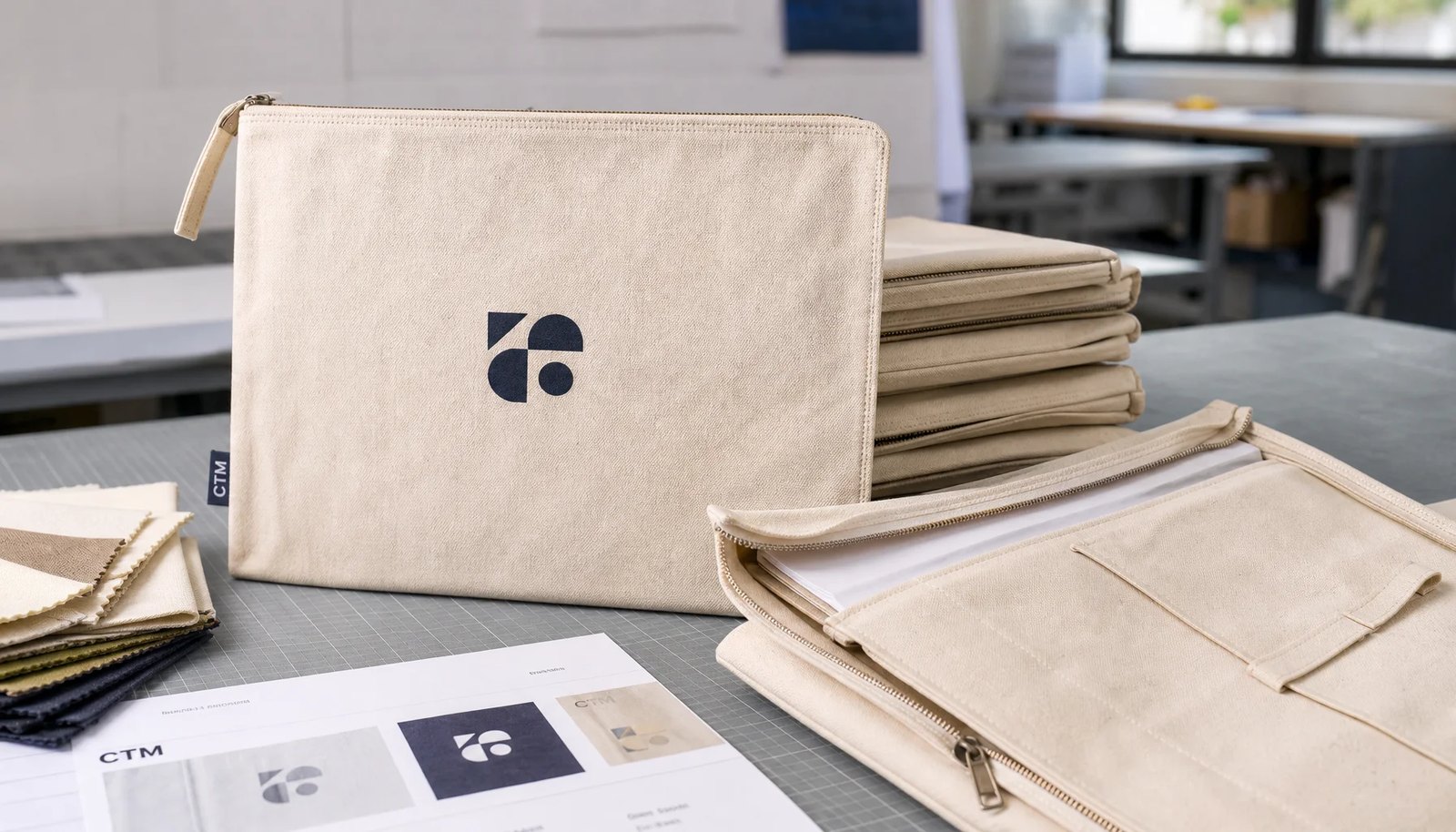
Start With The Event Kit, Not The Logo
A custom canvas zipper portfolio for a trade show is a working container before it is a branding surface. It may hold a brochure set, contract sheets, notebook, badge insert, pen, USB card, small swatches, sponsor cards, or a product catalog that needs to survive freight, warehouse handling, registration, and booth distribution. A front-logo mockup can look clean while the actual kit bends at the corners or jams under the zipper.
Procurement should define the use case before asking for pricing. A registration handout may need a simple flat pouch. A VIP meeting kit may need a lined interior, pen loop, business card pocket, and a more structured front panel. A dealer pack may need a gusset because catalogs and sample cards create thickness. A press folder may prioritize a clean logo field and fast opening on a table. These are not cosmetic differences; they change fabric, sewing time, zipper path, packing volume, and inspection criteria.
Sizing is where many quote comparisons become misleading. Ask suppliers to quote outside finished size, clear internal size, and zipper mouth opening. A4 and US letter are close enough to confuse a rushed buyer, but seam allowance, lining, zipper tape, and corner radius can remove usable space. If the portfolio will hold thick inserts, the buyer should also confirm loaded thickness, not just length and width.
- List every insert by size, thickness, and quantity before pattern approval.
- Allow clearance for booklet spine thickness and paper corners, not just sheet dimensions.
- Test the pre-production sample with the heaviest realistic kit, then zip and unzip it several times.
- Confirm whether the portfolio must lie flat, open like a folio, or work mainly as a transport pouch.
Specify Canvas By Behavior, Not Weight Alone
Canvas weight is a useful purchasing shortcut, but it does not fully describe the finished portfolio. A 10 oz canvas may be acceptable for a budget document sleeve or short event giveaway. For most trade show zipper portfolios, 12 oz to 16 oz cotton canvas is a practical quoting range because it can provide structure without making cartons unnecessarily heavy. The exact GSM will vary by weave, finishing, and supplier measurement, so ask for both oz and approximate GSM rather than treating either number as complete proof.
Finish changes performance. Natural unbleached canvas shows seed flecks, slubs, and warm color variation. Bleached canvas gives a cleaner print base but still absorbs ink differently from paper. Dyed canvas needs shade control and may require underbase printing for light logos. Washed canvas feels softer but can lose structure and show more size variation. Coated or laminated canvas may improve wipeability, but it can affect folding, print adhesion, and handfeel. Lining or interlining can add structure more predictably than simply moving to a heavier outer fabric.
For B2B sourcing, the important question is what the recipient sees and what the event team handles. Heavy yarn knots through the logo zone can make a printed mark look broken. A fabric that feels premium in one sample may be too stiff when wrapped around a zipper corner. A soft washed canvas may photograph nicely but collapse when filled with brochures. Ask for fabric swatches, then confirm behavior in a sewn sample.
- Quote fabric weight in oz and approximate GSM, plus weave and finish when available.
- Separate natural, bleached, dyed, washed, recycled-content, coated, and laminated canvas in the RFQ.
- Define acceptable slubs, seed flecks, shade variation, and yarn knots in visible areas.
- Ask whether bulk fabric will come from stock, a reserved lot, or a custom dye batch.
Use Construction Details To Prevent Hidden Fit Problems
A portfolio pattern can look generous on a flat drawing and still become tight after sewing. Zipper tape consumes space. Lining reduces clearance. Reinforcement adds bulk at corners. Topstitching can pull the panel slightly. These details matter because event staff often pack hundreds or thousands of pieces quickly. If brochures catch on the zipper tape or a notebook forces the slider around a tight corner, the product feels unreliable even if the outside size matches the purchase order.
Choose construction around the load. A flat zip pouch is efficient for thin papers and lightweight handouts. A gusseted construction is better for catalogs, notebooks, or bundled documents, but it changes how the front logo sits when full. A lined interior improves presentation and hides raw seams, though it may reduce usable space. Interlining can smooth the print panel and improve structure, but it adds sewing complexity and can make the portfolio harder to fold or pack. Inside pockets need their own measurements after sewing, especially for tablets, badge holders, pens, and small sample cards.
Ask suppliers to mark seam allowance, zipper path, gusset depth, corner radius, and reinforcement locations on the sample review. That level of detail is more useful than broad wording such as premium stitching. The buyer should load, close, stack, carry, and reopen the sample the way the booth team will use it.
- Confirm outside finished size, clear internal size, zipper mouth opening, and gusset depth.
- Measure pocket openings after sewing, not from the artwork file.
- Check zipper corners for puckering, tightness, and fabric bunching.
- Approve the sample with final insert thickness, not loose sheets of paper.
Match Print Method To Artwork, Quantity, And Version Count
Print proofing begins with an honest artwork review. Screen printing is usually the practical option for solid corporate logos on canvas zipper portfolios. It gives strong coverage, works well for one to three colors, and often suits the order sizes used for trade shows. The limitation is detail. Thin lines, small reversed type, tight negative space, and close registration can soften on textured cotton, especially when the artwork was built for paper, vinyl, or a digital screen.
Heat transfer can work better for gradients, photographic elements, many colors, or short runs with many logo versions. The buyer should approve not only the image but also the surface feel, edge, flexibility, and behavior after bending. Embroidery can look premium for simple marks, yet dense stitching may pucker a flat canvas panel and make a document portfolio feel less clean. Woven labels or sewn patches can make sense when the same brand element is used across several bag styles, or when the buyer wants to avoid reprinting the main panel for every variation.
Quantity and version count influence the right method. A single 2,000-piece logo may favor screen printing. Ten sponsor logos at 200 pieces each may push the buyer toward transfers, woven labels, or a standardized blank portfolio with variable inserts. Ask suppliers to quote more than one decoration method when the order split is complex.
- Use vector artwork for screen print, embroidery, woven labels, and clean corporate marks.
- Ask for minimum line thickness, minimum text height, and clear space from seams.
- Compare screen setup cost against transfer setup when there are many exhibitor versions.
- Keep logos away from zipper seams, fold lines, gusset folds, and bulky corner stitching.
Make The Print Proof Control Production
A digital mockup helps stakeholders understand layout, but it is not a production proof. A paper proof confirms artwork details, but it does not show how ink sits on cotton texture. For custom canvas zipper portfolios print proofing checklist for trade show exhibitors, the practical control is a strike-off on the actual production fabric color and finish, followed by a pre-production sample using final construction.
The strike-off should confirm color, opacity, line clarity, edge quality, print size, and whether fabric texture interrupts the logo. Pantone expectations need to be realistic. Raw cotton can dull a color. Natural canvas can warm it. Dark or dyed canvas may need an underbase. If the order uses several body colors, one proof may not be enough. At minimum, approve the lightest and darkest body colors; for strict brand programs, approve each colorway.
Placement also needs a measurable standard. On sewn canvas panels, plus or minus 3-5 mm is a common starting point, depending on panel size, print method, and fixture control. If a centered logo must align tightly to a pocket, seam, or zipper, ask whether printing happens before cutting, after cutting, or after sewing. Each sequence creates different risks. Define what counts as a reject before bulk production: crooked logo outside tolerance, wrong print size, low opacity in key brand areas, smears, offset marks, or print too close to the zipper.
- Approve the strike-off under consistent lighting and keep it as the color reference.
- Measure placement from fixed sewn edges, not soft folds or carton-flattened corners.
- Record logo size tolerance and placement tolerance in the purchase file.
- Require a revised proof if fabric color, print method, logo size, or placement changes.
Treat The Zipper As A Core Specification
The zipper is the component recipients touch first. It also reveals weak construction quickly. For most canvas document portfolios, a No.5 nylon zipper is a sensible default because it is flexible, smooth around corners, and strong enough for repeated event use. A No.3 zipper can feel light on structured canvas. Larger zippers, resin teeth, or metal teeth can support a specific design direction, but they may add cost, weight, stiffness, and corner resistance.
A complete zipper spec includes type, size, tape color, slider material, slider finish, puller shape, end stops, opening direction, and whether the zipper wraps around one, two, or three sides. Branded pullers add another decision: tooling charge, MOQ, lead time, plating, weight, and whether the puller drags against the front panel during packing. If the zipper tape is meant to match the canvas, request a trim card because tape and fabric dye lots can read differently under hall lighting.
The sample must be tested loaded. An empty portfolio can open smoothly while a filled one binds at the curve. QC should look for wavy tape, uneven topstitching, skipped teeth, loose end stops, cracked pullers, sharp edges, and crooked zipper alignment. If the item will be used at registration counters or sales meetings, the slider should not require force or two-handed correction at the corners.
- Use No.5 nylon as the default unless design, load, or brand positioning justifies another option.
- Approve zipper tape color, slider finish, and puller shape on the pre-production sample.
- Test opening and closing with the actual insert pack inside.
- Reject zippers that catch, separate, wave heavily, or distort the portfolio edge.
Compare Quotes With Real Cost Drivers Visible
A low unit price is only useful when the product being quoted is the same. One supplier may price 10 oz unlined canvas with a stock zipper and one-color print. Another may price 14 oz canvas, lining, reinforced corners, No.5 zipper, individual packing, and carton labels by destination. Those quotes should not be compared as if they represent the same portfolio.
Ask for price breaks at realistic quantities, such as 300, 500, 1,000, 3,000, and 5,000 pieces, then separate recurring unit cost from one-time charges. Screen setup, film, transfer setup, embroidery digitizing, woven label setup, branded puller tooling, custom dyeing, lab dips, sample freight, individual bags, carton marks, and inspection can change landed cost. The buyer does not need every supplier to use the same internal costing model; the buyer does need every supplier to disclose what is included.
Pricing bands vary by market, specification, and freight timing, so fixed public prices can mislead. A useful comparison is a cost-driver table: base portfolio, fabric upgrade, lining, gusset, extra pockets, zipper upgrade, print method, number of colors, number of logo versions, packing, and Incoterm. If the order has many sponsor logos, calculate the all-in cost per version, not only the blended unit price. A 3,000-piece order split into ten artwork versions can behave commercially like ten smaller orders.
- Normalize quotes by Incoterm, port, currency, packing basis, and inspection requirement.
- Separate one-time setup charges from unit price.
- Request carton dimensions, carton count, net weight, and gross weight before estimating landed cost.
- Show the order split by logo, body color, destination, and event code at quote stage.
Set MOQ And Lead Time Around Version Complexity
MOQ is rarely one number. It can be driven by fabric color, zipper color, print method, logo version, label, packing, or carton mark. A supplier may accept 1,000 pieces total but require a minimum quantity per logo screen or per dyed fabric lot. A distributor managing multiple exhibitors should ask for MOQ by variable, not only MOQ for the whole purchase order.
Lead time also depends on which choices are custom. A simple stock-color canvas portfolio with one screen print and standard zipper may move through sampling and production faster than a program with custom dyed canvas, branded zipper pullers, ten logo versions, and split shipments. A practical sourcing calendar should show artwork check, strike-off, pre-production sample, sample transit, buyer approval, material purchase, cutting, printing, sewing, inspection, packing, export paperwork, freight booking, customs, inland delivery, and warehouse check-in.
When timing is tight, standardize what is not important. Use one body color. Keep the zipper stock. Avoid new puller tooling. Reduce print colors. Use the same packing for all versions. If branding must vary, consider changing only the print or insert while holding the base portfolio constant. These tradeoffs are often more useful than asking the factory to compress every step after late approval.
- Ask for MOQ per body color, logo version, print color count, zipper color, packing version, and destination.
- Request a lead-time line for strike-off, pre-production sample, bulk production, inspection, and shipment booking.
- Identify long-lead items such as custom dyeing, branded pullers, special labels, and unusual zipper colors.
- Build sample revision time into the calendar before the event date is at risk.
Approve Samples Before Bulk Production
Samples should control production, not merely sell the idea. A development sample can use substitute materials to check shape, size, and pocket layout. The pre-production sample should represent the order: final canvas, final zipper, final print method, final logo size, final lining, final pocket layout, final reinforcement, and intended packing. If any major material or process changes afterward, the approval should be updated.
Review the sample physically. Load it with the actual documents. Zip it closed. Carry it. Stack several pieces if possible. Open it on a table. Check whether the logo distorts, the zipper binds, the corners bulge, the front panel waves, or the pockets block closure. Smell should be checked, especially for dyed canvas, coatings, ink, transfer films, and tight export packing. Strong odor is not a small issue when items go directly to event visitors.
Keep an approved reference sample with written notes. Photos are helpful for documenting placement, print size, and inside layout, but they cannot fully capture fabric handfeel, zipper movement, smell, or stiffness. If timing requires approval by video while the sample is in transit, treat that as a risk decision and document what still needs physical confirmation.
- Label samples as development, revised, or pre-production so approval status is clear.
- Keep one approved sample as the inspection benchmark.
- Record any approved deviations in writing, including color, placement, trim, pocket, or packing changes.
- Do not release bulk production from a sample using substitute fabric, substitute zipper, or approximate print placement.
Write QC Rules The Inspector Can Apply
Quality control should be measurable. For canvas zipper portfolios, inspection should cover finished dimensions, clear internal size, zipper mouth opening, logo placement, print quality, fabric defects, zipper function, stitching, lining, pockets, odor, cleanliness, individual packing, carton quantity, and carton labels. A request for good quality does not give inspectors enough direction when a shipment is days from pickup.
Use defect classes. Critical defects include wrong logo, wrong event code, broken zipper function, unsafe sharp edges, mold contamination, wet cartons, or mixed versions where separation is required. Major defects include logo outside tolerance, visible print smears, open seams, severe stains, zipper catching, wrong pocket size, missing packing, or carton labels that do not match the packing list. Minor defects may include small loose threads, minor slubs outside the logo area, or slight shade variation within the approved range.
AQL or a buyer-specific sampling plan can be used, but the checklist must match the product. Measure a sample of pieces for outside size and internal size. Open and close zippers with inserts. Compare print against the approved strike-off. Inspect the front logo zone closely. Verify that cartons are not mixed unless mixed packing was approved. Ask for inspection photos of the print face, zipper path, inside layout, pocket details, individual packing, carton marks, and any defects found.
- Use plus or minus 5 mm as a common starting point for finished size unless the design requires tighter control.
- Use plus or minus 3-5 mm as a practical starting range for logo placement, then confirm feasibility with the supplier.
- Treat wrong logo, broken zipper, wet cartons, mold odor, and mixed event codes as serious release issues.
- Require inspection photos that show both product appearance and packing accuracy.
Specification comparison for buyers
| Spec decision | Recommended option | When it fits | Buyer risk to check |
|---|---|---|---|
| Finished size and usable size | Quote outside finished size, clear internal document size, and zipper mouth opening separately. | Best for exhibitor kits containing A4 or US letter sheets, brochures, contracts, notebooks, badge inserts, sample cards, or catalogs. | A portfolio can meet outside dimensions but still be too tight after seam allowance, zipper tape, lining, and corner radius are included. |
| Outer canvas weight | 10 oz for budget sleeves; 12 oz to 16 oz cotton canvas for most trade show portfolios; confirm GSM, weave, and finish. | Useful when buyers need a balance of structure, print appearance, carton weight, and cost. | Canvas weight alone does not prove stiffness. Washed, lined, laminated, or interlined canvas can behave very differently at the same nominal weight. |
| Canvas finish and color | Specify natural, bleached, dyed, washed, recycled-content, coated, or laminated canvas as separate quote lines. | Important for brand color, ink opacity, handfeel, presentation level, and sustainability requirements. | Natural cotton may show seed flecks and slubs; dyed fabric may need lab dips and underbase printing; coating may affect folding and print adhesion. |
| Construction | Flat zipper pouch for thin kits; gusseted or lined folio for thicker document sets, notebooks, tablets, or premium meeting packs. | Fits buyers who need the portfolio to function during registration, booth meetings, sales calls, or post-show office use. | Added gusset, lining, pockets, and interlining can reduce clear space, change logo flatness, and increase sewing risk at zipper corners. |
| Logo method | Screen print for solid one- to three-color logos; heat transfer for gradients or many short versions; woven label or patch for repeat brand programs. | Screen print is usually practical for exhibitor branding on textured canvas; transfer may simplify multi-logo orders. | Fine type can fill in on canvas. Digital mockups do not prove opacity, edge quality, or Pantone appearance on production fabric. |
| Print placement | Measure from fixed sewn references, with clear space from zipper seam, binding, corner stitching, gusset fold, and pocket seams. | Works for corporate marks that must look straight when the portfolio is filled, stacked, or carried. | Printing before cutting, after cutting, or after sewing changes alignment risk. Placement tolerance must be agreed before bulk production. |
| Zipper specification | No.5 nylon zipper for most canvas portfolios; confirm tape color, slider finish, puller style, end stops, and opening direction. | Good default for repeated opening, curved corners, and moderate contents. | Low-grade zipper tape can wave on canvas; test smooth running with the real insert pack inside, not only on an empty sample. |
| MOQ and versioning | Define MOQ by body color, logo version, print method, zipper color, packing version, and destination. | Useful for distributors, event teams, agencies, and brand owners managing multiple exhibitors or regions. | A total order quantity may not reduce cost if every version needs separate screens, trims, labels, carton marks, or packing instructions. |
| Lead time planning | Build the calendar around artwork check, strike-off, pre-production sample, material booking, bulk production, inspection, packing, and freight. | Necessary when the trade show date is fixed and rework is not realistic. | Custom dyeing, branded zipper pullers, many logo versions, or split shipments can add more time than the sewing itself. |
Buyer checklist before sampling
- Define the real use case: registration pack, VIP meeting kit, press folder, dealer kit, sales sample holder, sponsor pack, or post-show office portfolio.
- List every insert by size and thickness, including A4 or US letter sheets, brochures, notebook, pen, badge holder, USB card, tablet, sample card, or product catalog.
- Specify finished outside size, clear internal size, zipper mouth opening, gusset depth if any, and required clearance so paper corners do not catch.
- State canvas weight in oz and approximate GSM, plus weave, finish, color, lining, interlining, coating, and acceptable shade variation.
- Ask whether natural slubs, seed flecks, heavy yarn knots, or shade bands are allowed in the front logo zone.
- Send vector artwork with Pantone references, final print size, minimum line thickness, minimum text height, and exact placement from sewn edges.
- Choose the print method after reviewing artwork complexity, number of logo versions, setup cost, handfeel, and durability expectations.
- Require a strike-off on actual production canvas before the pre-production sample when color, opacity, small type, or fine borders matter.
- Approve zipper type, size, tape color, slider finish, puller shape, end treatment, opening direction, and corner sewing method.
- Check the sample loaded with real contents; confirm zipper movement, corner stress, lying-flat behavior, logo distortion, odor, and packing fit.
Factory quote questions to send
- What exact canvas is included: weight in oz and GSM, weave description if available, finish, color, shrinkage expectation, and whether the fabric is stock, custom dyed, washed, recycled-content, coated, or laminated?
- Is the quoted size the outside finished size, flat pattern size, clear internal size, or zipper mouth opening after seam allowance, lining, zipper tape, and corner radius are included?
- What construction is included: seam allowance, reinforcement, gusset depth, lining, interlining, inside pockets, pen loops, tablet sleeves, binding, and corner treatment?
- Which zipper specification is included: nylon, resin, or metal; No.3, No.5, or another size; tape color; slider finish; puller style; end stops; and opening direction?
- Which logo method is included, how many print colors are covered, what is the maximum print area, and are screen setup, film, transfer setup, embroidery digitizing, woven label, or puller tooling charges separate?
- Will the print strike-off be made on the same canvas color and finish as bulk production, and what tolerance do you apply for Pantone matching on natural, dyed, or dark canvas?
- What minimum line thickness, minimum text height, trapping requirement, and clear distance from seams do you recommend for this fabric, artwork, and print method?
- What is the MOQ per fabric color, logo version, print color count, zipper color, packing version, carton mark, and shipping destination?
- Please quote price breaks at practical quantities such as 300, 500, 1,000, 3,000, and 5,000 pieces, with setup charges, sample charges, and packing charges shown separately.
- How many working days are needed for artwork checking, strike-off, pre-production sample, sample shipping, buyer approval, bulk material purchase, cutting, printing, sewing, inspection, packing, and shipment booking?
Quality-control points to confirm
- Finished outside size should usually be controlled within plus or minus 5 mm for document portfolios, with tighter limits agreed if a tablet, rigid insert, or fitted inner sleeve is involved.
- Clear internal size and zipper mouth opening must be checked on the sewn sample with real inserts because flat pattern dimensions do not equal usable space after zipper and lining are installed.
- Logo placement tolerance should be written before production; plus or minus 3-5 mm is a practical starting range for many sewn canvas panels, but tighter layouts need supplier confirmation.
- Logo size should be measured after printing and sewing, with agreed tolerance for width and height so artwork is not scaled differently across production batches.
- Print quality should show even opacity, clean edges, no major pinholes through key logo areas, no ink smears, no offset marks, and no transfer to the opposite panel or lining.
- Pantone matching on raw or dyed cotton canvas should be judged against the approved fabric strike-off under consistent light, not against a coated paper chip alone.
- Zipper should open and close smoothly for the full length without skipped teeth, slider catching, wavy tape, loose end stops, cracked pullers, sharp edges, or crooked topstitching around corners.
- Stitching should be straight at visible edges, with secure back-tacking, no broken stitches, skipped stitches, loose threads, exposed raw seams, needle damage, or puckering near the zipper.
- Canvas should be free from oil marks, dirt, mold odor, wet cartons, dye stains, heavy slubs across the logo area, and strong chemical smell that would affect event distribution.
- Inside pockets, pen loops, sleeves, and gussets should match the approved sample and must hold intended inserts without tearing seams, blocking zipper closure, or distorting the front logo.