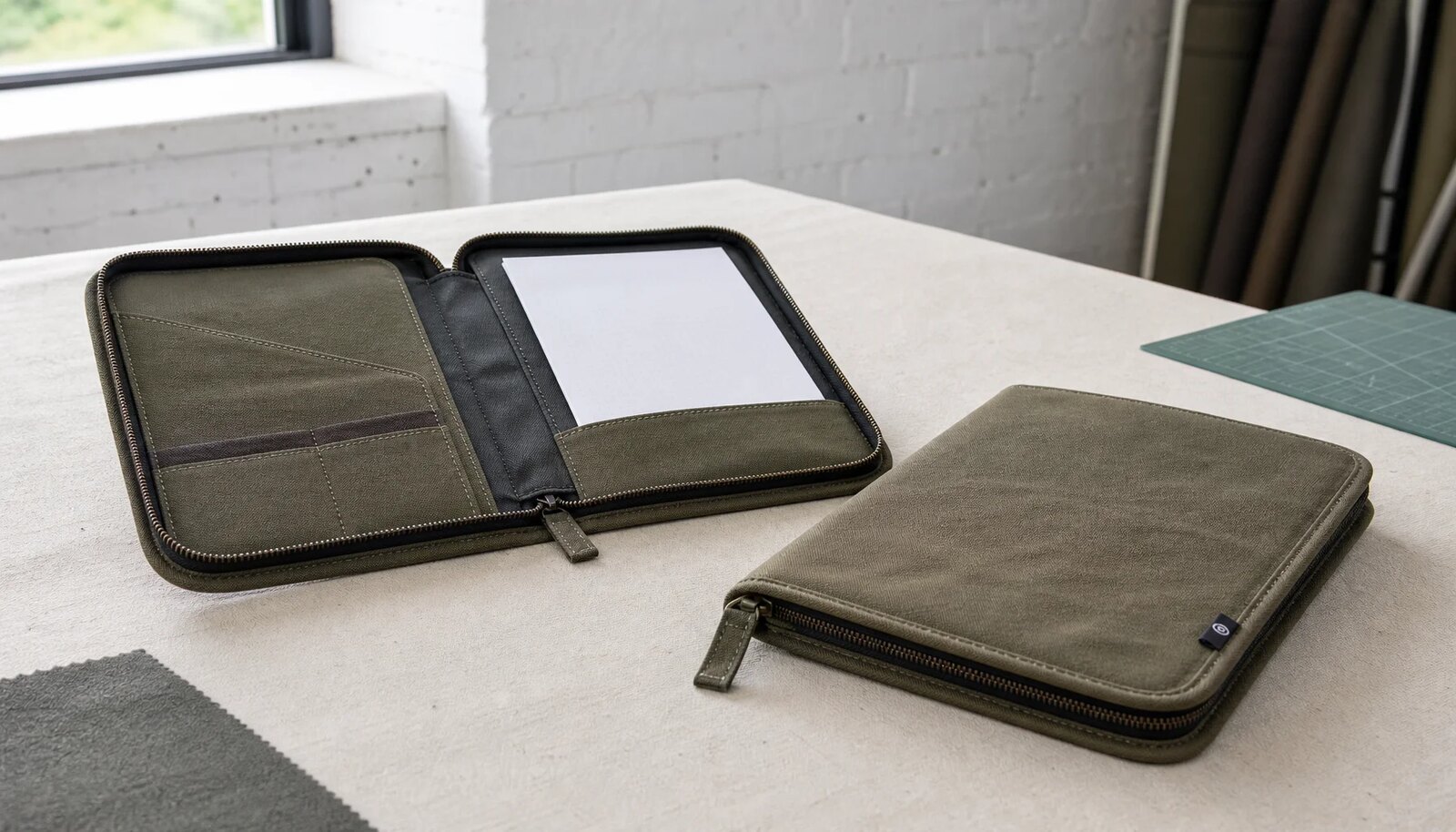
Start with the approval target
For a B2B event order, a print proof is more than a logo preview. It is the control point that ties the artwork to the portfolio construction, packing method, inspection standard, and delivery date. Custom canvas zipper portfolios look simple in a flat mockup, but the finished item includes fabric weight, weave texture, lining, zipper path, pocket depth, seam allowance, reinforcement, decoration method, and carton packing. If the proof only approves the logo, the factory still has room to make ordinary production choices that become event-day problems.
A useful approval target states what is locked and what is still open. Finished outside size, usable inside size, zipper opening length, logo size, logo location, fabric color, canvas weight, lining, zipper tape color, puller style, pocket layout, label placement, and packing method should all be named. "Logo centered" is not enough for inspection. "Logo 110 mm wide, centered on front panel, top edge 55 mm below zipper seam, placement tolerance plus or minus 3 mm" gives the buyer, factory, and inspector the same reference.
Event planners usually have an in-hand date that cannot move. That makes vague proofing expensive. The order should identify who approves the digital proof, who approves the physical pre-production sample, and whether each approval covers artwork only or the full finished and packed product. Keep one retained approved sample with the PO record, not just a photo in an email thread. When final inspection happens, that sample is the practical standard.
The strongest custom canvas zipper portfolios print proofing checklist for event planners separates proof types. A digital proof confirms artwork scale and placement. A strike-off confirms decoration on the actual canvas. A physical PP sample confirms construction and function. A packed sample confirms crease risk, zipper-pull marking, barcode position, and presentation condition. Each step answers a different buying question.
- State whether approval covers artwork only, construction only, or the full finished and packed product.
- Use one controlled proof file with date, version number, dimensions, color references, and approval owner.
- Require the final PP sample to use the same canvas, zipper, lining, label, print method, and packing planned for bulk.
- List acceptable substitutions before PO release, such as equivalent zipper tape shade or alternate inner wrap.
- Retain one approved sample with the final proof version for inspection and dispute resolution.
Specify the build before the art
Construction should come before decoration approval because the build changes how the artwork sits, bends, and wears. A 12 oz cotton canvas body is often a balanced choice for lighter document packets, registration materials, sponsor sheets, and conference handouts. A 14 oz canvas or tighter upgraded weave can give a firmer hand feel and a flatter front panel when the portfolio is empty. Weight matters, but it is not the whole story. Surface smoothness, weave density, finishing, shrinkage, and shade consistency all affect the print result.
Ask suppliers to state the commercial canvas description and approximate GSM when possible. Cotton canvas ounce ratings are commonly based on square-yard weight, while many technical specs use grams per square meter. Those numbers are useful, but they are not perfectly interchangeable across mills. The buyer's real approval question is simpler: does the bulk fabric match the retained sample in hand feel, shade, surface texture, and print behavior?
Finished outside dimensions and usable inside dimensions should be approved separately. A portfolio may be described as A4 or letter size, yet seam allowance, lining thickness, zipper curve, or an internal board can reduce the actual usable space. If it must hold a notebook, sales sheet, program guide, badge pack, tablet, catalog, or sponsor folder, test the PP sample with those inserts. A 5 mm shortage may not be obvious in a photo, but it can slow down event assembly.
Zipper details belong in the spec, not in a late email after the sample is made. A #5 nylon coil zipper is a practical default for many soft canvas portfolios because it balances flexibility, cost, and smooth opening. Still, the right zipper depends on portfolio size and load. Lock zipper tape color, slider finish, puller shape, opening length, end stops, and reinforcement stitches. If the portfolio needs a rigid insert, state whether it is sewn between layers, slipped into a sleeve, or removable.
- Approve finished outside size and usable inside size with written tolerances.
- Choose canvas by weave, surface smoothness, hand feel, shade consistency, and weight.
- Lock lining material, pocket layout, pen loop, card slot, board insert, and reinforcement points before print placement.
- Specify zipper size, tape color, puller style, slider finish, opening length, end stops, and bar tacks.
- State whether the approved portfolio should lie flat, hold structure, or fold softly when empty.
Choose decoration by risk
Decoration method should match the artwork, the canvas surface, the order quantity, and the way the portfolio will be handled. Screen printing is usually the best route for bold spot-color logos, large sponsor marks, and one- to three-color artwork. It can give clean edges when the art is simple and the fabric face is suitable. The proof should identify color count, ink references, underbase requirement, print size, and placement from fixed seams. On natural or dark canvas, an underbase can change color accuracy, opacity, cost, and hand feel.
DTF, digital transfer, and other heat-transfer routes can work well for gradients, small multicolor marks, sponsor variations, and lower-volume orders. They reduce some setup complexity, but they add their own inspection points. Review edge halo, transfer film visibility, heat-press shine, stiffness, cracking after bending, rub performance, and bonding at the corners. A transfer can look fine in a phone photo and still feel too heavy on a textured canvas portfolio that attendees carry all day.
Embroidery, woven patches, leather-look patches, and sewn labels can create a more premium brand treatment when used with restraint. They are not automatically better than print. Large filled embroidery may pucker a flat panel, especially on lighter canvas. Small stitched text can lose readability. A patch can catch near a pocket opening or leave pressure marks in cartons. For formal programs, a small woven label or patch may work better than a large decoration area.
Ask the factory to recommend the decoration method and explain the tradeoffs. A useful answer mentions canvas surface, logo detail, quantity, setup cost, durability, and placement. A vague "all methods are okay" is not a procurement answer. The physical sample should confirm the method under real handling: opening, closing, stacking, packing, and loading with the actual event inserts.
- Use screen print for bold spot-color logos, repeat orders, and larger fixed artwork runs.
- Use DTF or digital transfer for gradients, many logo versions, or lower-volume sponsor variations.
- Use embroidery only when the stitch area, fabric weight, and logo detail support it without puckering.
- Use woven labels or sewn patches when a smaller tactile brand mark is preferred.
- Review edge feel, readability, rub resistance, and carton pressure marks on the physical sample.
Make the proof inspectable
A good proofing checklist turns visual approval into measurable production instructions. The artwork file should identify the decoration method, art size, placement point, color reference, and production surface. Instead of "front logo in center," use measured placement from stable features: top edge, side seam, zipper seam, pocket edge, or corner. For many soft sewn goods, print-placement tolerance is often discussed around plus or minus 2-5 mm, but the agreed number should be realistic for the construction and written into the PO.
Color control needs a physical reference when brand accuracy matters. Screens and office printers are not reliable standards for canvas. Provide Pantone references or approved brand standards, then ask how the chosen method will reproduce those colors on the actual fabric. Natural canvas can warm the appearance of ink. Dark canvas may require an underbase. Heat transfers may match a color while adding surface sheen. Embroidery thread may need the closest available shade rather than an exact ink match.
Registration and detail checks should fit the decoration route. For screen print, inspect edge sharpness, ink coverage, registration between colors, and pinholes caused by fabric texture. For DTF or transfer, inspect bonding, edge halo, film outline, heat marks, and flexibility. For embroidery, inspect stitch density, thread shade, backing, loose threads, and puckering. For patches and labels, inspect sewing alignment, corner security, and whether the attachment distorts the front panel.
The proof also protects function. Keep art away from zipper seams, heavy fold lines, pocket openings, and raised hardware. A large print across a crease area can crack, polish, or distort during packing. A patch near the zipper path can interfere with use. A logo too close to a curved zipper seam may look crooked even when the sewing is correct.
- Confirm artwork file format: AI, EPS, vector PDF, or production-ready raster when appropriate.
- List print size in millimeters or inches and placement from fixed seams, edges, or zipper lines.
- Include color references, underbase notes, ink opacity expectations, transfer notes, or thread shade codes.
- Set safe margins from zipper, seams, corners, pockets, folds, labels, and reinforcement boards.
- Approve a digital proof before sampling and a physical decoration proof or PP sample before bulk.
- List each logo version, sponsor variation, or personalization rule separately to avoid mixed cartons.
Sample like the final inspector
A practical sampling process has at least two decision points: digital proof approval and physical PP sample approval. The digital proof checks layout, scale, orientation, color callouts, and decoration boundaries. The PP sample checks what a screen cannot show: canvas hand feel, front-panel flatness, zipper smoothness, seam finish, pocket depth, lining behavior, print texture, board stiffness, and packed appearance. For sizeable event orders, photos help, but they should not replace a physical sample unless the buyer accepts that risk knowingly.
When the sample arrives, measure it against the written spec. Check outside width, outside height, gusset, usable inside area, zipper opening, pocket depth, print size, print location, label position, and individual-pack presentation. Keep ruler photos with the PO file. Open and close the zipper at least 10 times, load the real event inserts if available, and watch for bulging, strain, print abrasion, or zipper drag.
If the sample needs a revision, write the change in production language. "Move the logo a little down" leaves too much room for interpretation. "Move the logo down 8 mm; keep horizontal center unchanged; revised placement tolerance plus or minus 3 mm" is inspectable. If the supplier changes canvas, zipper, lining, or print process after revision, approve the revised physical sample or at least clear ruler photos and material notes before bulk starts.
The retained sample is not a formality. It is the standard used to judge bulk output. Label it with factory name, style number, proof version, fabric spec, decoration method, approval date, and approver. If a third-party inspection agency is involved, send the written spec and images of the retained sample before the inspection date. If inspection is internal, use the same reference at first-line, mid-line, and final checks.
- Require ruler photos for finished size, usable inside size, print position, zipper opening, pocket depth, and label placement.
- Test the sample with real inserts, including agendas, sponsor sheets, notebooks, or badge packs if they will be preloaded.
- Check whether the packed sample creases, dents, abrades, or marks the logo surface.
- Keep one retained sample with the final approval date, version number, and material notes.
- Write revision instructions with measured changes, not subjective comments.
Read MOQ and cost line by line
MOQ is driven by more than the number of portfolios. Fabric roll usage, canvas dye color, decoration setup, zipper tape color, lining, woven labels, patches, rigid inserts, cutting efficiency, and packing method can each create minimums. A supplier may accept 300 pieces, but the unit price may rise because screen setup, sampling, and export handling are spread across fewer units. Custom zipper tape, custom lining, or a woven label can push MOQ higher even when the body construction is simple.
A comparable quote should separate cost components. Ask for quantity tiers such as 300, 500, 1,000, and 3,000 pieces, or the tiers that match the event plan. The quote should show blank portfolio cost, decoration setup, unit decoration cost, sample fee, packing cost, carton cost, inland freight, inspection charge if included, and incoterm. Without line items, a lower unit price may mean lighter canvas, a cheaper zipper, no individual packing, or excluded export cost.
Decoration economics vary by method. Screen printing may have setup charges by color and artwork version, then a stable unit cost after setup. DTF or digital transfer may reduce setup for multicolor art but add a higher per-piece decoration cost. Embroidery pricing may depend on stitch count and filled area. Patches may involve mold, weaving, cutting, backing, and sewing charges. Ask which changes trigger a new setup charge: logo size, logo color, sponsor version, placement, or product color.
Define overrun and underrun before production. For event handouts, a small spare allowance can be useful for staff, VIPs, late additions, or carton damage. At the same time, unapproved overruns can create budget and storage problems. A practical PO states whether plus or minus 3-5 percent is acceptable, whether exact quantity is required, and how rejected units will be replaced without risking the event date.
- Request tiered pricing instead of comparing one headline unit price.
- Separate product, decoration setup, unit decoration, sample, packing, carton, inspection, and logistics charges.
- Ask which specs change MOQ: body color, zipper color, lining, label, patch, print version, or insert.
- Define acceptable overrun or underrun and spare-piece requirements before production starts.
- Confirm whether replacement pieces after inspection can still arrive before the in-hand deadline.
Compare sourcing routes honestly
The lowest quote is not always the lowest procurement risk. Direct factory sourcing can be efficient when the buyer has a clear spec, enough lead time, and a repeatable product. It is strongest when the same supplier controls cutting, sewing, decoration, trimming, packing, and final QC. Even then, confirm which steps are truly in-house. Many sewing factories outsource screen printing, embroidery, patch production, or woven labels.
A trading company or sourcing office can be the right fit for multi-SKU event kits. If the order includes canvas zipper portfolios, tote bags, notebooks, lanyards, badges, and printed inserts, one coordinator can reduce management time. The tradeoff is visibility. Ask whether the quoted sample and bulk order come from the same factory, who owns the approved sample, who checks each sub-supplier, and who pays if material or print process changes without approval.
Local decorators and domestic producers are valuable for rush work, late sponsor additions, personalization, or replenishment after an imported main order. They can reduce international transit risk and support same-country delivery. However, they may rely on blank portfolios already available in the market, which can limit control over canvas GSM, zipper grade, lining, pocket structure, and carton economics. If one supplier provides blanks and another decorates them, defect ownership must be written down.
Compare sourcing routes only after the spec is aligned. A direct factory quoting 14 oz canvas, individual paper wrap, #5 zipper, PP sample, and FOB carton data is not comparable to a local decorator quoting an available blank with heat transfer and no carton optimization. The RFQ should force all vendors to answer the same construction, decoration, sample, QC, packing, and delivery questions.
- Use direct factory sourcing when construction control, repeatability, and carton economics matter most.
- Use a sourcing office when multi-SKU coordination and consolidation are more important than factory visibility.
- Use local decoration for speed, personalization, replenishment, and late sponsor changes.
- Ask each supplier to identify in-house steps and subcontracted steps in writing.
- Compare quotes only after fabric, zipper, decoration, sample, packing, inspection, and incoterm are aligned.
Set measurable QC limits
Quality control must be measurable enough for production and inspection. For custom canvas zipper portfolios, the QC plan should cover finished dimensions, usable inside dimensions, print placement, registration, color reference, zipper function, stitch quality, fabric appearance, pocket alignment, lining behavior, odor, and packing accuracy. A PO that says "good quality" gives the factory too much room to interpret defects when the schedule gets tight.
Tolerances should be realistic for soft sewn goods. Finished size may commonly need a tolerance such as plus or minus 5 mm depending on size and construction. Print placement may need plus or minus 2-5 mm depending on the method and reference point. These figures are not universal. Agree them with the factory before production and check that the supplier can hold them consistently. A tolerance that is too tight for the product type can raise cost or rejection risk.
Attach defect classifications to the PO. Critical defects might include wrong logo, wrong brand color beyond agreed tolerance, sharp hardware, severe odor, mold, unsafe contamination, or a zipper that cannot close. Major defects might include incorrect size affecting insert fit, logo placement outside tolerance, broken stitches at stress points, visible stains on the front panel, crooked patches, or mixed logo versions in cartons. Minor defects might include small loose threads, slight internal lining wrinkles, or small marks outside the visible front area, if they do not affect presentation or use.
Inspection should happen at first-line output, mid-production, and final packing. First-line inspection catches a wrong setup before hundreds of pieces are made. Mid-run inspection catches operator drift, ink viscosity changes, fabric-roll variation, and stitch issues. Final inspection verifies quantity, carton data, packing, labels, barcode position, shipping marks, and finished appearance. If a third-party inspection is used, send the sampling plan, defect list, approved sample, and PO spec before the inspection date.
- Define tolerances for size, usable inside space, print placement, label position, registration, and zipper function.
- Classify critical, major, and minor defects before bulk starts.
- Inspect first output, mid-run pieces, and final packed cartons, not only the PP sample.
- Check zipper function with repeated open-close cycles and real insert loading where possible.
- Tie inspection photos and defect notes to carton numbers if the order ships in multiple lots.
Control packing and cartons
Packing is part of product quality for canvas zipper portfolios. Canvas can crease, zipper pulls can dent adjacent pieces, and printed surfaces can abrade when portfolios rub inside a carton. The RFQ should state whether each piece is packed in an individual polybag, recycled bag, paper wrap, belly band, tissue, or bulk pack. If the event has sustainability guidelines, share them before quotation because alternative packing can affect cost, pack speed, moisture protection, and carton volume.
If the portfolio must arrive presentation-ready, approve the packed sample. Check how the item is folded, whether a stiffener sheet is used, whether the zipper pull contacts the print, and whether the front face picks up pressure marks. For sponsor kits, define barcode position, hangtag location, insert orientation, inner pack count, and whether cartons must be separated by logo version, destination, event wave, or recipient group.
Carton data is needed before freight booking and landed-cost comparison. Ask for pieces per carton, carton dimensions, gross weight, net weight, carton material, and CBM per 1,000 pieces. A slightly cheaper portfolio can become more expensive if thick packing or inefficient carton sizing pushes the order from ocean to air freight, increases courier charges, or creates venue receiving problems. Event teams also need carton marks that make distribution simple under time pressure.
Moisture control deserves a line in the PO. Cotton canvas can absorb odor and moisture during storage and shipping. Ask the supplier to use clean, dry cartons and suitable moisture protection for the lane and season. If silica gel, carton liners, or pallet wrapping are required, include them in the quote. Avoid last-minute packing changes after the PP sample, because packing changes can alter the product's arrival condition.
- Choose individual bag, paper wrap, belly band, tissue, or bulk pack before comparing quotes.
- Protect the print face from zipper-pull marks, abrasion, hard fold creases, and carton pressure.
- Confirm pieces per carton, inner pack count, carton strength, shipping marks, and logo-version separation.
- Request carton dimensions, gross weight, net weight, and CBM per 1,000 pieces before freight booking.
- Approve a packed sample if the portfolios must arrive presentation-ready for event distribution.
Protect the event schedule
Lead time should be broken into stages instead of quoted as one broad number. For a custom canvas zipper portfolio, the schedule may include artwork review, digital proof, strike-off, material sourcing, PP sample production, sample transit, revision time, bulk fabric booking, cutting, decoration, sewing, trimming, final inspection, packing, export booking, international freight, customs clearance, domestic trucking, venue receiving, and kitting. A supplier's "30 days" may mean only bulk production after sample approval.
Work backward from the in-hand date, not the factory completion date. The useful deadline is when the event team has received, checked, sorted, and prepared the portfolios for use. Build time for customs, local handling, repacking, sponsor-kit assembly, damaged-carton replacement, venue delivery windows, and internal review. If the event date cannot move, the RFQ should ask for the latest safe artwork approval date and latest safe PP sample approval date.
Some specs add schedule risk. Custom-dyed canvas, custom zipper tape, special lining, woven labels, molded patches, embroidery thread matching, rigid boards, and retail-style packaging can add procurement time before bulk sewing starts. Multiple sponsor versions can add proofing and carton-separation time. Air freight can recover some lost time, but it may erase savings from a lower unit price and can still be limited by inspection, customs, and local receiving schedules.
Landed cost should be compared with the schedule attached. FOB or EXW unit price, sample fees, setup charges, inspection, inland transport, export charges, freight, duties, taxes, courier charges, local handling, storage, and kitting all affect the real budget. A quote that protects proofing discipline and carton efficiency may be better than a lower quote that forces rushed approval and premium freight.
- Break lead time into proofing, strike-off, sampling, material booking, production, inspection, packing, and freight.
- Set the in-hand event deadline separately from factory completion and ship dates.
- Ask for the latest safe artwork approval and PP sample approval dates.
- Compare unit price with carton volume, freight mode, duty, inspection, local handling, and kitting cost.
- Keep schedule buffer for revisions, customs, venue receiving, carton damage, and event-kit assembly.
Specification comparison for buyers
| Spec decision | Recommended option | When it fits | Buyer risk to check |
|---|---|---|---|
| Direct factory with in-house cut, sew, and print | Best for repeatable 500-3,000+ pc event orders where one supplier controls canvas sourcing, cutting, decoration, sewing, trimming, packing, and final QC | Use when the artwork is fixed, the event date is firm, and the buyer needs one retained approval sample matched by bulk production | Confirm the print room is in-house, the approved PP sample is made on the same process as bulk, and the factory can provide carton size, weight, and CBM before PO release |
| Direct sewing factory with outsourced decoration | Acceptable when the cut-and-sew factory is strong but a specialist decorator is needed for DTF, embroidery, woven patch, leather-look patch, or specialty ink | Fits projects where construction quality matters and the decoration method is beyond the sewing factory's normal line | Ask who owns color drift, registration errors, heat-press marks, decorator delays, rejected pieces, and replacement cost if the subcontracted step fails inspection |
| Trading company or sourcing office | Useful when the event kit includes several SKUs and one coordinator must manage portfolios, lanyards, notebooks, badges, inserts, or bundled packing | Works for multi-product orders where vendor management and consolidation matter more than maximum factory visibility | Verify the real production factory, whether the sample and bulk factory are the same, who keeps the approved sample, and who attends final inspection |
| Local decorator or domestic producer | Best for rush replenishment, personalization, local kitting, or late sponsor-logo changes after the main import order is closed | Fits small drops, same-country delivery, and event teams willing to pay more for speed and schedule flexibility | Expect fewer canvas weights, limited zipper and lining options, higher blank cost, and less control over GSM, weave, carton density, and sewing details |
| 12 oz cotton canvas body | Balanced option for paper packets, conference documents, registration kits, sponsor handouts, and lighter meeting materials | Use when budget, weight, and a natural canvas surface matter more than a rigid executive hand feel | Check actual GSM, shrinkage after finishing, weave evenness, print show-through, front-panel creasing, and whether the portfolio collapses too much when empty |
| 14 oz cotton canvas or tighter upgraded weave | Better for a sturdier hand feel, flatter front panel, heavier inserts, catalogs, notebooks, or more formal client-facing programs | Use when the item must feel substantial and hold its shape better during check-in, gifting, or sales meetings | Confirm heavier seams do not create zipper drag, bulky corners, visible needle holes, higher reject rates, or freight-volume increases |
| #5 nylon coil zipper | Practical default for many canvas document portfolios because it balances flexibility, cost, and smooth opening on soft fabric | Use for most conference and business document sizes unless the portfolio is very small or built for unusually heavy contents | Check zipper tape color, slider finish, puller shape, end stops, bar tacks, opening length, and 10-cycle open-close performance on the PP sample |
| Screen print route | Best for bold spot-color logos, large sponsor marks, solid typography, and repeatable artwork across medium to large quantities | Use when the logo has 1-3 colors, clean edges, limited gradients, and durability matters more than photographic detail | Verify color count, underbase, setup charges, ink hand feel, registration tolerance, small-text readability, and edge clarity on a physical strike-off |
| DTF or digital transfer route | Best for gradients, small multicolor artwork, multiple sponsor versions, lower MOQs, or variable event branding | Fits planners who need faster setup or several logo versions without making screens for every variation | Check transfer edge halo, hand feel, heat-press shine, cracking after bending, rub resistance, bonding at corners, and whether the film looks too heavy on textured canvas |
Buyer checklist before sampling
- Final artwork supplied as AI, EPS, or vector PDF where possible; high-resolution raster only when the decoration method supports it, with Pantone, CMYK, RGB, or brand-standard references noted clearly
- Approved finished outside size, usable inside size, gusset depth, zipper opening length, corner radius or square corner, pocket layout, pen loop, card slot, and whether the portfolio needs a rigid insert or reinforcement board
- Canvas target stated by ounce and approximate GSM where possible, plus weave preference, surface finish, shrinkage expectation, lining material, zipper size, zipper tape color, puller style, and hardware finish
- Approved print method, number of colors, underbase requirement, decoration size, artwork orientation, and exact logo placement measured from fixed seams, zipper line, corners, pockets, and portfolio edges
- Proofing flow defined: digital proof, decoration strike-off if needed, physical pre-production sample, retained approval sample, revision owner, final sign-off person, and version-control rule
- Quote requested by quantity tier, incoterm, sample fee, setup charge, unit decoration cost, packing method, carton specification, barcode or hangtag requirement, and third-party inspection cost if applicable
- Finished-size tolerance, print-placement tolerance, registration tolerance, color tolerance reference, stitch-density expectation, zipper function standard, and defect classifications attached to the PO
- Carton count, pieces per carton, pieces per inner pack, individual bag or paper-wrap rule, barcode location, shipping mark layout, pallet requirement, and carton drop or strength expectation if required by the buyer
- Destination port or delivery address, required in-hand event date, latest acceptable ship date, freight mode assumption, customs buffer, venue receiving rule, and local distribution or kitting timeline
- Acceptable overrun or underrun range, spare-piece requirement for staff or VIP use, logo-version carton separation, and whether excess inventory may be delivered after the main event deadline
Factory quote questions to send
- What canvas weight and weave do you recommend for this size and use case, and can you quote both a standard 12 oz option and a heavier or tighter-weave upgrade with approximate GSM?
- Please split the quote by blank portfolio, decoration setup, unit decoration cost, sample fee, packing, carton cost, inland freight, export charge if any, and pricing at 300, 500, 1,000, and 3,000 pieces.
- Is cutting, sewing, screen printing, DTF transfer, embroidery, patching, or label sewing done in-house? If any step is outsourced, who is responsible for proof approval, color matching, rejected pieces, delay, and replacement cost?
- What is the MOQ by canvas color, zipper tape color, lining color, logo version, woven label, patch, rigid insert, and packaging method, and which changes trigger a new setup charge?
- Can you list digital proof lead time, strike-off lead time, PP sample lead time, sample transit time, bulk production lead time, final inspection window, packing time, and export booking time separately?
- What tolerances do you normally apply for finished size, usable inside size, logo placement, print registration, label placement, stitch density, and color matching for canvas zipper portfolios?
- Can you provide ruler photos for sample dimensions, usable inside space, logo placement, zipper opening, pocket depth, gusset, label position, and packed sample condition before bulk approval?
- What are the carton dimensions, gross weight, net weight, pieces per carton, inner pack count, CBM per 1,000 pieces, carton material, and expected overrun or underrun policy?
- What defects do you classify as critical, major, and minor for this product, and can our PO attach an agreed defect list and AQL or inspection sampling plan?
- If the event date cannot move, what is the latest artwork approval date and latest PP sample approval date needed to protect production, inspection, shipping, customs, and local delivery?
Quality-control points to confirm
- Fabric weight and appearance match the approved spec, with no thin spots, excessive slubs, oil marks, stains, mildew odor, dye marks, severe creases, or visible weave defects on the front print panel
- Finished width, height, gusset depth, corner shape, usable inside size, zipper opening, pocket depth, and insert fit stay within the agreed tolerance, especially when A4, letter, notebooks, tablets, catalogs, or sponsor sheets must fit
- Print placement is measured against the approved proof, with margins checked from edges, zipper seam, pockets, corners, label attachment points, fold lines, and any reinforcement board position
- Logo color stays within the approved reference and does not drift between the PP sample, first-line output, middle of run, final cartons, or different logo-version batches
- Screen print edges are clean, small type is readable, ink coverage is even, transfer film is fully bonded, embroidery does not pucker, and patches or woven labels are straight and secure
- Zipper runs smoothly from end to end for repeated cycles, slider and puller are aligned, zipper tape is not twisted, end stops hold, and bar tacks or reinforcements do not unravel
- Stitching is even at stress points, zipper ends, corners, pocket openings, handles or tabs if used, label points, and reinforced areas, with no skipped stitches, loose threads, broken stitches, or exposed raw seams
- Inside pockets, lining, pen loops, card slots, and reinforcement boards are aligned and do not pucker, block the zipper path, distort the outside panel, or make the portfolio close under strain
- Loose threads are trimmed, seam allowances are hidden or finished cleanly, no sharp edges or hard glue points sit near the zipper track, and the item lies flat or holds shape according to the approved sample
- Carton pack count, inner pack count, barcode placement, hangtag position, logo-version separation, shipping marks, carton strength, moisture protection, and presentation condition match the PO and approved packed sample