The MOQ Problem
Custom canvas zipper portfolios look simple in a product photo, but the MOQ discussion is usually driven by several small production decisions. For liquor retailers, the order may be split across store groups, seasonal campaigns, tasting events, distributor partners, and private label programs. The buyer sees one portfolio concept; the factory sees fabric procurement, zipper color, logo version, pocket cutting, packing method, and carton sorting.
The strongest negotiation position comes from reducing variation before discussing price. A factory can often support a lower MOQ when the body material, size, zipper, and inner sewing layout remain common across all versions. The buyer can then negotiate logo splits, carton marking splits, or delivery splits without forcing the factory to restart material planning for every store banner or liquor brand.
- Treat MOQ as a production planning issue, not only a sales policy.
- Keep the base portfolio common if you need several logo versions.
- Separate true customization from decoration changes before requesting quotes.
- Compare MOQ by component: fabric, zipper, print, label, packing, and carton sorting.
Define the Use Case
A liquor retailer may use canvas zipper portfolios for supplier meetings, tasting note binders, store manager kits, wine club documents, premium gift sets, or staff training material. Each use case changes the spec. A document portfolio for price sheets needs flat structure and smooth zipper travel. A giftable portfolio may need heavier canvas, cleaner branding, and individual packing. A field sales kit may need stronger corners and a pen loop that survives daily use.
Before asking for MOQ relief, define what the portfolio must carry. A4 and US letter sizes are close but not identical; a mistake here can make documents curl inside the bag or block zipper closure. If tablets, mini catalogs, coupons, or POS cards are included, measure the loaded thickness. A portfolio designed only around an empty sample can look fine at approval and fail once the retailer inserts real campaign material.
- For A4 documents, allow enough internal clearance so sheets do not catch the zipper seam.
- For US letter programs, confirm whether inserts are loose sheets, folders, or laminated tasting cards.
- For store allocation, keep the outer profile flat enough for carton packing and shelf storage.
- For gift programs, specify wrinkle control, clean individual packing, and logo presentation.
Canvas Weight Choice
Canvas weight is one of the easiest places for quotes to become misleading. One supplier may quote 8 oz cotton canvas while another quotes 12 oz or 14 oz. Both may write canvas zipper portfolio in the description, but the finished hand feel, structure, sewing difficulty, and cost will be different. For most liquor retail portfolio programs, 12 oz cotton canvas or roughly 340-380 GSM is a practical starting point.
Lighter canvas can work for short-term event folders, but it may wrinkle heavily and feel underbuilt when used as a brand-facing sales item. Heavier canvas gives better structure, but the zipper corners become harder to sew cleanly and the unit cost rises through fabric consumption, needle wear, slower sewing, and higher carton weight. If sustainability is part of the program, recycled cotton blends can be quoted, but shade consistency and lint level should be reviewed on swatches before bulk approval.
- 8 oz or 260 GSM: lower cost, softer body, better for simple event giveaways with lighter documents.
- 10 oz or 300 GSM: acceptable middle option when budget is tight and the portfolio is not overloaded.
- 12 oz or 340-380 GSM: recommended baseline for a better retail buyer or distributor presentation item.
- 14-16 oz or 420-500 GSM: stronger feel, but higher sewing risk at zipper corners and more expensive freight.
Zipper and Construction
The zipper is not a minor trim on this product. It controls how the user experiences the portfolio and it is one of the first parts to fail if the factory cuts cost too far. A No. 5 nylon coil zipper is usually a better choice than a small No. 3 zipper for canvas portfolios because it handles fabric thickness and repeated opening more reliably. Metal zippers can look premium, but they add weight, may scratch documents, and need careful testing around corners.
Construction should be described by opening style, seam allowance, corner radius, reinforcement, and puller design. A portfolio that opens on three sides lays flatter and is easier to load, but it uses more zipper length and requires better sewing control. A one-side opening is cheaper but less convenient for thick inserts. Reinforcement at stress points matters when store managers or sales reps use the item repeatedly rather than treating it as packaging.
- Specify zipper gauge, tape color, slider color, puller shape, and whether a branded puller is required.
- Request open-close testing on the sample with real documents inside, not only an empty portfolio.
- Review corner sewing for puckering, skipped stitches, and slider obstruction.
- Avoid very tight square corners if using heavier canvas; a small radius improves sewing consistency.
Branding Method
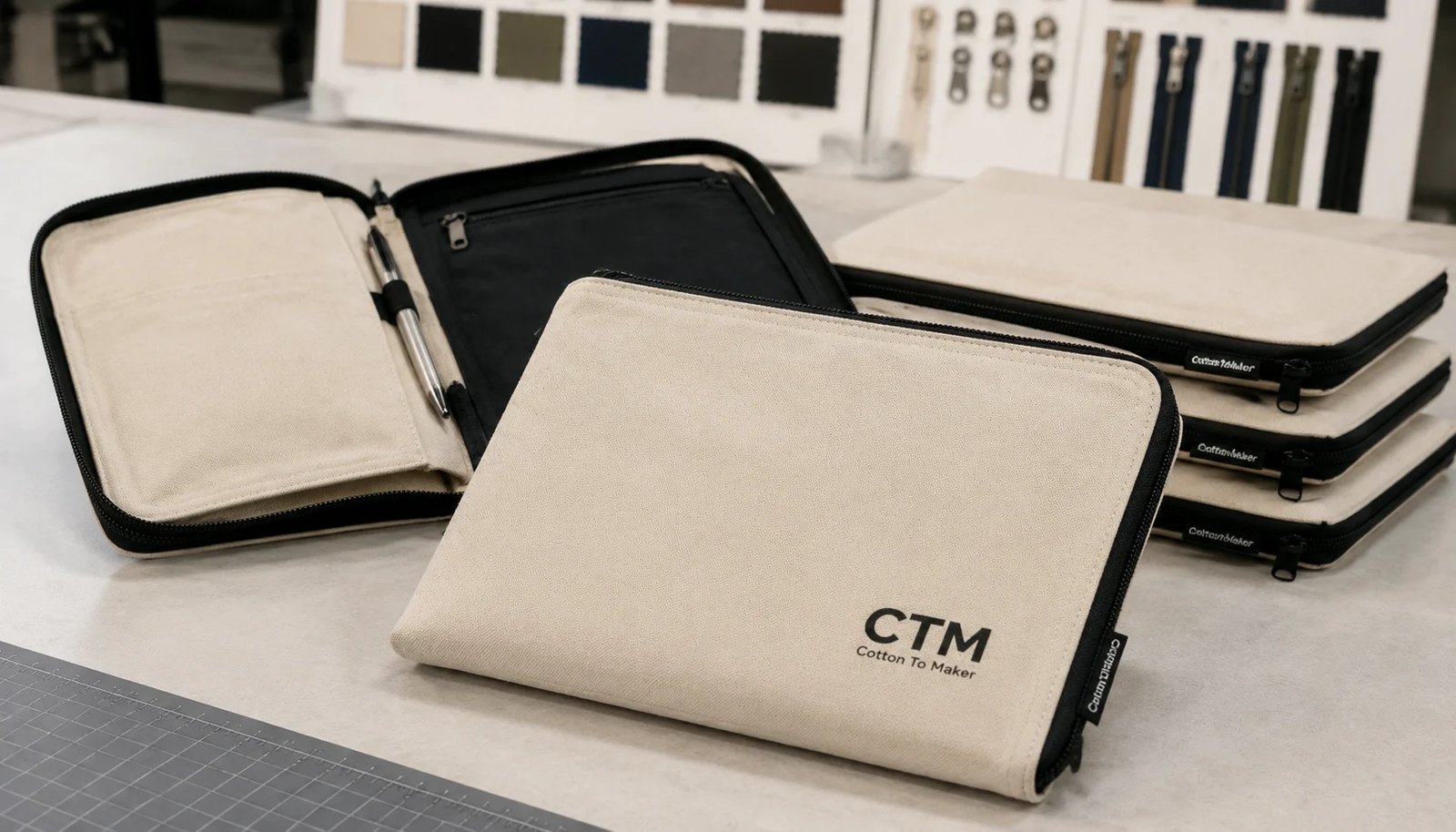
For liquor retailers, branding often needs to sit between store identity and supplier campaign identity. Screen printing is usually the most stable choice for simple CTM-style sample logos, store names, campaign marks, or one to three color graphics. It works well on cotton canvas when the artwork has solid areas and the buyer accepts a slightly textured ink surface. The factory should provide a print strike-off or pre-production sample because canvas absorbency affects color depth.
Heat transfer can reproduce more detail, but it must be tested on textured canvas. Low-quality transfer film may crack or lift when the portfolio bends. Embroidery gives a premium feel but can pucker lighter canvas and raise cost for large filled logos. Woven labels are useful when the retailer needs a consistent identity across repeat programs; they also help keep MOQ lower because the same base portfolio can be decorated with a small sewn label rather than a new large print for every version.
- Use screen print for solid store logos, supplier marks, and simple campaign artwork.
- Use woven labels when repeat reorder identity matters more than large front-panel branding.
- Use embroidery only after checking puckering on the chosen canvas weight.
- Provide Pantone references, logo size, exact placement, and print tolerance in the RFQ.
MOQ Negotiation Levers
A useful MOQ negotiation does not start with asking the supplier to match a number. It starts by giving the factory enough structure to see where quantity flexibility is possible. For example, 1000 pieces split into four printed logos may be possible if the same fabric, zipper, sewing pattern, and packing are used. The same 1000 pieces split into four canvas colors, three zipper colors, and two inner layouts may be treated as several small production runs.
The buyer should request a quantity ladder rather than one price. Ask for 500, 1000, 2000, and 5000 pieces on the same specification, then request the surcharge for lower MOQ or split logos. This shows whether the supplier is protecting setup time, material purchase quantity, printing setup, or sewing line efficiency. The negotiation becomes more practical when both sides can see which component is causing the MOQ floor.
- Use one base body size across all store banners whenever possible.
- Negotiate logo split MOQ separately from fabric MOQ.
- Keep zipper and lining colors common to avoid trim minimums.
- Accept a reasonable low-quantity surcharge if it avoids excess inventory.
- Avoid changing the inner pocket layout by region unless there is a real operational need.
Quote Data to Compare
Supplier quotes are only comparable when the cost basis is visible. A low unit price can exclude print setup, woven label mold, individual packing, export carton, sample cost, inspection, or domestic freight to port. For zipper portfolios, the quote should also identify whether the inner pockets and pen loop are included. Small internal components add cutting and sewing labor; leaving them vague often leads to later price changes.
The RFQ should request a clear specification sheet with material, size, tolerance, logo method, packing, carton quantity, sample lead time, bulk lead time, and payment terms. For landed-cost comparison, ask for carton dimensions and gross weight early. A heavier 14 oz canvas portfolio may look only slightly more expensive at FOB level but can cost more in air freight or take more warehouse space during store allocation.
- Unit price by quantity tier: 500, 1000, 2000, and 5000 pieces.
- Tooling and setup: screen charge, label setup, branded puller mold if any.
- Sample charges: proto sample, print strike-off, pre-production sample, freight.
- Packing cost: polybag, paper band, barcode label, master carton, inner carton if required.
- Logistics data: carton size, carton weight, pieces per carton, estimated CBM.
Sample Approval Workflow
A single sample is rarely enough for a custom canvas zipper portfolio unless the design is extremely basic. The practical sequence is a proto sample for shape and internal layout, followed by a pre-production sample using final canvas, zipper, logo, label, and packing. The proto stage can use available fabric to save time, but the buyer should not approve bulk cutting from a proto that does not represent final material and print.
Approval comments should be measurable. Instead of saying make the logo lower, write the placement in millimeters from the zipper edge or bottom seam. Instead of saying the zipper feels weak, specify the zipper gauge and require smooth operation after repeated opening. Photos are useful, but final approval should include a physical sample for color, canvas hand feel, zipper travel, and document fit whenever the order supports the cost.
- Approve body dimensions with the actual document stack inserted.
- Approve zipper movement with the portfolio loaded, not empty.
- Approve print color on final canvas, not on a paper proof.
- Approve inner pocket depth using the intended business cards, sheets, or inserts.
- Keep one signed or sealed sample as the inspection reference.
Packing and Distribution
Packing should match the retailer's distribution route. If the portfolios go to a central warehouse and then out to stores, mixed cartons and unclear carton marks create handling errors. If the portfolios are used in premium gift or supplier presentation programs, visible creasing and dust are more damaging than a small packing cost increase. Canvas can pick up moisture and odor, so cartons should be dry, clean, and strong enough for export stacking.
Individual polybags protect against dirt and zipper pull marks, but some liquor retailers prefer paper belly bands or plastic-reduced packing. Either option can work if the portfolio is held flat and the zipper pull is positioned so it does not dent the fabric. Carton quantity should be agreed before production because too many pieces per carton can compress the product, while too few pieces can inflate freight volume.
- Use individual recycled polybag when warehouse handling and dust protection are priorities.
- Use paper belly band when the buyer wants reduced plastic and accepts lighter protection.
- Keep logo versions separated by carton unless the distribution plan requires mixed sets.
- Print carton marks with item code, logo version, quantity, gross weight, net weight, and destination if known.
- Request packing photos before shipment so carton sorting can be corrected before loading.
Lead Time Risks
Lead time for custom canvas zipper portfolios is affected by fabric booking, zipper procurement, sample revisions, print approval, and packing material. A common mistake is counting production days from the first quote date. In reality, bulk lead time normally starts after sample approval, deposit, and final artwork confirmation. If a liquor retail campaign has a fixed tasting event or store rollout, the RFQ should show that date clearly.
Schedule risk increases when the buyer adds several logo versions, special dyed fabric, custom zipper pullers, barcode labels, or store-specific carton sorting. These are manageable, but they need to be visible early. A practical schedule includes time for artwork correction, sample freight, buyer review, mass production, inspection, booking, and customs documents. Rush production without sample discipline usually shifts the problem into quality disputes.
- Allow sample time before bulk lead time; do not combine them into one vague delivery promise.
- Freeze artwork before the pre-production sample to avoid print screen changes.
- Treat custom dyed canvas and custom zipper pullers as separate lead time risks.
- Book inspection before the production finish date, not after goods are already packed for shipment.
- For event programs, keep a backup plan for partial shipment only if cartons can be sorted cleanly.
Specification comparison for buyers
| Spec decision | Recommended option | When it fits | Buyer risk to check |
|---|---|---|---|
| Canvas body fabric | 12 oz cotton canvas or 340-380 GSM recycled cotton blend with pre-shrunk testing | Good balance for liquor retailer sales kits, tasting notes, staff folders, and gift program documents | Thin 8 oz canvas may collapse after inserting catalogs; heavy 16 oz canvas increases sewing cost and may make zipper corners bulky |
| Zipper construction | No. 5 nylon coil zipper with matching or contrast cotton tape and metal puller | Suitable for A4 or letter-size portfolios that must open smoothly during store meetings | Cheap zipper tape can wave on canvas; require open-close testing and clean corner turning on pre-production sample |
| Branding method | Screen print for solid liquor store logos; woven side label for repeat reorder identity | Best when the logo has one to three spot colors and the buyer wants stable unit cost | Heat transfer may crack on textured canvas if the supplier uses low-grade film or insufficient press control |
| Inner layout | One document sleeve, one business card pocket, one pen loop, optional elastic band for tasting sheets | Fits distributor reps, wine club packets, staff training folders, and retail buyer presentations | Too many inner pockets raise labor time and MOQ because each small component needs cutting and stitching control |
| MOQ negotiation lever | Keep one body size and one fabric color; negotiate print color splits instead of size splits | Works when multiple stores, regions, or liquor brands share the same base portfolio | Changing canvas color, zipper color, or pocket layout can reset the factory MOQ even if total quantity looks large |
| Packing format | Individual recycled polybag or paper belly band, then 25-50 pieces per export carton | Useful for retail distribution centers, store allocation, and clean presentation to brand partners | Overpacked portfolios increase carton volume; loose packing can cause zipper pull marks and canvas creasing |
| Sample approval | Proto sample for structure, then pre-production sample using final fabric, zipper, print, and packing | Needed before bulk orders tied to campaign launch dates or trade events | Approving a layout sample without final zipper and print can hide real production problems until mass production |
| Supplier route | Direct bag factory for customized canvas portfolio programs; trading company only if consolidating multiple unrelated items | Direct route gives better control over fabric, cutting, sewing tolerance, print approval, and MOQ discussion | Some quotes hide subcontracted printing or sewing; request production photos, material cards, and process responsibility |
Buyer checklist before sampling
- Define the portfolio size by the actual documents used: A4, US letter, tasting sheet, price list, POS material, or tablet sleeve.
- Specify canvas weight in oz and GSM, not only the word canvas; include whether recycled cotton or organic cotton is required.
- Lock the zipper type, zipper length, puller style, tape color, and whether the portfolio opens on one side, two sides, or three sides.
- Decide whether the logo is screen printed, heat transferred, embroidered, embossed on patch, or sewn as a woven label.
- Separate must-have features from optional features: document sleeve, pen loop, card pocket, elastic strap, divider, handle, and gusset.
- State the expected order quantity by design, by print version, by delivery destination, and by shipment batch.
- Request quote lines for base MOQ, reduced MOQ surcharge, sample cost, print setup, label setup, packing, carton, and inspection.
- Require one pre-production sample made with final fabric, zipper, logo method, inner layout, and packing before bulk cutting.
- Define visual acceptance rules for logo position, zipper smoothness, stitching density, loose threads, stains, odor, and fabric shade.
- Confirm export carton dimensions, gross weight, carton marking, polybag or paper band requirement, and pallet limit if used.
Factory quote questions to send
- What is your MOQ for this canvas zipper portfolio by fabric color, zipper color, logo version, and inner layout?
- Can you quote 500, 1000, 2000, and 5000 pieces with the same specification so we can see the real MOQ cost curve?
- Which canvas weight do you recommend for a structured portfolio: oz, GSM, yarn count if available, and shrinkage result?
- Is the zipper sewn in-house with the bag or supplied as a finished zipper component, and what zipper brand or grade is used?
- What print method is included in the quote, how many colors are included, and what is the setup charge per artwork?
- Does the quoted price include inner pockets, pen loop, woven label, individual packing, export carton, and carton marks?
- What sample stages do you propose, how many days for each sample, and can the pre-production sample use final bulk materials?
- What is the normal lead time after sample approval and deposit, and what parts of the order can create delays?
- What inspection standard do you use for canvas bags, and what AQL levels or defect categories can be written into the PO?
- Can you provide material swatches, zipper pull samples, print strike-off, and packing photo before we approve bulk production?
Quality-control points to confirm
- Canvas weight should match approved sample within the agreed tolerance, commonly plus or minus 5 percent if no stricter rule is written.
- Finished size should stay within agreed tolerance, normally plus or minus 5 mm for small pocket positions and plus or minus 10 mm for body dimensions.
- Zipper must run smoothly around corners without tooth separation, tape twisting, skipped stitches, or fabric caught in the slider path.
- Logo print must match approved color standard, placement, opacity, edge sharpness, and rub resistance after normal handling.
- Stitching should be straight, locked at stress points, and free from broken thread, long loose thread ends, and puckering on visible panels.
- Inner pockets must hold the intended document size without tight insertion, sagging, or blocked zipper closure.
- Fabric must be free from oil marks, dark yarn contamination, mildew smell, uneven dye patches, and excessive lint.
- Packing must prevent zipper pull dents, canvas creasing, moisture exposure, and mixed designs inside the same carton.