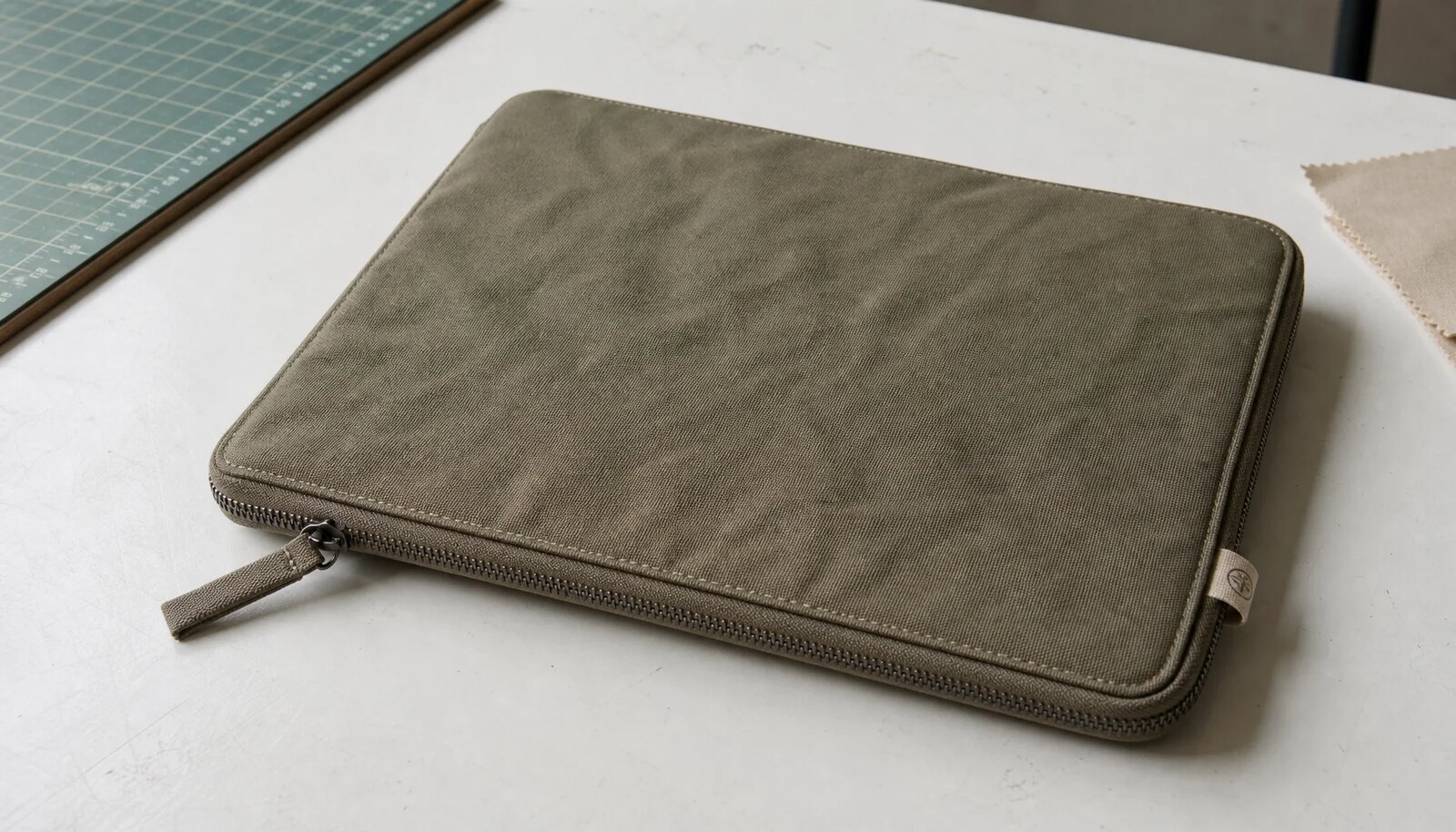
Why MOQ negotiation matters more than unit price
For custom canvas zipper portfolios, the quoted unit price is only one part of the buying decision. A low headline price can become expensive if the MOQ forces too many colors, too many logo versions, or a packaging format that does not fit your warehouse or retail process. Eco apparel brands usually need the portfolio to feel durable, ship efficiently, and support a clean visual identity, so the order structure matters as much as the material spec.
The right negotiation starts by understanding how the factory makes money on the item. Canvas cutting efficiency, zipper procurement, printing setup, sewing labor, and packing labor all influence the minimum viable run. When you understand those cost drivers, you can negotiate a smarter order split: one body color, one zipper color, one decoration method, and a repeat order path that rewards consistency instead of forcing a one-off exception.
- Best leverage points: limit colorways, standardize zipper color, and keep artwork placement simple.
- Worst cost leaks: mixed sizes in one run, multiple logo versions, or vague packaging instructions.
- Practical target: ask for pricing at several breakpoints, not just the first MOQ number.
Define the product spec before you ask for pricing
A supplier cannot quote accurately if the product description is vague. 'Canvas zipper portfolio' is too broad for procurement. The buyer should define the finished size, closure length, whether the item needs a gusset, handle, or internal pocket, and what the portfolio must carry in real use. A document carrier for lookbooks is not the same product as a tablet sleeve or sales kit, even if the outer shape looks similar.
This is especially important for eco apparel brands that care about presentation. The portfolio may need to hold catalog inserts, fabric swatches, wholesale line sheets, or event packets. That means the zipper opening, seam stiffness, and corner shape all matter. If the supplier is free to interpret the product, the quote may look acceptable but the final item may be too soft, too narrow, or too shallow to serve its actual purpose.
- Write finished dimensions in millimeters or inches and include a tolerance if fit matters.
- State whether the portfolio must hold documents, tablets, swatches, or mixed contents.
- Specify whether the bag needs a gusset, internal divider, handle loop, or side label.
Choose the right canvas weight and closure stack
Most buyers start by asking for 'canvas' and then discover later that the weight, finish, and hand feel were not aligned. For most portfolio programs, 12oz to 14oz canvas is the practical range. It gives enough body for a premium presentation without making the item overly heavy or expensive to ship. If the portfolio is expected to move through trade shows, wholesale appointments, or retail resale, the extra structure helps the product hold its shape and look intentional on a desk or shelf.
A lighter 10oz canvas can work when the order is cost-sensitive and the item is carrying only flat documents. The tradeoff is visible: softer corners, more wrinkling near the zipper, and a greater chance of print strike-through on darker graphics. The closure stack matters too. A #5 nylon zipper with a matching puller is often the best balance of cost and function. If the zipper is underspecified, the portfolio can fail long before the canvas wears out.
- 12oz canvas: balanced cost and structure for general B2B use.
- 14oz canvas: better for premium presentation, heavier contents, and retail shelf appeal.
- 10oz canvas: only if the portfolio is light-duty and the buyer accepts a softer body.
- Choose nylon zipper tape when smooth operation and lower metal weight matter more than decorative hardware.
How MOQ really works in factory math
When a factory gives you an MOQ, it is usually protecting three things: cutting efficiency, component sourcing efficiency, and setup time. A portfolio with one logo print and one zipper color can be produced in a cleaner sequence than a mixed-color order with multiple decoration positions. That is why one supplier may quote a low MOQ for a standard spec and a much higher MOQ for a customized version, even when the item looks similar on paper.
The buyer should not negotiate only on quantity. It is often more effective to simplify the specification so the factory can quote a realistic minimum. If you reduce the number of body colors, keep the zipper color standard, and keep decoration to one location, the supplier can often give a better MOQ without sacrificing margin. The strongest position is not 'make it smaller at any cost'; it is 'make it repeatable so the factory can build it efficiently'.
- Ask for MOQ separately for fabric color, print artwork, zipper color, and size.
- Request tiered pricing at 300, 500, 1,000, and 3,000 pieces if the factory can support it.
- If the supplier is rigid, reduce variants before reducing quantity.
Comparison of sourcing routes for low-MOQ portfolio orders
For eco apparel brands, the sourcing route affects both cost and control. A direct factory quote is usually best when the portfolio is a repeat item and the buyer can control specs tightly. A trading company can help when you need mixed product categories in one shipment, but the quote may hide the factory's real MOQ or component constraints. Distributors can move quickly, but they typically offer less flexibility on print placement, zipper type, and packing format.
The table below is useful because it compares the commercial tradeoffs, not just the list price. Procurement buyers should use it to decide how much control they need before choosing the route. If the order is strategic, repeated, or tied to a brand-standard presentation, direct factory sourcing usually gives the cleanest path. If the order is a one-off or needs consolidation across multiple item types, a trading partner may still be the right choice.
- Direct factory sourcing gives the best visibility into material and construction decisions.
- Trading companies can simplify mixed shipments but may add an extra margin layer.
- Distributors are fastest for stock-like products, but they are usually the least flexible on customization.
What to compare in supplier quotes
A quote that only shows unit price is not usable for procurement. You need the supplier to break out fabric spec, zipper spec, decoration cost, packing method, and any sample or tooling charges. Without that detail, two suppliers can look similar while actually quoting different canvas weights, different zipper qualities, or different packing assumptions. Those differences show up later as complaints, rework, or freight overages that were never visible in the initial offer.
To compare suppliers cleanly, ask them to quote the same finished size, the same artwork placement, and the same pack-out. If one supplier includes individual polybags and another quotes bulk packing, the comparison is not equivalent. The goal is to force the same commercial package across all suppliers so you can compare landed cost, not just product price. The best RFQ reads like a production brief, not a casual inquiry.
- Quote should show finished size, fabric weight, zipper spec, print method, and packing style.
- Separate sample fee from bulk price so development cost is visible.
- Confirm whether the quote includes a carton insert, barcode label, or recycled packing request.
- Ask for clarification on what the supplier considers standard versus optional.
Build a sample approval workflow that catches real defects
A pre-production sample is not a formality. For zipper portfolios, it is the best way to catch zipper tape mismatch, print misalignment, fabric stiffness, and stitch quality around the corners. The sample should use the final canvas weight, the final zipper, the final label method, and the final artwork position. If any of those change after approval, the sample is no longer representative and should not be used as the production reference without review.
The sample should also be tested like a working product, not only inspected visually. Open and close the zipper repeatedly. Put paper inserts or sample documents inside. Check whether the corners distort and whether the zipper ends sit cleanly. If the portfolio will be sent to retail buyers or used in client presentations, compare the sample against the presentation standard you want. A sample that photographs well can still feel too soft, too bulky, or too rough in hand.
- Approve only after verifying final fabric, final decoration, and final zipper puller.
- Test actual use: document fit, zipper smoothness, and stitch strength at stress points.
- Keep one signed sample as the production reference and one as the packing reference if needed.
- Do not approve a sample if the supplier says final components are still pending.
Quality control points that belong in the purchase order
Quality control should be written into the purchase order, not left as an informal expectation. The buyer should specify the allowed tolerance for fabric weight, the acceptable look of the print, the required stitch quality at stress points, and the handling of surface defects. If the item is used for eco apparel branding, the visual standard matters because the portfolio is often part of the first tactile impression a buyer gets from the brand.
QC should also include the parts procurement buyers often miss: zipper action, thread trimming, smell, contamination, and packing count. A portfolio can pass visual inspection and still fail in use if the zipper catches or the stitching at the zipper ends is weak. Likewise, a shipment can be physically complete but still cause receiving problems if barcode labels are inconsistent or carton counts are not clear.
- Fabric weight should match the agreed spec within an acceptable tolerance.
- Zipper action should be smooth across the full opening with no snagging or misalignment.
- Stitching around zipper ends and corner seams should be tight, even, and free of skipped stitches.
- Print edges should be clean, legible, and centered within the approved placement.
- Finished size should fit the intended contents without forcing the zipper line to warp.
- First-carton inspection should check odor, stains, oil marks, and any dye transfer.
- Packing count should be verified at both inner pack and master carton levels.
Packing, cartonization, and freight details that affect landed cost
Packing is not an afterthought. A flat canvas zipper portfolio may seem easy to pack, but the final carton count, polybag thickness, barcode label placement, and carton fill ratio all affect freight efficiency and warehouse intake. If the buyer wants retail-ready packaging, the supplier should quote it separately because it changes labor, packaging materials, and carton dimensions. That can materially affect both the production cost and the freight bill.
For importers and distributors, the packing spec should match how the goods will be received. If the warehouse scans by barcode, each unit needs a consistent label position. If the goods are reworked in-house, bulk packing may be the cheapest and cleanest option. The commercial mistake is to accept the factory's easiest standard method when it does not fit your receiving process. Packing should support your downstream operation, not create extra handling after arrival.
- Define unit packing: bulk, polybag, recycled bag, or retail sleeve.
- Specify carton count and target carton weight so handling stays practical.
- Ask the factory to optimize carton dimensions before production if freight is tight.
- Confirm whether carton markings need SKU, PO number, or destination labeling.
Lead time planning and re-order strategy
Lead time for custom canvas zipper portfolios depends on sample approval, fabric availability, print approval, zipper sourcing, and packing requirements. If a supplier promises a short turnaround without locking those steps, the schedule can slip as soon as artwork or zipper colors are finalized. A realistic plan separates development time from bulk production time and leaves room for component sourcing, especially when you are buying recycled or specially dyed materials.
For seasonal eco apparel programs, the main risk is not the sewing line. It is the delay caused by late artwork approval or a change after sampling. Once the zipper color, label position, or print layout changes, the factory may need to reorder components or redo cutting. Buyers should freeze the spec before bulk material release and ask whether the factory can reserve fabric or zippers before the PO is issued. That makes the lead time more reliable and makes re-orders easier to repeat.
- Build the schedule around sample approval and component lock, not only sewing days.
- Leave buffer time if artwork has multiple revisions or if recycled materials need sourcing.
- Ask whether the factory can reserve fabric and zippers before PO release.
- Keep a repeat-order spec sheet so the next run does not require re-approval from scratch.
Specification comparison for buyers
| Spec decision | Recommended option | When it fits | Buyer risk to check |
|---|---|---|---|
| Fabric weight | 12oz to 14oz canvas for most portfolios | Brand kits, conference packs, retail-ready stationery sets, document carriers | Light 10oz canvas can look thin, wrinkle easily, and show print-through on dark artwork |
| Closure style | #5 nylon zipper with matching puller and reinforced ends | Daily-use portfolios, premium eco apparel mailers, resale channels | Cheap zipper tape, weak sliders, or loose end stitching can fail after repeated use |
| Decoration method | 1 to 2 color screen print for simple logos; woven label for minimalist premium branding | Straightforward logos, lower setup cost, repeat programs | Complex art can lose detail if line thickness, ink coverage, or placement is not controlled |
| MOQ approach | Tiered MOQ by color, size, or artwork rather than one rigid number | New SKU tests, seasonal drops, or multi-program buying | Too many variants can fragment the order and push unit cost up sharply |
| Sample stage | Pre-production sample with final fabric, zipper, print, and label placement | Any order with strict brand approval or retail expectations | Sales samples made from substitute materials hide real production issues |
| Lining option | Unlined or light cotton lining unless documents need extra structure | Eco apparel brands seeking lower weight and cleaner cost | No lining can reduce body if stitching quality and seam allowance are weak |
| Packing method | Bulk pack for wholesale, or individual polybag with barcode label for retail receiving | Distributor orders, warehouse-managed inventory, retail replenishment | Loose packing can scuff print, distort corners, and create count errors at receipt |
| Supplier route | Direct factory for repeat volume; trading company only for mixed-category consolidation | Brands comparing landed cost across multiple bag programs | Middlemen can hide true factory MOQ, lead time, or sample source |
| Lead time strategy | Build around fabric reservation, sample approval, print approval, and carton confirmation | Time-sensitive launches and seasonal programs | Rushed schedules often skip curing time, zipper testing, or carton drop checks |
Buyer checklist before sampling
- State the exact finished size, zipper opening length, and whether the portfolio needs a gusset, handle, or inside pocket.
- Lock fabric weight in GSM or oz, not just 'canvas', and specify whether you want standard cotton canvas or recycled cotton canvas.
- Separate decoration requirements by artwork file, print colors, logo size, placement, and any required PMS or Pantone reference.
- Ask for a pre-production sample made with final fabric, final zipper spec, and final label placement before bulk approval.
- Define packing rules clearly: bulk or individual packing, barcode label placement, master carton quantity, and any insert or tissue requirements.
- Request a quote that shows unit price at each MOQ tier, sample cost, tooling or setup cost, and production lead time separately.
- Confirm whether the supplier is quoting one size only or multiple sizes, because size mixing changes cutting efficiency and carton logic.
- Ask who owns the final spec sheet and sample reference so there is no ambiguity when production starts.
Factory quote questions to send
- What exact canvas weight are you quoting, and what finished GSM or oz does it translate to after finishing and cutting loss?
- Which zipper spec are you offering, including brand, gauge, tape width, slider material, and zipper puller finish?
- What is the MOQ per color, per artwork, and per size, and how does the unit price change at 300, 500, 1,000, and 3,000 pieces?
- Can you make a pre-production sample with the final fabric, print method, zipper color, and label position before bulk production?
- What stitch count or seam reinforcement do you use at the zipper ends and stress points, and can you show a sample close-up?
- What carton pack quantity, carton size, and gross weight do you recommend for export and warehouse receiving?
- What is your standard lead time after sample approval, and what steps would extend it if artwork, fabric, or zipper colors change?
- Can you quote the same spec in bulk packing and retail-ready packing so we can compare landed cost cleanly?
Quality-control points to confirm
- Fabric weight should stay within an agreed tolerance, typically around plus or minus 5 percent of the quoted canvas spec unless otherwise stated.
- Zipper must open and close smoothly across the full length without jamming, skipping teeth, catching fabric, or leaving loose end stitching.
- Print registration should keep critical artwork aligned and legible; edge blur, cracking, and off-center logos are rejectable if visible at arm's length.
- Stitching density should be consistent on load-bearing seams and zipper ends; loose threads, skipped stitches, and needle damage should be trimmed or rejected.
- Finished size should match the approved sample and tolerate only small manufacturing variation, especially if the portfolio must fit documents or tablets.
- Packing count must be verified by carton and by inner pack; receiving shortages often happen when bundle counts are not written clearly.
- Smell, contamination, and surface staining should be checked on the first cartons, especially for cotton canvas that may absorb oil or dye residue.
- Label placement, barcode legibility, and carton marking should be checked before shipping so the warehouse does not need to relabel inbound stock.