1. Start With Why MOQ Moves
MOQ for custom canvas zipper portfolios is not one fixed factory rule. It is the result of several smaller minimums sitting inside the product: fabric, zipper tape, sliders, pullers, print setup, label production, packing materials, and the labor needed to run the order without constant line changes. When a supplier says the MOQ is higher than expected, the useful question is not only "Can you do less?" It is "Which part of this spec is creating the minimum?"
That shift matters for trade show buyers because the order often has a hard event date and a very specific use. The portfolio may need to hold sales sheets, sample cards, dealer agreements, brochures, or press material. It has to look clean on a table, unzip easily when staff are moving fast, and arrive in cartons that the event team can handle without confusion. A low MOQ is helpful only if the product still performs in that environment.
The strongest negotiations usually begin by removing unnecessary change points. A standard natural canvas body, one-color logo, and stock zipper tape can still look polished. Custom zipper pullers, dyed canvas, lining, inside pockets, and multiple logo positions can all be valid, but they should earn their place. If the buyer cannot explain why a feature matters for the show or the brand, it is a candidate for simplification.
- Ask which components have separate MOQs before discussing the total order quantity.
- Keep the body fabric and zipper family standard if your real priority is a lower opening order.
- Protect the functional parts first: size accuracy, zipper feel, seam strength, and clean logo placement.
2. Match Construction To The Event Job
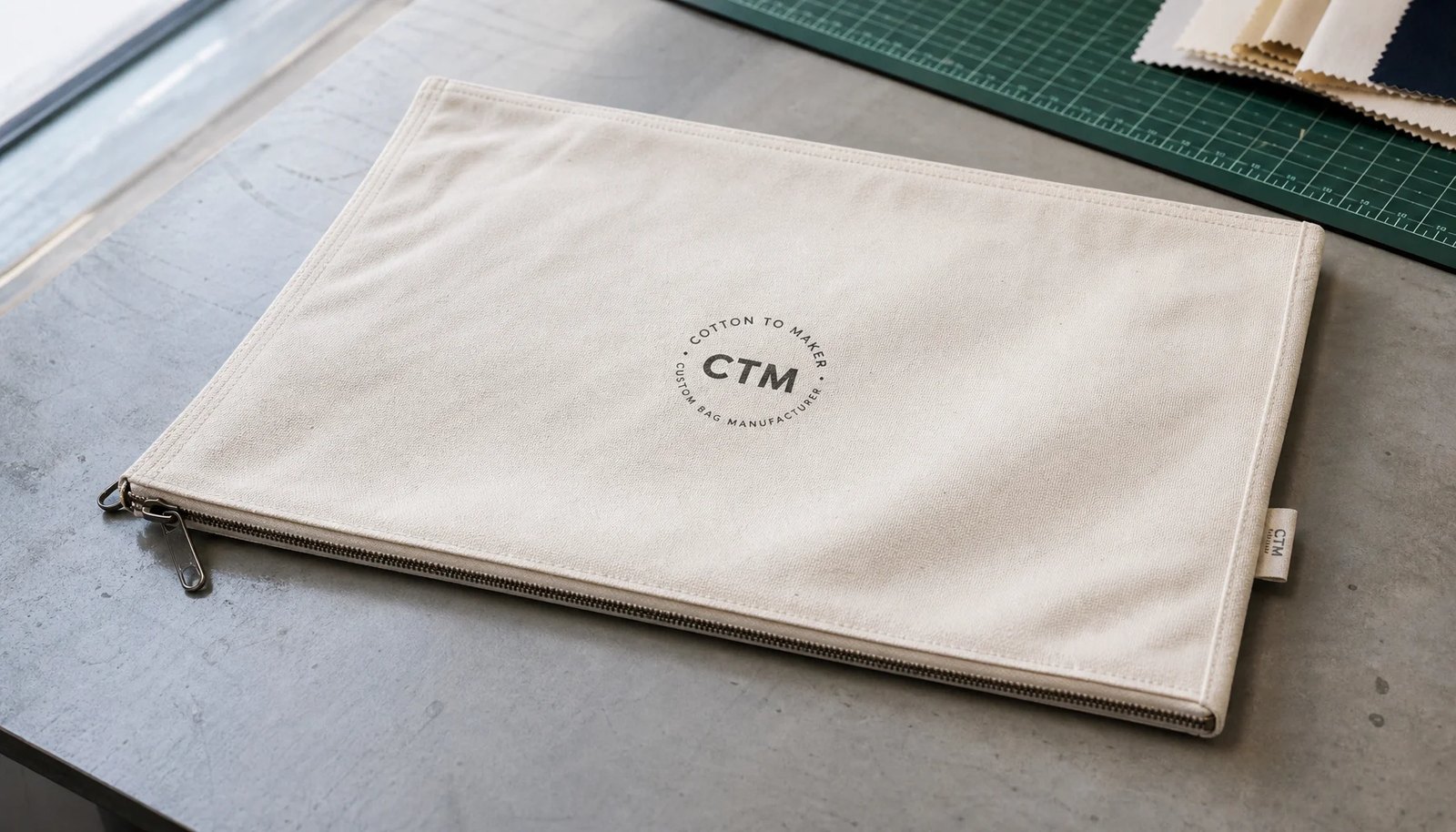
A canvas zipper portfolio sounds simple until the buyer defines what it must carry. A flat pouch-style portfolio works well for documents, A4 or letter sheets, slim catalogs, and press handouts. It packs efficiently, lays cleanly on a table, and is easier for factories to make consistently. A gusseted portfolio is better when the kit includes thicker brochures, notebooks, sample cards, or small product literature bundles. The tradeoff is more sewing complexity and more room for corner puckering if the spec is rushed.
Canvas weight should be chosen for use, not as a reflex. Ten-ounce canvas can be enough for light document kits and reduces packing weight. Twelve-ounce canvas is often a practical middle point for trade show portfolios because it feels substantial without becoming bulky. Fourteen- and sixteen-ounce canvas can create a firmer, more premium hand-feel, but heavier fabric may affect folding, carton count, freight cost, and the way print ink sits on the weave. The supplier should confirm actual gsm, not only the ounce label, because fabric descriptions are not always used consistently across mills.
Do not ignore the zipper opening. A portfolio that technically fits the paper size may still frustrate users if the zipper opening is too short or the corner radius catches the insert. For exhibitor teams, the item is handled repeatedly. Staff may load materials the night before a show, carry the portfolios to a booth, and hand them out while speaking with prospects. Smooth opening is part of the product, not a small detail.
- Flat portfolio: best for slim documents, press kits, dealer sheets, and lightweight handouts.
- Gusseted portfolio: better for thicker literature packs, notebooks, samples, or multi-document buyer kits.
- Heavier canvas: useful for structure and perceived value, but check packing weight, folding marks, and print behavior.
3. Choose A Sourcing Route Before Negotiating Price
A direct factory, a trading company, and a domestic decorator can all be the right answer, but not for the same order. A direct factory gives better access to construction details, material substitutions, sample corrections, and packing instructions. That matters when the portfolio is part of a repeat trade show program or when the buyer needs control over canvas weight, zipper quality, and logo placement. The direct route may also expose the real MOQs for each component, which can feel less flexible at first but is often clearer.
A trading company can be useful when the order includes several related products, such as portfolios, tote bags, drawstring bags, and small pouches. Consolidation can simplify communication and shipment planning. The buyer should still ask which factory makes each item, whether the same canvas is used across products, and who controls final inspection. A tidy presentation from the intermediary does not replace a real production spec.
Domestic decoration works best when timing is tight and the buyer can accept stock blanks. It can be a smart way to test a logo, support a regional sales meeting, or cover a last-minute show. The limitation is that the buyer is decorating an existing product. Size, canvas, zipper, and sewing are mostly locked. Before paying for decoration, inspect the blank portfolio itself. A nice print will not fix a scratchy zipper or weak seam.
- Use a direct factory when repeatability and construction control matter most.
- Use a trading company when the program combines several sewn items and one PO is valuable.
- Use domestic decoration when deadline pressure is higher than customization needs.
4. Send An RFQ A Factory Can Actually Price
Many MOQ problems begin with a vague RFQ. "Please quote custom canvas zipper portfolios" leaves too much room for assumptions. One supplier may price 10oz natural canvas with a nylon zipper and single screen print. Another may price 12oz dyed canvas with a metal slider and individual bags. The quotes may look comparable in a spreadsheet, but they are not quoting the same product.
A stronger RFQ gives the factory a narrow target. Include the finished dimensions, usable internal dimensions if important, gusset depth, canvas weight target, body color, zipper tape color, slider finish, decoration method, artwork size, logo position, label requirement, packing method, carton mark needs, target MOQ, and delivery basis. If you do not know the ideal canvas weight or print method yet, say that and ask for two controlled options. Do not ask every supplier to guess in a different direction.
Line-item pricing is especially helpful for procurement teams. Ask the supplier to separate the base body, decoration, zipper upgrade, custom puller, woven label, packing, sample charge, tooling, and freight assumptions. This does not mean every supplier will reveal every internal cost, but it forces the quote to show where the money is going. It also makes negotiation more practical. You may discover that the MOQ issue is not the portfolio body at all, but a custom puller or printed insert card.
- Provide a dimensioned sketch or tech pack, even if it is simple.
- Quote one base spec first, then request alternate pricing for upgrades.
- Ask suppliers to list assumptions clearly so low quotes do not hide missing requirements.
5. Negotiate By Reducing Change Points
The cleanest MOQ negotiation is usually a spec conversation. Instead of pushing the supplier to accept a smaller run of a complicated product, identify which features can be standardized. Use one canvas color. Keep the same zipper tape across versions. Limit the logo to one print position. Use a stock slider before moving to a custom puller. Choose one carton format where possible. Each decision removes friction from the production run.
This approach is not about making the product cheap. It is about spending customization where buyers will notice it. For trade show exhibitors, the most visible elements are the body fabric, front logo, zipper feel, and overall neatness. A custom lining color may delight an internal team during review, but it may not matter to the prospect receiving a document kit. A smooth zipper and centered print will matter every time the product is touched.
If the order must support several exhibitors, regions, or sales teams, ask whether the supplier can run one shared body spec and change only the logo or carton mark. That is often easier than splitting body colors, zipper colors, and print methods. When a supplier offers a lower MOQ, confirm what is changing. A smaller minimum tied to a different fabric stock, weaker zipper, or unapproved packing method is not a true win.
- Keep one approved canvas base across all logo versions whenever possible.
- Reduce print colors before compromising zipper quality or seam reinforcement.
- Confirm whether split MOQs are split by decoration only or by separate material batches.
6. Compare MOQ Options With A Simple Decision Table
Procurement teams often need to explain why one option is better than another. A short internal decision table can prevent a long email chain and keep the discussion grounded in risk. The point is not to chase the lowest MOQ at any cost. The point is to understand what the buyer gives up or gains when changing the spec.
For example, a standard 12oz natural canvas portfolio with one-color screen print may have the strongest balance for a first order. A dyed canvas body may look closer to brand colors, but it can raise MOQ and add color approval risk. A custom zipper puller can improve brand feel, but it may require tooling and longer lead time. A domestic blank can solve an urgent deadline, but it usually reduces control over size and construction.
Use the table before final supplier selection, not after the PO is ready. Once artwork, event dates, and internal approvals are moving, it becomes harder to simplify. Early comparison gives the buyer room to choose the order strategy that fits the show calendar.
- Lowest-risk first order: standard canvas, stock zipper, one-color logo, simple carton packing.
- Higher-brand-control order: custom trim, labels, or lining with a longer approval path.
- Urgent-event order: stock blank with local decoration, after blank quality is checked.
7. Make Sample Approval Functional
A portfolio sample should not be approved from a front-view photo alone. The buyer needs to handle it like the event team will handle it. Open and close the zipper several times. Load the intended documents. Check whether the zipper opening is wide enough. Look at the corners after the portfolio is filled. Lay it flat and see whether the logo is straight. If it will be packed flat, check whether the product stays neat after being stacked.
Measurement is just as important. Record finished width, finished height, gusset depth, zipper opening, print size, print position from the edge, and label position. If the approved sample is slightly off but acceptable, write down what is acceptable. Otherwise, the factory and buyer may disagree later about whether bulk production matched the sample.
For screen print, inspect edge sharpness, ink coverage, and whether the canvas texture creates broken areas in the logo. For heat transfer, check the edge, feel, adhesion, and how it sits over the weave. For embroidery, look at puckering and backing. For woven labels or patches, make sure placement is straight and does not pull the panel out of shape. A beautiful logo method on the wrong fabric surface can still create a weak final product.
- Test the sample with the actual documents or inserts planned for the show.
- Photograph measurements and print placement with a ruler in frame.
- Approve the sample only after construction, decoration, zipper feel, and packing are reviewed together.
8. Set QC Rules Before Bulk Production
Quality control for custom canvas zipper portfolios should focus on the defects that will be visible or disruptive at a trade show. A tiny thread tail can be trimmed. A rough zipper, crooked logo, weak seam, stained canvas panel, or wrong carton label creates a real problem. Write the inspection standard before bulk production begins so the supplier knows which issues are critical.
A practical QC plan uses the approved sample as the reference. Inspect finished size, fabric shade, canvas hand-feel, zipper operation, print placement, stitch security, thread color, trim placement, and packing. Pay extra attention to stress points near zipper ends, gusset corners, and puller attachment. These areas reveal whether the product was sewn cleanly or pushed through too quickly.
For larger programs, a third-party inspection can be worthwhile, but the inspection brief must be specific. A generic bag checklist may miss portfolio-specific details such as document fit, print window, zipper opening, and carton sortation by event site. Ask for photos of random units from multiple cartons, not only the first sample pulled from the top. If the order has several logo versions, each version should be checked.
- Classify zipper failure, open seams, stains, wrong logo, and wrong SKU labels as serious defects.
- Check random cartons across the shipment, not only loose samples supplied by the factory.
- Use the approved PP sample, artwork file, and carton mark layout as inspection references.
9. Pack For The Way Exhibitors Receive Goods
Packing is where many good product specs become messy shipments. Trade show buyers rarely receive portfolios in a calm, unlimited warehouse environment. Cartons may go to a booth builder, hotel, distributor, sales office, or event site. The receiving team may need to split them quickly by region, salesperson, logo version, or show date. If carton marks are unclear, the product may be fine but the event execution becomes harder.
Decide whether the portfolio should be packed flat or folded. Flat packing usually protects appearance better, especially for printed canvas, but it can increase carton size. Folded packing may reduce volume, yet it can leave creases through the logo or zipper line. Individual polybags protect against dust and moisture but add material and handling. Paper wrap may fit some brand preferences, but it should still protect the print surface. The right pack-out depends on distribution, not only factory convenience.
Ask for carton dimensions, gross weight, net weight, pieces per carton, carton strength, and labeling before the PO is locked. Heavy cartons may look efficient on paper but slow down booth setup and local handling. If the order includes multiple SKUs, carton labels should show product name, size, color, logo version, PO number, quantity, and destination code if needed. A clear label is cheaper than a confused receiving process.
- Approve packing with the same seriousness as the product sample.
- Avoid pack-outs that crease the logo area or crush zipper corners.
- Make carton marks match the way the receiving team will sort and distribute goods.
10. Use Landed Cost, Not Unit Price Alone
A low unit price can be misleading when portfolios are bulky, time-sensitive, or heavily branded. Landed cost includes the unit price, sampling, revisions, tooling, inspection, packing, inland transport, export charges, freight, duties where applicable, local delivery, and the cost of fixing mistakes. Procurement buyers do not need to overcomplicate the math, but they should compare suppliers on the same basis.
Start with like-for-like quote comparison: same canvas weight, same dimensions, same zipper type, same print method, same packing, same incoterm, and same inspection expectation. Then look at schedule risk. A supplier offering a lower price with uncertain trim availability may be a worse choice for a fixed event date. A slightly higher quote from a supplier with clearer sample control, better packing, and a specific production calendar may reduce the chance of late or unusable goods.
The first order should prove the spec. Once the buyer knows the portfolio size, fabric, zipper, and decoration work well, repeat orders become easier to negotiate. At that stage, you may be able to consolidate volume, forecast annual demand, or standardize a house portfolio style for multiple shows. MOQ negotiation becomes much more productive when the supplier sees a repeatable program instead of a one-time request for the lowest possible quantity.
- Compare quotes only after normalizing specs, packing, and delivery terms.
- Include sample cost, inspection, freight assumptions, and event handling in the decision.
- Use the first order to validate the product, then negotiate repeat volume from a stronger position.
Specification comparison for buyers
| Sourcing or spec route | Best use case | MOQ advantage | Buyer risk to control |
|---|---|---|---|
| Standard factory canvas base with custom logo | 10oz-12oz natural or black canvas, one print position, stock zipper color, simple export carton packing | Usually the cleanest route for a first custom order because the factory can use existing fabric and trim supply | Confirm the exact canvas weight, shade, shrinkage behavior, and zipper tape color before comparing quotes |
| Factory build with branded trim package | Programs that need custom zipper pullers, woven labels, zipper tape colors, lining, or inside pocket branding | Lets the buyer create a more owned product while keeping the portfolio shape consistent | Each trim item may carry its own MOQ, lead time, tooling fee, or color tolerance |
| Mixed SKU program under one approved body spec | Exhibitors ordering A4, letter, brochure, or sample-kit sizes from one parent design | Can reduce decoration setup waste if the same canvas, zipper family, and logo method are shared | Carton marking and size forecasting become more important because sell-through may vary by format |
| Trading company consolidating portfolios with totes or pouches | Trade show kits where one supplier coordinates several sewn canvas products under one PO | May improve order management when total program volume is spread across related items | Ask which factory makes each item and whether approvals are tied to one workshop or several |
| Domestic decorator using imported blanks | Short deadline events, test runs, sales meetings, or regional shows where speed matters more than construction control | Lower opening commitment if blank inventory is already available | Limited size, fabric, zipper, and construction choices; inspect blanks before paying for decoration |
| Stock blank plus local logo application | Pilot orders, internal kits, or small distributor presentations where proving demand matters first | Avoids a true custom production MOQ and can move quickly | The product may look generic, and repeat orders may not match if blank inventory changes |
| Fully custom canvas portfolio with lining or shaped puller | Premium customer gifts, reseller kits, or executive-level show materials | Strongest brand control and better room for functional details such as pockets or reinforced panels | Longer sample cycle, higher trim dependency, and more chances for approval delays |
| Split production across two suppliers | Large orders with tight delivery windows or phased delivery to several event sites | Adds supply flexibility if both suppliers can match the same approved spec | Color drift, zipper feel, stitch density, and carton label formats must be checked side by side |
Buyer checklist before sampling
- Define the finished outside size, usable inside size, gusset depth, zipper opening length, and whether the portfolio must fit A4, letter, catalogs, folders, or product sheets.
- State the target canvas weight, such as 10oz, 12oz, 14oz, or 16oz, and ask the supplier to confirm the actual gsm value and whether the fabric is raw, dyed, washed, or coated.
- Specify zipper type, zipper tape color, slider finish, puller shape, end stops, and whether the zipper must open flat enough for fast document loading at an event.
- Choose the decoration method before requesting final pricing: screen print, heat transfer, embroidery, woven label, rubber patch, leather-like patch, or a combined logo package.
- Give the target MOQ by body color, print color, and size, and state whether you can accept one shared canvas base across several logo versions.
- Ask for a line-item quote separating body cost, decoration, labels, zipper upgrades, packing, sampling, tooling, inland freight, and export charges where relevant.
- Request a preproduction sample with measurement tolerance, print placement photos, zipper test notes, fabric swatch reference, and packing mockup.
- Confirm whether portfolios are packed flat or folded, one per polybag or paper wrap, with carton count, carton size, gross weight, and retail or warehouse labels.
- Tie bulk lead time to final artwork approval and PP sample signoff, not to the first inquiry date or the day the supplier sends a rough quotation.
- Set the inspection plan before production: sample reference, defect limits, zipper function checks, stitch and seam checks, print placement, carton labels, and photo requirements.
Factory quote questions to send
- What is your MOQ by canvas color, canvas weight, zipper color, print color count, size, and trim package?
- Which canvas weights do you use regularly for zipper portfolios, and what are the actual gsm values, shrinkage expectations, and available stock colors?
- Can you quote the same design three ways: standard zipper parts, upgraded metal slider, and custom puller, so we can see the cost and MOQ step-up?
- What decoration methods do you recommend for this artwork on canvas, and what are the setup fees, color limits, artwork requirements, and sample risks for each method?
- What is included in the quoted packing: individual bag or wrap, insert card, barcode label, carton marks, carton strength, and palletization if needed?
- What sample fee, tooling fee, artwork fee, or mold fee applies, and is any amount credited back after bulk order confirmation?
- How many days are needed for sample making, sample revision, material preparation, cutting, sewing, decoration, final inspection, and packing after PP sample approval?
- Are fabric, zipper tape, sliders, labels, and packing materials already available, or will any item require separate sourcing before production starts?
- What price basis are you quoting, such as EXW, FOB, FCA, or delivered to our warehouse, and which charges are excluded from the quoted unit price?
- What quality standard do you inspect against for size tolerance, stitch density, seam strength, print registration, ink coverage, zipper function, stains, odor, and carton labeling?
Quality-control points to confirm
- Finished outside size, usable inside size, gusset depth, and zipper opening match the approved spec within the agreed tolerance.
- Canvas weight, shade, weave, hand-feel, and panel direction are consistent across the lot and match the approved sample or swatch.
- Zipper opens and closes smoothly through repeated cycles without snagging, wave distortion, broken teeth, rough end stops, or a slider that twists under normal use.
- Stitching is straight, secure, and properly back-tacked at stress points, with no skipped stitches, loose thread tails, thread nests, or open seams.
- Print, transfer, embroidery, or label placement sits inside the approved artwork window and does not drift into seam allowance, zipper tape, folds, or gusset edges.
- Logo color, ink coverage, edge sharpness, and registration are acceptable against the approved proof, especially for brand-sensitive artwork.
- Corners, binding, gusset folds, zipper ends, and panel edges are clean, with no puckering, twisting, needle damage, or uneven trimming.
- Labels, side tags, patches, pullers, insert cards, barcode labels, and hangtags are attached in the correct position, direction, language, and SKU version.
- The product is free of oil marks, fabric stains, dye transfer, mildew smell, chemical odor, broken needle risk, dust, and packaging debris.
- Packing method prevents hard creases, scuffed logo areas, crushed corners, moisture exposure, and excessive compression during transit.