Start with the event risk, not the unit price
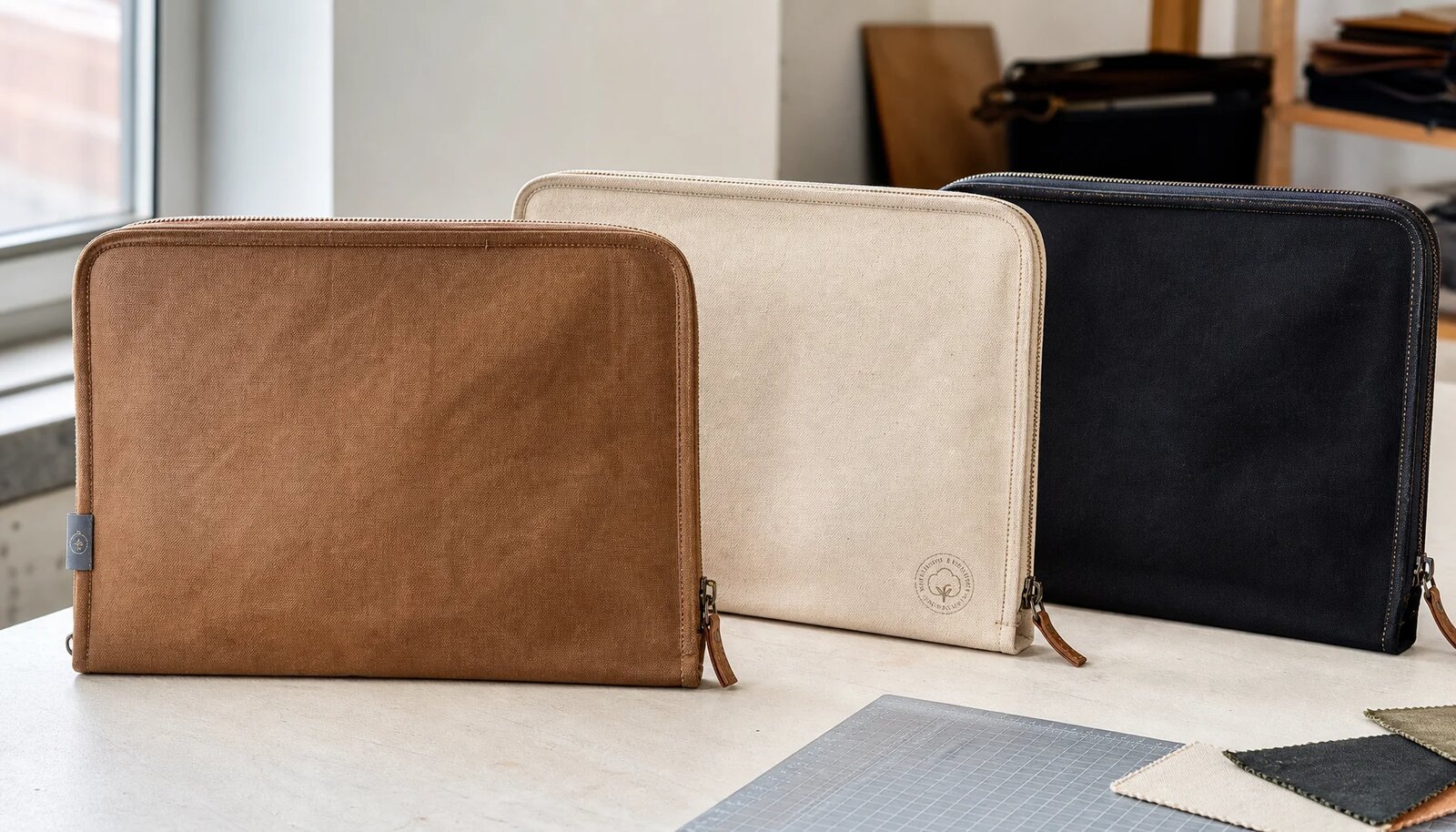
Custom canvas zipper portfolios are bought for a fixed handout moment. That makes them different from ordinary promotional inventory. If a zipper fails at registration, a sponsor logo is printed on the wrong version, or cartons arrive after the venue receiving window, the buyer has very little room to recover. The product cost is only one line. The real exposure includes staff time, emergency freight, repacking work, sponsor frustration, and a less polished attendee experience.
MOQ pressure usually appears after a simple product idea turns into an event operations plan. One portfolio becomes VIP, speaker, sponsor, regional, staff, media, and extra-stock versions. Then the sponsor team adds another mark. Marketing asks for a different logo placement. Logistics wants carton labels by venue zone. Each request can be reasonable on its own, but together they add print setups, sorting steps, inspection points, and production risk.
The best negotiating position is a stable base shell. Keep the finished size, canvas weight, zipper length, lining, pocket layout, and main logo position consistent wherever possible. Use inserts, belly bands, removable labels, hangtags, or carton sorting for the details that change by audience or destination. The supplier can then run one cleaner cutting and sewing lot instead of treating the project as several small custom orders.
For procurement, the first task is to separate what attendees will truly notice from what can be handled operationally. Attendees notice fit, zipper glide, clean stitching, readable branding, and whether the contents sit neatly inside. They rarely need every sponsor or attendee tier permanently printed on the outside panel.
- Treat the canvas zipper portfolio shell as the base product and event materials as variable components.
- Count size, color, artwork, insert, packing, and destination versions before requesting quotes.
- Use one finished size unless the contents truly require different physical dimensions.
- Keep sponsor or attendee segmentation removable when it does not need to be permanent on the portfolio.
- Negotiate MOQ after identifying which part of the specification creates the minimum.
Write the spec before you shop the price
A factory cannot quote accurately from the phrase custom canvas zipper portfolio. The RFQ should define the product in physical terms: finished width and height, gusset or packed thickness, canvas weight, lining, pocket layout, zipper opening, logo placement, and packing method. These details affect fabric consumption, cutting yield, zipper length, carton size, freight volume, and how the event kit actually fits.
Start with the contents. A portfolio for an agenda and badge sheet can be lighter and flatter than one holding a notebook, tablet, charger, pen, sponsor cards, and a printed booklet. Measure the largest paper size, total packed thickness, and any rigid items that may strain the corners. Also state how the portfolio will be used: carried by hand, inserted into a tote, placed on ballroom seats, shipped to homes, or distributed from a registration counter.
Canvas weight needs to be comparable across suppliers. Many bag suppliers quote canvas in ounces per square yard, while others use gsm. A practical event portfolio range often includes 12 oz/yd2, 14 oz/yd2, and 16 oz/yd2, roughly 407 gsm, 475 gsm, and 542 gsm before finishing. Ask whether the stated weight is before washing, after coating, or based on a supplier stock label. A 12 oz quote and a 16 oz quote are not the same product, even if both say cotton canvas.
Interior features also need dimensions. A document pocket should state usable width and depth. A pen loop should state elastic or fabric construction and target pen diameter. A tablet pocket should state device size and whether padding is included. When buyers leave these open, each supplier fills the gaps differently. That makes MOQ, price, and quality comparisons blurry.
- State finished dimensions in width x height x depth, with measurement tolerance for the sewn product.
- List actual kit contents and maximum packed thickness, not only intended audience size.
- Use one canvas weight target across the order unless there is a clear physical reason to split.
- Dimension pockets, loops, dividers, card slots, and lining details.
- Ask whether canvas weight is measured before finishing, after finishing, or by supplier stock label.
Find the real MOQ driver
MOQ is rarely one simple factory rule. A supplier may be able to sew 300 pieces but unable to buy custom-dyed canvas below 1,000 pieces. Another may have stock canvas but face a zipper tape minimum. A print room may accept 300 pieces for one logo, then price ten sponsor versions much higher because every version needs proofing, setup, drying time, cleanup, and inspection.
For custom canvas zipper portfolios, common MOQ drivers include fabric roll availability, dye lot size, zipper tape and slider supply, cutting efficiency, print setup, sewing line scheduling, custom labels, and packing complexity. Stock natural, black, navy, or gray canvas usually gives procurement more room. Standard zipper tape and a non-branded puller help too. Custom colors, waxed or coated canvas, contrast zipper tape, branded pullers, printed lining, woven labels, embroidery patches, and several decoration locations can all push the practical minimum upward.
Ask the supplier to identify the blocker instead of only asking for a lower MOQ. The answer may be useful. They may suggest stock canvas instead of custom dyeing, black zipper tape instead of exact PMS matching, one outside print instead of three decoration areas, or insert-based versioning instead of printed shell versioning. Those substitutions let the buyer choose deliberately: simplify the spec, pay the extra cost, or increase quantity.
It also helps to separate MOQ from unit-price preference. A factory may accept 300 pieces but price them high because setup costs are spread over fewer units. Another supplier may list 500 pieces because that is where the line runs efficiently. Tiered pricing reveals whether the minimum is a material constraint, a setup issue, or a commercial threshold.
- Ask which component prevents the supplier from accepting the target quantity.
- Request the lowest MOQ for a simplified spec using stock canvas, standard zipper, one logo, and simple packing.
- Confirm whether MOQ applies to the full order or separately to each size, color, artwork, or packing version.
- Do not compare MOQ without comparing setup charges and unit price at the same specification.
- Use substitutions to negotiate: stock fabric, standard trim, fewer versions, or simpler packing.
Keep versions under control
Version count is one of the easiest costs to underestimate. A 1,000-piece order sounds efficient until it becomes ten versions of 100 pieces. Each version may need its own artwork proof, screen, print setup, drying rack, sorting instruction, packing label, carton mark, and final count. If the version list appears after the quote, the supplier may revise both price and lead time.
Separate versions into three groups: construction, decoration, and packing. A construction version changes the physical product: size, canvas color, canvas weight, lining, zipper, pocket layout, or hardware. A decoration version changes logo file, print color, patch, label, or sponsor mark. A packing version changes inserts, barcodes, carton labels, destination, or kit sequence. Construction versions usually have the strongest MOQ impact because they affect cutting and sewing. Packing versions may be easier, but they still require labor and QC.
Decide what must be permanent on the portfolio. A core event logo or company mark may belong on the outside panel. Sponsor recognition, session track names, attendee categories, and regional messages may work better as insert cards, belly bands, hangtags, removable labels, or outer pack labels. This also keeps leftover units more usable after the event.
Put the version matrix into the RFQ. It can be simple: version name, quantity, body color, zipper color, logo file, logo position, insert set, individual label, carton mark, destination, and delivery date. Suppliers can manage variation when it is visible early. Hidden variation is what turns MOQ negotiation into a late-stage scramble.
- Build a version matrix before sending the RFQ.
- Classify each version as construction, decoration, packing, or destination.
- Keep the physical shell common across attendee tiers whenever possible.
- Move short-life sponsor or track information to removable materials when suitable.
- Ask whether each version carries a separate MOQ, separate setup charge, or only sorting labor.
Specify canvas, zipper, and seams
Fabric, zipper, and stitching should be treated as measurable buying requirements, not style notes. They control handfeel, durability, appearance, and the supplier's ability to meet the requested MOQ. Words like heavy canvas, good zipper, and strong stitching sound clear in conversation, but they leave too much room for interpretation in production.
For canvas, ask for fiber content, weight, color, finish, and tolerance. Cotton canvas may be unwashed, washed, dyed, coated, or laminated. Each finish can change handfeel, shade, shrinkage, and print behavior. If color consistency matters, request a swatch or lab dip and define whether shade will be judged against the approved sample. Slight shade movement across a lot may be acceptable for some events, but mismatched panels on the same portfolio should not pass inspection.
For zippers, a #5 nylon coil zipper is often a practical option for this category because it is flexible and usually smooth on soft fabric products. Still, the buyer should specify tape color, slider finish, puller style, zipper length, top and bottom stops, and reinforcement at the ends. Metal zippers can look more premium, but they can be heavier and less forgiving on soft canvas unless the construction is tested. Custom pullers add branding, but they may also add tooling, trim MOQ, and sample time.
For stitching, ask the supplier to confirm seam allowance, stitch density, thread color, topstitching, and reinforcement points. More stitches are not automatically better if they pucker or perforate the fabric. What matters is consistency: straight seams, secure backstitching, no skipped stitches, no loose thread nests, and reinforced stress points at zipper ends, pocket corners, tabs, and handles if the portfolio includes them.
- Name canvas fiber content, weight, finish, color, and acceptable tolerance.
- Use fabric swatches or lab dips for color-sensitive programs.
- Specify #5 nylon coil zipper, tape color, slider finish, puller style, zipper length, and end reinforcement unless another zipper is required.
- Define stitch color, visible topstitching, seam allowance, and reinforcement points.
- Reject vague quote language that does not identify fabric weight, zipper gauge, or construction method.
Build an RFQ that shows the cost curve
A strong RFQ makes suppliers price the same product. Include dimensions, canvas specification, zipper specification, logo method, artwork count, interior features, quantity tiers, packing format, sample expectations, QC expectations, delivery terms, and the event in-hands date. It does not need to be long, but it does need to prevent different assumptions. Otherwise, the lowest quote may simply be thinner canvas, no lining, weaker packing, or missing inspection support.
Ask for the exact same specification at 300, 500, 1,000, and 3,000 pieces. If the price drops sharply between 300 and 500 pieces, setup may be dominating. If 1,000 pieces does not improve much, the product may be labor-heavy or limited by material cost. If the supplier cannot quote 300 pieces at all, ask which component blocks it. That tells you whether to simplify the spec, move to a stock program, or accept a higher minimum.
Require separated charges. The quote should show unit price, sample fee, strike-off fee, screen or tooling charge, artwork setup, custom label cost, packing labor, individual polybag, barcode label, carton mark, export carton, inspection support, and freight if freight is being quoted. Many event buyers discover late that a clean unit price excludes the work needed for destination labels, kitting, or individual packaging.
Quote validity matters. A supplier may quote based on fabric currently on hand or trim available from a previous run. If artwork approval takes three extra weeks, that stock may be gone and the MOQ may change. Put sample lead time, approval deadline, bulk lead time, inspection date, ship date, and in-hands date into the request so the schedule is visible from the start.
- Send the same written RFQ to every supplier.
- Require tiered pricing at 300, 500, 1,000, and 3,000 pcs using identical specs.
- Ask for setup charges and packing charges separately from unit price.
- Include quote validity, payment terms, sample timing, bulk timing, inspection date, and ship date.
- Request written confirmation of all assumptions before issuing the purchase order.
Compare suppliers by control
Catalog language can make very different suppliers sound the same. For event portfolios, the better comparison is control: who can confirm the material, manage the sample, hold the construction, protect version accuracy, and document final packing before shipment? A low price with weak control is not much help when the event date is fixed.
A direct cut-and-sew factory can offer stronger visibility into canvas sourcing, cutting, stitching, zipper installation, decoration placement, and carton packing. This route is useful when the buyer needs repeatability or expects to reorder for an annual event. It also allows more precise discussion of construction changes, such as pocket depth, zipper opening, or reinforcement.
A trading company or sourcing office can be valuable when procurement needs supplier comparison, export coordination, or several product categories under one purchase order. The key question is visibility. Can the partner provide production photos, fabric confirmations, sample-room notes, inline inspection records, and final QC evidence from the actual factory? A capable sourcing partner adds control. A weak one only passes along vague updates.
A domestic decorator or local converter may be the right choice for a very tight timeline, especially when the buyer can use existing blank portfolios and add a simple logo. The tradeoff is limited control over canvas weight, zipper quality, interior layout, and carton configuration. That may be acceptable for an urgent event, but procurement should make the tradeoff consciously.
Ask every supplier for real evidence: similar portfolio photos, zipper close-ups, interior construction, stitching details, print samples on canvas, and packing examples. Also ask what happens when a sample fails or a version count is wrong. The answer will tell you more than a polished product page.
- Use a direct factory when construction control and repeatable QC matter most.
- Use a sourcing partner when supplier comparison, export support, or mixed-category purchasing is valuable.
- Use a domestic decorator when the timeline is tight and customization is light.
- Ask for real production evidence, not only polished catalog images.
- Judge responsiveness during quoting because clarification speed often predicts production communication.
Normalize landed cost and risk
Quote comparison starts by making every offer comparable. Two suppliers may both quote custom canvas zipper portfolios, but one quote may include 14 oz canvas, lining, #5 nylon zipper, individual packing, carton marks, sample approval, and inspection support. Another may include lighter canvas, no lining, bulk packing, and no final report. The lower unit price may be a different product, not a better deal.
Landed cost includes unit price, setup fees, sample cost, revision sample cost, packing, carton volume, freight, customs-related fees where applicable, inspection, receiving labor, and rework risk. Event planners should also price the consequence of failure. A broken zipper in a retail order becomes a return. A broken zipper at registration becomes a visible problem. A carton shipped to the wrong venue can cost more in emergency freight than the original savings.
Use a quote normalization sheet. Include supplier, included spec, excluded charges, MOQ by version, production lead time, sample lead time, packing method, carton details, inspection support, and risk notes. Mark whether each quote includes the same fabric weight, zipper gauge, logo method, lining, individual pack, barcode label, carton mark, and final inspection record. If a supplier cannot specify these items, the quote is not complete enough to compare.
Overrun and underrun terms also belong in the comparison. Some factories allow a small production tolerance because fabric cutting, print defects, and QC rejection can change final yield. Event buyers often need exact quantities for attendee counts and venue splits. If exact quantity is required, state it early and ask how the supplier will handle extras, shortages, replacements, and invoicing.
- Compare only quotes based on the same fabric, zipper, logo, interior, and packing specification.
- Separate excluded charges from included charges before calculating total cost.
- Ask for carton dimensions, units per carton, gross weight, and packing method.
- Assign risk notes to late sample timing, many versions, unclear carton marks, and missing QC evidence.
- Confirm overrun, underrun, and exact-quantity requirements before issuing the purchase order.
Use samples as a formal gate
The pre-production sample is where the quote becomes a product. It confirms fabric handfeel, zipper glide, seam shape, logo quality, pocket usability, and packing method. A photo approval is not enough for a canvas zipper portfolio because the item is handled, loaded, zipped, stacked, sorted, and distributed. The sample should be tested the same way event staff and attendees will use it.
Load the sample with the actual contents. Add the notebook, agenda, badge sheet, tablet, pen, charger, sponsor cards, or printed packet. Close the zipper while the portfolio is full. Check whether the corners strain, whether the zipper catches, whether the contents bend, and whether the exterior panel distorts. Then inspect the empty product for shape, flatness, seam alignment, zipper tape waviness, loose threads, and canvas defects.
Logo approval should happen on production canvas, not only on a digital proof. Textured canvas affects ink edge sharpness, opacity, and small details. For screen printing, check coverage, registration, color, and edge quality. For heat transfer, check adhesion, edge lifting, abrasion, and behavior near bends or seams. For embroidery or patches, check backing, thread density, panel distortion, and whether the decoration pulls the canvas out of shape.
Document sample decisions in measurable language. Mark the approved sample with supplier name, date, version, fabric weight, zipper spec, logo method, and buyer approval. Keep one golden sample for final inspection and one approved artwork proof for placement and color reference. If changes are needed, write them as exact corrections: move logo 8 mm toward center, increase pocket depth to 180 mm, change zipper tape to black, or reduce insert thickness.
- Review the sample with the exact event materials inside.
- Open and close the zipper repeatedly with the portfolio empty and loaded.
- Measure finished size, zipper opening, pocket depth, and logo placement.
- Approve decoration on production canvas, not only on a digital mockup.
- Keep a signed golden sample before bulk production starts.
Define QC and packing before production
QC for custom canvas zipper portfolios should focus on use, appearance, version accuracy, and event distribution. The highest-risk defects are broken zippers, open seams, incorrect size, wrong artwork, unreadable logos, wrong insert sets, wrong carton labels, and shortages by destination. Small loose threads or slight shade variation may be acceptable within limits, but those limits should be written before final inspection.
Many B2B buyers use AQL sampling plans with separate thresholds for critical, major, and minor defects. The exact inspection level should match order value, timeline risk, and internal requirements. More important than naming the AQL level is classifying defects clearly. A zipper that cannot close is major or critical. A logo on the wrong side is major. A carton label that sends the wrong version to the wrong venue is major. A small thread end inside the product may be minor if it does not affect use or appearance.
Measurement tolerances should be practical. Finished sewn textile products should not be judged like machined parts, but the supplier still needs clear limits. Define tolerances for finished width and height, zipper opening, pocket depth, logo placement, carton quantity, and version count. Ask the supplier what tolerance they can hold before production starts, then align the inspection checklist to that agreement.
Inspection should happen in layers. Incoming checks verify fabric, shade, and zipper components. Inline checks catch cutting errors, seam problems, zipper installation issues, and early print defects before the full order is packed. Final inspection verifies measurements, zipper function, workmanship, logo placement, version counts, inserts, carton marks, and carton quantity. For event-critical orders, request photos or inspection records before shipment release.
Packing deserves the same attention as product quality. A perfect portfolio in the wrong carton is still a procurement failure. Confirm units per carton, carton marks, destination codes, version labels, barcode placement, insert sequence, and whether cartons should be mixed or kept version-pure. Venue receiving teams often work fast, so labels should be readable, consistent, and tied to the version matrix.
- Define critical, major, and minor defects in the purchase order or QC checklist.
- Treat broken zippers, open seams, wrong artwork, wrong version, and wrong packing as major risks.
- Set written tolerances for size, zipper opening, logo placement, and pocket dimensions.
- Request inline photos before all goods are packed.
- Verify carton labels and destination counts as part of final QC.
Specification comparison for buyers
| Buying decision | Lower-risk procurement choice | Where MOQ can usually move | Cost or quality risk to confirm |
|---|---|---|---|
| Finished size and pattern | One finished size for the full event program, with the same zipper opening, pocket layout, seam allowance, and corner construction | MOQ is easier to negotiate when cutting dies, paper patterns, zipper length, and sewing operations stay unchanged across the order | A small size change can create a separate cutting lot, different zipper length, new carton size, and separate inspection measurements |
| Canvas material | Supplier-held cotton canvas in natural, black, navy, or gray, commonly 12 oz, 14 oz, or 16 oz before finishing | Stock fabric can often support lower order quantities because the supplier is not opening a custom mill lot | Custom dyeing, washing, coating, lamination, or uncommon shade matching may trigger fabric minimums that are higher than the sewing MOQ |
| Fabric weight and tolerance | Written target weight, such as 12 oz/yd2, 14 oz/yd2, or 16 oz/yd2, with gsm conversion and tolerance stated by the supplier | MOQ may move if the buyer accepts a standard stock weight instead of a special weight | Quotes based on different canvas weights are not comparable; a lighter fabric may reduce cost but change handfeel, structure, and corner durability |
| Zipper specification | #5 nylon coil zipper with standard tape color, standard slider, and non-branded puller unless the event brief requires otherwise | Standard zipper tape and sliders are usually easier to source in smaller quantities | Matched tape colors, metal zippers, rubber pullers, logo pullers, or uncommon finishes can create trim minimums outside the bag MOQ |
| Logo method | One-color screen print, tested heat transfer, or embroidered patch chosen after checking the artwork against canvas texture | MOQ can improve when one logo method and one placement are used across all pieces | Fine sponsor text, small QR codes, metallic ink, tight registration, or dark ink on textured canvas requires strike-off approval |
| Version control | Same blank portfolio shell, with sponsor, location, or attendee segmentation handled by inserts, belly bands, removable labels, or carton sort | Factory can run one bulk production lot and separate versions later in finishing or packing | Multiple printed versions can create separate screens, separate setup charges, higher defect risk, and more complicated final inspection |
| Quote tiers | Same exact specification quoted at 300, 500, 1,000, and 3,000 pcs, with setup and packing charges separated | Tiered pricing reveals whether the real constraint is setup labor, material purchase, print setup, or line efficiency | A low unit price may exclude sample fees, artwork setup, screen charges, barcode labels, carton marks, inspection support, or export cartons |
| Sample approval | Physical pre-production sample made with production fabric, production zipper, actual logo process, and intended packing method | A supplier may accept a lower MOQ when sample approval is fast, written, and not repeatedly revised | Digital proofs cannot verify zipper glide, fabric stiffness, print edge quality, seam strength, pocket fit, or actual insert capacity |
| Packing and kitting | Bulk pack for simple registration distribution; individual pack, barcode label, or full kitting only when the receiving workflow needs it | Simpler packing reduces labor and can make smaller runs more practical | Unclear kit sequence, missing version labels, or weak carton marks can cause sorting errors at the venue even when product quality is acceptable |
Buyer checklist before sampling
- Confirm the event date, in-hands date, ship-to location, receiving hours, and latest acceptable delivery date before negotiating production timing.
- Define finished portfolio size in width x height x depth or gusset, and state whether the tolerance applies to the finished sewn product.
- Measure the actual contents: agenda, notebook, tablet, badge sheet, pen, charger, sponsor inserts, and total packed thickness.
- Select one body construction for the program wherever possible: same canvas weight, same lining, same zipper length, same pocket layout, same logo position.
- Choose a practical canvas target: 12 oz/yd2 for light paper sets, 14 oz/yd2 for a firmer conference portfolio, or 16 oz/yd2 for heavier inserts and a more structured handfeel.
- Ask the supplier to state fabric weight tolerance in writing, such as plus or minus 5% or the factory's normal incoming fabric tolerance.
- Specify zipper type, zipper gauge, tape color, slider finish, puller style, zipper length, end stops, and reinforcement at zipper ends.
- List every artwork version, sponsor mark, department version, event location, language version, or carton destination in a simple matrix.
- Ask for tiered pricing at 300, 500, 1,000, and 3,000 pcs using the same specification at each tier.
- Separate unit price from sample fee, screen charge, artwork setup, trim tooling, packing labor, labels, inserts, export cartons, inspection, and freight-related charges.
Factory quote questions to send
- What is the MOQ by finished size, canvas color, fabric weight, zipper color, logo method, print version, lining, label, and packing version?
- Which component creates the highest minimum for this order: fabric, zipper tape, slider, puller, logo setup, lining, woven label, labor schedule, or carton packing?
- Can you quote the same exact specification at 300, 500, 1,000, and 3,000 pcs, with all assumptions unchanged?
- Is the canvas stock fabric or made to order, and what incoming fabric weight tolerance do you apply in oz/yd2 or gsm?
- Is the quoted canvas weight before washing, after finishing, or based on supplier inventory labeling?
- What zipper type, zipper gauge, tape color, slider finish, puller style, zipper length, and end reinforcement are included in the unit price?
- What seam allowance, stitch density, reinforcement, and thread type do you normally use for this portfolio construction?
- Does the quote include artwork setup, screen charge, strike-off, pre-production sample, revision sample, individual packing, barcode labeling, carton marks, export cartons, and inspection support?
- What logo process do you recommend for this artwork on textured canvas, and what limitations should we expect for small text, fine lines, gradients, or metallic colors?
- Can the same shell be used for multiple event versions while only changing insert, belly band, removable label, print color, or packing destination?
Quality-control points to confirm
- Fabric weight matches the approved target within the supplier's written tolerance, and the inspection record states the measurement method used.
- Fabric shade, handfeel, coating, washing effect, and shrinkage appearance remain within the approved sample range across the inspected lot.
- Finished portfolio width, height, gusset or thickness, zipper opening, pocket depth, and insert fit stay within agreed tolerances.
- Canvas panels are cut cleanly, aligned consistently, and not visibly twisted, warped, distorted, or mismatched in grain direction where it affects appearance.
- Zipper opens and closes smoothly when the portfolio is empty and when loaded with the approved kit contents.
- Zipper tape is sewn evenly without puckering, waviness, loose topstitching, missing stops, exposed raw ends, or stress points at the corners.
- Slider, puller, top stops, bottom stops, and zipper end reinforcement are secure after repeated opening and closing checks.
- Logo size, color, placement, orientation, opacity, edge sharpness, and registration match the approved sample and artwork proof.
- Fine text, sponsor marks, QR codes, and registration details remain readable on the actual canvas texture at normal handling distance.
- Stitching is straight, dense, and consistent, with no skipped stitches, open seams, loose thread nests, broken thread, or unsecured backstitching on visible panels.