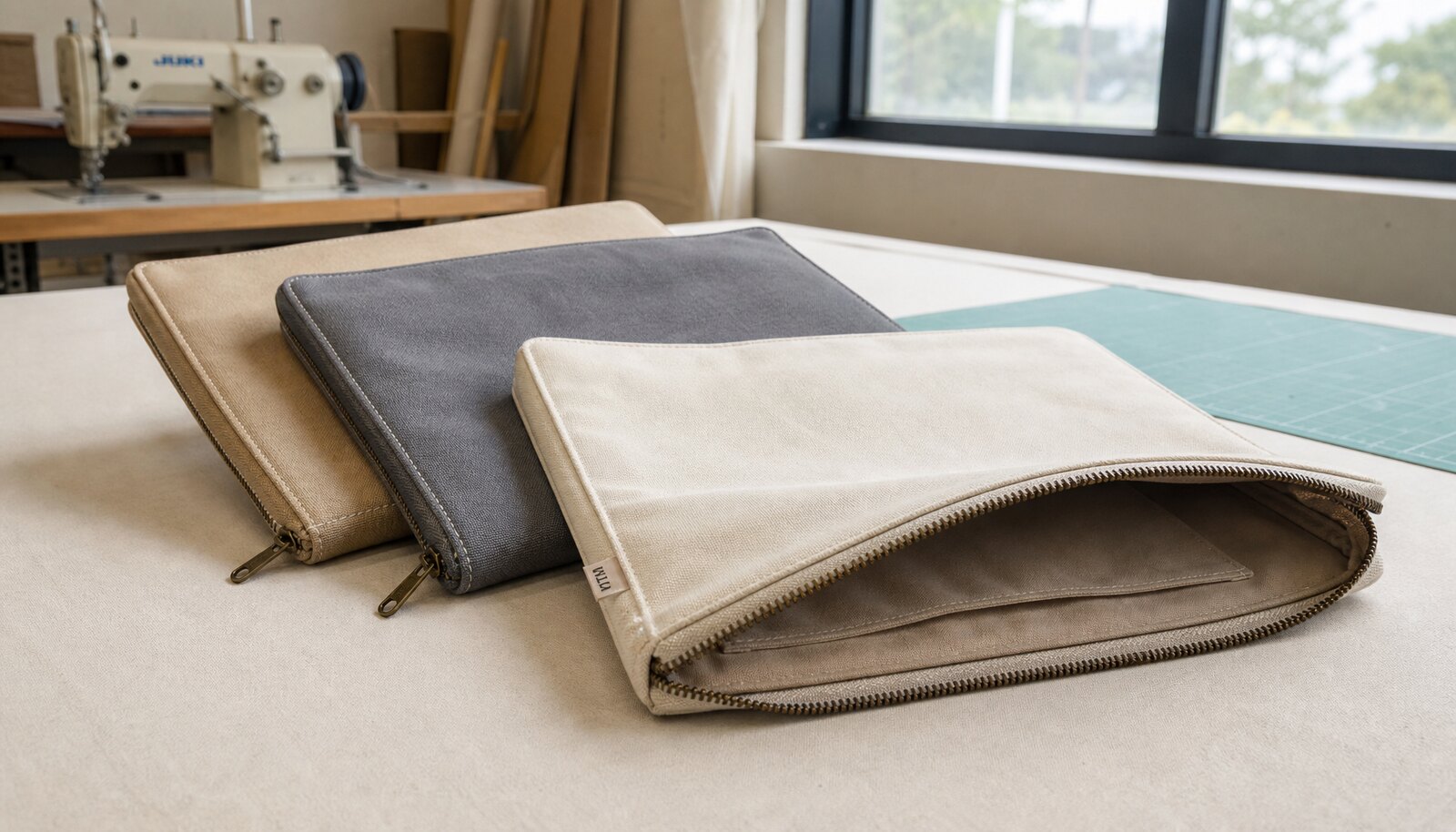
Start With the Buying Problem, Not the MOQ Number
For corporate gifting, a canvas zipper portfolio is not just a document holder. It is usually part of an onboarding kit, conference pack, executive welcome box, or a branded retail program that needs to look consistent across a run. That means the first buying decision is not the order quantity. It is whether the portfolio needs to hold A4 papers, a tablet, a slim notebook, or a mixed stationery set, because that single choice drives the size, structure, and the amount of material the factory has to reserve.
If the spec is vague, the quote will be vague too. Suppliers will protect themselves by adding a wider MOQ, extra setup charges, or a longer lead time. A clean RFQ starts with one clear use case, one finished size, and one print approach. Once those are fixed, the supplier can tell you which parts are standard and which parts are custom, which is the real basis of MOQ negotiation.
- Define the use case first: document folder, conference handout sleeve, tablet portfolio, or gift insert.
- Specify the paper size or device size the portfolio must fit, not just the outer dimensions.
- State whether this is a one-time gift order or a repeat program, because repeat programs justify more supplier flexibility.
Choose a Spec That Does Not Inflate the Run
Canvas weight matters more than many buyers expect. For corporate gifting, 8oz canvas is light and economical, but it can feel soft and less structured in a zipper portfolio. A 10oz or 12oz body is often the practical middle ground because it gives better shape and print clarity without pushing the product into a heavy, expensive build. If the portfolio must feel premium or protect documents better, 14oz can work, but it usually increases material cost and may affect sewing speed.
The zipper and lining should be selected together. A nylon coil zipper is usually the safer default for smooth operation and easier sourcing, while a metal zipper can elevate the perceived value but may raise cost and minimums. Lining is worth including when the portfolio will carry pens, business cards, or devices, but lining also adds sewing steps and QC points. A buyer who wants lower MOQ should standardize these parts instead of changing them for every order.
- Common corporate gifting default: 10oz or 12oz canvas, one-color logo, standard nylon zipper, basic lining, and no unusual hardware.
- Use a structured insert only if the gift needs a rigid presentation, because board or foam increases packing complexity.
- Ask for fabric swatches before quote finalization if the brand has strict color or texture requirements.
Understand What Actually Drives MOQ
MOQ is usually a production efficiency question, not a sales tactic. The factory has to buy or reserve canvas, zipper tape, slider parts, thread, lining, labels, and packing materials. If your order uses a standard fabric color, a common zipper shade, and one print location, the supplier can often combine your requirement with existing material flow. If you request a custom body color, a special zipper color, multiple artwork positions, and individualized packaging, the factory must lock more inventory for your job, which pushes the minimum higher.
Decoration method is another major driver. Screen printing is often the easiest path for a lower MOQ because the setup is straightforward and repeatable, especially for one- or two-color art. Embroidery raises labor time and may distort on thin sections, while woven labels, embossing, or stitched patches change both the design workflow and the sourcing chain. The negotiation point is simple: if you want a lower MOQ, reduce the number of unique decisions the factory has to manage at one time.
- Each added print color can change setup time and proofing complexity.
- Each custom trim color can create a separate material reservation.
- Each unique packing format, from polybag to gift box, adds labor and carton planning.
Use the Right Sourcing Route for the Order Size
Not every supplier type is suited to the same buyer problem. A factory direct quote is usually the cleanest when the order is large enough to justify development and when you need the producer to own the fabric, sewing, printing, and packing. A trading company can be useful when the buying program spans several items, but the buyer should verify who is actually making the portfolios and who controls the final sample. If the order is urgent, a stock blank plus local decoration route may be faster, but it rarely gives the same material control as a true custom run.
For procurement teams, the best route is the one that matches the product risk. If the portfolio is a premium gifting item, a direct factory or a tightly managed sourcing partner usually gives better traceability and more honest feedback on MOQ. If the order is a small market test, a low-MOQ factory that keeps common canvases and zippers in stock may be the better answer. The route should follow the buying objective, not the other way around.
- Use direct factory quotes when quality control and material control matter more than speed.
- Use a distributor or local decorator only when the timeline is short and the spec is simple.
- Use a trading company when consolidation matters and you can accept one more layer of coordination.
Write the RFQ So the Quote Is Comparable
A quote is only useful if it is built on the same assumptions. For custom canvas zipper portfolios, the RFQ should include finished size, canvas weight target, lining spec, zipper type, logo method, logo size, logo position, artwork color count, and packing format. If the quote does not separate sample cost, bulk unit price, setup charge, and packing cost, comparing suppliers becomes guesswork. Procurement teams should insist on line-item clarity, even when the order is small, because hidden assumptions are where most budget surprises start.
The RFQ should also state the buying terms that affect landed cost. That means Incoterms, destination country, carton limits, whether master cartons must be export-safe, and whether barcode labels or retail hangtags are required. If the portfolio will be sold into retail later, include the packaging spec now. A supplier that knows the final channel can quote more accurately and is less likely to understate the packing work.
- Attach a dimension sketch or reference sample photo if the shape is unusual.
- Send artwork in vector form and specify Pantone references if color fidelity matters.
- Ask for a separate quote for sample, pilot run, and full production if the program may scale.
Approve the Sample Like a Buyer, Not Like a Designer
The sample should prove that the product can be made repeatedly, not just once. A good pre-production sample checks the fabric hand feel, zipper smoothness, stitch alignment, print coverage, and whether the portfolio opens and closes cleanly without warping. It should also show whether the branding looks correct at actual size, because a logo that looks good on screen can become too small, too dense, or too close to a seam once it is sewn onto the real bag.
Set the approval standard before the sample arrives. Buyers should define what is acceptable for logo placement tolerance, zipper operation, visible seam allowances, and any acceptable variation in canvas tone. If a sample has one small defect and the factory can explain how bulk production will avoid it, that may still be acceptable. What is not acceptable is approving a sample without knowing which details are cosmetic and which are structural.
- Test the zipper ten to twenty times before approval, especially on longer portfolio openings.
- Check the portfolio with real inserts, not just empty, so the fit is confirmed under use.
- Mark one golden sample and tie it to the bulk order to prevent later disagreement.
Packing Can Change Both MOQ and Landed Cost
Packing is not an afterthought for corporate gifting. If the portfolio ships in bulk, the factory can usually run faster and keep MOQ lower. If every piece needs a polybag, insert card, barcode sticker, tissue wrap, or gift box, then labor and material usage rise quickly. That does not mean premium packing is a mistake. It means buyers should treat packing as part of the commercial design, not as a last-minute add-on after the product has already been quoted.
Carton planning matters because zipper portfolios are flat but not weightless. Once the order is packed with inserts or box sets, the carton size can jump, which affects freight, warehouse storage, and damage risk. Ask for the packed quantity per carton, the gross weight, and the external carton dimensions before final approval. That lets you compare freight quotes properly and avoid a case where the product cost looks acceptable but the shipped cost does not.
- Use bulk pack for pilot orders if presentation is not the main buying requirement.
- Use polybag plus barcode when the order enters a warehouse or retail system.
- Use gift box sets only when the perceived value justifies the extra packing labor and freight volume.
Negotiate MOQ by Standardizing the Right Things
The best MOQ negotiation lever is not pressure. It is standardization. If you accept the supplier's standard canvas color, a common zipper shade, and one print location, you remove setup friction and increase the chance that the factory will lower the floor. If you need to keep the order flexible, negotiate in the right place: standardize the body material but allow a custom woven label, or keep the logo one color but change the packaging insert. That gives the factory fewer variables while preserving brand impact.
Another practical move is to separate the program into phases. A buyer can ask for an initial pilot lot using the standard material stack, then a second replenishment order after the sample and sell-through are confirmed. This is more credible than asking a factory to commit to a low MOQ on a fully custom spec. Suppliers usually respond better when they see a realistic repeat path, because they know the job is not just a one-off test.
- Negotiate by reducing custom variables, not by demanding a lower number with the same spec.
- Consider one standard body color across multiple logo versions.
- Use phased orders when the brand wants to test the market before committing to a full run.
Build a Quote Comparison That Exposes Hidden Cost
A useful comparison is not just unit price versus unit price. For custom canvas zipper portfolios, buyers should compare fabric weight, print method, zipper type, lining, packing format, carton quantity, sample charges, and lead time together. A cheaper quote can be expensive if it hides a weaker canvas, a thinner zipper, or packing that is not ready for your channel. A strong quote shows what is included, what is optional, and what changes the price after approval.
Use landed cost thinking even if the order ships FOB. Freight, customs brokerage, local delivery, and warehousing can shift the real cost far more than a small difference in factory price. If one supplier can pack more units per carton without damaging the product, that may beat a lower unit price from another factory. Procurement teams should compare the total shipped result, not just the factory line on the quote.
- Ask every supplier to quote the same packing count per carton.
- Compare sample cost against expected order value, not against the bulk unit price alone.
- Do not ignore lead time because a late delivery can cost more than a slightly higher unit price.
Control Lead Time Before It Controls Your Program
Lead time is usually where a corporate gifting program goes sideways. The sample may be approved, but if the fabric has to be dyed, the zipper color must be sourced specially, or the packaging needs rework, the calendar can slip quickly. A realistic plan starts with sample approval, then material reservation, then production, then packing, then inspection, and finally shipping. Each step should have a date and an owner. If the supplier cannot explain the schedule by phase, the buyer should treat the timeline as a risk rather than a promise.
Seasonality also matters. Conference season, year-end gifting, and back-to-school periods all tighten capacity for canvas and zipper products. If you are trying to lower MOQ at the same time as pushing an urgent delivery, the factory will usually protect itself with higher minimums or less flexibility on custom materials. The practical answer is to lock the spec early, approve the sample quickly, and keep the order path as standard as possible.
- Build in time for sample revision if the artwork has not been printed on the exact fabric weight before.
- Ask whether the factory will reserve material after sample approval or only after deposit.
- Treat peak-season lead time as a separate quote condition, not a normal assumption.
Specification comparison for buyers
| Spec decision | Recommended option | When it fits | Buyer risk to check |
|---|---|---|---|
| Factory direct order | Use a factory that already makes zipper business bags and can quote fabric, print, and packing in one sheet | Best for repeat corporate gifting programs with stable artwork and a clear delivery window | Confirm whether the quoted MOQ is per style, per color, or per artwork version |
| Trading company route | Use a trading company only if you need several related items bundled under one buying point | Useful for mixed gift kits or buyers who want one contact for portfolios, pouches, and totes | Check whether the factory behind the quote is the same one that approved the sample |
| Stock blank plus local decoration | Buy plain canvas portfolios and add print or labels near the destination market | Works when timing is tight and the decoration is simple | Watch for zipper color mismatch, print placement drift, and higher unit cost on small runs |
| Full custom factory run | Order a fully custom size, lining, pocket layout, and zipper color from one producer | Best for branded gift sets where the portfolio is part of a premium identity program | Expect higher MOQ because every nonstandard part adds setup and material risk |
| Gift supplier bundle | Source portfolios through a supplier that also handles notebooks, pens, and boxes | Good when the buyer wants one packaged corporate gift rather than a stand-alone product | Make sure the portfolio spec is not weakened just to make the set easier to pack |
| Local distributor | Use a distributor for urgent replenishment or event fill-in orders | Fits last-minute conference or onboarding needs with short transit time | Verify whether the product is a true custom build or a stock item with a logo slapped on later |
| Regional sourcing agent | Use an agent when you need factories compared across multiple countries or plants | Useful for brand teams managing multiple markets or languages | Ask who owns quality approval, fabric reserve, and post-order problem solving |
| Low-MOQ specialist factory | Choose a factory that keeps standard canvases, zippers, and linings in stock | Works when the target is a smaller pilot order or a test market | Check if the lower MOQ only applies to one color and one print location |
Buyer checklist before sampling
- Lock the finished size, document fit, and zipper opening before asking for price.
- State canvas weight target, such as 10oz or 12oz, instead of saying only 'thick canvas'.
- Confirm whether the logo will be screen printed, woven, embroidered, or label sewn.
- List every colorway, even if the body is the same, because color changes affect MOQ.
- Specify lining, pocket count, pen loops, gusset depth, and any internal board or foam insert.
- State packing format, such as bulk pack, polybag, tissue, barcode sticker, or gift box set.
- Ask the supplier to quote sample cost, setup cost, and bulk lead time separately.
- Request carton dimensions and gross weight early so freight and storage costs can be estimated.
Factory quote questions to send
- Is the MOQ based on one style, one color, or one artwork version?
- Which canvas weights are standard for this portfolio, and what is your normal fabric stock?
- What print method is included in the quote, and how many colors are covered?
- What zipper type and zipper color are standard, and which options require a surcharge?
- Are lining, pocket layout, and binding included in the base price or treated as upgrades?
- What is the sample process, sample lead time, and sample charge for a pre-production approval piece?
- What packing standard is included, and what changes the carton size or master carton quantity?
- Which Incoterms are available, and what cost items are excluded from the factory quote?
Quality-control points to confirm
- Canvas weight should match the approved spec within a practical tolerance, and the hand feel should not drift between production lots.
- Logo placement should stay centered and consistent, with no visible skew, bleed, or color mismatch versus the approved strike-off.
- Zipper must run smoothly across the full opening, with no tooth separation, snagging, or pulled tape after repeated testing.
- Stitching density should stay even around stress points such as zipper ends, corners, handles, and pocket edges.
- Finished size should support the intended document format without forcing the zipper or buckling the body panel.
- Lining and internal pockets must be cleanly trimmed, with no loose threads, exposed raw edges, or skipped stitching.
- Packing count per master carton must match the shipping mark, carton label, and packing list exactly.
- Pre-production sample, golden sample, and bulk shipment should all be tied to the same approved material references.