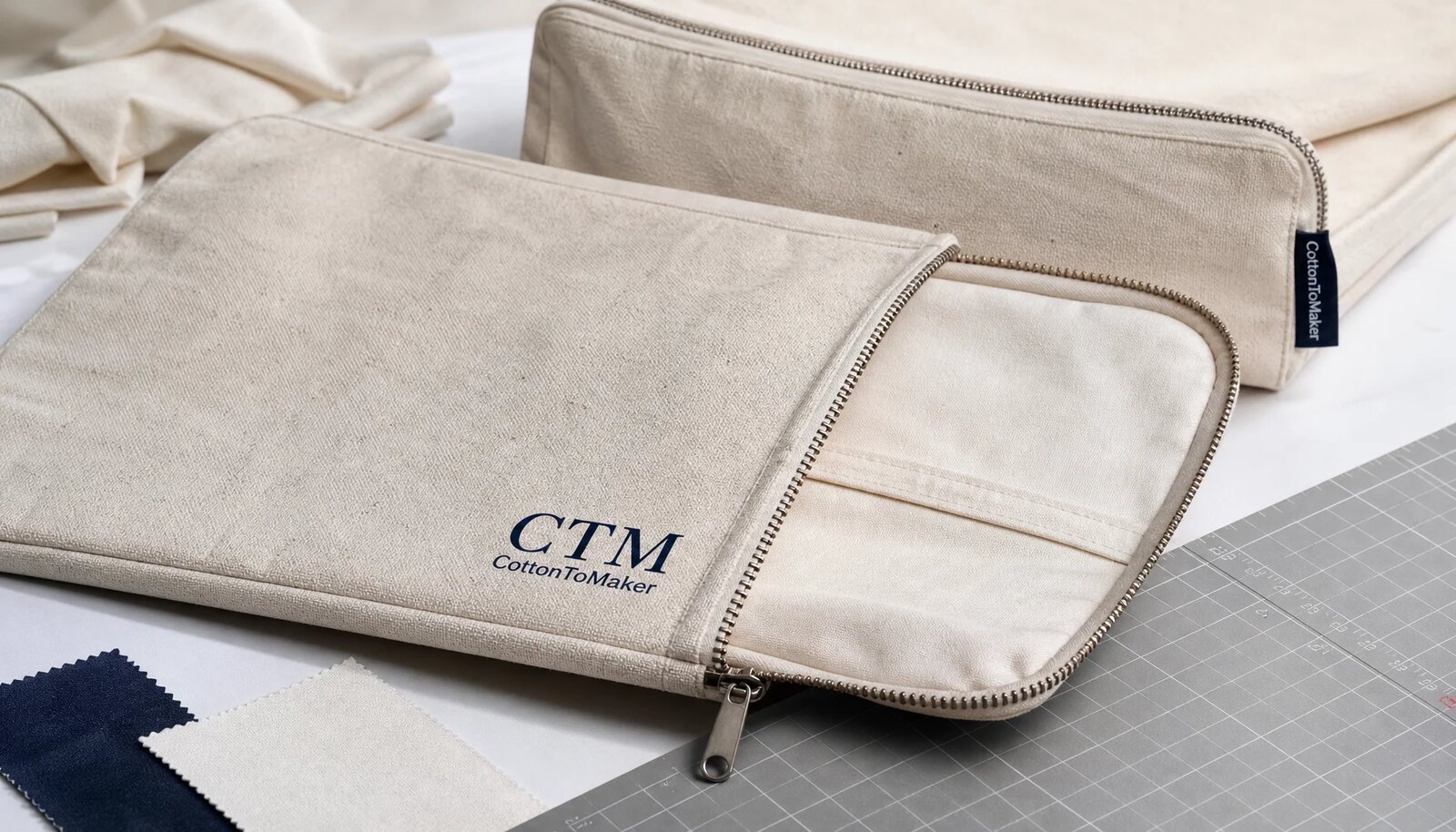
Start MOQ Negotiation With the Product Architecture
A custom canvas zipper portfolio looks simple on a hotel shop shelf. To a factory, it is a sewn accessory with fabric purchasing, cutting markers, zipper installation, decoration setup, trim control, packing control, and SKU separation. MOQ problems usually start when the project is described as one generic pouch while every property asks for its own canvas color, lining, zipper puller, retail band, and logo placement. The cleaner route is to separate the base product from the brand variables before asking for the lowest minimum.
For hotel retail, the base product is the physical build: body size, canvas weight, color route, zipper size, thread, lining decision, pocket layout, seam structure, and packing method. The variable layer can be screen print artwork, woven label version, paper belly band, barcode, or carton destination. If several hotel properties share the same build, the supplier may be able to cut and sew one efficient batch, then decorate or pack by version. If every property changes the material and trims, the supplier is not negotiating one MOQ; it is planning several small productions.
Use the first RFQ to ask for three numbers: finished-goods MOQ for one SKU, minimum quantity per artwork version, and shared-material MOQ if multiple logos are combined. This gives procurement a useful map of the constraint. A factory may not be able to reduce a custom dyed fabric minimum, but it may accept lower artwork-version quantities if the body stays common. That answer is far more useful than a simple lowest-MOQ reply because it shows which part of the specification is driving the minimum.
- Best MOQ lever: one shared size, canvas, zipper, thread, lining, construction, and packing method.
- Best customization lever: change only print, label, barcode band, or carton destination.
- Quote structure: request MOQ by base product, by artwork version, and by material batch.
- Risk signal: every unique fabric color, zipper color, puller, or lining can become a separate SKU run.
Define Use Case, Fit, and Tolerances Before Styling
The phrase custom canvas zipper portfolio is not enough for an accurate B2B quote. The product may hold A4 welcome documents, US letter conference papers, spa treatment menus, resort maps, voucher sets, membership kits, room amenity cards, or retail gift items. Each use case changes the internal size, zipper opening, seam allowance, stiffness, and interior layout. A gift-shop item needs to arrive in sellable condition and display well. An in-room document holder needs to survive repeated handling. An event portfolio must load quickly when staff are assembling hundreds of packs.
Define the insert before defining the portfolio. A4 paper is 210 x 297 mm and US letter is 8.5 x 11 in, but the usable internal space must be larger than the paper because seams, zipper tape, lining, and corner shape reduce the real loading area. If the portfolio carries a menu, booklet, amenity set, or tablet box, state the thickness and expected weight. A flat body may not work for thicker kits; a shallow gusset, longer zipper opening, or different loading direction may be needed.
Sewn canvas needs practical tolerances. For many flat portfolios, a finished-dimension tolerance around +/-5 mm is more realistic than molded-product precision. Critical fit points can be controlled more tightly, but they must be named: internal height, internal width, zipper opening length, pocket depth, logo position, or barcode band position. Also state whether the quoted size is the external finished size or the internal usable size. This avoids the common surprise where a sample looks good on a table but the real insert set catches at the zipper or curls at the corners.
- RFQ input: list actual contents with width, height, thickness, weight, and loading direction.
- Dimension control: separate external finished size, internal usable size, pocket depth, and zipper opening.
- Tolerance default: use around +/-5 mm for many flat sewn dimensions unless the factory agrees otherwise.
- Sample test: approve only after loading the real documents, menus, vouchers, or retail kit.
Canvas Specification: Weight, Color, Finish, and MOQ
Canvas is one of the biggest drivers of cost, perceived value, sewing performance, and MOQ. Lightweight 6 oz to 8 oz canvas can reduce material cost, but it may feel soft around the zipper and may not support a premium hotel retail position. Heavy 14 oz canvas can look substantial, yet it adds seam bulk at zipper ends and corners, may show needle marks more clearly, and increases freight weight. For many hotel retail zipper portfolios, 10 oz to 12 oz cotton canvas, roughly 340 to 407 GSM depending on weave and finish, is a practical starting point.
Do not specify weight alone. Cotton content, weave appearance, surface texture, finishing, and whether the canvas is washed or unwashed all affect the finished portfolio. Washed or softened canvas may improve hand-feel, but it can introduce shrinkage and shade variation. Natural canvas can range from cream to oatmeal depending on yarn and finishing, so a physical reference or approved sample is safer than a color name. If the front panel carries a logo, the factory should confirm that the fabric surface can accept the intended print, transfer, label, or patch.
Color route is often the real MOQ trigger. Supplier-held natural, black, navy, beige, or gray canvas may support a lower finished-goods MOQ because those fabrics are used across other bags and pouches. Custom dyed canvas may require lab dip approval, a dye-lot minimum, bulk shade tolerance, extra calendar time, and a decision about leftover fabric. If a hotel brand has strict color standards, ask whether the brand color can be carried through decoration, woven label, zipper pull accent, or retail band instead of dyeing the entire body fabric.
- Practical default: 10 oz to 12 oz cotton canvas for structure without excessive seam bulk.
- Low-MOQ route: supplier stock natural or recurring stock color with property-specific decoration.
- Custom dye controls: lab dip, bulk shade tolerance, mill MOQ, overage, and leftover fabric cost.
- Spec detail: define oz or GSM, composition, color standard, finish, and approved shade reference.
Zipper, Puller, Lining, and Interior Decisions
The zipper is the highest-contact component on a canvas portfolio. A No. 5 nylon coil zipper is a practical default because it is flexible, smooth, and easier to source in standard tape colors. Metal zippers can create a more premium look, but they may add weight, stiffness, scratching risk, and packing pressure marks. Plastic molded zippers can work for rugged or casual styling, but they need a deliberate design reason in hotel retail rather than being chosen by habit.
Puller choice can change MOQ and lead time more than buyers expect. A standard metal puller is stable and simple. A fabric pull tab can add a softer lifestyle detail without custom hardware tooling. A branded metal puller may require mold or die setup, plating selection, accessory MOQ, sampling, and separate inspection. For a pilot order in a hotel gift shop, opening program, or conference retail pack, it is usually safer to keep hardware standard and put brand value into print, label, or packaging. Upgrade custom hardware once reorder volume supports the trim minimum.
Interior construction should be useful, not crowded. One main compartment plus one flat slip pocket is often enough for vouchers, spa menus, resort maps, or conference inserts. Lining creates a cleaner interior and can hide seam allowances, but it adds material, cutting, sewing, and inspection steps. Card pockets, pen loops, dividers, elastic, and mesh panels only help if the guest or staff member actually uses them. At low MOQ, each added internal feature increases labor minutes, alignment defects, and reject risk.
- Zipper default: No. 5 nylon coil with stock tape color, smooth slider, and reinforced ends.
- MOQ-friendly puller: standard metal puller or fabric pull tab before custom molded hardware.
- Interior default: one main compartment plus one flat slip pocket unless the use case demands more.
- QC checkpoints: zipper smoothness, tape twist, slider security, end reinforcement, pocket alignment.
Choose Decoration That Matches the Order Size
Decoration is where many hotel retail projects become more expensive than expected. Screen print is often the most practical low-to-mid MOQ choice for simple hotel marks, resort logos, and conference artwork. It works best with clean vector files, limited colors, and adequate line thickness. On textured canvas, fine type, gradients, detailed crests, and small registered marks can lose definition or fill in. The RFQ should include vector artwork, print size, Pantone or color reference, placement from edges, and a position tolerance such as +/-3 mm to +/-5 mm, depending on the design and factory capability.
Heat transfer can handle more complex art, but it must be tested for adhesion, edge lift, cracking, transfer outline, and hand-feel on canvas. Embroidery can look premium, although dense embroidery can pucker a flat panel and make a document portfolio feel stiff. Woven labels are useful for repeat programs because one label concept can work across zipper portfolios, pouches, totes, and other hotel retail products. PU patches or embossed patches can improve shelf presentation, but they may require die setup, trim MOQ, and protective packing to prevent pressure marks.
The strongest MOQ strategy is to standardize the product while allowing controlled brand variation. Use one shared canvas body and change only the screen print, woven label, or paper band by property. Ask the supplier to quote setup fees by artwork version and confirm whether several artwork versions can run inside one production batch. If the hotel group needs barcodes, property names, event names, or seasonal messages, a removable paper band may be more flexible than changing the sewn item itself.
- Low-MOQ decoration: one-color screen print with clean vector artwork and approved placement.
- Repeat-program route: woven label used across several hotel retail accessories.
- Premium route: PU patch, embossed patch, or custom puller when volume supports trim MOQ.
- QC focus: color match, opacity, tilt, edge sharpness, adhesion, cracking, and packing marks.
Understand How Suppliers Calculate MOQ and Price Breaks
A factory MOQ is not one fixed mystery number. It is built from material purchasing, cutting efficiency, decoration setup, trim procurement, packing preparation, and line scheduling. For custom canvas zipper portfolios, the supplier may need canvas rolls, zipper tape, sliders, pullers, lining fabric, labels, thread, paper bands, polybags, and cartons. If most of those components are standard, the finished-goods MOQ can be lower. If several components are custom, each one may add its own minimum, cost, and lead time.
Price breaks usually appear when fixed work is spread across more units. At 300 pcs, development handling, artwork setup, cutting preparation, and line changeover carry a heavy unit-cost burden. At 500 to 1,000 pcs, cutting and sewing often become more efficient. At 2,000 to 3,000 pcs, material purchasing and line planning may improve further, but the buyer still needs to manage shade consistency, batch separation, inspection sampling, and carton allocation. A lower unit price is not useful if it comes with weaker specs or mixed hotel versions at delivery.
Request a price ladder instead of one quote. A useful ladder includes 300, 500, 1,000, 2,000, and 3,000 pcs, with notes on what changes at each break. Ask the factory to separate unit price, sample cost, print setup, trim setup, custom hardware tooling, packing cost, and inland freight if applicable. Procurement can then see which costs are fixed and which scale with volume. Negotiation becomes practical: accept stock canvas to reduce MOQ, consolidate logos to improve cutting efficiency, or postpone custom pullers until a confirmed reorder.
- Low-MOQ path: stock canvas, stock zipper, standard puller, simple interior, one-color print.
- Mid-MOQ path: shared body with multiple hotel logos and controlled SKU packing.
- High-MOQ path: custom dyed canvas, custom puller, custom lining, patch, and printed sleeve.
- Quote requirement: show product MOQ, material MOQ, setup fees, unit price, and price breaks.
Negotiate MOQ Without Weakening Quality
Good MOQ negotiation is based on simplification, not pressure alone. If a buyer demands a very low MOQ while keeping custom dyed fabric, custom pullers, complex lining, multiple pockets, and printed retail packaging, the factory may refuse or accept with risk built into the process. A better conversation gives the supplier a clean manufacturing plan: one size, one stock canvas, one zipper specification, standard thread, simple interior, and controlled decoration versions.
Separate the pilot order from the reorder plan. A pilot for a boutique hotel shop, seasonal retail display, opening event, or conference gift may carry a higher unit cost because development and setup are spread across fewer pieces. If the product sells through, the reorder can move to a larger quantity, stronger price break, upgraded trim, or more efficient packing. Ask for pilot MOQ and reorder MOQ in the same RFQ so internal teams can see the cost curve instead of treating the pilot unit price as the long-term price.
Multi-property consolidation is often the strongest hotel retail tactic. Collect demand from gift shops, spa teams, conference teams, loyalty programs, and VIP guest services, then issue one shared-material order. The supplier can cut and sew the same body, then decorate and pack by property or channel. The PO should list each artwork version, quantity, packing method, barcode requirement, carton label, and destination. Without that structure, the supplier may quote every property as a separate small job.
- Negotiate first by standardizing materials and construction, then by asking for lower MOQ.
- Use one base portfolio and vary only print, woven label, paper band, or barcode where possible.
- Quote pilot and reorder quantities together so the cost curve is visible to stakeholders.
- Do not force custom dye, custom hardware, and complex interiors into a tiny test order.
Control Sampling and Pre-Production Approval
Sampling should match the project risk. A development sample is useful when the buyer is still deciding size, shape, pocket layout, or decoration placement. It may use substitute fabric if the purpose is only to confirm structure, but that substitution must be clearly noted. A pre-production sample is different. It should use final canvas weight, final color route, final zipper, final puller, final lining if used, final decoration method, and representative packing. Bulk cutting should not start from a substitute-material approval for a guest-facing retail product.
Review samples the way the product will be used. Load the real hotel documents, menus, vouchers, or kit items. Open and close the zipper repeatedly to check smoothness, corner clearance, and slider security. Watch whether paper corners catch at the zipper path, whether the body bends or bulges, whether the pocket depth is useful, and whether the logo is visible in the planned retail display. If the item will be packed flat or stacked, place samples together and check for pressure marks from pullers, patches, thick seams, or bands.
Approval notes should be measurable. Photos should show front, back, interior, zipper ends, pocket opening, logo placement, trim details, and packing. Measurements should be recorded against the spec sheet. Change requests should use production language: move logo 10 mm upward, increase pocket depth by 15 mm, reduce zipper pull length by 5 mm, change slider finish to antique brass, or widen internal usable height by 8 mm. Comments such as make it nicer or improve quality do not give production a controllable standard.
- Development sample: confirm structure, fit, and styling before final material decisions.
- Pre-production sample: final fabric, zipper, puller, lining, logo method, and packing.
- Approval test: load real contents, operate zipper, measure dimensions, check logo, and review stacking.
- Records: keep signed sample photos, measurement sheet, artwork file, material references, and change notes.
Write a QC Plan Before Production Starts
Quality control should be written before production, not negotiated after defects appear. For hotel retail, the product must be functional, clean, correctly branded, and packed for sellable condition. Define critical, major, and minor defects in advance. Critical defects may include unsafe sharp metal, mold odor, wrong logo, wrong SKU, or zipper failure that prevents use. Major defects may include visible front stains, severe shade mismatch, open seams, broken stitches, misaligned logo beyond tolerance, or portfolio size outside agreed tolerance. Minor defects may include small loose threads or slight non-front-panel marks within the approved standard.
Inspection should cover materials, in-line sewing, finished goods, and packing. Material checks verify canvas shade, fabric flaws, zipper tape, slider finish, puller color, lining, labels, and packaging. In-line checks catch zipper insertion, seam allowance, pocket alignment, stitch density, and corner construction before the whole batch is completed. Finished-goods checks measure dimensions, load inserts, operate zippers, inspect decoration, and review cleanliness. Packing checks confirm barcode, polybag or band, inner pack, carton label, quantity, property version, and destination.
Buyers can reference an inspection standard if their organization uses one, but the important point is to define what is being judged. For sewn accessories, many buyers use sampling inspection with agreed AQL levels, while hotel retail orders may also need 100% checks on critical branding elements when multiple logos are involved. At minimum, the inspection report should record inspected quantity, sample size, defect type, defect count, SKU, carton numbers, photos, and disposition: pass, rework, sort, replace, or hold shipment.
- Critical checks: wrong logo, zipper failure, mold odor, unsafe trim, wrong SKU, or unusable fit.
- Major checks: visible stains, open seams, size out of tolerance, severe shade mismatch, bad print.
- Minor checks: loose threads, small non-critical marks, slight trimming issues within agreed limits.
- Packing checks: barcode, property version, carton label, quantity, destination, and mixed-carton rules.
Plan Packing, Cartons, and Hotel Distribution
Packing affects both landed cost and retail condition. A canvas zipper portfolio can ship in an individual polybag, paper sleeve, belly band, tissue wrap, or small retail carton. Polybags protect against dust, moisture, and print rubbing, although some hotel brands prefer reduced plastic. Paper bands improve retail presentation and can carry barcodes, property names, or collection information, but they offer less protection during warehouse handling. Tissue can reduce rubbing, while a full retail box adds cost and carton volume.
Carton planning belongs in the quote, not after production. Flat portfolios pack efficiently, but zipper pulls, patches, and thick seams can create pressure marks if goods are overcompressed. Ask for pieces per inner pack, pieces per master carton, carton dimensions, gross weight, stacking method, and maximum carton weight. If several hotel properties are included, each carton should show property name, SKU, artwork version, color, quantity, PO number, barcode status, and destination. Inner-carton sorting can cost more, but it is often cheaper than repacking at a hotel warehouse or distributor.
Hotel retail goods may pass through the factory, forwarder, importer, distributor, hotel warehouse, shop staff, and event teams. Every handoff increases the risk of mixed SKUs and damaged presentation. The packing specification should state whether cartons may mix versions, how mixed cartons are labeled, whether barcodes are on the product or band, and whether pieces must arrive retail-ready. The goal is not just to ship units; it is to receive sellable portfolios that can move directly to a shop, room program, welcome desk, or event table.
- Protection options: polybag, paper band, sleeve, tissue, or retail box based on brand policy and route.
- Carton data: pieces per carton, dimensions, gross weight, stacking method, and pressure-mark controls.
- SKU control: label by property, artwork, color, quantity, PO, barcode status, and destination.
- Cost control: plan inner packs before production to avoid repacking after import or hotel delivery.
Specification comparison for buyers
| Procurement decision | Recommended B2B default | Best fit for hotel retail | MOQ or quality risk to control |
|---|---|---|---|
| Finished size | Use one shared body size per program; define external finished size and internal usable size separately | Gift shop document sets, welcome packs, conference folders, spa menus, loyalty kits | Each size needs its own pattern, cutting marker, zipper length, carton plan, and often its own MOQ |
| Size tolerance | Flat sewn portfolio tolerance is commonly around +/-5 mm unless a tighter insert-fit area is agreed | A4, US letter, voucher sets, menus, and retail inserts that must load without bending | Unclear tolerance creates disputes after sewing, turning, pressing, and packing |
| Canvas weight | 10 oz to 12 oz cotton canvas, approximately 340 to 407 GSM depending on weave and finish | Retail portfolios needing structure without excessive seam bulk | 6 oz to 8 oz may feel soft; 14 oz+ can create bulky zipper corners, needle marks, and higher freight weight |
| Fabric color route | Supplier stock natural, black, navy, beige, gray, or recurring house colors | Multi-property orders with lower SKU volume and faster repeatability | Custom dyeing may trigger lab dips, mill MOQ, shade tolerance, overage, and unused fabric liability |
| Zipper specification | No. 5 nylon coil zipper with stock tape color, standard slider, and standard metal or fabric pull tab | Smooth document loading and practical sourcing for 300 to 3,000 pcs programs | Custom tape, custom puller, metal teeth, or special plating can add accessory MOQ and timeline risk |
| Interior layout | One main compartment plus one flat slip pocket; lining only when the use case justifies it | Room collateral, spa vouchers, resort maps, retail kits, or event agenda packs | Extra pockets, dividers, pen loops, and lining panels add labor minutes, alignment checks, and reject risk |
| Branding method | One-color screen print for simple logos; woven label or PU patch for repeat premium programs | Hotel marks, resort logos, conference artwork, and retail shelf identification | Fine type can fill in on canvas; labels, patches, transfers, and pullers may have separate trim MOQs |
| MOQ negotiation lever | Keep size, canvas, zipper, thread, lining, construction, and packing common; vary only logo or removable band | Hotel groups buying for multiple properties, seasons, events, or shop channels | If each property changes body color, zipper, lining, patch, and packing, it becomes multiple small productions |
| Sample approval | Development sample for structure; pre-production sample in final materials before bulk cutting | Retail sale, VIP gifting, branded guest use, and hotel opening programs | Substitute-material samples cannot confirm hand-feel, shade, zipper behavior, print adhesion, or packing marks |
Buyer checklist before sampling
- Define finished external size, internal usable size, gusset if any, insertion direction, zipper opening length, and whether the portfolio must fit A4, US letter, tablet packaging, menus, vouchers, amenity cards, or room collateral.
- State measurement tolerance in millimeters, such as +/-5 mm for most flat sewn dimensions, and identify any critical fit areas that need tighter approval.
- Specify canvas weight in oz and GSM where possible, fabric composition, color standard, surface finish, shrinkage concern if washed, and whether supplier stock colors are acceptable before custom dyeing is quoted.
- Separate must-have specifications from optional upgrades so the factory can quote base MOQ, upgrade MOQ, setup fees, and price breaks without blending commercial assumptions.
- Confirm zipper type, zipper size, tape color, slider finish, puller style, zipper-end reinforcement, opening direction, and whether custom hardware is required now or only considered for reorder.
- Provide vector logo artwork with print size, Pantone or color reference, placement from edges, decoration method preference, and logo-position tolerance such as +/-3 mm to +/-5 mm.
- Decide whether the interior requires lining, slip pocket, card pocket, pen loop, divider, elastic, mesh, or only a clean main compartment, then mark each feature on a simple layout drawing.
- Ask the factory to identify MOQ drivers separately: canvas, dyeing, zipper tape, sliders, pullers, lining, labels, patches, decoration, packaging, cutting efficiency, and line setup.
- Request a development sample if the structure is new, then a pre-production sample using final canvas, final zipper, final puller, final logo method, final lining if used, and representative packing.
- Test the approved sample with the real insert set, not blank paper only; check zipper closure, corner clearance, paper curling, pocket depth, logo visibility, and packed appearance.
Factory quote questions to send
- What is your lowest practical finished-goods MOQ if we use stock canvas, stock zipper tape, standard slider, standard puller, one body size, one construction, and one-color screen print?
- Which MOQ is binding for this project: finished goods, canvas roll, custom dye lot, zipper tape, slider or puller, lining, woven label, PU patch, screen print setup, paper band, hangtag, or carton?
- Can several hotel properties or artwork versions be combined in one shared production run if the size, canvas, zipper, thread, lining, construction, and base packing remain identical?
- What canvas weights and colors do you hold regularly for zipper business bags, and what shade tolerance or shade-band control do you recommend for stock fabric and dyed fabric?
- If custom dyed canvas is requested, what are the lab dip lead time, mill MOQ, bulk shade tolerance, expected overage, and cost responsibility for unused fabric?
- What zipper grade do you recommend for canvas portfolios, and how do you check zipper smoothness, slider attachment, zipper tape twist, end reinforcement, and coil defects?
- Can you quote standard metal puller, fabric pull tab, and custom metal puller as separate options with tooling cost, accessory MOQ, plating choices, and lead time?
- What are the setup fees, minimum artwork requirements, lead time, and durability limits for screen print, heat transfer, woven label, embroidery, PU patch, and embossed patch?
- Can you quote the same specification at 300, 500, 1,000, 2,000, and 3,000 pcs, showing unit price, sample cost, setup fee, packing cost, and any price-break conditions?
- What dimensional tolerances, logo placement tolerances, stitch density range, seam allowance, and defect classifications will you use during production inspection?
Quality-control points to confirm
- Canvas weight, composition, color, hand-feel, and surface texture should match the approved sample, with no obvious shade mixing within one SKU and no prominent slubs, holes, stains, or weaving faults on the front panel.
- Finished dimensions should remain within the agreed tolerance after cutting, sewing, turning, pressing, and packing; external size, internal usable size, pocket depth, and zipper opening length should be measured separately.
- The portfolio should fit the intended contents without forcing the zipper, bending document corners, distorting the body, tearing seams, or creating excessive bulge at the zipper ends.
- Zipper should open and close smoothly across the full length without jamming, skipped coil, tape twisting, broken stitching, sharp edges, slider slippage, or puller detachment.
- Zipper-end seams, corners, pocket openings, and stress points should be reinforced where the design requires repeated document loading, guest handling, or retail demonstration.
- Logo decoration should meet approved size, Pantone or color reference, placement, tilt, opacity, edge sharpness, adhesion, and cleanliness requirements, with agreed position tolerance recorded in millimeters.
- Screen print or transfer should not show unacceptable cracking, tackiness, peeling, ghosting, heavy ink odor, transfer outline, or abrasion marks after normal handling and flat packing.
- Interior lining, slip pockets, card pockets, dividers, and pen loops should be aligned, clean, securely stitched, and sized to hold the intended cards, vouchers, menus, or documents.
- Thread color, stitch density, seam allowance, bartacks, zipper topstitching, and visible stitching should match the approved sample and should not create puckering, skipped stitches, or loose tension.
- Finished goods should be free from oil stains, chalk marks, needle holes outside seam lines, heavy lint, loose threads, broken stitches, mold odor, mixed trim colors, incorrect labels, and wrong carton allocation.