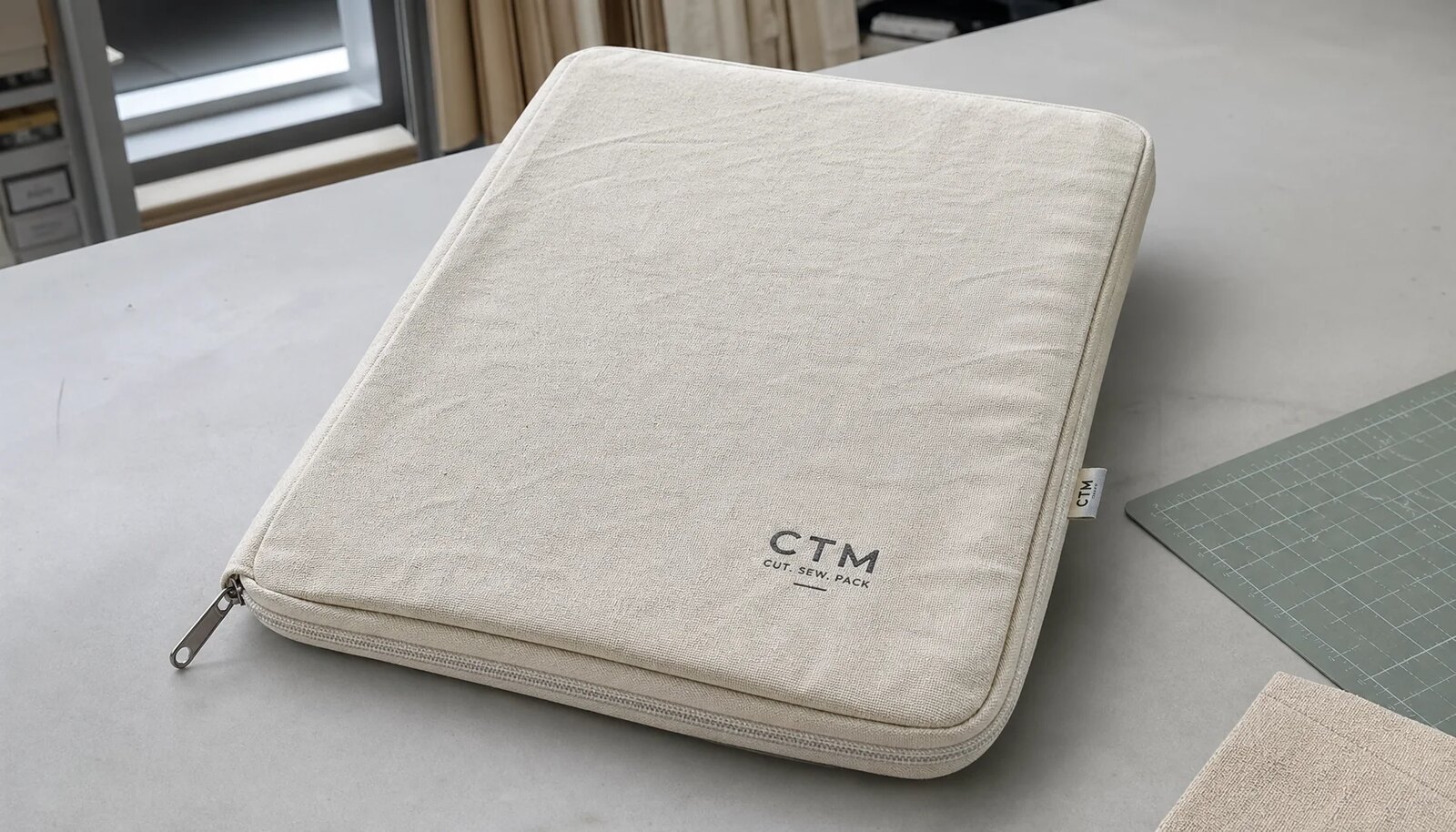
Start with the full material stack
A canvas zipper portfolio may look like a simple branded accessory, but procurement teams are really buying a stack of materials and processes. The final product depends on outer canvas, weave, finish, lining, zipper tape, slider, puller, thread, reinforcement, decoration, packing, and documentation. If one of those details is left open, suppliers will fill the gap differently, which makes quotes difficult to compare.
For eco apparel brands, material selection also has to match the language already used across garments, trims, hangtags, and packaging. A natural cotton canvas portfolio can feel consistent with a low-dye apparel line, while a recycled PET lining may be useful only if the brand is comfortable explaining a mixed-material product. The better RFQ does not say eco portfolio. It states the intended fiber, finish, claim documents, decoration method, and inspection standard.
- Define the portfolio as a material stack before requesting artwork mockups.
- Separate measurable requirements from brand adjectives such as premium, natural, or sustainable.
- Use a physical approved sample as the reference for bulk production, not only a PDF spec.
Choose for the actual use case
An onboarding folder, retail accessory, press kit, and trade show giveaway should not share the same specification by default. Internal document programs usually need clean branding, reliable zipper function, and predictable packing. Retail programs need stronger hand feel, sharper decoration control, and finishing that can survive shelf handling. Tablet or catalog programs need extra clearance because seam allowance, lining, and zipper curves reduce usable internal space.
The sustainability decision should also be practical. A very light portfolio may reduce material use, but it can feel disposable if it bends, twists, or fails quickly. A heavier canvas uses more material and costs more to ship, but it may remain useful for longer. Buyers should decide whether the priority is certified fiber content, low-dye appearance, durability, reduced packing volume, or a balanced position that the brand can explain honestly.
- For onboarding kits, avoid unnecessary pockets and custom trims that complicate repeat orders.
- For retail SKUs, test hand feel, zipper glide, logo durability, and shelf presentation together.
- For tablet use, approve the sample with the real device, cover, or insert inside.
- For eco positioning, weigh durability, material origin, chemistry, packing, and claim accuracy together.
Canvas weight, weave, and finish
Canvas weight is a major cost and quality driver, but there is no universal best number. Around 10 oz / 280-300 gsm can work for lightweight document sleeves and low-bulk programs. Around 12 oz / 340 gsm is often a balanced starting point for B2B portfolios because it gives more body without making the product too stiff. Around 14 oz / 400 gsm can feel more premium, but it may increase material cost, freight weight, needle wear, seam bulk, and resistance around zipper corners.
The quoted weight needs context. Some mills or suppliers quote greige weight before dyeing or finishing, while others quote finished fabric weight. Washed, softened, dyed, or coated canvas can change shrinkage, texture, and print behavior. Weave matters too: a tighter plain weave usually gives cleaner screen printing and more stable panel dimensions, while a looser rustic texture may create ink spread, seam puckering, or uneven edges.
- Ask whether the quoted weight is greige or finished fabric weight.
- Set an acceptable gsm or oz tolerance in the purchase order.
- Review shrinkage and shade variation before approving washed or dyed canvas.
- Use tighter canvas when the logo has fine lines or small text.
- Check zipper corners on the real canvas weight, not on a substitute sample.
Eco material options to compare
Eco apparel buyers usually compare more than one route. Organic cotton canvas may align well with apparel programs already using organic fibers, but MOQ and certificate availability depend on the mill. Recycled cotton blends can reduce reliance on virgin fiber, yet they may bring color variation or strength limits depending on blend ratio. Undyed natural cotton canvas can be visually honest and avoids a custom dye step, but buyers must accept natural flecks and shade movement between lots.
Cotton/recycled PET blends and recycled PET linings may improve stability or interior finish, but the claim language needs care. A supplier saying GRS, RCS, OCS, or GOTS is available is only the beginning. Buyers should ask whether the document is a scope certificate, transaction certificate, test report, or general declaration. Those documents do different jobs, and not all prove that the specific order contains certified material.
- Organic cotton canvas: strong apparel alignment where certification and MOQ are workable.
- Recycled cotton blend: useful story, but confirm blend percentage, strength, and color control.
- Undyed natural canvas: simple and credible, with accepted natural variation.
- Recycled PET lining: cleaner interior, but claim support must match the order.
- Conventional cotton canvas: still worth comparing when durability, price, and availability are the main priorities.
Lining and reinforcement decisions
Unlined construction can be a good choice when the buyer wants material simplicity, lower cost, and a natural interior. It works best when seam allowances are bound or finished cleanly and when the canvas does not shed fibers onto documents or apparel. Lining improves the inside view and can reduce fiber transfer, but it adds another material, another color approval, and another possible source of twisting or bubbling.
Reinforcement should be specified by location. Zipper edges, corners, tablet panels, handles, and embroidered areas may need support. Interfacing or padding can improve structure, but it may complicate sustainability messaging and increase bulk. If mono-material simplicity matters, ask whether canvas weight, binding, or seam design can provide enough structure before adding synthetic support.
- Use unlined construction only when seams and fiber shedding are acceptable.
- Specify lining material, color, denier or gsm, and recycled-content documentation if claimed.
- Identify reinforcement areas on the technical drawing.
- Check whether support materials affect the brand's product claim.
- Measure usable interior space after lining and reinforcement are sewn.
Zipper, puller, and thread quality
The zipper is the functional center of the portfolio. Nylon coil zippers are commonly practical for canvas portfolios because they handle curves and slight sewing variation better than many rigid options. Metal zippers can add a more premium look, but they bring weight, plating checks, and more risk around tight corners. A buyer should specify zipper size, tape color, slider finish, puller style, and whether a named supplier or approved equivalent is required.
Thread is easy to overlook until seams fail or the color looks wrong. Polyester thread is widely used for strength and consistency, while cotton or recycled polyester thread may be requested for brand alignment. Whatever the choice, the PO should define thread color, stitch density, seam allowance, skipped-stitch tolerance, and trimming standard. Contrast stitching can look intentional, but it makes every uneven line more visible.
- Avoid vague zipper wording such as high quality; define size, type, supplier level, and finish.
- Test open-close smoothness across corners and seam intersections.
- For custom pullers, confirm mold cost, MOQ, lead time, logo detail, plating, and sharp-edge control.
- Approve zipper tape, thread, canvas, lining, and logo colors under the same light source.
- Include thread and stitch checks in final inspection, not only zipper function.
Decoration that works on canvas
Canvas texture changes how logos print, stitch, and age. Water-based screen print can work well for simple eco-aligned branding when the buyer accepts the softer surface and verifies opacity. Standard screen print remains efficient for bold marks. Heat transfer can hold fine detail but should be checked for edge lift, cracking, and compatibility with rough fabric. Embroidery adds texture, yet dense stitching can pucker the panel or make small type unreadable.
Labels and patches often solve problems that direct decoration creates. A woven label or cotton patch can hold small details while leaving the front panel clean. The tradeoff is claim control: if the portfolio uses organic cotton canvas but includes a polyester label, marketing language should not imply the entire product is organic unless documentation supports that claim. Artwork approval should list logo width, height, placement from fixed seams, minimum line thickness, color standard, and acceptable variation.
- Approve decoration on the actual bulk canvas or a true production substitute.
- Request a strike-off for dark canvas, colored canvas, fine lines, or large ink coverage.
- Use labels for small detail that will not print cleanly on textured canvas.
- Check rub resistance, adhesion, opacity, edge sharpness, and placement against the approved sample.
- Agree on product claim wording before bulk production begins.
MOQ and price drivers
MOQ is often controlled by component choices, not just total order quantity. Fabric color, certified fiber, zipper tape color, lining color, print color, custom puller, woven label, and packing format can each create a separate minimum. A 1,200-piece order split across several colors and logos can be harder to produce than a smaller single-spec order. Buyers should ask suppliers to show MOQ by component so the real constraint is visible.
Quote comparison should also separate unit cost from one-time and order-specific charges. Screen fees, puller molds, label setup, sample fees, testing, inspection, certificate handling, and packaging artwork can make first orders look high while reorders become more efficient. If the portfolio may become a recurring SKU, ask for first-order pricing and reorder pricing based on the same approved materials and tooling.
- Ask MOQ per body color, lining color, zipper color, logo version, and packing style.
- Identify stock materials versus mill-run, custom-dyed, or special-order materials.
- Separate unit price from setup, sample, test, certificate, inspection, and freight assumptions.
- Limit colorways and custom trims on the first order if MOQ pressure is high.
- Request a reorder quote when the product may repeat seasonally.
Documents and supplier verification
A reliable supplier should be able to explain what is made in-house, what is subcontracted, and how each process is controlled. Cutting, sewing, screen printing, embroidery, custom puller production, and packing may not all happen under one roof. Subcontracting is not automatically a problem, but procurement needs to know who owns the quality standard and how approved samples are shared between facilities.
Documentation should support specific claims. For recycled or organic materials, ask what the certificate proves and whether it applies to the order. For dyes, inks, metal trims, or destination-market compliance, ask whether the supplier can provide test reports, restricted-substance declarations, or arrange third-party testing. Not every program needs every document, but any claim used in sales copy, hangtags, or import paperwork should be backed by the right evidence.
- Confirm in-house and subcontracted processes before sample approval.
- Request documents tied to the exact claim being made.
- Distinguish scope certificates, transaction certificates, declarations, and test reports.
- Keep buyer and factory reference samples from the same approved version.
- Require written approval for substitutions in canvas, lining, zipper, thread, decoration, or packing.
QC, packing, and landed cost
Quality control should begin before cutting. Incoming canvas rolls should be checked for weight, color, stains, weaving defects, and obvious shrinkage risk. During production, inspectors should review panel alignment, stitch density, seam allowance, skipped stitches, corner shape, zipper attachment, and thread trimming. Final inspection should measure finished dimensions after sewing and zipper closure, because cut-panel measurements do not prove the portfolio will fit its contents.
Packing affects both product condition and landed cost. Flat packing can reduce carton volume, but zipper heads may press into the canvas and leave marks if the stack is too tight. Retail sleeves, hangtags, dust bags, or individual cartons may improve presentation but increase labor, material use, and freight volume. A useful landed-cost comparison includes carton count, dimensions, gross weight, moisture protection, barcode handling, and the cost of any packaging claim documentation.
- Inspect incoming canvas before cutting and decoration.
- Measure finished size after assembly, closure, and filling where relevant.
- Check zipper glide, puller safety, seam strength, decoration rub resistance, and logo placement.
- Verify claim-sensitive materials and documents before shipment.
- Specify carton dimensions, carton strength, moisture control, gross weight, barcode placement, and pack method.
Specification comparison for buyers
| Material or component | Common options to compare | Cost and quality tradeoff | Procurement checks before approval |
|---|---|---|---|
| Outer canvas weight | 10 oz / 280-300 gsm, 12 oz / 340 gsm, 14 oz / 400 gsm, heavier custom canvas | Lighter canvas lowers material weight and freight impact; heavier canvas usually gives more body but can raise sewing difficulty and zipper-corner bulk | Confirm whether weight is greige or finished, gsm or oz tolerance, shrinkage range, hand feel, panel distortion, and bulk at zipper corners |
| Canvas fiber choice | Conventional cotton, organic cotton, recycled cotton blend, cotton/recycled PET blend, undyed natural cotton canvas | Organic, recycled, and undyed options can support eco positioning, but MOQ, shade control, strength, and document availability vary by supply chain | Ask for fiber composition wording, certificate type where claimed, transaction-level documents if needed, and acceptable lot-to-lot shade variation |
| Canvas finish and color | Undyed, dyed, pigment-dyed, washed, enzyme-softened, coated or uncoated canvas | Undyed canvas simplifies the material story but varies naturally; dyed or washed canvas gives a specific look but needs tighter color and rubbing controls | Approve a physical color standard, request restricted-substance or azo-free confirmation where required, and test dry and wet crocking for dark shades |
| Lining material | Unlined, cotton lining, 210D polyester, recycled PET lining, light backing or interlining | Unlined construction is simpler and often cheaper; lining improves interior finish but adds material complexity and may reduce usable space | Confirm lining gsm or denier, recycled-content documentation if claimed, seam cleanliness, interior dimensions, and bubbling or twisting risk |
| Zipper grade | Nylon coil, higher-grade nylon coil, metal zipper, named-brand or approved-equivalent zipper | Nylon coil is often practical for canvas portfolios because it handles curves well; metal or branded zippers can lift perceived value but add cost and risk points | Check zipper size, tape color, supplier, slider pull strength, open-close smoothness, puller edges, plating quality, and performance around corners |
| Thread and stitching | Cotton thread, polyester thread, recycled polyester thread, contrast stitch, tone-on-tone stitch | Thread choice affects seam strength, claim language, appearance, and colorfastness; decorative contrast stitching makes defects more visible | Specify stitch density, thread color, seam allowance, skipped-stitch tolerance, thread certificate if claimed, and trimming standard |
| Decoration method | Water-based screen print, standard screen print, heat transfer, embroidery, woven label, cotton patch | Water-based print can suit simple eco branding; embroidery adds texture but may pucker; labels handle detail but add another component to document | Approve artwork size in millimeters, placement from seams, ink or thread color, minimum line thickness, rub test expectation, and claim wording for labels or patches |
| Interior organization | Single sleeve, pen loop, card slot, tablet pocket, elastic holder, removable insert | More pockets raise perceived utility but increase sewing time, tolerance stacking, and inspection points | Map actual contents, measure usable space after sewing, confirm stress points, and remove pockets that do not support the intended use |
| Structure support | No interlining, light interfacing, reinforced zipper edge, bound seams, padded tablet section | Reinforcement improves shape and protection but can add bulk, cost, and mixed-material complexity | Ask what reinforcement material is used, whether it affects sustainability claims, and whether the portfolio still packs flat without zipper dents |
Buyer checklist before sampling
- Finished size in millimeters, measured after sewing and zipper closure, with tolerance for length, width, thickness, and filled capacity
- Target use case: A4 or letter documents, onboarding kit, retail accessory, tablet sleeve, trade show pack, press kit, or gift-with-purchase
- Outer canvas specification: fiber composition, weave, finished weight, finish, color, shrinkage expectation, and acceptable lot variation
- Eco material preference: organic cotton, recycled cotton blend, recycled PET blend, undyed canvas, lower-impact dye route, or durability-first conventional canvas
- Documents required for claimed materials, such as GRS, RCS, OCS, GOTS, transaction certificate, scope certificate, mill declaration, or restricted-substance statement where applicable
- Lining specification, including material, color, denier or gsm, recycled-content claim if used, and whether unlined construction is acceptable
- Zipper specification: coil or metal, size, tape material and color, slider finish, puller shape, logo puller requirement, and approved supplier or equivalent grade
- Thread specification, including fiber, color, stitch density, seam allowance, trimming standard, and recycled or cotton claim documentation if relevant
- Decoration method with actual logo size, placement from seam edges, minimum line thickness, ink or thread colors, and approved physical color reference
- Restricted-substance expectations for fabric, dyes, inks, coatings, trims, metal hardware, and packaging based on destination market requirements
Factory quote questions to send
- What exact canvas are you quoting: fiber composition, finished gsm or oz, weave, finish, color process, shrinkage range, and tolerance?
- Can you quote conventional cotton canvas, organic cotton canvas, recycled cotton blend, and undyed natural canvas side by side, including MOQ differences for each?
- Which certifications or documents can you provide for any eco claim, and are they transaction-level certificates, scope certificates, test reports, or general declarations?
- Is the lining unlined, cotton, polyester, or recycled PET, and what denier or gsm is included in the price?
- What zipper type, zipper size, tape material, slider grade, puller finish, and zipper supplier are included in this quotation?
- What thread fiber, stitch density, seam allowance, and trimming standard are included in the quoted construction?
- For this artwork, do you recommend water-based screen print, standard screen print, heat transfer, embroidery, woven label, or another method, and why?
- What are the minimum readable line thickness, smallest letter height, and color tolerance for the proposed decoration on this canvas?
- What is the MOQ per fabric color, zipper color, lining color, logo version, print color, custom puller, woven label, and packing format?
- Which components are stock items, which require mill dyeing or custom procurement, and which items have the longest lead time?
Quality-control points to confirm
- Incoming canvas gsm is checked against the approved specification, with tolerance recorded by roll or lot
- Fiber composition and recycled or organic claims match the approved documents and purchase order wording
- Canvas color is compared to the approved swatch under consistent lighting, with separate review for lot-to-lot variation
- Colorfastness to dry and wet rubbing is checked for dyed canvas, dark prints, and linings that may touch documents or apparel
- Finished dimensions are measured after sewing and after zipper closure, not only on cut panels
- Panel alignment, seam allowance, stitch density, and corner shape are checked so the portfolio lies flat without twisting or zipper wave
- Zipper opens and closes smoothly across the full track, especially at curved corners and seam intersections
- Slider, puller, zipper stops, and metal trims have no sharp edges, plating flaws, loose parts, or discoloration
- Thread color, skipped stitches, loose threads, seam strength, and trimming quality are checked against the approved sample
- Decoration placement is measured from fixed seam points, with logo size, registration, edge sharpness, opacity, and color density compared to the approved sample