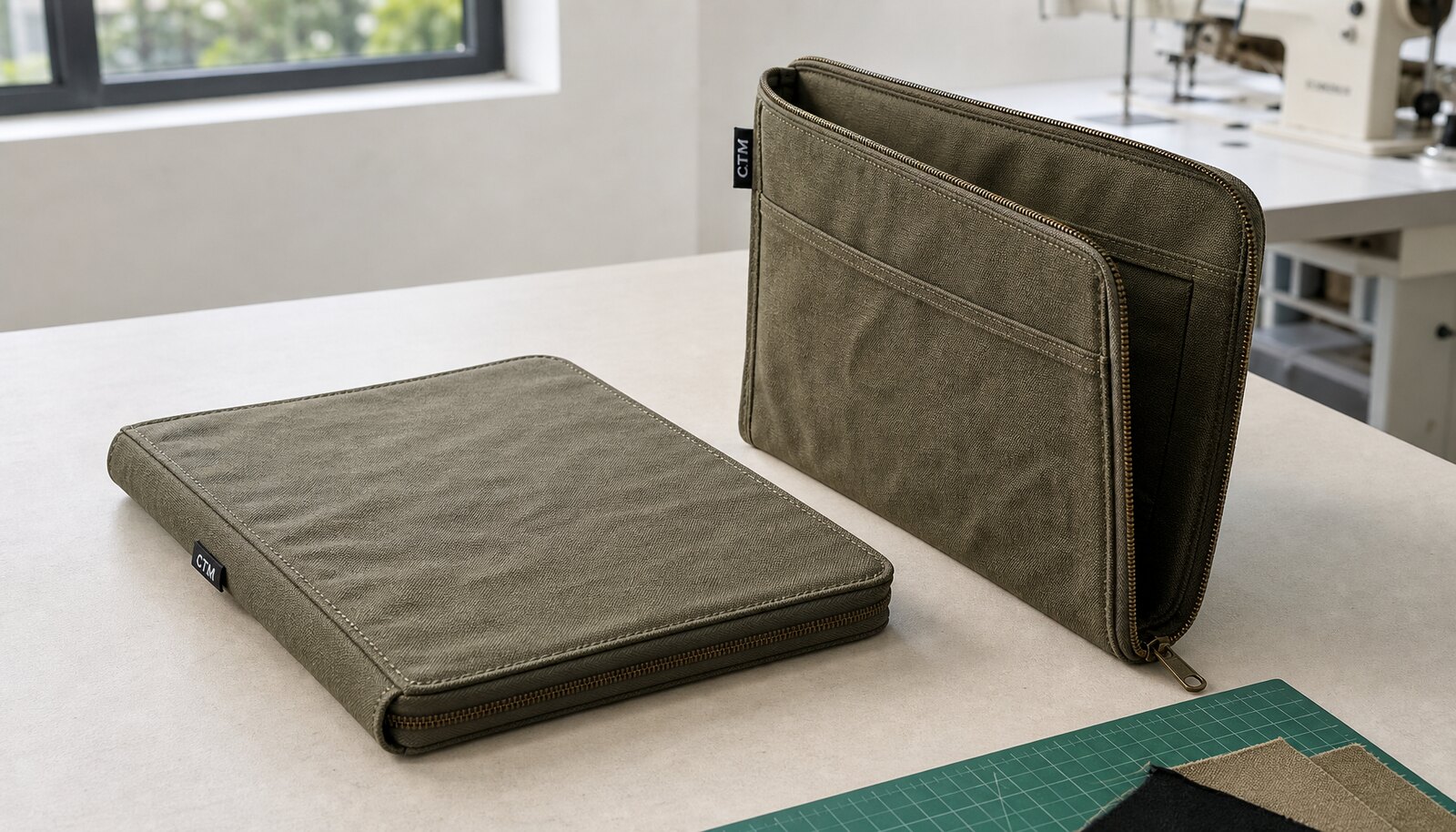
Why the material decision matters more than the artwork
For gift shops, a canvas zipper portfolio competes on first touch, shelf neatness, and repeat handling. Artwork gets the buyer’s attention, but material selection determines whether the product feels like a useful retail item or a thin promotional pouch. If the canvas is too light, the portfolio wrinkles, exposes stitching, and can look underbuilt once it is stocked and handled all day. If it is too heavy or overly coated, it may feel stiff, over-constructed, or awkward to slide into a display fixture. The right build has to support the brand story without compromising closure, fold behavior, or shipping efficiency.
That is why this is a sourcing decision, not just a design choice. The shell fabric affects print sharpness, zipper pull feel, seam visibility, and carton volume. A cleaner-looking 14 oz build can outperform a cheaper 12 oz option if it reduces returns, scuffed cartons, or shelf complaints. For a gift shop buyer, the right question is not simply whether the portfolio looks attractive in a mockup. The better question is whether it will still look sharp after packing, freight movement, store handling, and customer inspection at the counter.
- The shell fabric influences perceived value, not just sewing cost.
- A weak material choice can make a good print look cheap in retail lighting.
- Freight and carton behavior should be part of the material decision from the start.
Start with retail role, then choose the canvas weight
Most custom canvas zipper portfolios for gift shops sit in a 12 oz to 14 oz zone. That range is usually flexible enough for printing and sewing, but still light enough for economical shipping and straightforward display. Twelve-ounce canvas is common when the buyer wants a casual, everyday feel and a lower landed cost. Fourteen-ounce canvas usually gives a firmer hand, cleaner edge control, and a better chance of standing up neatly on a shelf. Once the build moves above 16 oz, the item can start to feel closer to a utility bag than a gift-shop accessory, especially if it includes lining, pockets, or reinforcement patches.
The practical move is to define the retail role before you ask for samples. A stationery insert or travel-document sleeve may need a slimmer, softer body. A museum shop or premium gift assortment can justify a denser, firmer canvas if the product is meant to read as more durable and giftable. Buyers should also ask whether the quoted weight is finished fabric weight or greige weight, because those are not interchangeable. If the supplier does not state that clearly, price comparisons become misleading and size tolerance often becomes the hidden problem later.
- 12 oz usually fits entry or seasonal programs where price sensitivity is high.
- 14 oz is often the safest middle ground for premium shelf appearance and structure.
- 16 oz and above should be chosen for positioning, not for the number alone.
Compare the real material options side by side
The fastest way to compare suppliers is to normalize the build before you compare the quote. A portfolio made from 12 oz plain canvas with a nylon coil zipper is a very different commercial item from a lined 16 oz build with a metal zipper and woven patch. If those are quoted together, the lower price is not necessarily better. It may only mean the supplier trimmed out structure, decoration, or packing detail. For procurement, the useful comparison is a side-by-side look at cost, hand-feel, durability, print behavior, MOQ, and retail positioning.
The table below is meant for buying decisions, not design inspiration. Use it to decide which material route matches the store tier, expected handling, and margin target. If the program is for entry-level gift shops, simplicity usually wins. If the portfolio is meant to feel premium, you can add weight, lining, or a more refined trim package, but only if the landed cost still works and the sample stays consistent in bulk. This is where many programs go wrong: they upgrade three things at once and then wonder why the MOQ, freight, and reject risk all move together.
- Normalize all quotes to the same fabric weight and closure spec.
- Compare hand-feel and retail positioning, not just unit cost.
- Keep the build simple if you need lower MOQ and faster approval.
Match decoration to the fabric surface, not the other way around
Canvas texture changes how artwork lands on the product. A plain weave with moderate texture is usually the most forgiving base for screen print. It gives enough tooth for ink adhesion without swallowing fine detail. If the fabric becomes too rough, thin logo strokes can break up and small text can look uneven. If the fabric is coated too heavily, ink may sit on top of the surface and crack at the fold line. In other words, the same artwork can perform very differently depending on the shell finish, and that is why decoration should be selected after the material is chosen.
For gift-shop buyers, a restrained decoration approach often works best. A bold single-color print, woven label, or small patch usually survives handling better than a highly detailed graphic pushed onto a textured or coated base. Embroidery can look premium, but it adds bulk and can distort a lighter canvas at the stitch zone. Heat transfer can be useful for more complex art, but it should be tested for rub resistance and fold durability before you accept it as production-ready. The buyer’s job is to choose the method that stays legible and flat after packing, opening, and daily retail handling.
A practical rule: if the artwork depends on thin lines, gradients, or small type, ask the supplier to show the result on the exact canvas weight you plan to order. If the artwork is bold and simple, screen printing usually remains the most efficient route. If the branding needs a more premium feel, a woven patch or label often gives better consistency than overworking the fabric with dense embroidery. The material and the logo should support each other; they should not compete for space on the front panel.
- Use screen print for bold logos and larger runs with stable artwork.
- Use a woven patch or label when the logo needs premium presence without heavy stitch bulk.
- Do not approve fine-line art on textured or coated canvas without an exact-material sample.
Build the zipper and seam spec for repeated handling
The failure points on a canvas zipper portfolio are usually predictable: zipper ends, top seams, corner folds, and any area where the user repeatedly opens and closes the item. That means the construction spec deserves as much attention as the outer fabric. Ask for zipper gauge, tape type, end-stop detail, seam allowance, bartack placement, and thread type in the sample stage. A neat outside appearance is not enough if the internal build is loose or inconsistent. Retail handling is repetitive, and weak attachment points show up quickly when the product is touched frequently on a shop floor.
For most gift-shop portfolios, a nylon coil zipper is often the most practical starting point because it balances smooth operation, cost, and flexibility on a soft shell. Metal zippers can read as more premium, but they can also add weight and require more careful matching to the fabric feel. Resin zippers can work in some styles, but the buyer should verify the pull action and the visual match to the canvas. Whatever the zipper type, the sample should prove that the tape sits flat, the pull runs smoothly, and the end stops are reinforced enough to prevent distortion at the corners.
The stitch plan matters too. Consistent stitch density is useful, but consistency is more important than a single magic number. If the seam line wanders, the zipper can look crooked even when it technically functions. Ask to see the seam allowance at the zipper insertion, not just on the outer panel. If the portfolio includes a lining or pocket, confirm that those parts do not force the shell to bubble or twist when the item is empty. This is the difference between a product that merely assembles and one that merchandises cleanly.
- Confirm zipper gauge, puller style, and end-stop detail before artwork approval.
- Inspect the zipper under repeated open-close cycles on the sample, not just once.
- Check seam allowance and bartack placement at the highest-stress points.
Quote the BOM, not the idea of the product
A reliable quote should read like a bill of materials, not a vague promise. The portfolio price needs to separate shell fabric, lining if any, zipper, puller finish, decoration, label, packing, and carton configuration. When those items are bundled into one line, the buyer has no way to compare one supplier against another or spot where a material downgrade is hiding. If one factory quotes an unlined build and another quotes a reinforced lined version, the lower number is not a better deal. It is a different product.
This is also where MOQ can become misleading. A supplier may offer a low unit price but require color-based or print-based minimums that push the real order size much higher than expected. Another supplier may have a slightly higher quote but lower setup pain because the canvas, zipper, and trim are stock items. For gift-shop assortments, the best quote is not the cheapest line in a spreadsheet; it is the one that stays true after fabric, decoration, packing, and freight are all normalized. The buyer needs a comparable spec before any price comparison is meaningful.
- Ask for a line-item BOM and compare only like-for-like builds.
- Check MOQ by color, decoration method, and packaging version.
- Treat a low quote without detail as a risk until the spec is fully disclosed.
Choose the sourcing route that matches your control needs
The right supplier route depends on how tightly you need to control the build. A direct factory with in-house sewing and printing usually gives the clearest accountability for a custom canvas zipper portfolio. That is useful when sample fidelity, repeatability, and construction control matter more than chasing the absolute lowest price. A mill-backed supplier can be helpful when fabric consistency or dye booking is the main concern. A trading company can still work, especially if you need flexible consolidation, but it usually requires more verification because components may come from different places and show up with more variation.
For gift shop buyers, a polished quote is not the same as a controlled supply chain. Ask who actually cuts the fabric, who applies the print, who sources the zipper, and who signs off on packing. If the supplier cannot show the actual canvas, zipper tape, and label options that will be used in bulk, the order still has open risk. The better sourcing route is the one that reduces handoffs. Fewer handoffs usually mean fewer opportunities for spec drift, especially when the build includes multiple colors, decoration types, or retail-ready packaging.
Use samples to lock the build before bulk cutting
Sample approval should act like a production gate, not a design review. Start by measuring the actual finished width, height, zipper length, and pocket depth. Then inspect the product under normal store lighting rather than under ideal studio conditions. If the logo shifts, the zipper looks wavy, or the panels do not lie flat, the sample is telling you something useful about the production risk. The point is not to chase visual perfection; it is to catch the issues that become expensive once bulk sewing begins.
The strongest approval workflow uses one pre-production sample built from the final BOM, not a sales sample with upgraded trims or extra hand-finishing. Buyers should ask for front, back, inside, zipper close-up, and label-placement photos as part of approval records, then physically test the sample by opening and closing it several times, folding it as a customer would, and checking whether the shell shows whitening at the corners. If the product only looks good before it is handled, the build still needs work.
A practical acceptance note helps avoid later disputes. Record the approved fabric, zipper color, print placement, seam allowances, and packaging details in one sign-off file. That way, bulk production is measured against the same reference. If the supplier proposes a change after approval, even a small one, it should be treated as a controlled deviation rather than a casual substitution. In custom retail goods, small substitutions often become the reason the final carton does not match the sample.
Use the sample stage to confirm:
- the canvas weight actually matches the quote;
- the zipper runs smoothly and closes flat;
- the print stays clear at the fold line;
- the label or patch does not distort the side seam;
- the item still looks neat after repeat opening and closing.
- Approve only a sample built from the final materials.
- Document dimensions, trim colors, and placement before bulk starts.
- Test the sample under realistic folding and handling, not just by eye.
Specify packaging and carton strategy with damage risk in mind
Packaging is not just a finishing touch for gift-shop goods. It directly affects scuffing, shelf presentation, and damage risk in transit. A loose-packed portfolio can arrive dusty, crease-marked, or slightly bent at the corners. A tightly wrapped one may hold a harsh fold line into the canvas, especially if the material is lighter or lightly coated. The right balance is usually a protective sleeve or polybag that keeps the item clean without squeezing it into a permanent crease. If the product is sold with a barcode, hangtag, or insert card, those details need to be fixed before packing starts, not added at the end of the line.
Carton planning should be part of procurement, because canvas goods are often more bulky than they are heavy. The carton pack count, gross weight, and carton dimensions can shift freight cost more than a small change in unit price. Ask the factory to state the packing orientation and the carton cube before final approval. If the portfolio has a zipper pull, patch, or lining that could press against the main panel, the packing method should protect those details from compression. A good pack spec reduces damage claims and helps the product arrive ready for shelf placement rather than requiring rework at receiving.
For gift shop programs, the packaging standard should be practical and repeatable. Individual polybags are often enough, but the material should not trap moisture or scuff printed surfaces. If the shop needs retail-ready presentation, an insert card can improve shelf impact, but it should be sized so it does not curl or fold inside the package. Small packaging decisions show up in customer perception and in freight math, so they belong in the sourcing spec from day one.
- Choose packaging that protects the canvas without creating hard crease lines.
- Lock barcode placement, insert-card size, and carton count before bulk packing starts.
- Use carton dimensions to estimate freight density and warehouse handling impact.
Use QC checks that catch the defects buyers actually see
Quality control for canvas zipper portfolios should focus on the defects a gift-shop customer will notice at the counter: crooked zipper insertion, uneven stitching, visible shade mismatch, bad print registration, and corner distortion. A general visual inspection is not enough. Buyers need checks that connect the sample to production reality. Measure dimensions with a ruler rather than guessing. Open and close the zipper several times to see whether the tape pulls or the slider hesitates. Inspect seam lines against the approved sample and look for loose threads, skipped stitches, or seam tunneling. These are the issues that can make a product feel cheap even when the artwork is strong.
Acceptance criteria should be concrete. For example, finished dimensions can stay within ±0.5 cm for smaller formats and ±1 cm for larger ones. Print placement should remain visually aligned within about 2 mm from the golden sample. If the item is lined, the lining should not twist, balloon, or pull the outer shell out of shape when the portfolio is empty. If there is a patch, label, or woven tag, it should not interfere with zipper travel or edge folding. These are simple checks, but they are much more useful than generic claims about being “well made.”
If you want the QC process to be efficient, ask the supplier to send pre-shipment photos of the same angles every time: front, back, zipper close-up, interior, and carton pack. Then define what a defect looks like. For example, visible oil stains, broken yarns outside the accepted slub range, open bartacks, or mixed SKUs in one carton are clear reasons to hold or rework the lot. Clear defect language saves time because it reduces the chance of arguing after the goods are already on the water.
- Inspect zipper motion, seam alignment, and print placement against the approved sample.
- Set numeric tolerances for dimensions and visible placement before production begins.
- Define defect examples clearly: stains, broken yarns, open bartacks, shade mismatch, or mixed cartons.
Specification comparison for buyers
| Material option | Cost level | Hand-feel / retail positioning | Durability / QC focus | Print compatibility |
|---|---|---|---|---|
| 12 oz natural canvas | Low | Soft, casual, entry-price gift-shop feel | Check shrinkage, seam puckering, and white stress marks after folding | Strong for screen print and woven labels; fine-line art can blur on textured weave |
| 14 oz dyed canvas | Medium | Cleaner shelf presence, more structured, mid-price positioning | Watch shade consistency, lot variation, and color migration in rub testing | Good for most screen print jobs; confirm ink contrast on dyed grounds |
| 16–18 oz heavy canvas | Medium-high to high | Firm, premium, giftable; can read as museum-store or stationery-plus | Inspect corner bulk, zipper-end bulk, and fold memory | Works best with bold print, woven patch, or restrained embroidery |
| Recycled cotton canvas blend | Medium | Eco-led merchandising story, natural slub appearance is acceptable | Require fiber-content documentation, color tolerance, and shade-match approval | Print clarity can vary because recycled fibers are less uniform |
| Lightly coated canvas | Medium-high | Cleaner, slightly more polished look; easier wipe-clean retail positioning | Test for odor, cracking at fold lines, and coating transfer to adjacent items | Good for simple logos only; some coatings resist ink adhesion |
| Waxed or wax-finish canvas | High | Premium, tactile, more fashion-forward or travel-gift feel | Check for surface rub-off, cold-weather stiffness, and crease whitening | Decoration can be limited; labels and patches are safer than detailed print |
| Canvas with PU reinforcement at stress points | Medium-high | More polished at corners and zipper ends; useful when buyers want a finished look | Inspect edge peeling, adhesive bleed, and mismatch between PU and fabric texture | Print is usually best on the main body, not on PU zones |
| Lined canvas build with internal slip pocket | Medium-high | Better perceived value for premium stationery or document sets | Check lining tension, pocket opening width, and seam alignment | Print compatibility stays mostly on the outer shell; lining is a separate spec item |
Buyer checklist before sampling
- Define the retail role first: display sleeve, stationery case, travel document holder, or premium gift set insert.
- Lock finished canvas weight in oz and GSM, and state whether the number is finished fabric weight or greige weight.
- Specify zipper type, gauge, puller style, zipper tape color, and end-stop finish before artwork approval.
- Match decoration to fabric texture: screen print, embroidery, woven label, woven patch, heat transfer, or debossed patch.
- Ask the factory to quote the exact BOM, including shell, lining, zipper, label, packing, and carton configuration.
- Request a pre-production sample built from the final materials, not a sales sample with upgraded trims.
- Set packaging requirements early: polybag type, insert card, barcode location, carton pack count, and moisture protection.
- Require a golden sample with front, back, inside, zipper close-up, and label-placement photos before bulk starts.
- Ask for evidence of the supplier’s quality tests, such as seam strength, zipper cycling, color fastness, and rub resistance.
- Confirm landed-cost drivers beyond unit price, especially carton volume, freight density, reject rate, and packing damage risk.
Factory quote questions to send
- What is the finished canvas weight in GSM or oz, and is that measured before or after finishing/washing?
- Is the zipper nylon coil, metal, or resin, and what gauge and puller finish are included in the quote?
- Which decoration method is quoted, and does the price include setup, screens, digitizing, or label application?
- What minimum order quantity applies per color, per print, and per packaging version?
- Are sample charges refundable against bulk, and how many sample revisions are included before production?
- Can you provide a BOM with each component priced separately, including shell fabric, zipper, lining, label, and packing?
- What in-house tests can you support, such as seam strength, zipper cycle testing, color fastness, or rub testing?
- What packaging is included by default, and what changes in cost if we add an insert card, hangtag, or individual polybag?
- What is the lead time for sample, pre-production approval, bulk sewing, packing, and shipment?
- Which parts are sourced internally and which are subcontracted, and can you show component samples for the exact build?
Quality-control points to confirm
- Finished dimensions should stay within ±0.5 cm for small portfolios and ±1 cm for larger formats.
- Zipper motion should be smooth across at least 10 open-close cycles on sample inspection, with no snagging, wavy tape, or skipped teeth.
- Stitching should be even, with no skipped stitches, loose thread tails, seam tunneling, or puckering at zipper attachment points.
- Seam allowance should match the spec sheet on both sides; check a few units with a ruler, not just by eye.
- Print placement should stay within a 2 mm visual tolerance from the approved sample, with no misalignment at folds or corners.
- Rub test should not show heavy ink transfer, excessive surface smear, or visible scuffing on the main artwork area.
- Fabric should be free from oil stains, broken yarns, panel shading mismatch, and unexpected slubs outside the approved range.
- Bartacks or reinforced stitches should be present at zipper ends and stress corners, and they should not open under a light pull test.
- If lined, the lining should not twist, bulge, or pull the outer shell out of shape when the portfolio is empty or lightly filled.
- Labels and woven tags should match the approved position and must not interfere with zipper travel or edge folding.