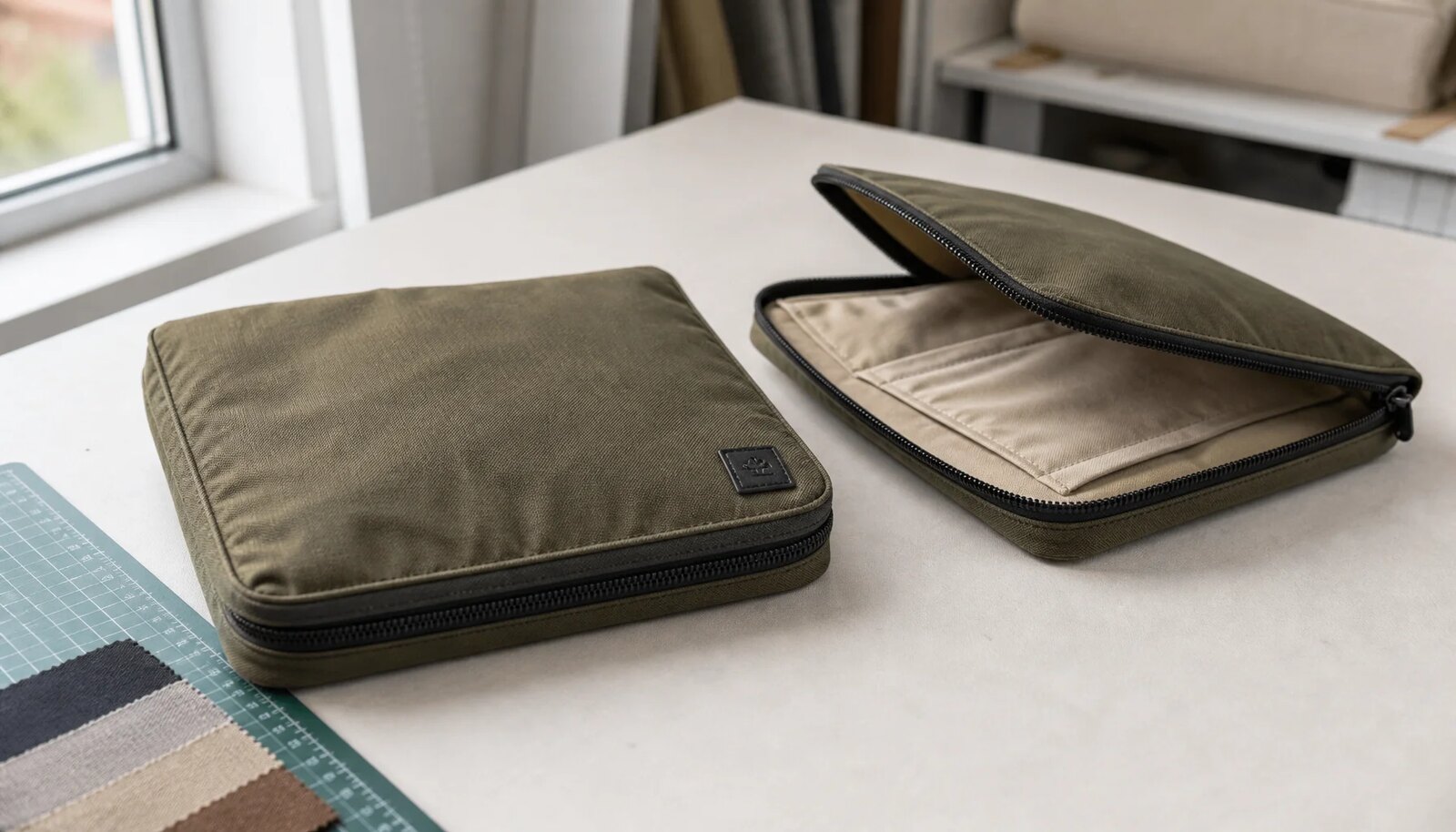
Begin with the event job, not the fabric name
A custom canvas zipper portfolio can mean very different things to different suppliers. One factory may picture a soft document pouch with one zipper and no lining. Another may quote a structured business portfolio with pockets, reinforcement, branded pullers, and individual polybags. Both may call the product a canvas zipper portfolio, but the cost, lead time, and inspection risk are not the same.
For event planners and procurement buyers, the cleaner starting point is the job the item must perform. A one-day attendee portfolio may only need to carry an agenda, badge sheet, sponsor insert, and a few loose papers. A staff portfolio used across a conference season may need to hold room-change notes, pens, vendor contacts, badges, and a notebook while being opened many times each day. A speaker or VIP version may need a better hand feel, tighter logo placement, and packing that looks organized when unpacked at the venue.
The most important measurement is not the outside size alone. Confirm the largest insert, the expected stack thickness, and the clearance needed after the zipper is closed. A portfolio built exactly to A4 or Letter size may look correct on a spec sheet but bend document corners in real use. If the finished product must fit inside a welcome box, conference tote, hotel-room amenity kit, registration drawer, or carry-on, include that constraint in the RFQ before sampling begins.
- Define the audience: attendee, staff, speaker, VIP, sponsor, exhibitor, or internal event team.
- Measure the largest document, insert stack, notebook, or thin tablet before confirming the finished size.
- State where the portfolio will be used: registration table, meeting room, backstage area, travel kit, sponsor desk, or post-event office use.
- Choose the main priority: low freight weight, premium feel, repeated handling, clean branding, or fast distribution.
- Describe the failure you want to avoid, such as zipper strain, bent papers, bulging corners, dust pickup, weak handles, or mixed venue shipments.
Choose canvas by weight, weave, and finished behavior
For most custom canvas zipper portfolios, a practical sourcing range is about 8 to 12 oz canvas, often around 280 to 410 GSM depending on how the material is measured. For conference, sponsor, staff, and general event use, 10 to 12 oz finished canvas is usually a reliable starting point. It gives the panel enough structure to lie neatly on a table, supports cleaner stitching around the zipper, and presents many printed logos better than very light fabric.
The word finished matters. Some suppliers quote greige weight before dyeing, washing, coating, or finishing. Others quote the weight after finishing. Two fabrics described as 12 oz can behave differently if the yarn count, weave density, twist, shrinkage, and surface finish are different. On a zipper portfolio, those differences are easy to see. Loose canvas can ripple beside the zipper. A soft open weave can make print edges look fuzzy. A stiff finish may help structure but can make corners harder to turn cleanly.
Heavier is not automatically better for B2B procurement. A 14 oz canvas can feel substantial, but it may increase sewing difficulty, needle marks, unit weight, carton cube, and lead time. If the order is large or the event date requires air freight, small changes in weight and packed volume can matter. The better target is the lightest construction that still meets the approved appearance, hand feel, strength, zipper behavior, and decoration standard.
- Use 8 to 10 oz canvas for light document carriers where low weight and lower cost matter most.
- Use 10 to 12 oz finished canvas for most event portfolios that need cleaner structure and repeated handling.
- Ask whether the quoted oz and GSM are measured before or after dyeing, washing, coating, or finishing.
- Review swatches for weave density, stiffness, surface texture, shade, slub level, and print suitability.
- Confirm whether a heavier canvas changes needle size, stitch appearance, seam allowance, carton quantity, or production speed.
Lock fabric finish, shade, and shrinkage early
Canvas finish is a real sourcing decision, not a final styling note. Natural cotton canvas can suit casual, campus, nonprofit, or sustainability-focused programs, but it may show seed flecks and shade variation. Dyed canvas gives stronger brand control, especially for black, navy, gray, green, or event colors. Washed canvas can feel softer and more relaxed, but it can make exact shade repeatability harder. Coated, brushed, waxed, or treated canvas can change the surface feel and may affect print adhesion or heat-transfer bonding.
For procurement, color approval should be built into the calendar. Pantone numbers are helpful for communication, but fabric is not coated paper. The final decision should rely on a physical lab dip, stock fabric swatch, or master sample viewed under consistent light. If a shade range is acceptable, write it down. If flecks, slubs, high contrast yarn variation, or vintage texture are not acceptable, write that down too. Ambiguity becomes expensive once the goods are sewn and packed.
Shrinkage deserves attention because zipper portfolios depend on flatness. Canvas, lining, zipper tape, and decoration may react differently to dyeing, washing, heat curing, pressing, and storage. If one component shrinks more than the others, the panel can twist, wave, or pull near the zipper. Ask the supplier whether the fabric is pre-shrunk or stabilized before cutting, and check the sample after any decoration or heat process that will also be used in bulk.
- Define the finish as natural, dyed, washed, coated, brushed, waxed, printed, or untreated.
- Approve shade by physical swatch, lab dip, or master sample rather than screen image alone.
- State whether seed flecks, slubs, uneven tone, or vintage texture are acceptable.
- Ask for expected shrinkage and whether fabric will be pre-shrunk before cutting.
- Confirm that the finish is compatible with screen print, heat transfer, patch sewing, embroidery, or woven labels.
Specify size and construction as one package
A flat unlined holder, a lined document portfolio, and a padded organizer can share the same outside dimensions while being completely different products. They use different material quantities, labor steps, packing space, and inspection criteria. A useful RFQ should define finished outside size, internal usable size, gusset depth if any, lining material, seam finish, reinforcement points, and internal features together.
Lining should follow the use case. A light cotton, TC, or polyester lining gives a cleaner interior and helps documents slide in without catching on raw fabric edges. Unlined construction can reduce weight and cost, but exposed seams must still be bound, overlocked, or otherwise finished neatly. If the portfolio carries contracts, premium sponsor inserts, certificates, or printed schedules, rough interior seams and loose thread tails are not small defects. They can damage the presentation.
Reinforcement should be targeted rather than excessive. Corners, zipper ends, handle attachments, strap points, pen loops, and pocket openings are common stress areas. Full-body foam may add thickness, but it can reduce packing efficiency and create compression marks in cartons. Many event orders are better served by stable canvas, clean lining, adequate seam allowance, and reinforcement at the points that actually take pressure.
- Specify finished outside dimensions and internal usable dimensions separately.
- Set a size tolerance, such as +/-5 mm for simple flat portfolios unless a different tolerance is approved.
- List lining fabric, lining color, seam finish, binding width, pocket material, and corner reinforcement.
- Classify each feature as required, optional, or excluded: gusset, divider, pocket, pen loop, card slot, handle, wrist strap, window, barcode, or label.
- Require reinforcement at zipper ends, corners, handles, straps, and pocket mouths when those areas will carry stress.
Build the zipper spec for repeated handling
The zipper is the part people notice when it fails. Fabric can be attractive and the logo can be correct, but a snagging zipper makes the whole item feel cheap. Event portfolios may be opened at registration, in breakout rooms, backstage, during sponsor meetings, or while traveling between venues. A low-grade zipper can separate, drift open, catch the lining, or pull loose at the end stop at the exact moment the product is supposed to help the event run smoothly.
A #5 nylon coil zipper is a practical baseline for most canvas document portfolios. It handles curves better than many metal options, keeps weight reasonable, and is widely available with matching or contrast zipper tape. A #3 zipper may be too light for thicker insert stacks or repeated use. A #8 zipper may be useful for larger organizers, but it can look oversized on a slim portfolio. Metal zippers can create a premium look, yet they add weight and may scratch canvas or neighboring packed items.
Do not leave slider details to assumption. An auto-lock slider helps prevent the zipper from drifting open during handling. Pullers may be standard metal, fabric, rubber, leather-look, or custom molded, and each choice affects cost, lead time, abrasion, and brand feel. The zipper start and stop points should be reinforced with secure stitching, folded tape, bar-tacks, binding, or a zipper garage depending on the design. These details look minor on a quote sheet. They are major in daily use.
- Use #5 nylon coil zipper as the default for most event document portfolios.
- Specify zipper type, size, tape color, slider finish, lock function, puller style, and zipper route.
- Require reinforced zipper start and stop points, especially for thicker insert stacks.
- Test the sample with real contents, not only while the portfolio is empty.
- Ask whether the zipper is a named brand, factory standard, or subject to substitution.
Match branding to canvas texture and artwork risk
Branding is often the reason the item is being ordered, so it should not be treated as a simple add-on after the bag price is set. Screen printing is usually efficient for one- to three-color event logos, sponsor marks, larger typography, and bold front-panel artwork. It can be clean and repeatable, but textured canvas may soften edges. Small legal lines, fine sponsor text, gradients, and low-contrast colors can lose clarity unless the artwork is adjusted for fabric.
Woven labels, patches, heat transfers, and embroidery each solve different problems. A woven label can hold small type and repeat well across reorder programs, but buyers need to approve size, fold type, edge finish, and sewing position. A patch can add a more premium or durable feel, though it introduces another material, perimeter stitching, and placement tolerance. Heat transfer can support more colors and fine graphics, but adhesion, hand feel, cracking resistance, and compatibility with washed or coated canvas should be checked. Embroidery can work well for a small mark; large dense embroidery can stiffen or distort a flat panel.
The safest step is an artwork review before final pricing. Send vector artwork, brand colors, required logo size, placement, and minimum text size concerns. Ask the supplier to flag details that may blur, fill in, crack, migrate, or shift on the chosen fabric. For multi-sponsor programs, count every logo version, colorway, and print position as a separate setup variable unless the supplier confirms otherwise in writing.
- Use screen print for bold marks, larger type, and one- to three-color artwork.
- Use woven labels or patches when fine detail, small type, or repeat brand consistency matters.
- Use heat transfer only after confirming adhesion and surface compatibility with the selected finish.
- Use embroidery for small controlled marks rather than large dense graphics on flat panels.
- Set logo placement tolerance in writing, commonly +/-3 mm to +/-5 mm depending on method and panel size.
Compare quotes beyond the headline unit price
A low unit price is only useful when suppliers are quoting the same product. Custom canvas zipper portfolios involve fabric sourcing, dyeing or fabric selection, cutting, decoration, sewing, trimming, inspection, inner packing, carton packing, and export documentation. A quote that excludes decoration setup, individual packing, carton marks, or inspection support may look attractive until the buyer compares landed cost and operational risk.
Ask each supplier to state the assumptions behind the quote. The RFQ should include finished size, internal usable size, fabric weight and finish, lining, zipper spec, internal features, decoration method, number of logo versions, packing method, carton quantity, shipping term, and lead time. If the reply is only a unit price, send a clarification list before shortlisting. A useful supplier can explain what is included and commit to a repeatable sample and inspection standard.
Supplier type also matters. A direct bag factory may be stronger for custom construction, zipper reinforcement, and repeat orders. A trading company may help with mixed event kits or consolidated sourcing, but the buyer should know who controls production and who handles defects. A decorator may be fast for printing stock goods, yet may not be the right source when the portfolio body is custom sewn.
- Ask who controls fabric sourcing, cutting, decoration, sewing, inspection, packing, and export cartons.
- Require quotes to state what is included and excluded: decoration, labels, packing, setup, inspection, and carton marks.
- Request photos of similar zipper construction and interior finishing, not only front-panel beauty images.
- Confirm whether printing happens before or after sewing and how placement is controlled.
- Shortlist suppliers that can discuss seam allowance, zipper tape, reinforcement, and carton cube in practical terms.
Plan MOQ, SKU splits, and event distribution together
MOQ is shaped by more than the total order quantity. Fabric availability, dye lot, zipper color, lining color, label production, screen setup, cutting efficiency, packing method, and inspection complexity all influence the real minimum. A 2,000-piece order with one body color and one logo may run efficiently. A 2,000-piece order split across four body colors, three zipper colors, ten sponsor logos, and two packing methods may behave like several small orders from the factory's point of view.
Procurement teams can often improve both cost and reliability by reducing variables. Use one canvas color and one zipper color across sponsor versions when brand rules allow. Keep logo size and placement consistent even if the artwork changes. Use one lining color and one packing method unless there is a clear operational reason to split them. Fewer variables reduce setup charges, shade differences, picking errors, and final inspection time.
SKU discipline is especially important for event planners shipping to multiple venues or building sponsor kits. Each version should have a clear code tied to body color, zipper color, logo version, packing type, destination, and in-hand date. Carton marks should match the purchase order and packing list. A well-made portfolio still creates a problem if the right version arrives at the wrong venue or mixed cartons slow down registration setup.
- Request MOQ by body color, zipper color, lining color, logo version, label version, and packing method.
- Ask for price breaks at the same specification, such as 300, 500, 1000, and 3000 pieces.
- Separate one-time setup charges from repeat order unit prices.
- Keep logo size and position consistent across sponsor versions where possible.
- Create SKU codes that match carton marks, inspection reports, packing lists, and warehouse receiving records.
Approve samples with measurable standards
A sample should prove the product the factory will actually produce. For a custom canvas zipper portfolio, the pre-production sample should use final canvas, final zipper, final lining, final decoration method, final label, and intended packing. A development sample can help settle the shape early. A photo mockup can help align logo placement. Neither should replace a physical pre-production sample for a branded event order with a fixed date.
Sample review should be practical and measurable. Load the sample with the largest approved insert stack and close the zipper without forcing it. Open and close the zipper repeatedly by hand. Measure outside size, internal usable size, pocket dimensions, gusset depth, and logo placement. Check stitch-per-inch consistency, seam allowance, zipper tape alignment, thread tension, lining finish, corner reinforcement, and packing fit. View the logo against the approved reference under consistent light.
Once approved, the sample becomes the master standard. Buyer and supplier should keep the same version and document any changes before bulk production starts. If a revised sample is issued, close out old comments so the approval trail does not contain conflicting instructions. Version control may feel plain, but it prevents disputes when bulk goods are inspected against an early prototype, a photo mockup, or a decoration test instead of the final approved product.
- Use a development sample for construction questions and a pre-production sample for final approval.
- Approve final canvas, zipper, lining, decoration, label, and packing before bulk production.
- Measure size, zipper clearance, logo placement, pocket size, and gusset depth against the spec sheet.
- Set written tolerances for size, shade, logo position, stitching, and acceptable fabric character.
- Mark the final master sample and retire old sample comments before production begins.
Write QC criteria before goods are packed
Quality control for zipper portfolios should cover function, appearance, construction, and packing accuracy. A front-panel photo is not enough because the product has moving parts and stress points. Inspectors should measure finished size, confirm insert fit, operate the zipper, inspect zipper ends, check stitching, review logo placement, inspect lining, and look for stains, odor, fabric defects, or packing damage. For event programs, defects are highly visible because products are often distributed together on tables or packed side by side in kits.
A useful QC plan defines defect severity before final inspection. Critical defects may include wrong logo, broken zipper, unsafe sharp trim, mildew odor, severe contamination, or mixed cartons. Major defects may include zipper snagging, wrong size outside tolerance, crooked logo outside tolerance, open seams, skipped stitches at stress points, wrong packing, or incorrect SKU labels. Minor defects may include short thread tails, small shade variation within the agreed range, or minor internal marks that do not affect use or presentation.
Buyers can request an inspection standard based on AQL if it fits their procurement process. Many consumer goods inspections use ANSI/ASQ Z1.4 sampling logic, but the exact AQL level should be agreed by the buyer, supplier, and inspection provider. Even without third-party inspection, the factory should provide in-process and final inspection records, including photos of measurements, zipper checks, logo placement, packed units, carton marks, and shipment-ready cartons.
- Check finished size, internal fit, zipper action, stitching, reinforcement, logo placement, lining, cleanliness, and packing.
- Define critical, major, and minor defects before the final inspection date.
- Set tolerances for size, logo placement, shade approval, stitch appearance, and carton labeling.
- Ask for photos of measurements, zipper cycle checks, logo alignment, carton marks, and packed cartons.
- Hold shipment release until functional defects, wrong SKUs, and carton mismatches are corrected.
Specification comparison for buyers
| Spec decision | Recommended option | When it fits | Buyer risk to check |
|---|---|---|---|
| Canvas weight | 10 to 12 oz finished canvas, commonly about 340 to 410 GSM depending on measurement method | Most event portfolios for agendas, contracts, badge sheets, sponsor inserts, notebooks, and light daily use | Ask whether weight is finished fabric weight or greige weight; light canvas can ripple at the zipper, while heavy canvas can raise carton cube and sewing difficulty |
| Canvas weave and finish | Plain-weave cotton or cotton-blend canvas with approved swatch, lab dip, or master fabric standard | Programs where appearance, hand feel, logo clarity, and color consistency matter at registration or sponsor tables | GSM alone does not control yarn count, weave density, shrinkage, shade variation, print adhesion, or slub level |
| Finished size and tolerance | Finished size specified with insert clearance; common tolerance +/-5 mm for simple portfolios unless supplier proposes otherwise | A4, Letter, contract sets, conference schedules, speaker notes, and flat sponsor kits | A portfolio that matches paper size exactly may force the zipper or bend document corners; check internal usable size, not outside size only |
| Interior build | Light cotton, TC, or polyester lining with bound or overlocked seams and reinforcement at stress points | Slim document carriers that need clean inside finishing without bulky padding | Unnecessary foam, thick lining, or wide binding can distort the shape, reduce pack efficiency, and create zipper strain |
| Zipper spec | #5 nylon coil zipper with auto-lock slider, matching or contrast tape, reinforced ends, and approved puller | Standard event portfolios opened repeatedly by attendees, staff, speakers, sponsors, and registration teams | Cheap sliders snag, non-lock sliders may drift open, and weak zipper ends can pull loose during loading or distribution |
| Branding method | Screen print for bold 1 to 3 color logos; woven label, patch, or heat transfer for fine detail or multiple colors | Event branding, sponsor marks, internal team portfolios, and repeat corporate programs | Small type, gradients, thin rules, and low-contrast colors may fail on textured canvas unless artwork is adapted |
| MOQ strategy | Quote by body color, zipper color, lining color, logo version, and packing type, not only total quantity | Multi-event calendars, venue splits, sponsor kits, and conference programs with several versions | Too many small SKUs increase setup charges, color variation risk, packing errors, and inspection time |
| Sample path | Development sample if needed, then pre-production sample using final fabric, zipper, lining, decoration, label, and packing | Orders with fixed event dates, sponsor approval, custom color, or public-facing distribution | A blank sample or photo mockup cannot prove print opacity, zipper behavior, color interaction, or packed presentation |
| QC standard | Written inspection checklist with size, color, zipper cycle, seam, logo, cleanliness, and carton checks | Bulk event orders where late defects are expensive because the receiving date is fixed | Without tolerances, factories and buyers may disagree on shade, logo position, thread tails, zipper smoothness, and carton labeling |
Buyer checklist before sampling
- Confirm the largest insert size, insert thickness, and required internal clearance after the portfolio is zipped.
- State whether the portfolio must carry flat documents only, a notebook, badges, pens, sponsor inserts, a thin tablet, or staff tools.
- Specify finished outside size, target internal usable size, gusset depth if any, and acceptable size tolerance such as +/-5 mm.
- Choose target canvas weight in oz and GSM, and ask whether the quoted weight is finished fabric weight after dyeing and finishing.
- Define canvas composition, weave, finish, shade standard, acceptable slubs, shrinkage expectation, and color approval process.
- State zipper type, size, tape color, slider type, puller style, slider finish, zipper path, and end reinforcement method.
- Define lining material, lining color, seam finish, binding width, pocket fabric, corner reinforcement, and whether foam or padding is allowed.
- List every feature as required or optional: gusset, handle, wrist strap, pen loop, internal pocket, divider, name-card window, label, or barcode.
- Select the branding method and provide vector artwork with logo size, placement, Pantone or brand color references, and minimum text size concerns.
- Split quantities by body color, zipper color, lining color, logo version, packing type, delivery destination, and ship date.
Factory quote questions to send
- What canvas composition, weave, finished GSM, and oz weight are you quoting, and is the weight measured before or after dyeing, washing, coating, or finishing?
- What fabric color process is included: stock fabric, piece dye, garment wash, custom dye, or printed canvas, and what color tolerance will you use for approval?
- What shrinkage range, colorfastness expectation, and shade-lot control can you provide for the chosen canvas?
- Which zipper type, size, tape color, slider type, auto-lock or non-lock function, puller, slider finish, and end reinforcement method are included in the unit price?
- What lining fabric, lining weight, seam finishing, binding, pocket material, and corner reinforcement are included, and which changes affect cost?
- What finished-size tolerance, logo-placement tolerance, and stitch-per-inch range will you commit to on the pre-production sample and bulk inspection?
- Which branding method will you use, what is the setup charge per color, position, logo version, or screen, and what artwork limitations should we know before approval?
- Can you make a pre-production sample using final canvas, zipper, lining, label, logo method, packing, and carton mark before bulk production starts?
- What is the MOQ per body color, zipper color, lining color, logo version, label version, and packing method?
- Can repeat orders reuse the same pattern, screen, label, zipper puller, carton specification, and approved master sample standard?
Quality-control points to confirm
- Finished outside size and internal usable size should stay within the agreed tolerance, commonly +/-5 mm for simple flat portfolios unless another tolerance is approved in writing.
- The loaded portfolio must fit the largest approved insert stack without forcing the zipper, bending document corners, twisting the body, or creating visible strain at the zipper ends.
- Canvas weight, weave density, color, hand feel, finish, and slub level should match the approved swatch or master sample, with shade variation kept within the agreed tolerance.
- Fabric should be free from obvious dye streaks, oil stains, water marks, mildew odor, severe slubs, thin spots, coating defects, and abrasion marks on the visible panels.
- The zipper should open and close smoothly through repeated manual cycles with no snagging, slider separation, broken puller, tape distortion, missing teeth, or end-stop failure.
- Zipper tape should be sewn evenly with proper seam allowance, secure backstitching or bar-tacking at stress points, and no puckering that distorts the portfolio edge.
- Stitching should be even, with no skipped stitches, loose thread nests, long thread tails, needle holes outside the seam line, open seams, or weak backstitching.
- Logo size and placement should match the approved sample within the agreed tolerance, such as +/-3 mm to +/-5 mm depending on method and panel size.
- Print should show clean edges, adequate opacity, correct curing or adhesion, and no smears, pinholes, ghosting, cracking, dye migration, or transfer marks on the opposite panel.
- Woven labels, patches, and heat transfers should be straight, securely attached, cleanly trimmed, and positioned consistently against the approved sample.