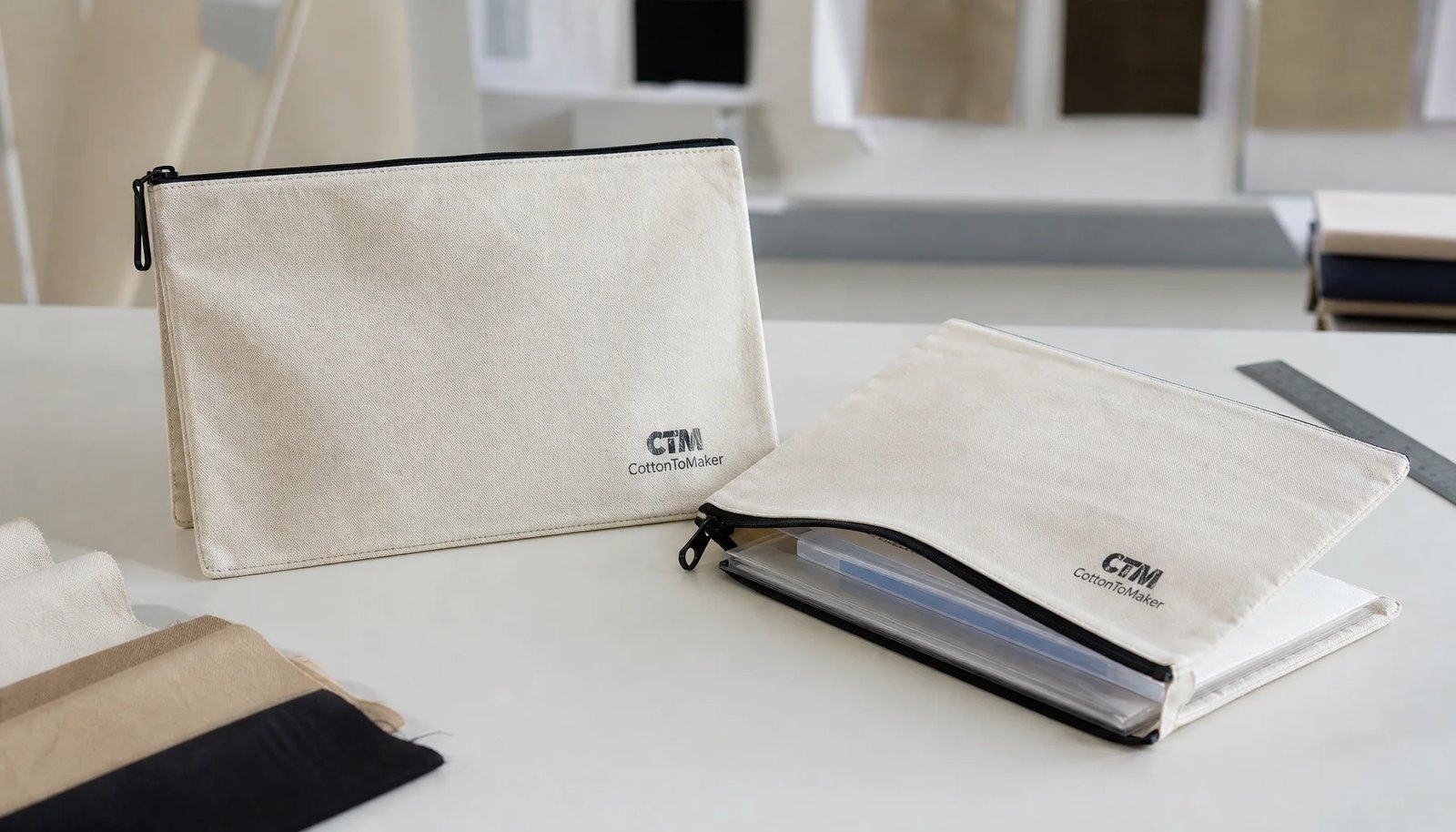
Start With the Use Case, Not the Artwork
Custom canvas zipper portfolios are not just branded folders. For trade show exhibitors, they often need to do three jobs at once: carry documents, present the brand cleanly, and survive shipping, storage, and repeated handling. That is why the best logo placement is the one that still works when the item is zipped, loaded, stacked, and carried, not only when it looks good in a mockup.
A buyer should define the business context before approving artwork. A portfolio handed out at registration has different branding needs from one used in a sales meeting or a VIP welcome kit. If the item is displayed closed on a table, the front panel matters most. If it is opened often during meetings, inside branding and pocket layout become part of the specification.
The most common sourcing mistake is treating logo placement as a design decision only. In practice, it is a production decision. The final location has to survive sewing, folding, zipper movement, and packaging. Procurement teams should ask the supplier to quote a placement method that can be repeated across the full order, not just a one-off sample.
- Define the item's primary use before choosing logo size or placement.
- State whether the brand must read when the portfolio is closed, carried, stacked, or opened.
- Treat logo placement as part of the manufacturing spec, not a marketing preference.
- Use the same use-case language in the RFQ, sample approval, and inspection sheet.
Build the Dieline Around the Real Construction
A useful dieline shows the finished product, not just the flat fabric panel. The drawing should include the zipper tape, seam allowance, fold line, corner radius, stitching line, pocket edges, strap or handle anchors, and any gusset or spine depth. Without those points, a logo can appear centered on the artwork file and still land too close to a seam after sewing.
For procurement, the simplest rule is to measure from finished edges on the assembled portfolio. That avoids confusion between raw cut dimensions and final dimensions. If the supplier prints before sewing, ask where the print sits relative to the cut line. If the supplier prints after assembly, ask how it compensates for thickness, curve, and panel tension.
The zipper puller deserves special attention. On many portfolios it rests near a corner or side edge when closed. If the puller covers part of the mark, the logo becomes less visible and can also wear faster. The same logic applies to straps, pockets, and hardware. A clear zone around those features makes the logo more durable and easier to photograph for event use.
- Request a flat dieline in both closed and open views.
- Measure logo placement from finished edges, not raw fabric edges.
- Show zipper tape, fold lines, pocket seams, and hardware anchor points on the drawing.
- Keep the logo clear of parts that move, fold, or press against the front panel.
- Check where the zipper puller rests when the portfolio is closed.
Choose the Right Placement for the Event Moment
Front center placement is the strongest choice when the portfolio will be handed out at a booth, stacked on a counter, or photographed as a sponsor item. It gives the fastest brand read and usually works best for larger marks. The trade-off is that it looks more promotional, so it may be less suitable for buyers who want the item reused after the event.
Lower-right placement is often the most balanced corporate option. It keeps the logo visible without dominating the whole front panel. This is a good fit for legal, finance, consulting, insurance, software, and other B2B services that want a cleaner look. Lower-left placement can work just as well when the right side has a zipper puller rest point, strap anchor, or pocket seam.
Inside branding is underused but practical. A welcome message, QR code, sponsor name, or organizer logo becomes visible when the portfolio is opened during a meeting. That makes it less prominent in a stacked display but more relevant in daily use. Because it sees more contact with documents and pens, the inside area should be treated as a wear surface, not just a decoration zone.
- Use front center for high-visibility trade show distribution.
- Use lower-right for a cleaner, more corporate presentation.
- Use lower-left when the right edge contains hardware or a hand grip point.
- Use inside print for QR codes, welcome text, or organizer branding.
- Use woven labels when the front panel should stay minimal or flexible for multiple client versions.
Match Fabric to Print Behavior, Not Just Price
Canvas weight affects structure, print sharpness, zipper feel, freight, and how the portfolio sits on a table. For many programs, 12 oz and 14 oz cotton canvas are the practical starting points. A 12 oz body usually gives a good balance of cost and flexibility. A 14 oz body feels firmer and can look more premium, but it may increase bulk at corners and in cartons.
Suppliers often convert canvas weight differently, so buyers should ask for both the oz target and the supplier's own GSM range. As a rough reference, many mills treat 12 oz canvas as roughly 400 GSM and 14 oz as roughly 475 GSM, but those figures are starting points, not universal rules. The more important point is to lock the supplier's verified spec and tolerance into the PO.
Finish matters as much as weight. Natural canvas has visible weave and shade variation. Dyed canvas can strengthen brand alignment but may require a white underbase for lighter logos. Washed canvas can feel softer but may change shrinkage and color consistency. Coated or laminated canvas can improve body, yet it may change the hand feel and the way ink or transfer graphics bond to the surface.
- Specify canvas by oz, supplier-verified GSM range, finish, and color.
- Use 12 oz when cost and flexibility matter most.
- Use 14 oz when a firmer, more premium body is worth the added bulk.
- Ask whether the canvas is natural, bleached, dyed, washed, coated, or laminated.
- Approve logo color on the actual fabric, not on a paper printout.
Choose Decoration by Artwork Complexity and Reorder Risk
Screen printing is still the most practical decoration method for many canvas zipper portfolios. It handles solid logos, sponsor names, and event graphics well, especially when the artwork uses one to four colors. Buyers should ask whether the quote includes a white underbase, how the factory controls opacity on textured fabric, and whether the print is applied before cutting, after cutting, or after full assembly.
Embroidery creates a more tactile premium look, but it is not the default choice for every portfolio. It suits simple marks with limited detail and can struggle with very small text or thin strokes. On lighter canvas, dense stitching can pucker the fabric or pull the panel out of shape. The safer way to approve embroidery is on the exact bulk fabric with the intended thread colors and stitch count.
Labels, patches, transfers, and zipper pullers fill different roles. A woven label works well for subtle branding or multi-client distributor programs. A sewn patch adds dimension but requires separate material approval and edge quality checks. A heat transfer can reproduce more detail, including gradients, but the buyer should insist on bend and rub tests. A branded zipper puller is useful as secondary branding, but it should be treated as hardware with its own MOQ and lead time.
- Use screen print for most solid corporate and event logos.
- Use embroidery only when the design is simple enough to survive stitching.
- Use woven labels when the front panel should remain clean.
- Use sewn patches when added dimension is worth the extra cost and labor.
- Use heat transfer for full-color artwork only after physical durability checks.
- Use branded pullers as a secondary cue, not as the only brand carrier.
Write an RFQ the Factory Can Quote Accurately
Most quote problems come from missing assumptions. One factory may quote a stock natural-canvas body with standard zipper and one-color print. Another may include dyed canvas, custom puller, woven label, thicker lining, and stronger carton packing. If those differences are not visible, the unit prices are not comparable.
A good RFQ should include finished size, open size, quantity by logo version, canvas weight and color, zipper color and gauge, pocket layout, target document size, artwork file, logo size, decoration method, packing method, destination, trade term, inspection requirement, and required delivery date. If alternatives are allowed, label them clearly so the factory can price them separately.
Buyers should also ask for setup costs to be separated from unit costs. Screen setup, embroidery digitizing, label tooling, puller tooling, carton printing, and barcode labels can materially change the first-order budget. For repeat trade show programs, that separation makes reorders easier to forecast and makes supplier comparison much cleaner.
- Quote one exact construction as the base case before adding options.
- Separate base bag cost from decoration, hardware, packing, and freight assumptions.
- Attach a measured dieline and vector artwork to the RFQ.
- Ask the supplier to state when lead time starts: deposit, artwork approval, or sample approval.
- Request carton dimensions and gross weight so landed cost can be estimated correctly.
- If there are multiple exhibitor versions, ask how they will be split and labeled at packing.
Approve Samples in a Controlled Sequence
Sample approval should move from structure to decoration to final packout. Start with a blank fit sample or reference sample to confirm closed size, open size, zipper movement, pocket layout, and document fit. Then review the decorated sample on the actual canvas color and finish. Finish with a sealed pre-production sample made from bulk fabric, final zipper, final decoration method, and final packing method.
This sequence prevents a common mistake: approving a nice-looking artwork proof on the wrong body, or approving the body before the final logo location is fixed. The pre-production sample should become the master reference for production and inspection. Measure it, photograph it with a ruler, and write the comments into the spec sheet so there is one agreed standard.
Practical handling tests matter. Load the portfolio with the real inserts it will carry. Zip and unzip it several times. Hold it the way a visitor or salesperson would hold it. Open it on a table. These checks reveal whether the logo is visible when the portfolio is in use, whether the zipper puller rubs the print, and whether internal contents distort the front panel enough to change the visual balance.
- Approve structure first if the body is new or customized.
- Approve decoration on the actual canvas, not on a paper proof.
- Treat the sealed pre-production sample as the production master.
- Test the portfolio with the actual documents or inserts it will carry.
- Freeze artwork, fabric, zipper, and packing before mass cutting starts.
Set QC and Packing Standards Before Shipment
Trade show orders usually have no margin for late fixes. If the logo is crooked, the zipper fails, or the front panel arrives creased, the buyer may not have time to remake the order before the event. The inspection plan should therefore define defects in measurable terms: wrong artwork, wrong placement, unreadable print, severe skew, zipper failure, major seam issues, stains, odor, and packing damage.
Placement tolerances should be based on the supplier's verified process and the approved sample. As a starting point, many programs use a tolerance around ±3 mm for print before sewing and around ±5 mm for print after assembly, but those numbers should be confirmed by the factory for the selected decoration method. Skew tolerance should also be defined, because a small angle looks obvious on a rectangular portfolio.
Packing can protect or damage the logo. Folding the portfolio too tightly may create a permanent crease through the front print or heat transfer. Heavy cartons can compress the face of the product and leave marks from hardware or stacked layers. Packing instructions should state whether the portfolios are polybagged, separated with tissue or a protective sheet, packed flat, carton-labeled by SKU, and split by exhibitor version. For trade show delivery, carton marks should make receiving and booth setup easy.
- Classify wrong artwork, wrong placement, and zipper failure as major defects.
- Use the approved pre-production sample as the reference during inspection.
- Check dry rub and light wet rub performance on printed or transferred logos.
- Confirm zipper cycling, puller attachment, seam strength, and corner resistance.
- Specify flat packing when large or centered logos could crease in transit.
- Require carton labels that clearly identify version, color, and destination.
Use a Narrower Buying Checklist to Close the Order
The cleanest way to buy custom canvas zipper portfolios is to keep the specification narrow and measurable. The buyer does not need every possible option; it needs the right option for the event, the lead time, and the budget. A good order is usually the result of fewer assumptions, not more wording. Once the use case, construction, artwork, and packing are fixed, the supplier can quote and sample with far less back-and-forth.
For trade show exhibitors, the best decisions usually come down to a few questions: should the logo be visible when closed, should the item feel premium or promotional, should the decoration be durable under handling, and can the factory repeat the result across the whole run? If those are answered clearly, the rest of the program becomes easier to control.
That is the real value of a logo placement guide. It reduces subjective feedback and makes the order easier to source, compare, inspect, and reorder. For procurement teams, the objective is not just getting a printed portfolio. It is getting one that arrives on time, reads correctly, and matches the approved sample when the event starts.
- Keep the spec short, measurable, and tied to the actual event use.
- Prefer one approved construction over a long list of optional details.
- Use the same terminology in the RFQ, sample sign-off, QC sheet, and PO.
- Reorder from the approved master sample whenever possible.
Specification comparison for buyers
| Buying choice | Best fit | Main trade-off | Buyer risk to check |
|---|---|---|---|
| 12 oz natural canvas + screen print | Standard trade show handouts, sponsor kits, and lower-cost exhibitor programs | Balanced structure and cost, but the fabric weave can soften fine detail and vary slightly in shade. | Ask for a sample on the actual canvas color and confirm the ink does not flood the weave. |
| 14 oz canvas + screen print | Corporate meeting packs, VIP folders, and repeat event programs | A firmer, more premium feel, but the item weighs more and may cost more to freight and pack. | Check whether the extra body changes zipper action, corner bulk, or carton dimensions. |
| Dyed canvas + light-colored print | Brand-led programs where the portfolio color is part of the presentation | Better color control for the body, but light logos may need an underbase and more print steps. | Confirm shade standard, washfastness, and whether the supplier can hold the same dye lot across the run. |
| Embroidery on front panel | Simple logos with low detail and a premium tactile look | Good perceived value, but small text, thin lines, and dense fills can distort canvas and raise labor cost. | Ask for stitch-count approval and a sewn sample on the bulk fabric to check puckering. |
| Woven side label | Subtle branding, multi-client distributor programs, or stock-body portfolios | Clean visual result, but the label is small and may not be enough for high-visibility event branding. | Confirm label MOQ, fold style, sewing position, and whether the label survives repeated handling. |
| Heat transfer decoration | Full-color campaign graphics, gradients, or short-run event artwork | Good detail reproduction, but it can feel less natural on canvas and may show edge lift if poorly applied. | Require bend, peel, and rub testing on the finished portfolio, not only on a flat swatch. |
| Sewn patch on front panel | Repeat programs that need a more elevated, dimensional look | Adds labor and material complexity, and patch edges must be clean to avoid a rough finish. | Separate patch cost from bag cost and check whether the patch changes sewing order or placement tolerances. |
| Branded zipper puller | Secondary branding where the front panel should stay clean | Works well as a small brand cue, but tooling and hardware compatibility can affect lead time. | Confirm slider fit, finish, minimum order, and whether the puller is available for reorders. |
| Inside panel print | Organizer messages, QR codes, or welcome-kit content | Visible during use rather than display, but it gets more wear from inserts and handling. | Test rub resistance and make sure the print does not interfere with documents or pockets. |
Buyer checklist before sampling
- Define the use case first: trade show giveaway, sales kit, VIP meeting folder, delegate pack, sponsor welcome kit, or retail resale item.
- Specify finished size, open size, spine or gusset depth, zipper direction, pocket layout, and any strap or handle details.
- State the canvas target in oz and, when available, the supplier's GSM range rather than relying on a single converted number.
- Confirm what the portfolio must hold: A4, US letter, legal documents, tablet, notebook, badge insert, pen, or product samples.
- Mark logo position on a flat dieline with finished-edge measurements, zipper tape clearance, seam allowance, corner radius, and fold line.
- Send vector artwork with Pantone references, minimum line thickness, smallest text size, and clear-space rules.
- Choose the decoration method by location: front print, inside print, woven label, embroidery, patch, zipper puller, or carton mark.
- Request a pre-production sample built with bulk fabric, final zipper, final decoration method, and final packing method.
- Set acceptance criteria for logo placement, color match, print clarity, zipper action, seam strength, and packing condition.
- Make sure the quote separates base bag price, decoration setup, special hardware, packing upgrades, and freight assumptions.
Factory quote questions to send
- What canvas weight, yarn construction, finish, and shade standard are you quoting for the body, and what tolerance range will you hold?
- Is the canvas natural, bleached, dyed, washed, coated, or laminated, and how does that affect print adhesion and sewing behavior?
- Will the logo be applied before cutting, on cut panels, or on the assembled portfolio, and what placement tolerance applies to that method?
- Can you provide a production dieline showing finished edges, seam allowance, zipper tape, fold line, pocket edges, and safe logo areas?
- Which decoration method do you recommend for our artwork, quantity, and deadline, and what quality or cost trade-offs should we expect?
- What is the MOQ for the base portfolio, each fabric color, each logo version, each print color, each label type, and any custom hardware?
- What sample stages are included before bulk production: reference sample, blank fit sample, decorated strike-off, revised sample, and pre-production sample?
- Which zipper brand, slider material, puller style, lining fabric, and reinforcement details are included in the quote, and which are upgrades?
- What inspection points do you check in-house before shipment, and can we review the inspection report or photo record?
- How many days are needed after artwork approval for material purchase, sampling, mass production, inspection, and export packing?
Quality-control points to confirm
- Treat the sealed pre-production sample as the master reference for size, placement, decoration, zipper action, and packing.
- Use supplier-verified placement tolerances rather than assuming one rule fits every construction; a practical starting point is often around ±3 mm before sewing and ±5 mm after assembly, but the factory should confirm what it can hold on the selected method.
- Check logo skew on the finished portfolio, not just on the flat print panel; even a small angle is visible on a rectangular item.
- Inspect the print on actual canvas for pinholes, broken edges, bleed into the weave, missing underbase, and color shift under the agreed lighting.
- Test QR codes and small text on the real fabric, since texture and ink spread can reduce scan reliability.
- Cycle the zipper several times to confirm smooth travel, proper corner movement, and no snagging at the end stops or puller.
- Check stitch lines, strap anchors, patch edges, and pocket seams so they do not intrude into the approved logo zone after assembly.
- Require rub checks for printed or transferred logos, especially on dyed or coated canvas where surface behavior can change.
- Inspect carton condition and packing compression so the portfolio front panel does not arrive creased, bent, or marked by hardware.
- Record defects by severity: wrong artwork, wrong placement, unreadable print, zipper failure, major seam issues, and shipment damage should all trigger escalation.