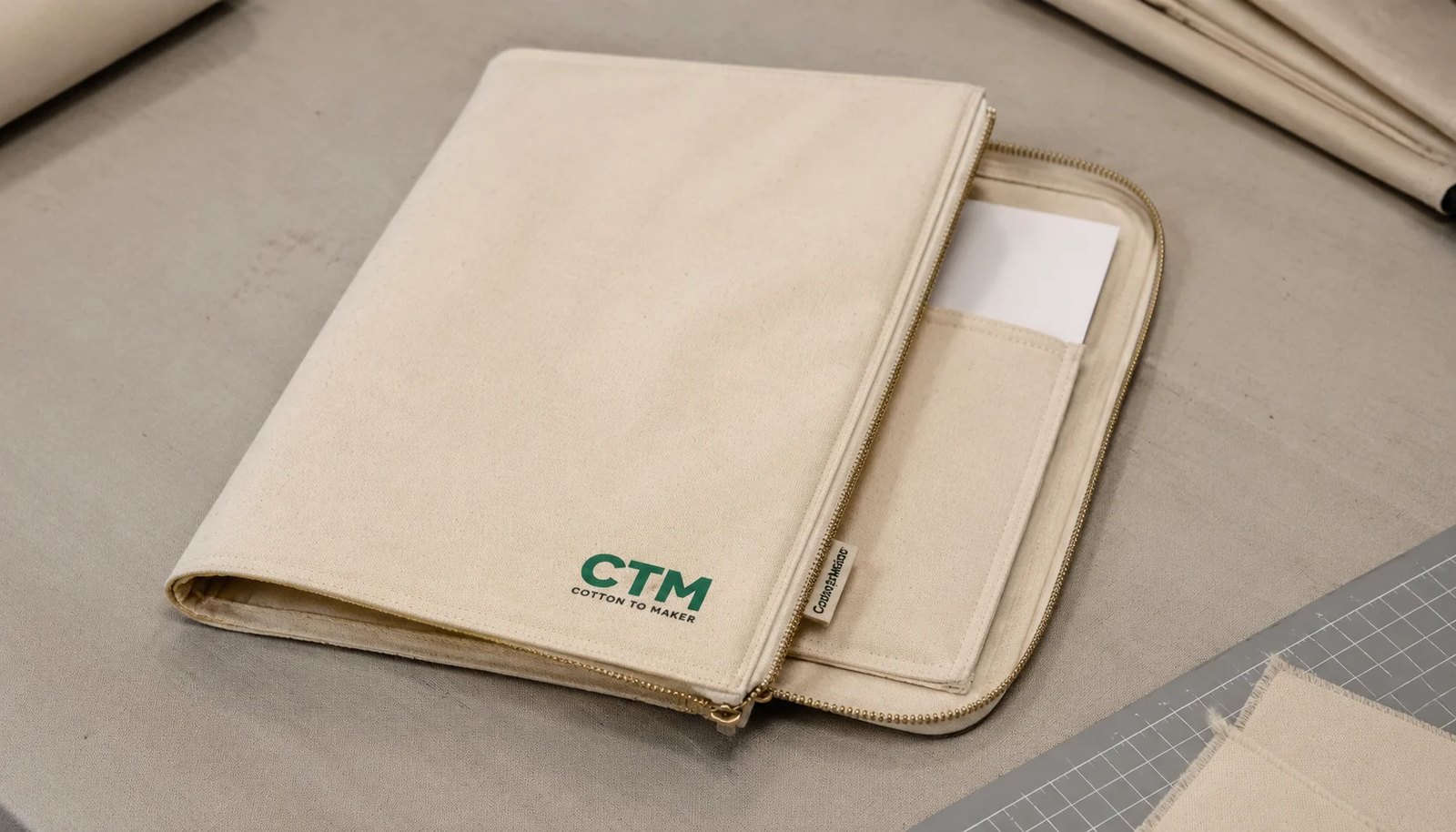
The buying problem: logo placement looks simple until the portfolio is sewn
A custom canvas zipper portfolio is not a flat poster. The logo is affected by zipper tape, seam allowance, fabric shrinkage, panel folding, canvas slubs, and the way the operator loads the piece for printing. For natural grocers, the brand mark often includes leaves, small text, certification language, or earthy color tones. Those details can become muddy or crooked if the placement is described only as 'front center logo'.
The safest RFQ defines the finished product first, then defines the printable area from finished edges. This matters because cutting panels may lose 10-15 mm per side during sewing, and the zipper edge can pull the panel slightly out of square. If the factory prints before sewing, placement must account for seam take-up. If it prints after sewing, the portfolio bulk may limit how close the screen frame can print to the zipper and corners.
- Use finished-edge dimensions: for example, logo centered horizontally, baseline 40 mm above finished bottom seam.
- Reserve a no-print zone of at least 25 mm from zipper tape, side seams, and bottom seam unless the supplier proves a closer result on sample.
- Avoid placing important text over heavy seam intersections, pocket edges, or folded gusset areas.
- Treat the approved sample as the placement standard, not just a color reference.
Define the portfolio body before deciding logo position
Most sourcing mistakes start when the buyer approves a logo mockup before confirming the actual portfolio size and construction. A zipper portfolio for grocery brand teams may need to hold US letter documents, A4 supplier sheets, coupons, recipe cards, a thin tablet, or store training material. A slightly undersized bag can make the product feel cheap even when the print is correct.
For a practical business portfolio, the buyer should specify the internal use size, finished outside dimensions, zipper opening, pocket arrangement, and whether the item is padded or unpadded. Padding gives a premium feel but changes the way the front panel lies under the print screen. A flat, unpadded 12 oz canvas panel is easier to print cleanly than a padded panel with uneven bulk near the zipper.
- Common finished sizes: about 260 x 350 mm for A4 documents, or about 250 x 330 mm for US letter with modest clearance.
- A top zipper opening is simpler and usually cheaper than a three-side zipper, but a three-side zipper may open flatter for sales kits.
- An inner slip pocket adds function but should be mapped so stitching does not create visible lines through the logo area.
- If the portfolio must hold a tablet, specify the maximum device size and whether protection is expected or only document organization.
Canvas weight and surface: the hidden driver of print quality
Natural canvas is attractive for grocery and wellness brands because it matches a low-waste, reusable image. However, natural canvas is not a uniform white print substrate. Yarn thickness, slubs, seed flecks, and fabric finishing affect the logo. A 10 oz canvas may be economical, but it can wrinkle around the zipper and show less structure. A 16 oz canvas feels premium, but it increases sewing bulk and carton weight.
For custom canvas zipper portfolios, 12 oz canvas, roughly 400-420 GSM, is often the balanced specification. It has enough body for repeated handling while still allowing stable screen printing and neat sewing. If the buyer wants a softer washed hand feel, the factory must test shrinkage and print behavior because washing can change panel size and logo position.
- 8 oz canvas, around 270 GSM: lower cost, lighter freight, but less structure and more risk of wrinkles around the logo.
- 10 oz canvas, around 330-360 GSM: acceptable for budget promotions, but sample should be checked with documents inside.
- 12 oz canvas, around 400-420 GSM: recommended baseline for zipper portfolios used as reusable business bags.
- 14-16 oz canvas, around 475-540 GSM: more premium hand feel, but higher sewing difficulty, higher shipping weight, and possible zipper bulk issues.
- Natural shade variation should be accepted within a defined range or controlled with lab dip and lot approval.
Logo placement rules that prevent zipper and seam interference
The front lower panel is usually the cleanest logo position because it stays visible when the portfolio is carried flat, placed on a meeting table, or stacked at an event. For natural grocers, a restrained logo position often looks better than oversized branding. A horizontal mark around 90-130 mm wide generally works well on A4 or letter-size portfolios.
The top area near the zipper is tempting because it is visible when the item is held, but it is also where zipper tape, pullers, and seam folding create the most production variation. If a logo is placed too close to the zipper, one batch may look acceptable and the next may appear crowded or tilted. Placement should be measured from the finished bottom and side edges, with a defined centerline and clear distance from hardware.
- Recommended standard: horizontal logo centered on front panel, 35-45 mm above finished bottom seam.
- For vertical logos, keep the artwork within the flat middle zone and avoid crossing pocket stitch lines.
- For small secondary marks, use an exterior woven side label or inner pocket print rather than shrinking the main logo until it becomes unreadable.
- For multi-location branding, define which logo is primary so the factory does not align every element independently without visual hierarchy.
Print method choices for natural grocer branding
Water-based screen print is often the best starting point for cotton canvas zipper portfolios. It gives a softer hand than heavy plastisol, fits one- or two-color grocery logos, and avoids a thick plastic feel. The tradeoff is that water-based ink can sink into coarse yarns, so fine reverse lines and small legal text may need to be enlarged or simplified.
Heat transfer can reproduce gradients and detailed artwork, but it may look less natural on unbleached canvas and can crack or lift if the transfer quality is poor. Embroidery is durable and premium, but it can pucker the panel and is not ideal for thin leaf details or small lettering. Woven labels and sewn patches are useful when the buyer wants consistent brand color across varied canvas shades.
- Use screen print for solid logos, simple taglines, and repeat programs with predictable unit cost.
- Use embroidery for small marks where texture matters more than fine detail, and approve puckering limits on sample.
- Use woven labels for consistent brand color, especially when natural canvas shade may vary by lot.
- Use heat transfer only after adhesion and wash/rub checks, especially if the portfolio will be handled daily.
- Avoid very small certification icons unless the print area and method can hold the detail clearly.
MOQ and cost drivers buyers should separate in the RFQ
MOQ is not only a factory preference. It is linked to fabric purchasing, dyeing or finishing, zipper procurement, printing setup, labor efficiency, and packing materials. A standard natural canvas zipper portfolio with one screen print location may be possible at 300-500 pieces, depending on the factory's stock fabric and production schedule. Custom dyed canvas, custom zipper tape, special pullers, or multiple print locations can push the practical MOQ higher.
When comparing quotes, buyers should separate unit price from setup charges and sample fees. A low unit price may exclude screen charges, revised samples, carton labels, export packing, or local transport to port. For a distributor or importer, the landed cost difference may be driven as much by carton volume and gross weight as by the factory unit price.
- Main cost drivers: canvas GSM, zipper grade, lining or padding, number of pockets, print color count, print positions, labels, and packing method.
- One-color screen print usually has lower repeat cost than embroidery or patch application.
- Heavy canvas increases product cost and can also increase freight by both weight and carton size.
- Custom zipper pullers add tooling or MOQ risk; consider standard pullers with a woven side label if timing is tight.
- Quote comparison should show EXW, FOB, or delivered terms clearly, because inland freight and export handling are not always included.
Sample approval: what a useful pre-production sample must prove
A flat print strike-off is useful for ink color and artwork detail, but it does not prove the final portfolio will look right. The buyer needs a sewn pre-production sample made with the quoted canvas weight, zipper, pocket construction, print method, and packing fold. This sample reveals whether the logo sits level after sewing, whether the zipper pull touches the print, and whether the panel wrinkles after documents are inserted.
Natural grocer buyers often care about the overall material impression, not only the logo. The sample should be reviewed under normal daylight and store-office lighting because unbleached canvas can shift the perceived print color. If the brand green turns too dull on natural fabric, the ink may need adjustment or a different print method.
- Measure finished size, zipper opening length, logo distance from bottom seam, and logo centerline.
- Photograph the sample flat, filled with documents, zipped closed, and stacked with another piece.
- Rub the printed logo lightly with a white cloth after curing to detect loose ink or poor fixation.
- Open and close the zipper at least 20 cycles on the sample to catch catching or rough pull issues.
- Seal the approved sample or create a signed digital approval sheet with dimensions and placement photos.
QC thresholds for logo placement, printing, and zipper function
QC should not be written as 'good quality' or 'same as sample'. For canvas zipper portfolios, the inspection plan should include measurable placement tolerance, print appearance criteria, zipper function, seam security, fabric cleanliness, and packing condition. Without these details, the factory and buyer may disagree about whether a slightly slanted logo is acceptable.
A practical tolerance for screen-printed canvas goods is often plus or minus 5 mm for logo position from the approved location. Tighter tolerance may be possible, but it should be agreed before pricing because it can slow production and increase rejection rate. Canvas is cut and sewn by people, and the material can move; the goal is to control visible defects, not specify an unrealistic machine-like tolerance.
- Logo tilt: visually level, with no obvious slant when compared with the bottom seam; define a maximum if your inspection team uses angle measurement.
- Print defects: reject heavy smearing, missing ink in key logo areas, double images, major pinholes, and unreadable brand text.
- Zipper function: every inspected piece should zip smoothly without fabric caught in the slider.
- Seam strength: stress points at zipper ends and corners should not open under normal hand pull.
- Fabric defects: reject stains, mildew odor, major oil marks, and large slubs crossing critical logo details.
- Carton condition: no crushed cartons, water damage, or excessive compression that marks the printed panel.
Packing choices that protect the print and control freight cost
Packing is part of the product specification because it affects both the arrival condition and landed cost. Canvas zipper portfolios should normally be packed flat when the logo needs to stay clean and uncreased. Folding may reduce carton size, but it can create a line through the printed logo or press the zipper pull into the fabric. If folding is required for parcel shipments or retail shelf packs, the fold position must be approved on sample.
The zipper puller is a small detail that causes real damage during transit. If the puller rests directly on the printed logo, stacked pressure can leave an impression or scratch. A tissue insert, puller parking position, or alternating stack direction can prevent this. For importers, carton dimensions and gross weight should be collected at quotation stage so the freight forwarder can estimate cost before the PO is placed.
- Flat pack is preferred for clean logo presentation and lower crease risk.
- Individual polybags protect against moisture and dirt, but some natural grocers prefer reduced plastic; paper bands or master polybag options can be discussed.
- Use tissue or protective paper near zipper pulls when hardware may touch the printed panel.
- Request carton quantity, carton size, net weight, and gross weight before order confirmation.
- For retail distribution, define barcode labels, carton marks, country-of-origin label placement, and any inner pack quantity.
Lead time risks and quote data that make comparisons fair
Lead time depends on more than sewing capacity. Artwork approval, ink mixing, screen making, canvas availability, zipper procurement, sample shipping, buyer review time, and final inspection all affect the delivery date. A standard order might move quickly when the factory has fabric and zipper stock, but a special canvas shade or custom puller can add weeks before production even starts.
A good quote for custom canvas zipper portfolios should provide enough data for procurement to compare suppliers on the same basis. If one supplier quotes 10 oz canvas with printed logo after sewing and another quotes 12 oz canvas with pre-sewing print and reinforced zipper ends, the lower price is not necessarily better. The RFQ should force each supplier to state materials, construction, logo method, tolerances, packing, and commercial terms.
- Quote data to require: finished size, canvas oz/GSM, fabric finish, zipper specification, lining or pocket details, logo size and method, number of print colors, MOQ, sample charge, setup charge, unit price, packing, carton data, lead time, and trade term.
- Schedule risk increases with custom dyed fabric, custom zipper tape, metal logo plates, multi-location printing, and strict retail packing.
- Buyer review time should be built into the timeline; late artwork changes after sample approval can reset the production clock.
- For urgent programs, choose stock natural canvas, standard zipper, one-color screen print, and flat bulk packing.
Specification comparison for buyers
| Spec decision | Recommended option | When it fits | Buyer risk to check |
|---|---|---|---|
| Front logo position | Centered on lower front panel, 35-45 mm above bottom seam and clear of zipper line | Best for natural grocery loyalty kits, employee onboarding folders, and vendor meeting portfolios | Logo placed too high can look crowded against the zipper; logo placed too low may distort near the bottom seam after sewing |
| Logo size | 90-130 mm wide for a horizontal logo on A4 or letter-size portfolios | Works for most grocer brand marks without turning the bag into a billboard | Large logos over 160 mm may need a bigger screen, higher print cost, and stricter registration control |
| Fabric weight | 12 oz canvas, roughly 400-420 GSM, pre-shrunk or well-compacted | Balanced choice for portfolios that must hold samples, papers, coupons, and small tablets | Light 8-10 oz canvas may wrinkle around the print; heavy 16 oz canvas can increase sewing bulk and freight weight |
| Print method | Water-based screen print for one- to two-color natural grocer logos | Best for earthy branding, soft hand feel, and repeat bulk orders | Fine reversed text and thin leaf details can fill in on coarse canvas unless artwork is adjusted |
| Logo on pocket vs main panel | Main exterior panel for brand visibility; inner pocket for secondary message or website | Fits retail buyer events, supplier summits, and store team training kits | Printing on assembled pockets may be uneven; pocket printing should be done before sewing whenever possible |
| Zipper selection | No. 5 nylon or antique brass zipper with puller parked away from logo area | Good for reusable business portfolios where function matters more than decorative trim | Metal zipper teeth can scratch adjacent print during packing if no tissue or correct folding is used |
| MOQ logic | 300-500 pcs for standard canvas and one-position print; higher if custom dyed fabric or woven label is added | Suitable for regional natural grocer promotions and distributor programs | Small orders may carry sample, screen, and setup charges that make unit price comparisons misleading |
| Packing method | Flat pack with tissue at zipper/puller area, 25-50 pcs per export carton depending on size and GSM | Reduces creasing and protects printed panels during ocean or parcel shipment | Over-compressed cartons can create permanent zipper impressions across the printed logo |
Buyer checklist before sampling
- Define portfolio size by actual document or tablet use: A4, US letter, or custom insert size, then add seam allowance and zipper clearance.
- State canvas weight in oz and approximate GSM, not only 'heavy canvas' or 'natural cotton'.
- Provide logo artwork in vector format with Pantone or CMYK reference, plus minimum acceptable logo width.
- Mark the logo placement from finished bag edges, not from cutting panel edges.
- Keep print at least 25 mm away from zipper tape, side seams, bottom seam, and folded corners unless the factory confirms it is printable.
- Decide whether natural canvas shade variation is acceptable or whether shade approval must be part of the sample process.
- Specify zipper type, zipper color, puller style, and whether the zipper must close left-to-right or right-to-left.
- Approve a physical pre-production sample after sewing, not only a flat print strike-off.
- Set logo placement tolerance, common acceptable range being plus or minus 5 mm for screen print on sewn canvas goods.
- Require carton packing details, including pieces per polybag if used, carton size, gross weight, and whether flat packing or folded packing is planned.
Factory quote questions to send
- What canvas weight in oz and GSM are you quoting, and is it greige, bleached, dyed, washed, or pre-shrunk natural canvas?
- Will the logo be printed before sewing or after assembly, and how will that affect placement tolerance?
- What is the recommended clear area from zipper, seams, and corners for our artwork size?
- Which print method is included in the quote: water-based screen print, plastisol screen print, heat transfer, embroidery, woven label, or patch?
- Are screen charges, artwork adjustment, print strike-off, and pre-production sample charges included or listed separately?
- What is the MOQ for this exact fabric, zipper, print color count, and packing method?
- What zipper size, zipper material, zipper tape color, and puller style are included in the base price?
- What are the production lead time and sample lead time after artwork and deposit approval?
- How many pieces per carton, what carton dimensions, and what gross weight should we use for freight estimation?
- What QC standard will be used for logo position, print defects, zipper function, seam strength, stains, and carton drop damage?
Quality-control points to confirm
- Logo centerline should align to the finished front panel within plus or minus 5 mm unless a tighter tolerance is agreed before sampling.
- Print edges should be sharp enough that small text remains readable at normal viewing distance; no heavy bleeding into canvas yarns.
- Print adhesion should pass light rub testing after curing, with no obvious flaking, powdering, or tacky surface.
- Zipper should open and close smoothly for the full length without catching the lining, loose threads, or zipper tape.
- Finished portfolio size should match approved sample within agreed tolerance, commonly plus or minus 5-8 mm for cut-and-sewn canvas goods.
- Seams at zipper ends and portfolio corners should have reinforcement or secure backstitching to prevent early failure.
- Canvas surface should be free from oil stains, heavy slubs directly across the logo, mildew odor, and visible needle damage.
- Cartons should not be overpacked; printed panels must not be crushed against zipper pulls or sharp hardware.
- Random inspection should include both visual logo placement checks and functional zipper testing, not only carton count.
- Approved sample should remain sealed or digitally archived with measurements, placement photos, fabric swatch, and print color record.