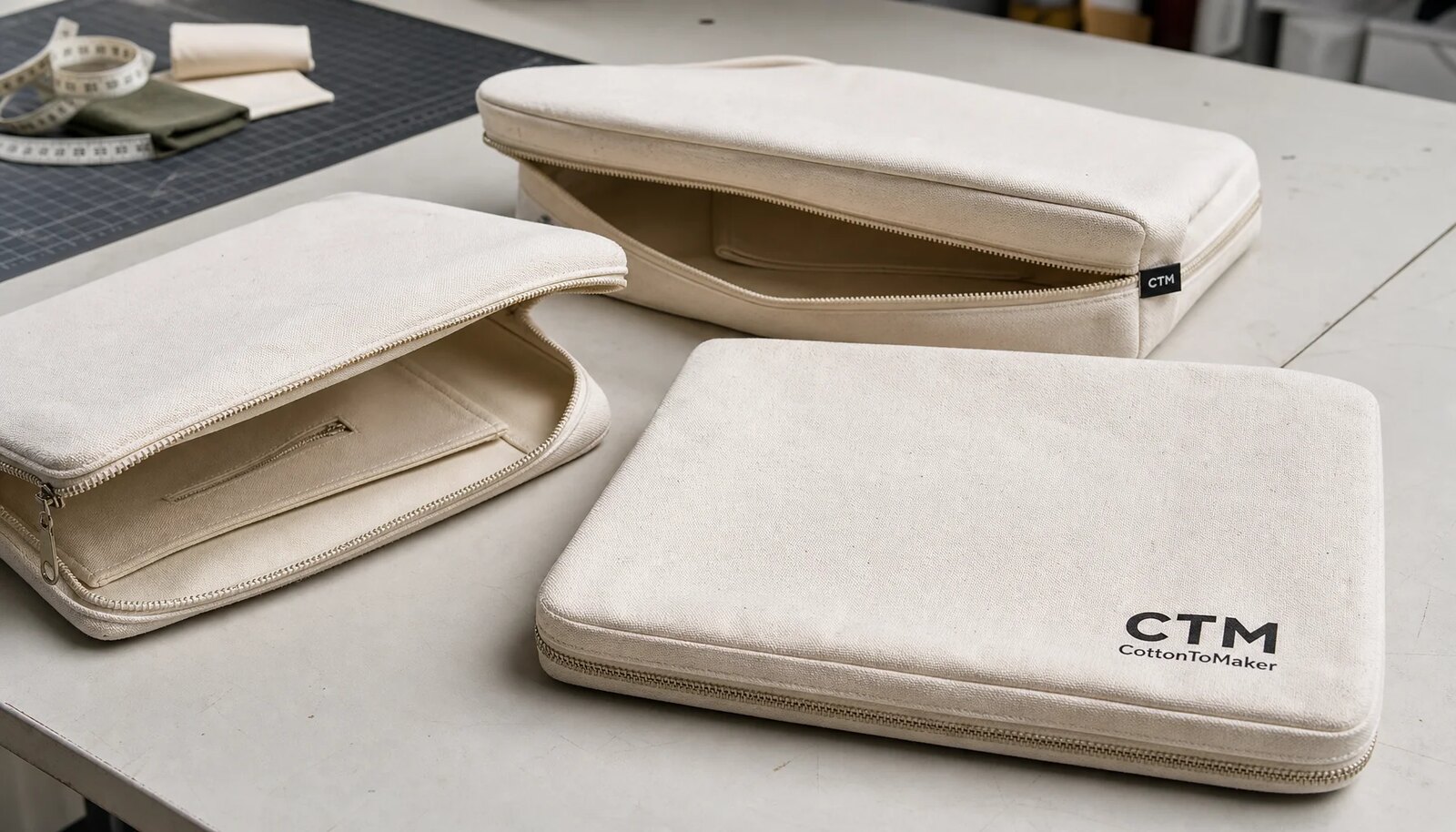
Buying Problem: Logo Placement Controls Retail Value
For craft fairs, a canvas zipper portfolio is not only a document holder. It often carries prints, stationery, receipts, samples, maker catalogs, workshop materials, or small craft kits. The buyer sees the front panel while the item is stacked on a booth table, hung from a peg, or handed over as branded packaging. If the logo is too low, too close to the zipper, or hidden by a fold, the product loses shelf impact even when the bag construction is acceptable.
Procurement teams should treat logo placement as a production specification, not a decoration note. The correct RFQ should define the printable zone, logo size, logo method, tolerance, fabric weight, and packing direction. Without those details, two suppliers may quote very different products while both say they can make custom canvas zipper portfolios. One quote may include a durable screen print on 16 oz canvas, while another assumes lightweight 10 oz canvas and a small heat transfer. The unit price difference may look attractive until samples reveal weak structure or poor logo visibility.
- Main buying issue: making the logo visible without creating printing, sewing, or packing defects.
- Best RFQ focus: front-panel dimensions, artwork size, print method, canvas GSM, zipper position, and tolerance.
- Common mistake: approving a digital mockup without checking the real seam allowance and zipper curve.
Portfolio Size and Logo Zone
Start with the contents before choosing logo placement. A portfolio for A4 catalogs, 8.5 x 11 inch prints, or craft workshop sheets needs a different front-panel area than a smaller receipt pouch or tablet sleeve. For business-bag style zipper portfolios, buyers usually want enough structure for papers to stay flat, but not so much bulk that the item becomes costly to ship. The usable logo area is the flat panel area after excluding seam allowance, zipper tape, corner curve, handle base, and any front pocket.
A practical placement drawing should show the finished bag size, logo centerline, distance from left and bottom seam, zipper direction, and whether the logo faces the customer when the zipper pull is on the right or left. For most flat canvas portfolios, a front-center logo between 80 and 120 mm wide works well. For subtle brand positioning, a lower-right logo between 60 and 90 mm wide can look cleaner, but only if the booth display does not cover the lower panel.
- For A4 use, keep the logo away from zipper ends where fabric tension is higher.
- For stacked table display, place the logo high enough to remain visible when items overlap.
- For hanging display, confirm the hang orientation before approving logo direction.
- For kits with labels or belly bands, prevent the packing label from covering the printed logo.
Canvas Weight and Structure
Canvas weight affects both logo quality and the way the portfolio sits on a craft fair table. A very light canvas may fold nicely and reduce cost, but it can look soft when used as a business portfolio. A very heavy canvas gives stronger perceived value, but it increases sewing resistance around zipper corners and may make the item feel too bulky for flat documents. For this product category, many buyers evaluate 12 oz to 16 oz cotton canvas, roughly 340 to 540 GSM depending on yarn and weave.
Do not compare supplier quotes using only ounce weight. Some factories quote finished fabric after washing, while others quote greige fabric before dyeing or finishing. A 14 oz canvas from one mill can feel different from another because yarn count, weave tightness, shrinkage, and finishing change the hand feel. For logo placement, tighter weave usually gives cleaner print edges, while very slubbed natural canvas can make small text look broken.
- 10 oz canvas: lower cost and easier sewing, but less structured for premium portfolios.
- 12 oz canvas: balanced option for craft fair giveaways and mid-range retail use.
- 14 oz canvas: stronger hand feel and better table presentation for branded merchandise.
- 16 oz canvas: premium structure, but higher freight weight and more care needed at zipper seams.
- Natural canvas: popular craft look, but color variation affects logo contrast.
Choosing the Logo Method
Screen printing is usually the first method to compare for custom canvas zipper portfolios because it handles solid logos well and scales efficiently in bulk. It is suitable for one to three spot colors, bold maker logos, event branding, and distributor programs. Buyers should specify whether an underbase is needed, especially on dyed canvas. On natural canvas, black, dark green, navy, and deep brown often print clearly, but fine type still needs a stroke thickness that survives the canvas texture.
Embroidery, heat transfer, woven labels, and patches each solve different problems. Embroidery gives a premium textile feel but can pucker the front panel if the canvas is not backed properly. Heat transfer handles gradients and detailed artwork, but buyers should test edge adhesion and abrasion. A woven side label is useful when one blank portfolio body will serve multiple brands, but label MOQ and sewing placement must be locked before bulk sewing. Leather or PU patches can look upscale, but the buyer should confirm patch thickness, stitch method, and whether the patch creates pressure marks during packing.
- Use screen print for clean spot-color logos and cost-efficient repeat orders.
- Use embroidery for simple premium marks, not tiny text-heavy artwork.
- Use heat transfer for multicolor art when MOQ is low or artwork changes often.
- Use woven labels for flexible branding across several SKUs.
- Use patches only after checking packing pressure and needle-hole consistency.
Placement Mistakes That Raise Cost
The most expensive logo placement mistakes are usually found after sample approval is already late. A logo placed too close to the zipper line may look fine on a flat drawing, but it can bend or disappear when the zipper is filled with papers. A logo printed across a pocket seam may break during sewing or show registration drift. A large logo on a coarse canvas may require more ink, slower drying, and a higher rejection rate. These details do not always appear in a low initial quote.
A safer approach is to define a no-print zone around seams and zipper areas. For standard canvas zipper portfolios, many factories prefer at least 15 to 25 mm clearance from seam lines and more clearance near zipper ends or curved corners. If the buyer wants edge-to-edge branding, the factory may need to print panels before sewing, which changes workflow, registration control, and defect risk. Printing before sewing can look strong, but it requires tighter cutting and sewing control to keep the logo aligned after assembly.
- Avoid placing small text over slubbed or uneven fabric areas.
- Avoid printing across seam joins unless the brand accepts broken artwork.
- Avoid oversized logos that force panel printing before sewing without extra tolerance.
- Avoid approving artwork scale without testing the real fabric texture.
- Avoid assuming front and back panels have the same flat printable area.
MOQ Logic and Cost Drivers
MOQ is not only about the number of portfolios. It is also driven by fabric purchase quantity, dye lot, printing setup, zipper color, label MOQ, packing materials, and cutting efficiency. A factory may accept a lower quantity for natural canvas with standard zipper colors, but require a higher MOQ for custom dyed canvas, special zipper tape, branded pullers, or woven labels. Buyers should separate the bag MOQ from decoration MOQ so quote comparisons are fair.
The main cost drivers are canvas weight, construction complexity, number of compartments, zipper quality, logo method, number of logo colors, packing style, and inspection requirements. A simple flat zipper portfolio with one screen print is a different product from a lined portfolio with inner pocket, pen loop, reinforced corners, woven label, hangtag, barcode sticker, and retail polybag. For importers and distributors, the cheapest quote is rarely the best reference unless every cost item is defined.
- Lower MOQ is easier with natural or stock-color canvas and standard zipper tape.
- Higher MOQ is common for custom dyeing, custom woven labels, branded pullers, and printed retail packaging.
- Screen charges are usually linked to artwork colors and positions.
- Embroidery cost depends on stitch count, backing, and machine time.
- Packing cost changes when the order needs barcodes, hangtags, inner cartons, or retail-ready sorting.
Sample Approval Workflow
A good sample workflow separates construction approval from logo approval when time allows. First, confirm the portfolio size, canvas weight, zipper movement, pocket layout, and hand feel. Then approve the logo strike-off on the actual canvas. Finally, approve a full pre-production sample that combines final fabric, final logo, final trims, and final packing. This prevents a common problem: the buyer approves a beautiful logo strike-off on fabric, but the finished product changes because the zipper seam shifts the printable area.
Sample comments should be written as measurable corrections. Instead of saying the logo should be higher, state that the logo baseline should move 20 mm upward from the bottom seam. Instead of saying the print is too light, provide a Pantone target or approved reference sample. For craft fair programs with multiple sellers or booth teams, it is useful to photograph the sample in the planned display position: stacked flat, standing in a basket, clipped to a rack, or packed with inserts.
- Blank sample: verifies shape, size, zipper, stitching, and canvas hand feel.
- Logo strike-off: verifies color, ink coverage, edge sharpness, and artwork scale.
- Pre-production sample: verifies final combined product before bulk cutting.
- Packing sample: verifies fold direction, logo protection, barcode position, and carton fit.
- Sealed sample: becomes the standard for production and inspection.
QC Thresholds for Bulk Inspection
Quality control for logo placement should include both measurement and appearance. A reasonable placement tolerance for standard front-panel screen printing is often around ±5 mm, but the buyer can request tighter tolerance if the artwork is geometric or aligned to a pocket. Tighter tolerance may increase production control requirements and inspection rejection risk. For handmade-looking craft fair goods, buyers may accept small variation, but the logo must still look intentional and consistent across cartons.
Inspection should also cover zipper function, seam strength, fabric defects, print durability, odor, color shade, and packing. For logo durability, simple buyer-side tests include dry rub, light wet rub, tape pull, fold at the printed area, and abrasion against another canvas panel. These are not substitutes for formal lab testing when required, but they quickly catch weak curing, poor adhesion, or heavy ink cracking before the goods move to shipment.
- Logo position: measure from fixed seam points, not from a soft folded edge.
- Logo color: compare under consistent daylight or light box conditions.
- Print quality: reject obvious bleeding, missing ink, smudges, offset, and severe pinholes.
- Zipper function: test full opening and closing, especially at corners and end stops.
- Seam strength: inspect stress points near zipper ends, pocket openings, and handle bases if included.
- Carton audit: confirm quantity, SKU sorting, carton marks, moisture protection, and packing direction.
Packing for Craft Fair Distribution
Packing is part of logo protection. If printed portfolios are folded too tightly, the front panel can crease through the logo. If items are packed before ink is fully cured, ink can transfer to the next unit. If zippers press against printed panels during carton compression, buyers may see pressure marks when goods arrive. For retail buyers and distributors, the packing method should match how the goods will be received, stored, and displayed.
Individual polybags are common for warehouse control, but some craft fair brands prefer paper belly bands or recyclable sleeves to reduce plastic use. If paper packaging is used, confirm whether it rubs against the print or hides the logo at display. Export cartons should not be overloaded because canvas portfolios are flat but dense. The carton should protect corners and zipper ends without forcing the products into a shape they cannot recover from.
- Use interleaving or face-to-back packing when print offset risk is high.
- Keep zipper pulls turned away from printed logo surfaces when possible.
- Confirm whether hangtags, barcode labels, or belly bands cover the logo.
- Use carton dimensions that avoid bending the portfolio body.
- Add moisture control where shipping route, season, or destination warehouse requires it.
Lead Time and Schedule Risk
Lead time depends on artwork approval as much as sewing capacity. A simple natural canvas portfolio with one screen-printed logo can move faster than a custom dyed, lined, multi-pocket portfolio with woven label and special zipper puller. Buyers often lose time because artwork is approved digitally but not approved on real fabric. Another common delay is label production: woven labels, branded zipper pullers, and custom patches can take longer than the bag body.
A realistic schedule should show material booking, sample making, sample transit, buyer approval, bulk fabric inspection, cutting, printing or embroidery, sewing, final QC, packing, and export handover. If the program is tied to a craft fair date, do not use the event date as the factory deadline. Work backward from warehouse receiving, domestic distribution, and booth kit packing. A small schedule buffer is cheaper than air freight or event inventory failure.
- Fastest route: stock natural canvas, standard zipper, one-position screen print, simple packing.
- Moderate risk: custom color canvas, lining, inner pockets, woven label, or multiple logo positions.
- High risk: new patch mold, branded zipper puller, complex embroidery, or strict retail packaging.
- Approval bottleneck: unclear artwork files, missing Pantone references, and late sample comments.
- Shipping risk: dense cartons, late inspection booking, and missing carton mark requirements.
Specification comparison for buyers
| Spec decision | Recommended option | When it fits | Buyer risk to check |
|---|---|---|---|
| Front-center logo placement | 80-120 mm wide logo centered on the front panel, positioned above the lower seam allowance | Best for craft fair retail tables where portfolios are stacked flat and buyers see the face panel first | Logo may distort if printed too close to zipper pull, edge binding, or a curved gusset area |
| Lower-right logo placement | 60-90 mm wide logo placed 35-50 mm from bottom and side seam on medium portfolios | Fits minimalist brands, artisan stationery kits, and higher-end gift packaging where subtle branding is preferred | Small logos lose visibility on coarse 12-16 oz canvas unless artwork has clean strokes |
| Woven side label | Cotton or polyester label sewn into side seam or zipper seam, 20-35 mm visible length | Useful when the front panel needs to stay clean or when one portfolio body serves several brand programs | Label MOQ, sewing accuracy, and color matching can create delays if approved after main sample |
| Screen print on canvas | Spot-color screen print with underbase on darker canvas and 1-3 solid colors | Most cost-effective for repeat fair programs, wholesale runs, and logos with strong line work | Ink can bleed on loose-weave canvas if mesh, viscosity, and curing are not controlled |
| Embroidery logo | Small chest-style embroidery up to 80 mm wide using reinforced backing | Works for premium craft kits, stationery brands, and logos with simple shapes | Heavy stitch count can pucker 10-12 oz canvas or make the front pocket feel stiff |
| Heat transfer logo | Matte transfer for gradients, small text, or short runs with multicolor artwork | Fits low MOQ launches, seasonal craft fair collections, or distributor testing | Edges may lift after abrasion if curing pressure, temperature, or wash test is not verified |
| Canvas weight | 12 oz to 16 oz cotton canvas, roughly 340-540 GSM depending on construction | Balances structure, table presentation, and freight cost for zipper business bags used as retail portfolios | Heavier canvas improves hand feel but raises sewing difficulty, carton weight, and zipper stress |
| Packing method | Individual polybag or paper belly band, silica gel where required, 20-50 pcs per export carton | Best for retail-ready craft fair inventory, distributor repacking, and warehouse receiving control | Over-tight packing can crush zipper corners, crease printed panels, or transfer ink between units |
Buyer checklist before sampling
- Define portfolio size by actual contents: A4 papers, sketch pads, receipts, tablet sleeve, pen loop, or craft kit inserts.
- Specify canvas weight in oz and GSM range, not only the word canvas.
- Send logo artwork with exact size, Pantone references, placement drawing, and maximum print area.
- Choose one primary logo method before sampling; changing print method after sample approval changes cost and timing.
- Set logo tolerance: placement within ±5 mm for standard screen print, tighter only if the design requires it.
- Confirm zipper type, zipper color, puller style, and whether the zipper area can contact printed artwork.
- Require a pre-production sample with final fabric, zipper, logo method, lining, and packing format.
- Review logo durability by rub test, tape test, fold test, and basic color comparison under daylight.
- Approve carton packing with sample photos showing fold direction, inner protection, and carton marks.
- Request quote breakdown for fabric, logo process, trims, packing, sample charge, mold or screen charge, and inland freight.
Factory quote questions to send
- What canvas construction and GSM are included in this quote, and is it washed, dyed, bleached, or natural greige canvas?
- What is the maximum printable area on the front panel after seam allowance, zipper allowance, and pocket construction are considered?
- Which logo method is quoted: screen print, embroidery, heat transfer, woven label, leather patch, or combined branding?
- What logo size and number of print colors are included, and what is the upcharge for each additional color or position?
- What is the MOQ for the bag body, and is there a separate MOQ for woven labels, zipper pullers, lining fabric, or printed packing?
- Can you provide a placement template with dimensions from seam edge, zipper line, and bottom edge before sampling?
- What sample types are available: blank construction sample, logo strike-off, full pre-production sample, and sealed sample?
- What acceptance tolerance do you use for logo position, print color, zipper function, seam strength, and carton quantity?
- How many days are needed for material sourcing, sample making, logo approval, bulk cutting, printing, sewing, QC, and packing?
- What quote data is not included, such as export carton printing, hangtags, barcode labels, document pouch, fumigation, or local trucking?
Quality-control points to confirm
- Logo placement should match approved template within the agreed tolerance, normally ±5 mm for front-panel screen print.
- Print edges should be clean without obvious bleeding, pinholes, ghosting, cracking, or ink transfer to adjacent panels.
- Canvas GSM should be checked from cutting-room material records and random weight verification, not judged only by hand feel.
- Zipper should open and close smoothly for the full length without skipped teeth, crooked tape, or loose stopper stitching.
- Seam allowance should be consistent at stress points around zipper ends, corners, handle attachments, and pocket openings.
- Embroidery or patch backing should not scratch documents, tablets, or inner contents inside the portfolio.
- Finished dimensions should allow the target insert or document size without forcing the zipper curve.
- Packing should protect the printed logo surface from crease marks, moisture, abrasion, and ink offset during shipment.