Buying Problem: Logo Placement on a Zipper Portfolio Is Not the Same as a Tote Bag
A custom canvas zipper portfolio for an artisan bakery is usually handled in a different way from a tote, pouch, or drawstring bag. It may sit on a distributor desk during a wholesale pitch, hold price lists for a franchise partner, carry product cards for a trade fair, or ship as part of a retail gifting set. The logo must look intentional when the portfolio is closed, but it also has to survive sewing tension, zipper bulk, carton compression, and daily handling.
The common mistake is to approve a flat digital layout without allowing for the zipper tape, binding, corner radius, seam allowance, and fabric movement. On canvas, even a clean bakery wordmark can look crooked if it is placed too close to an edge that shifts during sewing. Treat logo placement as a production spec, not a graphic design preference.
- Use this guide when ordering canvas zipper business bags, document portfolios, bakery presentation folders, or wholesale sales kits.
- Keep the buying decision focused on one problem: where the logo should sit so it stays visible, straight, clean, and durable after production.
- For bakery branding, avoid placing fine logo details directly over seam bulk, zipper pressure points, or folded packing lines.
Define the Portfolio Use Before Choosing the Logo Position
Logo placement should follow the way the portfolio is used. A bakery sales representative carrying wholesale catalogs needs a front logo that is visible when the portfolio lies flat on a counter. A franchise welcome kit may need a quieter logo and a premium woven side label. A retail gift-with-purchase may need stronger shelf presence and a larger print. These are different product roles, even if the base bag shape looks similar.
Procurement teams should write the use case into the RFQ because it changes the factory recommendation. If the portfolio will hold A4 or US Letter sheets, the front panel area is larger and can accept a lower-third logo. If it holds small recipe cards or voucher packs, an oversized front print may make the product look like giveaway packaging rather than a professional business portfolio.
- Wholesale sales folder: centered lower-third logo, moderate size, flat-pack protection.
- Franchise kit: smaller logo, woven label option, firmer canvas, cleaner inside finishing.
- Trade fair handout: screen print logo with stronger visibility and controlled unit cost.
- Retail gift pack: front logo plus hangtag may work better than a very large front print.
- Internal staff pack: durable zipper and easy-clean darker canvas may matter more than decorative complexity.
Canvas Weight, GSM, and Structure Affect Logo Appearance
For zipper portfolios, canvas weight is not only a cost line. It affects how flat the front panel stays, how sharply the corners can be sewn, and whether the print surface looks smooth. A 10 oz canvas may be acceptable for light promotional folders, but it can collapse around a zipper when filled with catalogs. For most bakery business portfolios, 12 oz / roughly 380-410 GSM is a practical starting point. A 14 oz / roughly 450-480 GSM canvas gives a firmer and more premium feel, but it adds bulk at the seams.
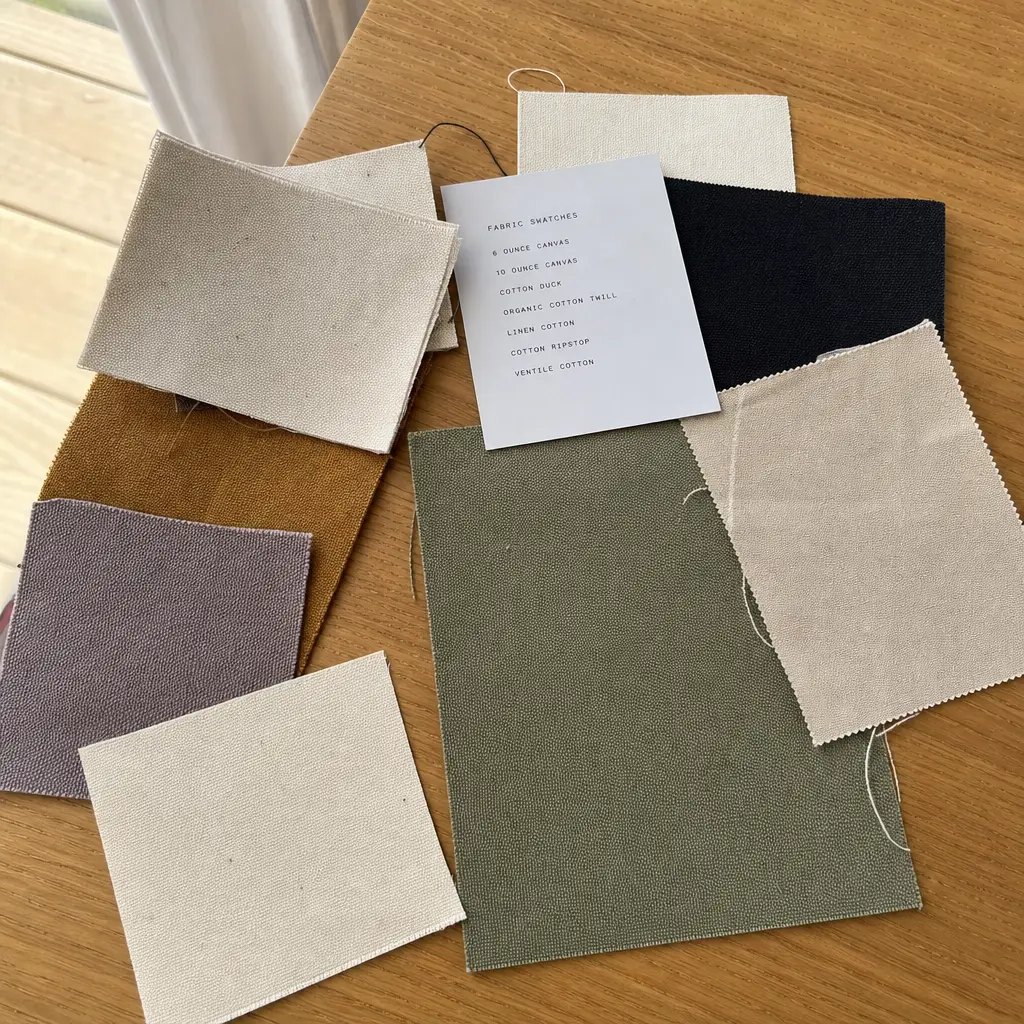
Natural cotton canvas fits artisan bakery branding because the fabric texture supports a craft look. However, natural canvas has slubs, seed specks, and shade variation. If the logo includes thin type, small registration marks, or light ink, the buyer should request a print test on the actual fabric lot. Bleached or dyed canvas gives a more controlled background, but custom dyeing changes MOQ, lead time, and shade approval work.
- Quote fabric as both oz and GSM, with tolerance, because factories and buyers may use different measurement habits.
- Use lining when the buyer wants a smoother inside and better document protection, but include lining GSM in the RFQ.
- Avoid very heavy canvas if the design has tight corner curves or multiple internal pockets.
- For natural canvas, approve the acceptable level of slub and seed visibility in the logo area.
- If the logo is white on dark canvas, request opacity testing before bulk approval.
Logo Placement Zones That Usually Work
The safest position for a front logo is the lower right or lower center area, with enough distance from the zipper, seams, and corners. For a typical document-size canvas zipper portfolio, a wordmark between 90 and 140 mm wide often reads well without overpowering the product. A round bakery seal or small wheat icon may work better at 45 to 70 mm. The logo should not sit where the zipper puller rests during packing or where the fabric folds inside the carton.
A factory should mark logo position from stable reference points, such as the finished bottom edge and finished side seam, not from an unfinished cut panel. Canvas panels can shift during sewing and pressing. If the artwork must align with a pocket, label, or stitch line, the technical drawing should show dimensions after sewing. This is where many buyer-approved mockups fail: the print is correct on the flat panel but visually wrong on the finished product.
- Keep at least 35-45 mm clearance from zipper teeth, binding, and corner seams for most screen-printed logos.
- Use a lower-third placement when the portfolio is often placed flat on a table during bakery sales meetings.
- Use a small side label when the brand wants a subtle premium look instead of a promotional front print.
- Avoid printing across the spine or fold area unless the factory tests the design on a finished sample.
- Measure logo position from finished edges, and state the acceptable tolerance in millimeters.
Decoration Method: Screen Print, Embroidery, Woven Label, or Heat Transfer
Screen print is usually the most practical method for custom canvas zipper portfolios for artisan bakeries. It handles solid bakery wordmarks, simple icons, and one- to three-color brand marks at a controlled cost. It also keeps the product flat and flexible. The factory should confirm ink type, curing process, print handfeel, and whether the ink will resist rubbing against tissue paper, catalogs, or other portfolios during packing.
Embroidery can look premium, but it is not always suitable for zipper portfolios. Dense embroidery can pucker canvas, add stiffness, and interfere with documents inside the front panel. Woven labels are useful when the logo is small, detailed, or used across several bag styles. Heat transfer can handle gradients and complex artwork, but buyers should test edge lifting, handfeel, and long-term cracking, especially if the portfolio may be pressed flat in cartons.
- Screen print: best for solid logos, repeat bulk orders, and cost-controlled bakery programs.
- Embroidery: suitable for small marks, but watch puckering and backing visibility.
- Woven label: good for subtle brand identity and multi-product consistency.
- Heat transfer: useful for gradients, but test cracking, edge lift, and shine on canvas.
- Debossing is uncommon on plain cotton canvas unless a leather or PU patch is added, which changes compliance and cost.
MOQ and Cost Drivers Buyers Should Separate in the Quote
The MOQ for a canvas zipper portfolio is usually driven by material, zipper, decoration, and cutting efficiency. A standard natural canvas with one-color screen print may be possible at lower MOQ than a custom dyed canvas with branded zipper puller and woven label. Buyers often receive confusing quotes because suppliers bundle these factors into one number. A clean RFQ should ask for the MOQ by component so the team can see where the real constraint sits.
Cost also changes with structure. A simple single-compartment portfolio costs less than a lined version with interior document pockets, pen loops, reinforced corners, and branded puller. Logo placement can affect cost if it requires printing after partial assembly or special jigs for alignment. For most bulk orders, printing on cut panels before sewing is more efficient, but the factory must control panel shrinkage and sewing alignment.
- Separate the quote into bag body, lining, zipper, logo decoration, labels, packing, sample charge, and freight basis.
- Ask for one quote using stock canvas and one quote using custom dyed canvas if brand color is important.
- Confirm whether screen charges are one-time, per color, per size, or repeated for reorders.
- Request carton dimensions and gross weight early because landed cost may change the best specification.
- Do not compare only unit price if one supplier includes packing protection and another uses bare bulk packing.
Sample Approval: What the First Physical Sample Must Prove
A pre-production sample should prove construction and logo placement together. A sample made with substitute fabric, substitute zipper, or temporary logo method is useful only for rough shape review. It should not release bulk cutting. For bakery buyers, the sample should hold the real documents or cards that will go inside, because filled thickness changes how the zipper sits and how the front panel looks.
The sample review should use measurable acceptance criteria. Instead of writing that the logo should look centered, specify its distance from the finished bottom edge and side edge. Instead of saying the zipper should be smooth, test opening and closing several times with the expected contents inside. Take photos of the approved sample from front, back, inside, and packed condition, then attach those photos to the purchase order or production file.
- Approve the actual fabric color, weight, and surface texture before approving print color.
- Measure logo position with a ruler and record the tolerance accepted for bulk.
- Load the portfolio with real catalog thickness to check zipper tension and panel shape.
- Review inside pocket size if the product will hold order forms, menus, product cards, or warranty inserts.
- Pack the sample as planned for export and inspect whether the logo area creases or picks up zipper marks.
Quality Thresholds for Bulk Production
Bulk inspection should focus on the defects that actually affect buyer acceptance: crooked logo, ink contamination, zipper failure, visible stains, distorted corners, and wrong finished size. Canvas is a natural material, so a zero-slub standard is unrealistic unless the buyer moves to a different fabric. A more practical standard is to reject heavy slubs, dark seed marks, or stains within the logo area and front presentation zone.
Logo position should be checked against the approved sample and technical drawing. For a simple front print, plus or minus 3 mm is a reasonable target for many factories, but complex structures or washed canvas may need a wider tolerance. The key is to agree before production. If the buyer waits until final inspection to define crooked, the factory and importer may argue over a subjective judgment while the shipping window closes.
- Inspect first 20-30 pieces after bulk sewing begins, not only the final packed goods.
- Check print adhesion with dry rub and light wet rub tests on the actual bulk canvas.
- Open and close zippers on both empty and filled portfolios during inline inspection.
- Reject loose threads near zipper ends because they can catch in the slider during use.
- Record acceptable and unacceptable examples of canvas marks before mass production.
Packing Plan to Protect the Logo Area
Packing is part of the logo placement decision. A perfect front print can arrive damaged if the zipper puller presses into it for four weeks in a tight export carton. Natural canvas also shows pressure marks more easily than many synthetic materials. For zipper portfolios, flat packing usually gives the best presentation, but it increases carton size. Light folding reduces volume, but it can create a permanent crease through the front panel if the fold crosses the logo.
The buyer should require the supplier to show the packed sample or first carton packing photo. Tissue paper, protective sheets, or alternating zipper puller direction can reduce pressure marks. For retail or distributor delivery, the carton weight should be manageable and the inner packing should support quick counting. If each portfolio is individually polybagged, confirm the material requirement and warning text needed for the destination market.
- Keep zipper pullers away from direct contact with printed logo surfaces.
- Use tissue or thin protective sheets when dark print sits against natural canvas.
- Avoid carton compression that causes zipper teeth to emboss the front panel.
- Confirm pieces per carton based on actual carton weight, not only container loading efficiency.
- Use carton markings that match the buyer SKU, color, quantity, and purchase order.
Lead Time and Schedule Risk for Bakery Programs
A realistic lead time includes artwork review, sample making, sample freight, buyer approval, material booking, bulk cutting, printing, sewing, inspection, packing, and export handover. The highest schedule risk is usually not sewing time; it is waiting for artwork corrections, fabric color approval, zipper color matching, or a sample revision after the logo is found too close to the seam. Buyers planning seasonal bakery campaigns should build approval time into the calendar.
For standard canvas and screen print, the process is usually faster than custom dyed fabric or special hardware. If the program must launch before a trade fair, avoid adding low-value custom parts that create new approval loops. A standard zipper with a clean logo placement may deliver a better commercial result than a custom puller that delays the order and increases MOQ.
- Send vector artwork, Pantone colors, finished size, and intended contents with the first RFQ.
- Approve the logo position on an actual sample before allowing bulk printing.
- Lock packaging before bulk completion so cartons and inner materials are ready on time.
- Avoid changing fabric color after sample approval unless the launch calendar allows a new sample.
- For repeat programs, keep screens, drawings, and approved sample photos filed under the buyer SKU.
Specification comparison for buyers
| Spec decision | Recommended option | When it fits | Buyer risk to check |
|---|---|---|---|
| Canvas body weight | 12 oz / 380-410 GSM cotton canvas with lining or 14 oz / 450-480 GSM unlined canvas | 12 oz works for lighter bakery sales kits; 14 oz gives a firmer premium handfeel for franchise or distributor presentation folders | Too light a canvas can wrinkle around the zipper; too heavy can make corners bulky and increase sewing needle marks |
| Logo position on front panel | Lower right or centered lower third, with at least 35-45 mm clearance from zipper teeth, binding, and corner radius | Best for bakery logos, seal marks, and simple wordmarks where the portfolio may be held under the arm or placed on a counter | Artwork placed too close to the edge may distort during turning, topstitching, or final pressing |
| Print method for bakery branding | Screen print for solid one- to three-color logos; heat transfer only for gradients or small batch photo-style artwork | Screen print gives better cost control on repeat bulk orders and suits flour sack, bakery, and craft brand aesthetics | Low-cure ink or poor drying can rub onto documents or tissue paper inside export cartons |
| Logo size | 90-140 mm wide for a front wordmark; 45-70 mm for a small seal or side label | Keeps the logo visible without turning a business portfolio into a promotional tote | Oversized logos cross seams and crease lines, causing broken print edges after packing compression |
| Zipper construction | Nylon coil zipper with metal puller, color-matched tape, and end stops covered by binding | Suitable for B2B document kits, bakery catalog folders, recipe sets, and wholesale price book storage | Cheap zippers may wave on thick canvas; request open-close testing on both flat and filled samples |
| MOQ logic | 300-500 pieces for standard canvas and one-color print; 800-1000 pieces when custom dyed canvas, woven labels, or special hardware are required | Helps buyers separate real production minimums from quote-padding minimums | A supplier quoting very low MOQ for custom dyed fabric may be using stock fabric close to, but not matching, your brand color |
| Sample approval | Pre-production sample using actual fabric, actual zipper color, actual logo method, and final packing fold | Needed before confirming logo placement and document-fit dimensions | Digital mockups cannot show canvas shrinkage, seam bulk, print handfeel, or zipper waviness |
| Export packing | Flat packed or light fold with tissue protection, 20-50 pieces per inner polybag depending on size, export carton under practical lifting weight | Protects the front logo area and reduces creasing before retail or distributor handover | Overtight cartons can emboss zipper teeth into the printed logo or create permanent fold marks |
Buyer checklist before sampling
- Define the portfolio use: wholesale sales folder, franchise welcome kit, retail gift-with-purchase, distributor price book, or staff training pack.
- Specify finished closed size, document size to fit, seam allowance, corner radius, and whether the buyer will insert catalogs, menus, order forms, or bakery samples cards.
- State fabric weight in oz and GSM, not only the word canvas; include whether the canvas must be natural, bleached, black, dyed, washed, or laminated.
- Provide logo artwork in vector format with Pantone references and minimum clear space from zipper, binding, stitching, and fold lines.
- Choose the decoration method by artwork type: screen print for solid logos, embroidery for small premium marks, woven label for repeat identity, or heat transfer for gradients.
- Request an actual-material pre-production sample before bulk cutting, including final zipper, puller, lining, label, thread color, and packing method.
- Set measurable acceptance criteria for logo position tolerance, print color variance, zipper function, seam strength, stain control, and carton condition.
- Confirm MOQ by material and decoration route, because standard canvas, dyed fabric, custom label, and special zipper pulls may each have different minimums.
- Require the supplier quote to separate bag unit cost, mold or screen charge, sampling cost, packing, carton dimensions, gross weight, and Incoterms.
- Review carton packing with the logistics team before approval so the portfolio does not arrive creased, over-compressed, or too heavy for store handling.
Factory quote questions to send
- What canvas weight do you recommend for this portfolio size, and can you quote both oz and GSM with tolerance?
- Is the canvas stock greige, bleached, dyed, or custom dyed, and what MOQ applies to each option?
- What is the exact printable area after seam allowance, zipper installation, binding, and corner rounding?
- Which logo method do you recommend for our artwork, and what are the setup charges, color limits, and expected durability?
- Can the sample be made with actual bulk fabric, actual zipper, final thread color, and final logo position rather than substitute materials?
- What position tolerance will you hold for the logo in bulk production, measured from which edge or seam?
- How will you prevent zipper teeth, pullers, or folded corners from marking the printed logo during export packing?
- What is the realistic timeline for sample, sample revision, material booking, bulk production, inspection, and packing?
- What carton size, gross weight, pieces per carton, and packing method are included in the quote?
- Which costs are excluded from the unit price, such as screen charges, woven label MOQ, sample freight, export documentation, or palletization?
Quality-control points to confirm
- Logo placement tolerance: keep bulk production within plus or minus 3 mm for simple front logos, or agree a wider tolerance before production if canvas shrinkage is expected.
- Logo clearance: maintain 35-45 mm from zipper teeth, binding, and corner seams unless a sewn label is intentionally placed on a seam.
- Print adhesion: conduct dry rub and light wet rub checks on approved bulk canvas before packing, especially for dark ink on natural canvas.
- Color control: compare print color against approved sample under neutral light, not only against a digital proof.
- Zipper function: test full open-close movement on filled and empty portfolios, with no catching at the end stops or corner binding.
- Seam strength: inspect topstitching around zipper, corners, handle tabs if used, and inner document pockets for skipped stitches or loose threads.
- Panel cleanliness: reject visible oil marks, thread contamination, dye spots, heavy slubs in the logo area, and pressure marks from zipper pullers.
- Finished size: measure closed size, open size, pocket depth, and document fit after sewing and pressing, not before assembly.
- Packing compression: inspect first packed carton after 24 hours to verify no zipper imprint, fold crease, or ink transfer appears on the front panel.
- Carton marking: verify SKU, color, quantity, gross weight, net weight, carton number, and country-of-origin marking follow the buyer packing instruction.