Start with the real production clock
Custom canvas zipper portfolios are often described as simple sewn accessories, but their schedule is rarely just sewing time. Fabric availability, material proof, zipper sourcing, print approval, curing, packing materials, inspection, and freight release all sit on the same critical path. For eco apparel brands, the calendar also has to protect the claim behind the product, not only the ship date.
A practical bulk production range for a standard custom run is often 30-45 days after pre-production sample approval when canvas, trims, artwork, and packing are already settled. That estimate becomes risky if the supplier uses it as a blanket promise. Buyers need to know when the clock starts: deposit date, artwork approval, material approval, or signed sample approval.
Use lead time as a sourcing filter. A supplier that can break down the calendar by stage is easier to manage than one that only gives a ship week. The best RFQ is not longer for the sake of administration; it is specific enough to expose the stages that can delay the order before the PO is released.
- Separate development sample time, bulk production time, inspection time, and freight time.
- Ask which approvals must happen before fabric cutting starts.
- Confirm whether material proof is required before PO, before cutting, or only before shipment.
- Add buyer review days for samples, strike-offs, trim cards, and documents.
- Treat missing artwork, packing files, or sustainability evidence as schedule risks, not small follow-ups.
Define the portfolio in manufacturing terms
A flat 10 oz unlined canvas portfolio with a one-color logo is not the same production job as a 14 oz lined portfolio with a divider, reinforced corners, custom zipper puller, woven label, and retail belly band. They may share a product name, but they carry different fabric yield, zipper handling, sewing time, carton volume, and QC requirements.
Start with the intended contents. A line-sheet holder may need dimensional stability and a neat presentation. A swatch-kit carrier may need a gusset, stronger seams, or a zipper opening that runs around a corner. A retail gift-with-purchase item may need better surface appearance, barcode accuracy, and presentation packing. These decisions should be visible in the spec before suppliers quote.
Write finished dimensions, not only insert size. Include length, width, gusset, zipper opening, compartment layout, lining or binding, seam construction, canvas weight, color standard, logo method, label position, packing format, and measurement tolerance. If a supplier prices from a photo, ask them to list assumptions next to the quote so changes do not disappear inside the unit price.
- State whether the portfolio must fit A4 sheets, letter sheets, lookbooks, hangtag cards, swatches, or a fixed kit.
- Define top opening, side opening, two-sided opening, or around-corner zipper construction.
- Specify bound, overlocked, lined, hidden, or intentional raw-edge seam finishing.
- Confirm whether measurement is taken empty, flattened, or loaded with contents.
- Request a trim card covering shell fabric, lining, zipper, puller, thread, label, print, and packing material.
Choose canvas and proof the claim by component
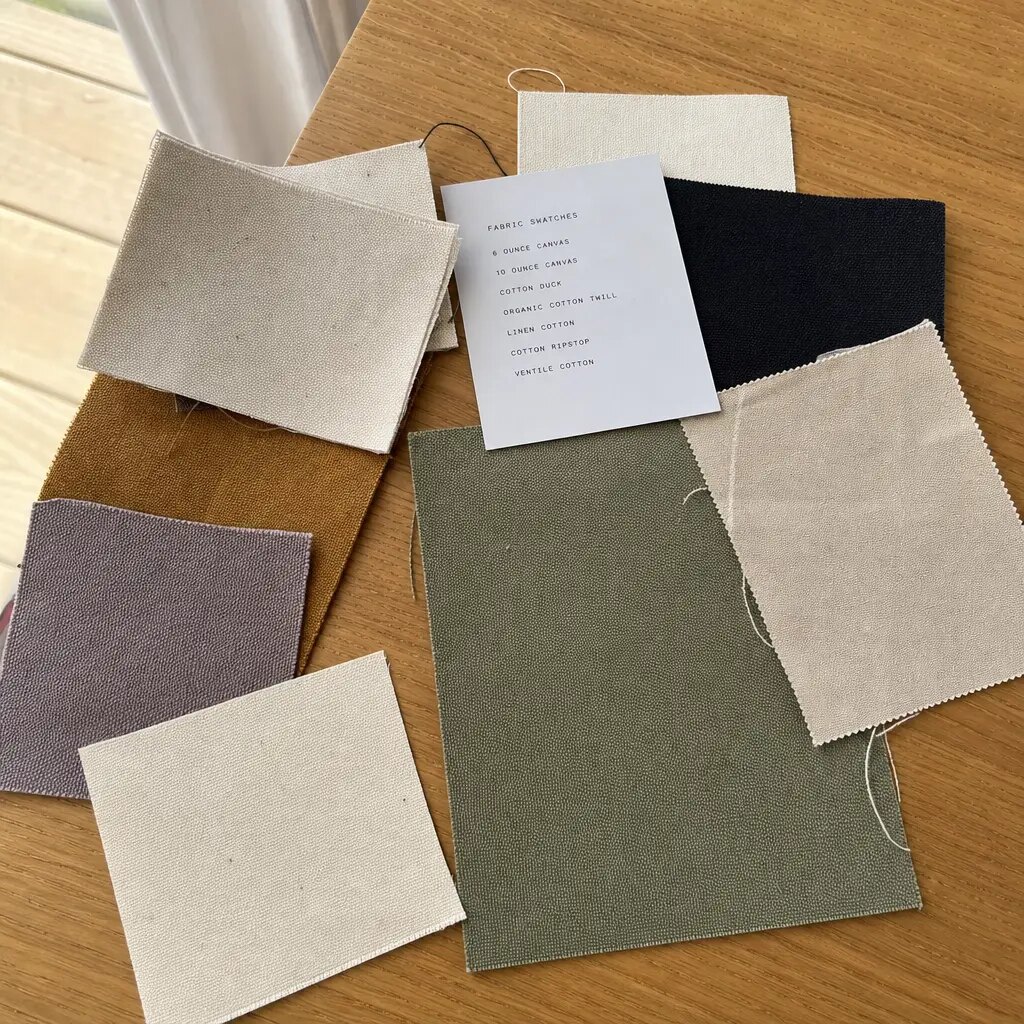
The phrase eco canvas is not precise enough for procurement. Organic cotton, recycled cotton, recycled polyester zipper tape, undyed canvas, recycled paper packing, and reduced-plastic packing are different claims with different evidence. Buyers should separate the story they want to tell from the documents needed to support it.
For organic cotton canvas, ask which component is covered and what chain-of-custody evidence can be reviewed before bulk cutting. For recycled content, confirm the recycled input type, percentage, claimed component, and whether supplier declarations or RCS/GRS-related records apply. For undyed natural canvas, approve a shade range rather than expecting uniform color from lot to lot.
Canvas weight affects more than hand feel. A 10-12 oz cotton canvas is often a balanced starting point for document and brand-kit portfolios because it has structure without becoming too stiff or heavy. A 14 oz canvas can feel more substantial, but it may slow sewing, increase needle marks at corners, change print hand-feel, and raise carton weight. If the portfolio holds heavy swatches, the added structure may be worth it.
- Organic claim: confirm component, certification scope, chain-of-custody route, and lot-level evidence timing.
- Recycled claim: confirm input type, percentage, claimed component, and available supporting records.
- Undyed claim: approve seed flecks, slubs, shade range, and lot variation before cutting.
- Canvas spec: state oz or GSM, weave, finish, shrinkage range, color standard, and acceptable shade tolerance.
- Packing claim: separate recycled paper, recycled polybag, compostable bag, no-bag packing, and carton requirements.
Compare MOQ by scenario, not only total quantity
MOQ is rarely one number. A supplier may accept 300 total pieces but require one body color, one logo, stock zipper tape, and bulk packing. Another supplier may quote 1,000 pieces because certified fabric, custom dyeing, or custom pullers create larger material minimums. The useful question is not only what is your MOQ, but what changes the MOQ.
A realistic small pilot might be 100-300 units using a stock body, standard canvas color, standard zipper, and one logo method. A custom cut-and-sew order often becomes more practical around 500-1,000 units per style or color, depending on pattern work and fabric sourcing. A certified-material or custom-dyed program may need 1,000-3,000 units or a fabric-lot commitment, even if sewing capacity is available for less.
Ask suppliers to quote order bands with the exact customization level attached. That makes tradeoffs visible. The buyer can decide whether to keep a stock zipper, reduce artwork versions, standardize packing, or book more units to access the preferred material.
- Low-MOQ test: stock size, stock canvas, one-color print, standard zipper, simple packing.
- Moderate custom run: custom dimensions, standard fabric color, standard zipper, private label, basic carton marks.
- Higher-control program: certified canvas, custom color, multiple artworks, custom puller, retail packing, stricter inspection.
- MOQ drivers: fabric color, certified lot, zipper tape color, print color count, label version, puller tooling, and packing version.
- Quote request: ask for 300, 500, 1,000, and 3,000-unit scenarios when demand is uncertain.
Use a stage-by-stage lead-time calendar
A decision-grade calendar shows sequence and buffers. Some stages can run in parallel, such as packing artwork and fabric approval. Others cannot. Printed panels should be approved before the whole batch is sewn. Final inspection cannot happen before cartons are ready. Freight booking needs packed-carton data.
The table below is a practical planning model, not a universal promise. Buyers should adjust it by supplier route, order size, material availability, artwork complexity, and approval speed.
Stage | Standard order | More complex order | Buyer decision point Sample or revision | 5-10 days | 10-20 days | Is the sample final enough to control bulk? Material proof and swatch | 3-7 days | 7-15 days | Is the claim usable before PO or cutting? Fabric and trim booking | 5-12 days | 15-30 days | Are canvas, zipper, label, and packing components reserved? Print strike-off | 3-7 days | 7-14 days | Is color, placement, adhesion, and hand-feel approved? Cutting and printing | 4-8 days | 7-15 days | Are first-bulk printed panels approved before full sewing? Curing and panel sorting | 1-3 days | 2-5 days | Are rejected panels replaced before assembly? Sewing and in-line QC | 8-15 days | 15-25 days | Are zipper ends, corners, and seams checked early? Final inspection and repair | 2-5 days | 5-10 days | Are defects repaired before packing release? Packing and carton release | 2-5 days | 5-10 days | Are barcode, carton mark, and carton quantity correct? Freight buffer | 2-5 courier, 5-10 air, longer for sea | Route-specific | Does the in-warehouse date include customs and receiving?
- Work backward from the required in-warehouse date, not the factory finish date.
- Protect the critical path: final artwork, material booking, strike-off approval, packing material arrival, and inspection rework.
- Ask what can run in parallel and what must wait for buyer approval.
- Add separate buffers for courier samples, bulk freight, customs documents, and warehouse receiving.
- Update the calendar whenever fabric, print, zipper, label, packing, or claim evidence changes.
Specify zipper details early
The zipper is a small component that can create large delays. Buyers should define zipper size, tooth material, tape color, slider type, puller finish, top-stop construction, and opening direction before sampling. A standard nylon coil zipper may be fast and practical for many canvas portfolios. Metal teeth or custom pullers can change cost, MOQ, weight, and timing.
Zipper tape color is often overlooked. Matching natural canvas, dyed canvas, thread, and print can require a practical tolerance. If the tape is custom dyed, it may introduce a trim MOQ and extra approval time. If the puller is custom molded or engraved, tooling and pre-production approval should be separated from the sewing schedule.
Function matters more than a clean sample photo. The approved sample should be opened and closed repeatedly, loaded with intended contents, and checked at corners and zipper ends. In bulk, QC should include sampled open-close cycles, slider security, top-stop strength, tape distortion, and trapped lining or canvas near the teeth.
- Define zipper gauge or size, tooth material, tape color, slider, puller, and finish.
- Ask whether the quoted zipper is stock, custom color, or custom puller with tooling.
- Check zipper path and ease of opening when the portfolio is loaded.
- Inspect zipper ends, corner turns, top stops, tape twist, and slider smoothness.
- Include zipper failure as a major or critical defect depending on intended use.
Approve print before sewing locks in the risk
Print problems become expensive after panels are cut and sewn. Screen printing is often efficient for bold one- or two-color logos on cotton canvas. Digital print or transfer can suit detailed artwork or smaller runs, but buyers need to check edge clarity, hand-feel, adhesion, film compatibility, and performance on textured fabric.
The strike-off should be made on the final canvas weight and color whenever possible. Paper proofs and smooth substitute fabrics do not show how ink behaves on a textured cotton surface. Natural canvas can change perceived color. Heavy ink can stiffen the panel. Dark canvas may require underbase printing that changes hand-feel and lead time.
For placement-sensitive logos, require first-bulk printed panel photos before the full batch proceeds. Use fixed references such as seam edge, panel edge, or zipper line, and define a tolerance such as ±3 mm to ±5 mm where appropriate. If printing is outsourced, decide in writing who pays for misprinted panels and how many replacements are included in the production plan.
- Screen print: confirm color count, Pantone target, screen fee, curing time, and reorder setup policy.
- Digital or transfer print: confirm line detail, film feel, heat effect, adhesion, and edge quality on canvas.
- Placement: measure from fixed seam or panel references, not by visual centering alone.
- Testing: ask whether dry rub, wet rub, tape pull, wash simulation, or internal handling checks are used.
- Defects: define smudge, ghosting, pinhole, under-curing, strike-through, contamination, off-register artwork, and color deviation.
Make sampling a production control tool
A pre-production sample should become the physical standard for bulk production. It should use final canvas, final color, final zipper, final puller, final logo method, final thread, final label, final construction, and ideally final packing. If a substitute is unavoidable, the gap should be written into the approval file and closed before bulk cutting.
Review the sample like an inspector. Measure length, width, gusset, zipper opening, compartment placement, logo placement, and label location. Load it with the intended contents. Open and close the zipper repeatedly. Check whether corners distort, lining catches, seams twist, print alignment changes after sewing, or the portfolio feels too stiff for its use.
Sample comments should be measurable. Move logo 10 mm upward, reduce gusset by 5 mm, change zipper tape to natural, or increase stitch density on the zipper end are actionable comments. Make it more premium is not a production instruction. If the first sample misses construction, material, and print at the same time, a revised sample is usually worth the extra days.
- Keep one approved sample with the buyer and one documented standard at the factory when possible.
- Sign off a trim card before bulk: shell, lining, zipper, puller, thread, label, print, and packing.
- Record comments with photos, measurements, dates, and spec version numbers.
- Retest zipper function and loading after any pattern, canvas weight, or lining change.
- Do not approve bulk cutting while final material proof or critical substitute trims remain unresolved.
Write QC standards for the actual product
Generic QC wording creates arguments at inspection. Canvas zipper portfolios need standards for measurement, fabric appearance, stitch density, zipper function, print quality, interior finish, and packing accuracy. Buyers should define critical, major, and minor defects before production begins.
Construction checks should focus on zipper ends, corners, seam turns, divider joins, heavy fabric layers, and any strap or handle anchors if included. Appearance checks should define acceptable shade variation, seed flecks, slubs, stains, and creases. Print checks should use the approved strike-off as the reference and name the test method used for adhesion or rub resistance.
Packing is part of quality. Incorrect carton quantities, wrong carton marks, missing barcodes, weak cartons, or mixed SKUs can delay warehouse receiving even when the product is usable. If the order ships to a retailer, distributor, or 3PL, the routing guide should be in the production file before cartons are packed.
- Critical defects: wrong material claim, broken zipper, unsafe sharp part, severe contamination, wrong item, or missing required label.
- Major defects: open seam, zipper malfunction, wrong logo placement, poor print adhesion, visible stain, wrong color, mixed carton, or incorrect packing.
- Minor defects: removable loose thread, light crease, or approved-range natural shade variation that does not affect use.
- Measurement checks: length, width, gusset, zipper opening, logo placement, label placement, and pocket or divider position.
- Packing checks: inner pack, barcode, carton mark, carton quantity, gross weight, carton numbering, destination, and PO reference.
Control packing, freight, and the quote file
Packing decisions should not wait until sewing is finished. Bulk-packed portfolios can move quickly into master cartons. Retail-ready portfolios may need hangtags, belly bands, barcode stickers, inserts, tissue, paper wraps, or individual bags. Each item needs artwork, approval, printing, delivery, and application time.
Eco apparel brands may prefer recycled paper, reduced-plastic packing, compostable bags, or no individual bag. These options still need practical testing. Paper bands can scuff in transit. Compostable bags may seal differently. No-bag packing can expose natural canvas to dust or moisture. Recycled cartons still need enough strength for export handling.
Keep one quote file that survives changes. It should contain the approved spec, artwork, material evidence, trim card, sample comments, QC checklist, packing guide, production calendar, and shipment instructions. When the buyer changes canvas weight, adds lining, splits artwork, upgrades the claim, or switches packing, the supplier should reissue both price and timing against the new version.
- Approve product artwork and packing artwork in the same calendar window.
- Confirm inner packing: individual bag, bundle pack, paper wrap, belly band, or no inner bag.
- Require carton labels showing PO, style, color, quantity, carton number, destination, and barcode where needed.
- Ask for packed-carton photos, carton dimensions, gross weight, and carton count before freight booking.
- Record actual stage durations after shipment to improve the next custom canvas zipper portfolios order.
Specification comparison for buyers
| Supplier route | Best-fit order profile | MOQ and sample behavior | Lead-time and cost drivers to compare |
|---|---|---|---|
| Factory-direct canvas bag manufacturer | Repeat orders, firm launch dates, custom dimensions, and buyers needing clear production ownership | Commonly stronger above 500-1,000 units per style; MOQ may rise by fabric color, certified material lot, or trim version | Confirm whether cutting, sewing, print, QC, packing, and export release are controlled in one production calendar |
| Factory with in-house print department | Logo-led portfolios, seasonal artwork changes, Pantone matching, and placement-sensitive branding | Sample and strike-off approvals can move faster when the print room uses the same production fabric | Compare screen fees, curing capacity, rejected-panel allowance, print tolerance, and approval on final canvas |
| Cut-and-sew factory using outside printer | Simple builds where the supplier has a proven local print partner and competitive sewing cost | Construction samples may be quick, but final print approval can add transport and queue time | Require named print schedule, responsibility for misprints, first-bulk panel approval, and curing test method |
| Trading company or sourcing agent | Low-volume trials, mixed accessory programs, or buyers coordinating several bag types | MOQ may look flexible if stock trims are used; sample revisions slow when the actual factory is not direct | Clarify factory identity, inspection authority, remake responsibility, documentation access, and included margin items |
| Stock-body customization supplier | Fast event packs, internal sales kits, small pilots, and programs accepting fixed size and construction | Often workable from lower quantities when blank stock exists; sample is usually a decorated stock body | Check stock canvas claim evidence, zipper grade, repeat availability, logo limits, carton standard, and shade consistency |
| Certified-material specialist supplier | Eco apparel brands requiring organic cotton, recycled inputs, or controlled chain-of-custody records | MOQ often follows certified fabric lot size; samples may use substitute fabric until the production lot is booked | Compare documents available before PO, before cutting, and at shipment; allow longer booking and stricter substitution control |
| FOB export-ready supplier | International buyers needing carton marks, forwarder handoff, inspection support, and commercial documents | MOQ may be less flexible because packing and export procedures are standardized | Confirm port, incoterm, carton dimensions, HS code assumption, booking window, document release timing, and rework process |
| Lowest-price general merchandise vendor | Noncritical giveaways where exact material claim, repeatability, and tight QC are less important | Low MOQ may rely on standard fabric, standard zipper, and limited inspection depth | Scrutinize traceability, zipper testing, print durability, measurement tolerance, carton strength, and whether lead time includes outsourced steps |
Buyer checklist before sampling
- Define finished size, gusset, opening direction, compartment layout, lining, binding, and intended contents before requesting price.
- Specify canvas composition, weight in oz or GSM, weave, finish, shrinkage expectation, color standard, and whether the material claim is organic, recycled, undyed, or conventional cotton.
- Separate mandatory sustainability claims from preferred features so suppliers know which evidence is required before PO release.
- Ask for component-level proof for shell canvas, lining, zipper tape, zipper teeth, puller, thread, label, inner packing, and carton instead of accepting one broad eco claim.
- Send vector artwork with Pantone references, logo size, placement measured from fixed seam edges, and acceptable placement tolerance.
- Confirm zipper size, tooth material, tape color, slider type, puller finish, top-stop construction, and whether custom pullers add tooling time or trim MOQ.
- Require a pre-production sample using final fabric, zipper, logo method, label, thread, and packing, or document every approved substitute.
- Build the calendar by stage: sample, material proof, fabric booking, trim booking, swatch approval, print strike-off, cutting, printing, curing, sewing, QC, packing, and freight booking.
- Add route-based buffers for courier samples, air or sea freight booking, customs documents, buyer-side approvals, and warehouse receiving requirements.
- Set measurable QC criteria for size, stitch density, seam strength, zipper function, print adhesion, rub resistance, stains, loose threads, shade variation, carton labeling, and mixed-SKU prevention.
Factory quote questions to send
- Which steps are performed in-house and which are outsourced: fabric sourcing, dyeing, printing, cutting, sewing, finishing, packing, inspection, and export documentation?
- What exact canvas composition, weight, weave, finish, shrinkage range, and color standard are included in the quote?
- For organic cotton, what chain-of-custody or transaction evidence can be reviewed before PO release and before bulk cutting?
- For recycled content, is the claim supported by supplier declaration, RCS/GRS-related records, transaction certificate where applicable, or another documented input record?
- For undyed or natural canvas, what shade variation, seed flecks, and lot-to-lot differences should be approved before bulk production?
- Is MOQ calculated by total order quantity, fabric color, artwork, print color count, zipper color, label version, packing version, or certified material lot?
- How many calendar days are required for sample development, swatch approval, print strike-off, material booking, cutting, printing, curing, sewing, final QC, packing, and export release?
- What stages can run in parallel, and which stages are on the critical path for this exact order?
- What zipper size, tooth material, tape quality, slider type, and puller finish are included, and what function checks are performed during production?
- What print method do you recommend for this artwork on this canvas, and how do you check curing, rub resistance, adhesion, color consistency, and placement?
Quality-control points to confirm
- Finished dimensions should be measured against the approved sample and spec sheet, with tolerances defined by panel, gusset, zipper opening, and pocket position rather than one vague overall allowance.
- Canvas weight should be checked against the approved standard, commonly with a practical tolerance such as ±5% unless the buyer sets a tighter material requirement.
- Stitch density should be consistent on visible seams and stress areas; buyers can approve the factory standard or define a range such as 7-9 stitches per inch for many canvas constructions.
- Seams at zipper ends, corners, divider joins, and handle or strap anchors if included should show no skipped stitches, broken threads, open seams, needle cuts, or loose backstitching.
- Zipper function should be checked through repeated open-close cycles on sampled units, with no catching, broken top stops, misaligned teeth, puller detachment, slider looseness, or tape distortion.
- Logo placement should be measured from fixed seam, panel, or zipper references, with an agreed tolerance such as ±3 mm to ±5 mm depending on artwork size and fabric movement.
- Print quality should show no unapproved smudging, ghosting, pinholes, under-cured ink, heavy strike-through, color mismatch, contamination, or edge cracking after normal handling.
- Print adhesion and rub resistance should be checked on production fabric, with the supplier stating whether dry rub, wet rub, tape pull, wash simulation, or internal handling tests are used.
- Interior finish should be inspected for loose threads, exposed raw edges beyond approved construction, lining twist, trapped fabric near zipper tape, and sharp trim ends.
- Natural or undyed canvas should be checked against an approved shade range so seed flecks, slubs, and lot variation are not disputed after packing.