Start With the Real Deadline
Custom canvas zipper portfolios for trade show exhibitors are deadline products first and merchandise products second. The order is only successful if finished cartons arrive early enough for receiving, inspection, sponsor sorting, booth-kit assembly, and final movement to the venue, event warehouse, distributor office, or sales team. A low unit price loses its value fast when portfolios arrive after the show materials have already shipped.
Work backward from the required in-hand date, not from the opening morning of the show. Many exhibitors need several extra days to insert brochures, add badges, split cartons by rep, attach sponsor materials, or meet an advance warehouse cutoff. If several internal teams must approve artwork, color, or packaging, those approvals belong on the same calendar as sampling and production. They are not background tasks. They can stop the order just as surely as a late zipper delivery.
Ask the factory to break lead time into visible stages: artwork proof, sample making, material preparation, cutting, logo application, sewing, trimming, inspection, packing, carton marking, and export handoff. A single line that says 30 days production sounds tidy, but it hides the points where procurement can still make decisions. If dyed fabric is late, stock natural canvas may be the practical recovery option. If a custom puller is late, a standard slider with a branded fabric tab may keep the event date alive. You can only make those calls when the schedule is specific.
- Set the required in-hand date before requesting final pricing, then add receiving, sorting, repacking, and show-warehouse buffer.
- Name the approval owners for artwork, logo placement, fabric color, sample, packing, inspection, and freight release.
- Request stage-by-stage timing instead of one blended lead time.
- Create a freight decision date while production is still active, so air, sea, courier, or split shipment can be chosen before the calendar is already gone.
Lock the Product Before Locking the Quote
A factory cannot schedule a dependable order from the phrase canvas zipper portfolio. The construction drives the timeline. A flat document pouch with one internal sleeve is a different sewing job from a padded tablet portfolio with lining, card slots, pen loop, gusseted pocket, woven label, and a zipper turning three corners. Each added part changes cutting markers, sewing order, inspection time, packed thickness, and defect risk.
Start with size, then make the size useful. Buyers should state finished outside dimensions and usable inside dimensions. The outside measurement may look correct while the interior is too tight after seam allowance, zipper tape, lining, padding, and corner radius are added. For trade show use, the actual load matters: A4 sheets, US letter handouts, tablet, brochure pack, badge, pen, sponsor card, or business cards all need different clearance. A loaded portfolio also puts more stress on the zipper path than an empty sample on a desk.
Opening style is the next practical decision. A top-edge zipper can work for a simple document carrier. A two-side or three-side zipper is easier to use in meetings and at booths, but it adds zipper length, corner handling, and sewing complexity. If the user will open the portfolio while standing in an aisle, smooth motion matters. If the item mainly protects printed handouts inside a kit, a simpler opening may be the better procurement choice.
- Provide a dimensioned sketch or tech pack with outside size, usable inside size, zipper path, logo placement, pocket positions, and seam references.
- Define the insert load with real objects and dimensions: A4 sheets, US letter brochures, tablet size, pen diameter, badge size, and sponsor insert size.
- Confirm whether the portfolio should open flat, open like a book, or behave as a secure document pouch.
- State the use case clearly: booth giveaway, sponsor folder, sales representative kit, distributor meeting folder, or retail-style merchandise.
Choose Canvas With Production in Mind
Canvas sounds simple until it reaches the purchase order. For B2B sourcing, canvas is not enough of a specification. Buyers should define composition, approximate weight, finish, color, lining, reinforcement, and acceptable variation. For many custom canvas zipper portfolios, 12 oz to 16 oz cotton canvas is a practical range, often about 380 to 540 GSM depending on yarn, weave, finishing, and mill measurement method.
Lighter canvas can reduce cost, carton weight, and sewing bulk, but it may wrinkle, collapse near the corners, show pocket outlines, or feel underbuilt for a sales meeting handout. Heavier canvas gives more body and perceived value, yet it also increases cutting resistance, needle stress, zipper bulk, carton weight, and freight cost. More weight is not automatically better. Often the stronger answer is medium-weight canvas with targeted reinforcement at zipper ends, pocket openings, or handle points if the design has them.
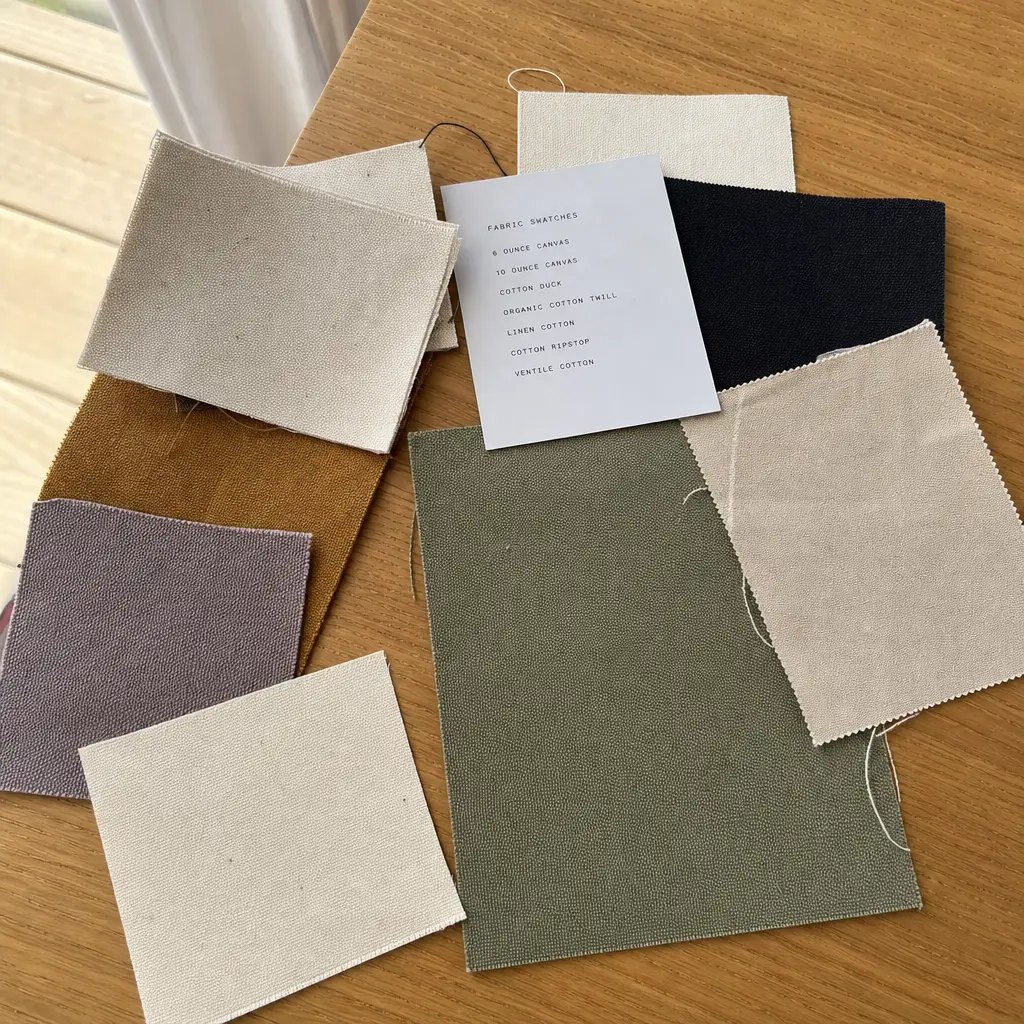
Finish and color can shift lead time sharply. Stock natural canvas is usually the fastest route because it may already be available through regular mill supply. Dyed canvas supports closer brand alignment but requires color approval, dye-lot control, and often a higher material MOQ. Washed canvas can create a softer hand, but shrinkage and distortion may require pattern adjustment. Laminated or coated canvas can add stiffness or wipeability, while also changing print adhesion, odor, fold behavior, and needle marks.
Before bulk production, define what natural fabric character is acceptable. Small flecks and slubs may fit a natural cotton look. Heavy stains, oil marks, holes, mold, strong odor, or dark slubs inside the logo area should not be left to interpretation. The cleanest inspection standard is visual: photograph acceptable and unacceptable fabric marks during sample approval and attach those images to the QC file.
- Ask for canvas weight in oz and GSM, plus the expected production tolerance.
- Use stock natural canvas when the event calendar is tight; use dyed canvas only when lab dip, shade approval, and bulk fabric production fit the schedule.
- Avoid solving every durability concern with heavier fabric; use reinforcement where the stress actually occurs.
- Define acceptable natural flecks, slubs, shade variation, odor, and logo-area cleanliness before bulk cutting.
Treat the Zipper as a Working Part
The zipper is often the first place a portfolio feels cheap or reliable. It has to move through canvas bulk, stitched corners, loaded contents, and repeated booth handling. For standard A4 or US letter portfolios, a No.5 nylon coil zipper is commonly suitable. For oversized, padded, or heavier-loaded styles, a No.8 nylon coil zipper may be the safer choice. Metal zippers may look premium, but they can add weight, stiffness, scratching risk, and rougher corner behavior on a flexible canvas body.
A good zipper specification includes size, coil type, tape material, tape color, slider type, puller style, puller finish, opening direction, and end-stop construction. If the zipper wraps around corners, the corner radius needs sample review. A tight curve may look clean in a drawing and still drag once sewn into 16 oz canvas. Test the zipper with the intended contents inside the portfolio, because an empty sample can hide stress at the corners and end stops.
Custom zipper colors, custom slider finishes, and custom pullers can affect both MOQ and lead time. A stock black, natural, or common neutral tape may be available quickly. A matched brand color may require dyeing. A custom metal puller can involve tooling, sampling, or minimum order quantities that do not suit a fixed show date. When timing is tight, a standard slider with a branded fabric pull tab, woven side label, or front print may carry the brand with less schedule risk.
- Quote No.5 nylon coil zipper for standard document portfolios unless size, padding, or load justifies No.8.
- Test zipper travel on a loaded pre-production sample, especially around corners.
- Check end stops, slider stability, tape waviness, puller strength, sharp edges, and threads that may catch in the coil.
- Ask whether zipper color matching, slider finish, or custom pullers change MOQ, material lead time, and replacement options.
Match Branding to Artwork and Calendar
Branding should follow the artwork, the canvas, and the deadline. Screen printing is often a practical choice for solid-color logos on canvas because it is repeatable, efficient at quantity, and clean on a flat front panel. Buyers should provide vector artwork, Pantone references where required, print size, placement from fixed edges, number of colors, and underbase requirements for dark canvas. Placement should be measured from seams or edges, not judged by eye.
Heat transfer can support full-color artwork, gradients, or sponsor graphics that are not ideal for screen print. The tradeoff is that adhesion, edge feel, dry-rub resistance, and blocking need to be checked on the actual canvas. Blocking is the risk that a transfer sticks to the polybag or opposite panel under carton pressure. For event products that may sit packed tightly until distribution day, this is not a minor detail.
Embroidery can look premium but may pucker the canvas if the stitch density is high, especially on larger logos. Woven labels, side labels, and patches give a quieter retail-style brand cue, but they bring their own MOQ, sampling, and sewing steps. A woven label may take longer than a one-color screen print when the order is small or the event date is close. The quote should state whether setup, label sampling, rejected-label allowance, and label sewing are included.
- For screen print, confirm Pantone colors, print size, underbase, curing method, canvas texture suitability, and placement tolerance.
- For heat transfer, request adhesion, dry-rub, blocking, and edge-lift checks after packing pressure.
- For embroidery, approve stitch density and backing on the actual canvas panel to control puckering.
- For woven labels or patches, confirm MOQ, lead time, fold type, size tolerance, sewing position, and setup charges.
Keep the Inside Useful
Interior features can make a portfolio more valuable, but they can also make it slower, bulkier, and harder to inspect. Many trade show portfolios work well with one document sleeve, one card pocket, and one pen loop. More compartments may look impressive in a mockup, yet each one adds cutting pieces, seam intersections, stitch lines, thread trimming, and inspection points.
The better approach is to connect every feature to a real insert. If the sleeve holds A4 documents, state the sheet size and approximate stack thickness. If the design includes a tablet divider, state the device size and whether a protective layer or elastic strap is needed. If business cards are included, provide the card dimensions and orientation. If a pen loop is required, confirm the pen diameter or approve a reference pen. This prevents the common situation where pockets look fine in photos but fail when the event team starts loading kits.
Lining is another choice to make deliberately. A lining can hide raw edges and improve the interior finish, but it adds fabric, labor, thickness, and inspection work. Reinforcement is often more useful when placed only at stress points: pocket openings, pen-loop ends, zipper ends, and corners. The goal is not to build the most complicated interior. The goal is to carry the intended materials cleanly and close without strain.
- Assign each pocket, sleeve, loop, divider, and strap to a specific insert size and function.
- Remove decorative pockets that add sewing time without improving the event use case.
- Test pocket fit with actual brochures, cards, pens, tablets, and badges during sample approval.
- Specify reinforcement at stress points and confirm whether lining is required for appearance, durability, or both.
Use the Sample as the Control Standard
For custom canvas zipper portfolios, a sample is more than a preview. It becomes the control standard for bulk production, final inspection, and dispute resolution. A useful sample confirms finished size, usable interior space, canvas hand feel, zipper movement, corner radius, print scale, pocket fit, stitch quality, packing behavior, and overall presentation. A digital proof can approve layout, but it cannot show whether a loaded zipper catches or whether a print blocks after carton pressure.
The strongest route is a pre-production sample made with bulk-intended fabric, final zipper or approved zipper equivalent, final logo method, final pocket layout, and intended packing format. If anything is substituted, the supplier should say so in writing. A sample made in stock natural canvas does not fully approve dyed bulk fabric. A sample with a standard zipper does not close the lead time question for a matched zipper tape. A blank sample does not confirm print hand, placement, or adhesion.
Sample review should be physical and practical. Measure the empty portfolio and the loaded portfolio. Open and close the zipper repeatedly through the corner area. Insert brochures, cards, pen, tablet, and sponsor items. Pack the sample as planned and apply light compression if cartons will be tight. Look for print transfer, permanent creasing, zipper waviness, pocket stress, and front-panel distortion. Once approved, keep one signed control sample with the buyer and one with the factory when possible.
- Require the supplier to identify any substituted fabric, zipper, print process, label, pocket material, or packing method.
- Measure outside dimensions, usable inside dimensions, pocket dimensions, and logo position from fixed reference points.
- Cycle the zipper on the loaded sample and record any catching, tight corner movement, tape twisting, or weak end stops.
- Use the approved sample as the comparison standard for AQL inspection, not just as a sales reference.
Build the Calendar Around Gates
A good lead time plan has decision gates. The first gate is specification and artwork freeze. The second is sample approval. The third is material readiness. The fourth is production start after cutting and print setup. The fifth may be an in-line review. The sixth is final inspection. The seventh is packed-carton release and freight handoff. These gates make delays visible while there is still time to adjust.
Timing varies by quantity, factory capacity, material availability, decoration method, and construction complexity, so a universal production promise is not enough. Buyers should ask for the logic behind the calendar. Sample making may take several working days after artwork and materials are ready. Dyed fabric, custom zipper tape, woven labels, or custom pullers can add material time before cutting begins. Sewing time depends on pocket count, zipper path, lining, and expected output per line. Packing and inspection should not be squeezed to zero; trimming threads, sorting defects, correcting carton marks, and replacing rejected units all take time.
Freight belongs on the calendar as its own workstream. Sea freight can protect unit economics but requires more buffer. Air freight is faster, but bulky canvas portfolios can become expensive by volume weight. Courier may be useful for samples, urgent replacement cartons, or small priority quantities. Split shipment is often the most realistic recovery tool: send enough portfolios by air for the booth while the remaining cartons move by sea, if the program allows it.
- Set dates for artwork freeze, sample approval, material order, bulk cutting, logo application, sewing completion, final inspection, packing completion, and export handoff.
- Hold bulk cutting until size, zipper path, print location, and interior layout are approved.
- Schedule final inspection early enough to allow repair, sorting, replacement, or air shipment of priority cartons.
- Request latest safe order dates for sea, air, courier, and split shipment based on the actual destination.
Normalize Quotes Before Comparing Price
Two quotes with the same product name may not describe the same product. One supplier may include 16 oz canvas, No.8 zipper, pre-production sample, individual packing, AQL inspection, and complete carton data. Another may look cheaper because it uses lighter canvas, a basic zipper, no physical sample, simplified pockets, minimal inspection, or tight cartons that crease the front panels. Procurement needs to compare like with like before treating unit price as the decision point.
A useful quote should list canvas composition, weight, finish, color process, zipper specification, lining if any, branding method, number of logo colors, pocket layout, label details, sample cost, setup charges, MOQ, production lead time, packing method, carton data, inspection standard, and Incoterms or shipping handoff point. One-time costs should be separate from repeat unit costs. Print screens, label setup, puller tooling, and sample fees should not be buried if the buyer expects reorders.
Carton data is part of the commercial quote, not an afterthought. Canvas portfolios can be heavy and bulky. Packing method affects freight, presentation, and defect risk. Ask for pieces per carton, carton dimensions, gross weight, net weight, total CBM, and carton marking format before comparing courier, air, sea, or split shipment. A low unit price can become expensive when air freight is calculated by volume weight or when damaged cartons require replacement at the last minute.
- Compare suppliers using the same canvas GSM, zipper size, logo method, pocket count, lining, packing, inspection requirement, and shipping terms.
- Separate setup costs, sample fees, label charges, tooling, and repeat unit cost.
- Use carton CBM and gross weight for freight estimates instead of piece count alone.
- Treat missing specifications as quote risk, especially when the order is tied to a fixed trade show date.
Write QC Rules Before Production
Quality control should be agreed before deposit, not debated after defects appear. Canvas has natural texture, but trade show portfolios are handled by prospects, partners, sales teams, and sponsors. A visible stain, crooked logo, rough zipper, loose pocket seam, strong odor, or crushed front panel can damage the value of the program even when the item technically holds documents.
Final inspection may use AQL sampling, but the AQL plan needs product-specific checks. Inspectors should measure finished outside size, usable inside space, pocket dimensions, and logo placement. They should cycle the zipper, including corner travel, on sampled pieces. They should review stitch density, back-tacking, skipped stitches, seam allowance, loose threads, print quality, shade consistency, odor, stains, and carton quantity. If the order includes multiple sponsor logos, departments, or destinations, mixed cartons should be treated as a serious issue because they can disrupt distribution.
Packing deserves its own QC line. Individual polybags protect against scuffing but can create blocking risk if print or transfer is not stable. Paper bands reduce plastic use but may offer less moisture and abrasion protection. Over-tight cartons can crease canvas and transfer print; loose cartons can allow movement and corner wear. Cotton canvas also needs moisture awareness, especially when ocean freight or humid storage is involved. Carton marks should match the purchase order, SKU, logo version, quantity, destination, and any event-team instructions.
- Define tolerances for finished size, logo placement, print color, stitch defects, zipper smoothness, pocket dimensions, stains, shade, odor, and carton damage.
- Use the approved pre-production sample as the physical standard for fabric hand, zipper behavior, logo scale, pocket fit, and packing.
- Include functional checks in final inspection: zipper cycling, pocket loading, seam pull review, print dry-rub, and carton count verification.
- Inspect before freight release so there is time to repair, sort, replace, or prioritize urgent cartons.
Specification comparison for buyers
| Spec decision | Recommended option | When it fits | Buyer risk to check |
|---|---|---|---|
| Finished size and fit | Confirm outside size, usable inside size, and target insert load before quoting | A4 documents, US letter handouts, tablets, sponsor inserts, badges, pens, and brochure packs | Outside dimensions alone can hide a tight interior; zipper tape, seam allowance, lining, and corner radius reduce usable space |
| Canvas body fabric | 12 oz to 16 oz cotton canvas, commonly about 380-540 GSM depending on yarn, weave, and finish | Trade show portfolios that need structure, print clarity, and repeated handling during booth distribution | Very light canvas may wrinkle or collapse; very heavy canvas increases sewing bulk, zipper stress, carton weight, and freight cost |
| Canvas finish and color | Stock natural canvas for shorter timelines; dyed canvas only with color approval and dye-lot control | Natural brand programs, sponsor kits, sales folders, and distributor meeting sets | Dyed-to-order fabric can add material lead time and shade variation; washed canvas can change shrinkage and finished dimensions |
| Zipper specification | No.5 nylon coil zipper for standard A4 or letter portfolios; No.8 coil zipper for oversized, padded, or heavier-loaded styles | Most document portfolios, tablet-document folders, and event handout kits | Weak sliders, rough coil, poor end stops, or tight corner radius can cause snagging, separation, waviness, or early failure |
| Branding method | Screen print for solid logos; heat transfer for full color; woven label for subtle retail-style branding | Exhibitor giveaways, sponsor kits, distributor samples, and sales meeting folders | Print near seams or zipper curves can distort; transfers need adhesion, dry-rub, and blocking checks on actual canvas |
| Interior construction | Start with one document sleeve, one card pocket, one pen loop, and optional tablet divider | Useful trade show portfolio without excessive sewing operations or inspection complexity | Extra small pockets add cutting pieces, seam intersections, puckering risk, longer sewing time, and higher defect sorting effort |
| Sample path | Pre-production sample using bulk-intended fabric, zipper, logo method, internal layout, and final packing | Orders tied to fixed show dates where late correction is expensive | A generic blank sample misses print feel, zipper movement on loaded corners, pocket fit, and carton compression behavior |
| MOQ logic | MOQ based on fabric availability, dye lot, zipper color, label MOQ, print setup, and sewing-line efficiency | Custom color, custom label, sponsor logo, and multi-pocket orders where unit economics matter | Very low MOQ may force stock fabric, limited zipper colors, digital proof-only approval, or shared production timing |
| Packing method | Individual polybag, recycled polybag, tissue wrap, or paper band, then export carton with moisture control and accurate carton marking | Distributor orders, event kits, pre-packed booth boxes, and retail-style handout condition | Over-tight cartons crease canvas and transfer print; under-filled cartons allow movement, corner abrasion, and count errors |
Buyer checklist before sampling
- Build the calendar backward from the required in-hand date, not the show opening date; include receiving, internal inspection, repacking, booth-kit assembly, and buffer for late cartons.
- Specify finished outside dimensions and usable inside dimensions for A4, US letter, tablet, brochure pack, badge, pen, and sponsor inserts.
- State canvas composition, weight in oz and GSM where possible, finish, color target, lining requirement, reinforcement zones, and whether natural slubs are acceptable outside logo areas.
- Define zipper size, coil type, tape color, slider finish, puller style, opening direction, end-stop construction, and whether the loaded sample must pass repeated corner cycling.
- Provide vector logo artwork with Pantone references, print size, placement from fixed edges, number of colors, underbase requirement, and acceptable placement tolerance.
- Choose interior pockets by function: document sleeve, card slot, pen loop, tablet divider, elastic strap, mesh pocket, or gusseted pocket; remove features that do not match actual inserts.
- Require a pre-production sample made with bulk-intended materials, final zipper, final branding method, approved pocket layout, and intended packing format before bulk cutting.
- Ask for material lead time separately from cutting, printing, sewing, trimming, inspection, packing, and export handoff; do not accept one blended lead time without milestones.
- Request carton size, pieces per carton, gross weight, net weight, total CBM, palletization preference if any, and carton marks before comparing courier, air, sea, or split shipment.
- Set defect limits for size, logo position, print quality, zipper smoothness, seam margin, skipped stitches, stains, shade variation, loose threads, pocket fit, odor, moisture, and carton damage.
Factory quote questions to send
- What exact canvas composition, construction, weight, and GSM tolerance are included in the quote, and is the fabric stock, greige, dyed-to-order, washed, laminated, or lined?
- What finished outside dimensions, usable inside dimensions, seam allowance, and finished size tolerance are you quoting for the portfolio?
- Which zipper size, coil type, tape material, slider type, puller style, puller finish, color, and end-stop construction are included, and what changes if we need a matched zipper color?
- For a zipper running around corners, what corner radius do you recommend for this canvas weight, and can you test smooth opening on a loaded pre-production sample?
- What logo method is included: screen print, heat transfer, embroidery, woven label, rubber patch, or another method, and what are the setup cost, color limit, artwork format, print-size limit, and placement tolerance?
- Will the pre-production sample use actual bulk-intended fabric, final zipper, final logo process, final internal pockets, and final packing, or will any substitute material be used?
- What is the sample lead time after confirmed artwork and available fabric, and what is the bulk lead time after sample approval, deposit, and material readiness?
- What is the earliest realistic final inspection date, and how many days are needed after inspection for trimming, repair, packing, carton marking, and export handoff?
- What is the MOQ for this exact specification, and which component drives it: fabric dye lot, zipper color, woven label, print setup, lining, or sewing-line efficiency?
- If we order below the efficient production quantity, which compromises apply: higher unit price, stock fabric only, limited zipper colors, combined production schedule, or simplified packing?
Quality-control points to confirm
- Finished outside size should normally be controlled within about +/-5 mm for common A4 or US letter zipper portfolios unless the buyer approves a more relaxed handmade tolerance. Usable inside size should be checked with the actual insert load, not only by measuring the empty shell.
- Logo placement should have a written tolerance, commonly +/-3 mm to +/-5 mm for a centered front-panel print, measured from fixed edges or seam lines. Tolerance should be tighter when the print aligns with a pocket, label, or zipper path.
- Zipper should open and close smoothly around corners on a loaded sample for repeated manual cycles, with no catching, coil separation, slider wobble, twisting tape, broken puller, loose end stop, or sharp puller edge.
- Seam allowance and stitch density should match the approved sample, with no skipped stitches, loose back-tacking, exposed raw edges, seam cracking at pocket corners, or puckering that prevents the portfolio from lying flat.
- Canvas surface should be free from oil marks, mold, strong odor, heavy stains, holes, severe slubs in the logo area, and obvious shade mixing between panels or cartons. Natural cotton flecks should be defined as acceptable or unacceptable before production.
- Print or transfer should pass a practical dry-rub check and visual adhesion review on the actual canvas. It should not crack, peel, bleed, block against the polybag, or transfer to the opposite panel under normal carton pressure.
- Interior pockets, card slots, elastic loops, pen loops, and tablet dividers should match approved dimensions and hold intended inserts without tearing seams, curling edges, or making the zipper difficult to close.
- Reinforcement zones at zipper ends, pocket openings, handle points if any, and pen-loop ends should be checked for bartack placement or equivalent secure stitching where the design requires repeated use.
- Carton packing should protect against heavy creasing, corner crushing, moisture damage, mixed SKUs, wrong carton marks, inaccurate counts, and excessive compression that leaves permanent fold lines on front panels.
- Final inspection should include carton quantity verification and SKU separation when multiple sponsor logos, destinations, or event teams are involved.