The Buying Problem: Portfolio Timing Is Not Tote Timing
A custom canvas zipper portfolio for a university bookstore has more production steps than a flat tote. The buyer is not only approving fabric and a logo. The factory must cut panels accurately, sew a zipper cleanly, control corner shape, decorate a flat but slightly flexible panel, and pack the finished goods without crushing the edges. If the order is tied to orientation, alumni weekend, graduation, or a textbook bundle launch, one missed approval can remove the safety buffer from the whole schedule.
The practical planning mistake is starting from the ship date instead of the selling date. Bookstore teams need time after delivery for receiving, barcode application, internal transfer, web photography, shelf setup, and possible shortage claims. A realistic RFQ should therefore include the in-store required date, the receiving warehouse location, and the last acceptable delivery date, not just a general request for fast lead time.
- Treat the campus launch date as the fixed point and build backward.
- Allow separate time for artwork approval, sample approval, bulk production, inspection, export, customs, and store receiving.
- Do not approve bulk cutting from a digital mockup only when zipper placement or pocket layout is new.
- Reserve extra buffer when school licensing approval is required before production.
Recommended Base Specification for Bookstore Programs
For most bookstore retail programs, a 12 oz cotton canvas, approximately 400 GSM, is the balanced starting point. It has enough body to feel like a durable product, accepts screen print well, and can be sewn around a No.5 zipper without creating excessive needle breakage or bulky corners. If the product must feel more premium, 14 oz canvas can work, but buyers should expect higher sewing time, more carton weight, and more visible folding memory after packing.
A typical portfolio size should be defined by contents, not by guesswork. If it must hold US letter paper, A4 documents, notebooks, or a tablet sleeve, the finished size and zipper opening must be tested with those items before bulk approval. Many quote disputes come from buyers approving an outside dimension but not confirming the usable internal opening after zipper tape, seam allowance, and lining fold are added.
- Retail standard: 12 oz canvas, about 400 GSM, for good balance of cost and structure.
- Budget route: 10 oz canvas, about 340 GSM, only with reinforced zipper edge and realistic retail positioning.
- Premium route: 14 oz canvas, about 475 GSM, when heavier handfeel supports the selling price.
- Size reference: define closed external size and usable internal opening separately.
- Tolerance: state finished size tolerance before order placement, commonly ±5 mm for flat portfolios.
Zipper, Pocket, and Sewing Details That Affect Lead Time
The zipper is the part most likely to expose weak factory planning. A No.5 nylon coil zipper is usually the safest choice because it is flexible, smooth, and easier to sew around corners than a heavier molded zipper. Metal zippers can look more expensive, but they add weight and may create wavy seams on softer canvas unless the sewing team has adjusted the construction. For bookstore programs, reliability normally matters more than decorative hardware.
Interior features also change production speed. One document pocket is simple. A pen loop, card pocket, mesh pocket, elastic strap, or laptop divider adds operations, templates, and inspection points. These details are useful only if they support how the bookstore sells the item. If the product is a retail gift portfolio, simpler construction may look cleaner and reduce defects. If it is part of a department welcome kit, extra pockets may be worth the added time.
- Use No.5 nylon coil zipper for most flat canvas zipper portfolios.
- Specify zipper tape color, slider finish, puller shape, and opening direction.
- Avoid changing zipper color after sample approval unless extra lead time is available.
- Define pocket dimensions by the insert they must hold, not by approximate wording.
- Require zipper cycling on samples, especially around corners and thick seam intersections.
Decoration Choices: Print Method, Logo Risk, and Approval Flow
Screen printing is usually the most practical logo method for canvas zipper portfolios when the artwork uses one to three solid colors. It gives good opacity on natural, black, navy, and school-color canvas, provided the ink layer is matched to the fabric texture. For detailed gradients, photo-style art, or many colors, heat transfer can be considered, but buyers should test edge adhesion and flexibility because portfolios bend during use and packing.
Embroidery can be attractive for a small crest or initials, but it is not always the best solution on a flat portfolio panel. Dense stitching can pucker the fabric, especially on lighter canvas, and it increases sample time because the embroidery file must be digitized and tested. A woven label or side seam label is often better for subtle branding, while the main university mark can be screen printed on the front panel.
- Screen print: best for bold university marks, department names, and bookstore private labels.
- Heat transfer: useful for complex artwork but requires rub, bend, and peel review.
- Embroidery: suitable for small marks, not large dense logos on soft canvas panels.
- Woven label: good for repeat programs and private-label retail presentation.
- Approval evidence: use a physical strike-off, not only a PDF proof, before bulk printing.
MOQ Logic and Cost Drivers Behind Supplier Quotes
A realistic MOQ depends on whether the buyer uses stock fabric and standard trims or asks for custom-dyed canvas, custom zipper tape, and custom woven labels. For a standard fabric color with a simple screen print, many factories can discuss 300 to 500 pieces. For custom-dyed fabric or trim, the MOQ often moves toward 800 to 1,000 pieces or more because the fabric mill and zipper supplier have their own minimums.
The unit price is affected by more than fabric weight. Sewing time, zipper quality, print colors, pocket count, packing method, carton requirements, and inspection level all matter. A quote that is unusually low may have removed important details, such as heavier canvas, reinforced seams, individual packing, or reliable zipper sliders. Buyers should compare quote assumptions line by line before comparing price.
- Fabric cost rises with GSM, dyeing method, washing, and shrinkage control.
- Decoration cost rises with print colors, print size, setup screens, and special ink.
- Sewing cost rises with zipper length, pocket count, lining, binding, and reinforcement.
- Packing cost rises with individual bags, belly bands, hangtags, barcode labels, and stronger cartons.
- Freight cost rises with carton volume and gross weight, not only order quantity.
A Practical Lead Time Map for University Bookstores
A clean reorder with approved artwork, stock canvas, and no design changes can move much faster than a first-time custom program. A first order should not be planned as if it were a reorder. The first order needs artwork review, material selection, sample making, sample courier time, comments, possible revision, bulk material booking, production, inspection, packing, and export. Each stage has a different owner, so the RFQ should show who approves what and by which date.
For planning purposes, buyers can use a staged schedule rather than a single promised lead time. Fabric and trim preparation may take one to two weeks for standard materials, longer for custom colors. Sample making may take about one week after artwork and specs are clear. Bulk sewing may take two to four weeks depending on quantity and complexity. Ocean freight adds much more time than air freight, but air freight on canvas goods can be expensive because portfolios occupy carton space.
- First-time program: build a wider buffer for sample revision and licensing approval.
- Repeat program: confirm whether the same fabric lot, zipper, and print screens are still available.
- Custom-dyed canvas: add time for lab dip approval and bulk dyeing.
- Back-to-school season: secure production capacity earlier because many campus goods run in the same window.
- Final inspection: schedule before balance payment and before cartons leave the factory.
Sample Approval: What Should Be Signed Off Before Bulk Cutting
A proper sample process should separate visual approval from production approval. A first prototype can prove size, shape, and layout. A print strike-off proves color, ink coverage, and logo position. A pre-production sample proves the exact fabric, zipper, print, pocket layout, thread color, label, and packing method. Bulk cutting should wait until the pre-production sample is approved or until the buyer accepts a clearly documented risk.
The sample should be tested like a bookstore product, not only photographed. Insert the intended notebook, paper packet, tablet sleeve, or gift card. Open and close the zipper repeatedly. Place the product in its individual packing and carton it with the planned quantity. If the corners bend, the zipper catches, or the print rubs against another unit, the problem is easier to fix before bulk sewing than during final inspection.
- Measure closed size, internal opening, pocket depth, and zipper length on the sample.
- Compare fabric handfeel and GSM against the approved swatch.
- Review logo position from seam edges using a ruler, not by eye only.
- Cycle the zipper at least 30 times during sample review.
- Approve packing with real carton quantity if the product will ship compressed.
Quality Thresholds That Should Be in the PO
Quality language should be measurable. Words such as good stitching, nice fabric, and strong zipper do not help during inspection. The purchase order should state finished size tolerance, fabric GSM tolerance, print placement tolerance, color approval standard, zipper function requirement, and packing count requirement. For retail bookstore goods, visible dirt, oil marks, loose threads, broken stitches, zipper catching, crooked labels, and misprinted logos should be treated as defects.
Inspection should include both appearance and function. Canvas portfolios can look acceptable in a stack but fail when opened, packed, or placed on a shelf. A random inspection plan should pull units from different cartons, test the zipper, inspect seam stress points, check print rub resistance, verify barcode labels if used, and confirm carton marks. If the bookstore uses a distributor or campus warehouse, carton labeling errors can create receiving delays even when the product itself is fine.
- Finished size: commonly ±5 mm unless a different tolerance is approved.
- Logo position: commonly ±3 mm to ±5 mm depending on print area and construction.
- Print quality: no major pinholes, smearing, cracking, ghosting, or wrong Pantone match.
- Zipper function: no catching, broken teeth, loose slider, or uneven tape at corners.
- Sewing: no open seams, skipped stitches, needle cuts, major puckering, or exposed raw edges.
Packing and Freight Choices That Change Landed Cost
Canvas zipper portfolios are not fragile like glass, but they can arrive with crushed corners, bent zipper edges, or dirty surfaces if packing is weak. Individual recycled polybags protect against moisture and dirt, while paper belly bands reduce plastic use and give a better shelf presentation. If the bookstore sells online, individual packing and barcode labels may reduce fulfillment labor. If the product is sold only in-store, simple protective packing may be enough.
Carton planning affects landed cost. A heavy 14 oz canvas portfolio packed too densely can exceed comfortable carton weight, while loose packing increases dimensional weight. Buyers should request carton dimensions, gross weight, net weight, units per carton, and pallet loading estimates before placing the order. These details help importers compare ocean, air, or courier options and avoid surprises after production.
- Set maximum carton weight based on warehouse handling rules, often around 15 to 18 kg if no special requirement is given.
- Use inner protection if zipper pullers can scratch printed panels during transit.
- Request a carton drop or compression review for export shipments.
- Specify carton marks with SKU, color, quantity, PO number, destination, and country of origin if required.
- Confirm whether barcodes are applied to the unit, hangtag, belly band, or polybag.
How to Compare Quotes Without Buying the Wrong Product
Two quotes can look similar while describing different products. One supplier may quote 12 oz canvas with a No.5 zipper and individual packing, while another quotes a lighter fabric, smaller zipper, and bulk packing. The lowest unit price may become more expensive after adding sample revisions, packing upgrades, stronger cartons, inspection, or air freight caused by schedule delay. A buyer should normalize quote data before making a decision.
A strong RFQ includes enough information for the factory to price the real product, not a guessed version. It should list dimensions, fabric weight, zipper type, print method, logo size, pocket layout, label needs, packing method, inspection requirement, Incoterm, destination, and required delivery date. When these details are clear, suppliers can give more accurate lead times and buyers can identify which quote is commercially safe.
- Compare fabric by GSM and construction, not by the supplier phrase heavy canvas.
- Compare zipper grade and function testing, not only zipper color.
- Compare included packing and carton data before judging unit price.
- Compare sample timeline separately from bulk production timeline.
- Compare Incoterms and destination charges before estimating landed cost.
Specification comparison for buyers
| Spec decision | Recommended option | When it fits | Buyer risk to check |
|---|---|---|---|
| Canvas body fabric | 12 oz cotton canvas, about 400 GSM, pre-shrunk when budget allows | Most university bookstore retail portfolios where handfeel, durability, and print clarity all matter | Unwashed canvas may shrink or skew after steam pressing; request GSM tolerance and finished size tolerance |
| Lower-cost fabric route | 10 oz cotton canvas, about 340 GSM, with reinforced zipper edge | Promotional semester events, bundled orientation kits, or price-sensitive bulk orders | Thin panels can wrinkle around zipper tape and look underbuilt if the portfolio carries notebooks or tablets |
| Premium fabric route | 14 oz canvas, about 475 GSM, or cotton-poly canvas for stronger shape retention | Alumni stores, gift departments, executive education, or higher retail price points | Heavier fabric increases sewing time, carton weight, and may require stronger needle settings and zipper pull testing |
| Zipper specification | No.5 nylon coil zipper with metal or color-matched puller | General bookstore use where smooth opening and lower breakage risk are more important than decorative hardware | Cheap zipper sliders fail before the canvas; test 30 open-close cycles on pre-production samples |
| Logo decoration | Screen print for 1-3 solid colors; heat transfer only for complex gradients; embroidery only for small marks | School logos, department names, or bookstore private-label branding | Thick ink cracks on folded areas; embroidery can pucker canvas and delay sampling if stitch density is not controlled |
| Interior layout | One main compartment plus flat document pocket; optional pen loop or card pocket | Retail portfolios sold for classes, conferences, admissions, or graduation gift packs | Too many small features add sewing operations and inspection points; define pocket sizes in millimeters |
| MOQ logic | 300-500 pcs for standard fabric and print; 800-1,000 pcs if custom-dyed canvas or custom zipper tape is needed | Normal bookstore wholesale orders with standard colors and repeatable trims | Very low MOQ quotes often use available fabric lots, causing shade variation between reorders |
| Packing method | Individual recycled polybag or paper belly band, 20-40 pcs per export carton depending on size and weight | Bookstore shelf stocking, web fulfillment, and distributor receiving | Overpacked cartons crush zipper edges; underpacked cartons raise freight cost and dimensional weight |
Buyer checklist before sampling
- Define finished portfolio size in millimeters, including closed size, zipper opening length, gusset depth if any, and acceptable tolerance.
- State canvas weight by oz and GSM, not only by description such as heavy canvas or premium cotton.
- Confirm whether the portfolio must hold A4, US letter, a 13-inch laptop sleeve, notebooks, or bookstore gift inserts.
- Specify zipper type, zipper color, puller finish, slider quality, and whether the zipper must run on one side, two sides, or three sides.
- Provide vector artwork, Pantone references, print size, print position from seam edges, and whether school licensing marks need separate approval.
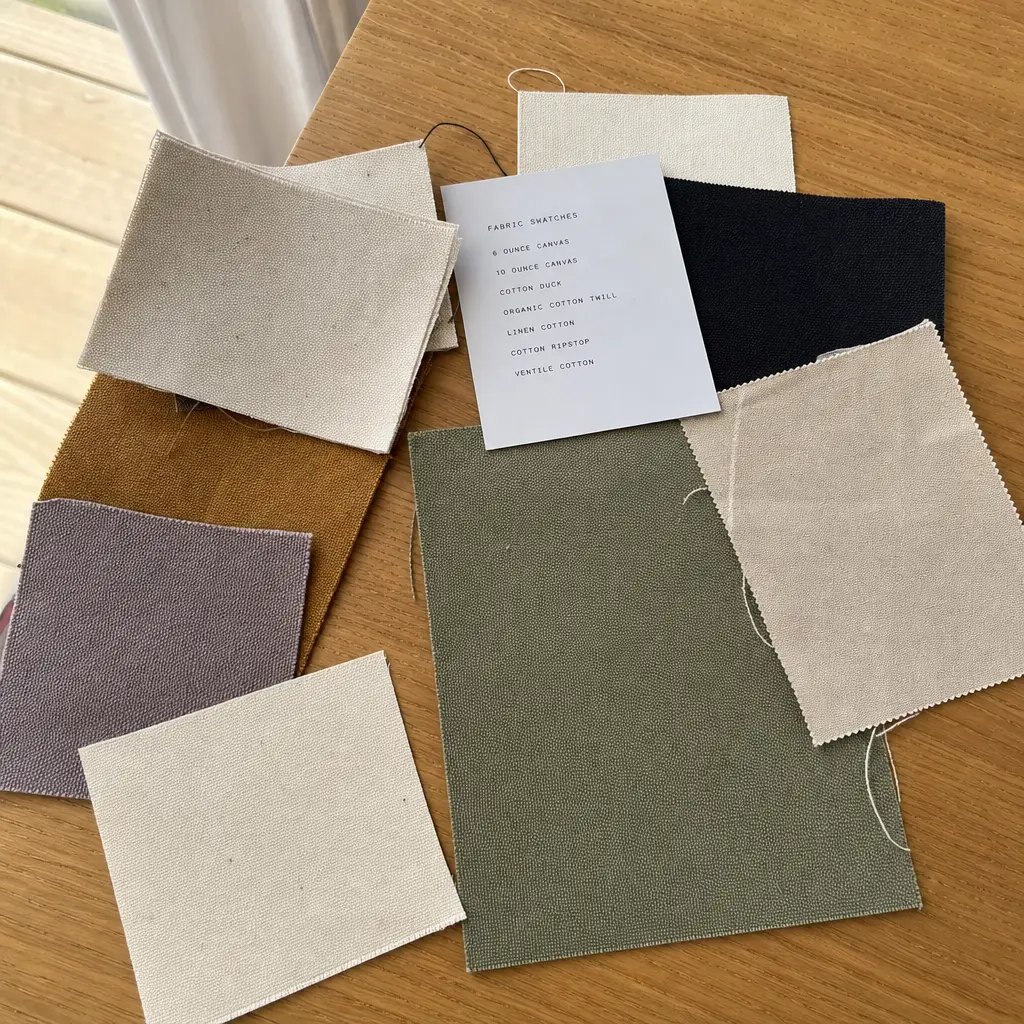
- Request a material swatch, print strike-off, and full pre-production sample before bulk cutting.
- Set carton requirements: unit packing, carton mark format, maximum carton weight, pallet preference, and retail barcode placement if needed.
- Build the purchase schedule backward from campus launch date, allowing time for artwork approval, sample courier, production, inspection, export, and receiving.
- Separate quote lines for tooling, sample cost, bulk unit price, packing upgrade, inland freight, and export documentation.
- Require supplier photos or videos of fabric, cutting, printing, sewing, zipper testing, and packed cartons before balance payment.
Factory quote questions to send
- What canvas weight, GSM tolerance, yarn type, and fabric construction will be used for this portfolio?
- Is the quoted fabric greige, stock-dyed, custom-dyed, washed, or pre-shrunk, and how does that affect lead time?
- What zipper brand or grade is included, and can you provide zipper pull strength and open-close test results?
- Which decoration method is quoted, how many colors are included, and what is the maximum printable area without distortion?
- What is the MOQ for standard colors, custom fabric colors, custom zipper colors, and custom woven labels?
- How many days are needed for artwork review, sample making, sample revision, bulk fabric preparation, printing, sewing, final inspection, and packing?
- What sample types are included in the quote: fabric swatch, print strike-off, size sample, pre-production sample, or shipment sample?
- What are the finished size tolerances, print position tolerances, color tolerances, and acceptable defect limits?
- How many units fit per carton, what is the carton size and gross weight, and can the carton pass normal export handling?
- Which Incoterm is quoted, what port is used, and what documents are included for import clearance and bookstore receiving?
Quality-control points to confirm
- Finished size tolerance should normally stay within ±5 mm for width and height on flat portfolios, unless heavy canvas or washing creates agreed variation.
- Canvas GSM should be verified from a cut swatch, with a practical tolerance such as ±5 percent stated before production.
- Zipper must run smoothly around corners without fabric catching, skipped teeth, or slider looseness.
- Seam allowance should be consistent, especially along zipper tape, pocket edges, and stress points near the opening.
- Print color should be matched against approved Pantone or physical strike-off under consistent lighting, not only against a phone photo.
- Logo placement should usually stay within ±3 mm to ±5 mm from approved position, depending on panel size and printing method.
- Interior pockets should be measured against intended inserts, such as letter paper, course packets, orientation cards, or tablets.
- Cartons should be drop-resistant for export handling and should not crush portfolio corners or deform zipper edges.
- Random inspection should include zipper cycling, seam pull checks, print rub checks, odor review, needle damage, loose threads, and packing count accuracy.