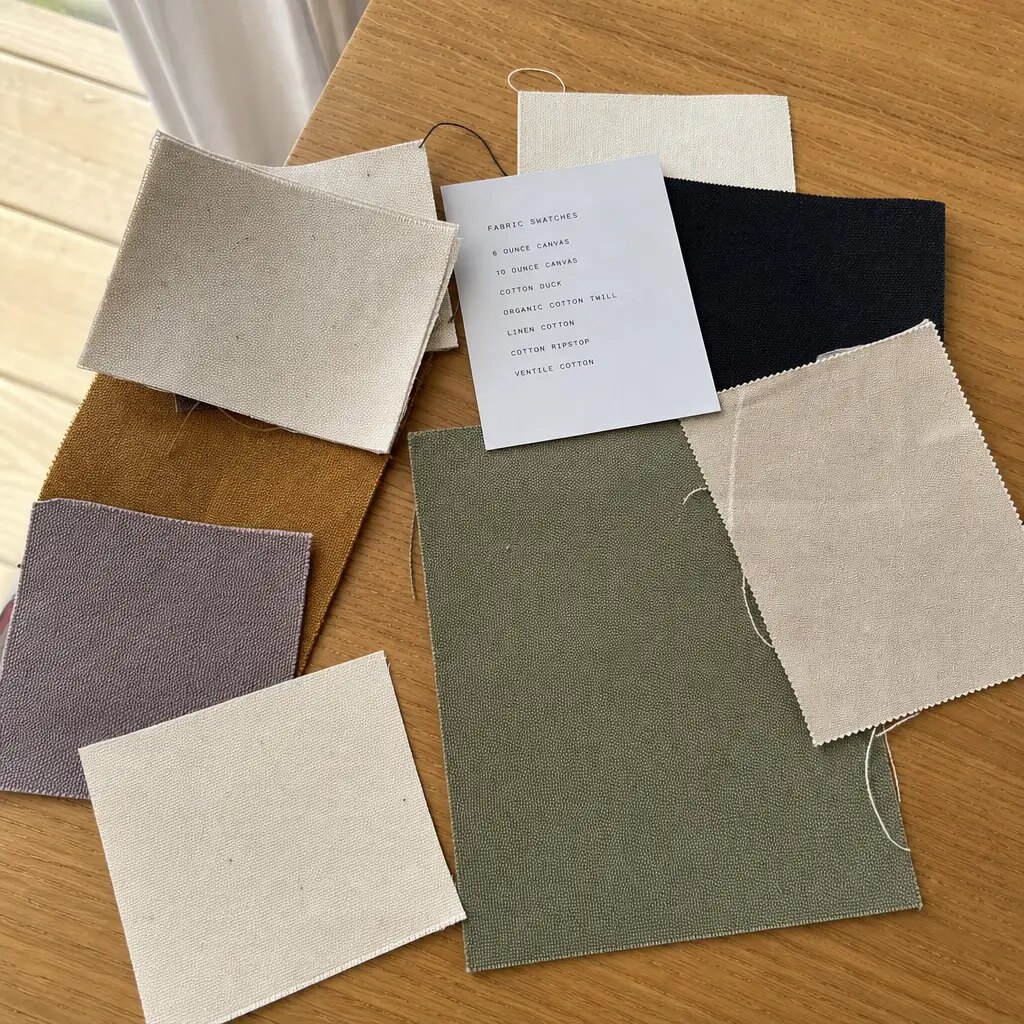
Where Portfolio Orders Usually Fail
A custom canvas zipper portfolio looks simple on paper, but the failure points are practical. Buyers usually lose control in three places: the body structure becomes too soft, the zipper line starts to wave or bite, and the logo print shifts from the approved sample once production starts. If the portfolio is meant to hold paper inserts, lookbooks, or a small notebook, any deviation in opening width, gusset shape, or zipper placement becomes visible immediately. That is why this product should be treated as a small sewn item with tight tolerances, not as a generic printed pouch.
For eco apparel brands, the risk is not only cosmetic. A portfolio that looks premium in a sample room can turn into a weak retail piece when the factory swaps fabric lots, uses a cheaper slider, or moves the print position to save labor. Buyers need to define the use case first: is this a sales kit item, a brand giveaway, a retail accessory, or a daily document carrier? The answer changes the canvas weight, the amount of reinforcement, and the inspection standard.
- Weak body structure usually comes from underweight canvas or poor seam layout.
- Zipper defects often show up only after repeated opening and closing, not on first inspection.
- A good sample must reflect the final use case, not only the front view of the product.
Lock the Core Spec Before You Quote
Start with the canvas itself. A 12 oz or about 340 gsm body is acceptable for light promotional use, but it can feel limp once the portfolio carries documents every day. A 14 oz or about 400 gsm canvas is the safest middle ground for most eco apparel programs because it holds shape better without becoming bulky. A 16 oz or about 450 to 480 gsm canvas is the premium choice when the buyer wants a stiffer hand, stronger shelf presence, and better shape retention after packing and transit. The right choice depends on the perceived value of the portfolio, not just on target cost.
Then lock the zipper and build details together, because those choices affect each other. A #5 nylon coil zipper with an auto-lock slider is usually the most practical option for smooth daily use and cleaner color matching. If the portfolio needs a cleaner retail look, add light lining and bound inner seams. If the brand is sensitive about material claims, write the spec in plain production terms instead of marketing language. State whether you want natural canvas, dyed canvas, washed canvas, recycled packing, or any low-impact ink requirement, and make sure the factory can repeat it on bulk material.
- Use 14 oz / 400 gsm as the default benchmark unless your brand position clearly supports a lighter or heavier body.
- Put the zipper type, slider style, and color code into the spec sheet, not only into a chat message.
- If the portfolio needs a premium finish, define lining, binding, and reinforcement in the first sample request.
Compare Sourcing Routes, Not Only Unit Price
The cheapest quote is often the one with the most hidden handoffs. A direct factory with in-house sewing, printing, and final QC usually gives the best control over material consistency and defect accountability. A trading company can be useful when you are buying multiple bag categories or need one contact for a broader program, but you must know whether the actual production sits in a stable factory or changes from order to order. A split route, where one shop prints and another shop sews, is workable for smaller or highly specialized orders, but it adds time and makes rework harder to manage.
When you compare suppliers, ask the same commercial questions every time: who buys the canvas, who owns the print screens, who approves the zipper color, and who signs off the final packing? The best supplier is not the one with the nicest sales sample. It is the one that can explain what happens if the zipper arrives off-shade, if the canvas batch is lighter than promised, or if the print needs to be redone after pre-production approval. Those answers matter more than a small unit-price difference.
- Direct factory sourcing gives the clearest defect responsibility when the order is simple and repeatable.
- Trading-company sourcing helps when you need multi-category coordination, but it demands stronger quote transparency.
- Split production only works when you control the handoff points and accept longer schedule risk.
Build an RFQ That Produces Comparable Quotes
A weak RFQ produces quotes that cannot be compared. The buyer needs one page that states final dimensions, open width, pocket count, fabric GSM, zipper spec, logo method, carton pack count, and destination market. If you leave any of those fields open, suppliers will fill the gap with their own assumptions, and the low quote will usually hide a downgrade in canvas weight, zipper quality, or packing. Add a simple measurement sketch if the portfolio has a gusset, inside pocket, or asymmetric logo placement. A good factory can quote quickly when the spec is clear.
The quote should also separate the commercial pieces that often get buried inside a unit price. Ask for unit price at MOQ, sample fee, print setup or screen cost, zipper upgrade cost, lining surcharge, packing cost, and any testing charge. This gives procurement a real landed-cost view and prevents the classic issue where the first quote looks cheap and the revised quote grows after artwork approval. If the portfolio is part of a larger eco apparel range, keep the same RFQ format across all items so you can compare factories by structure, not by storytelling.
- Provide one approved artwork file, one measurement sheet, and one packing instruction sheet.
- Ask the supplier to state what is included and excluded in the unit price line by line.
- Use the same RFQ format across vendors so each quote exposes the same cost drivers.
Sample Approval: What the Golden Sample Must Prove
The golden sample is not only a visual reference. It must prove that the canvas holds shape, the zipper runs cleanly, the logo lands in the right place, and the portfolio opens and closes without dragging on the inner seams. When the sample is stuffed with paper or a notebook, the buyer should look at corner shape, zipper alignment, and whether the front panel bows. If the item is meant for retail, the sample also needs to show that the fold line and packing method will not leave permanent creases or rub marks before the product reaches the shelf.
Do not approve a sample only because the front photo looks good. Measure it. Photograph it. Write down the zipper color code, fabric lot, print position, stitch density target, and the exact packaging used for the approved sample. Keep that reference with the PO, because bulk production often fails by one small change: a different slider, a lighter canvas batch, a shifted pocket height, or a faster print setting. A signed sample sheet saves time when the first inspection turns up a mismatch.
- Measure critical points on the sample: width, height, gusset, pocket depth, and zipper opening.
- Test zipper function under repeated open-close cycles before releasing bulk.
- Attach a signed sample sheet that records material, artwork, and packing details.
QC Points That Catch Real Defects
Production QC should follow defect logic, not just visual taste. The first check is fabric lot control: the approved canvas weight and shade must stay stable across panels, and the hand-feel should not shift from the sample. The second check is sewing accuracy: stitch lines should be straight, seam allowances consistent, and reinforcement present at every stress point. The third check is functional performance: the zipper should glide without snagging and stay aligned after repeated use. A portfolio that fails any of these tests will create service issues after delivery, even if the front view looked clean.
Use a clear rejection standard. Many buyers default to a generic AQL number without defining what counts as a major defect. That is too loose for a product that sits in front of customers or sales teams. A crooked zipper, a misaligned logo, a broken stitch at the zipper end, or a clearly lighter canvas batch should be treated as major. Minor issues, such as a loose thread trimmed during packing, are a different category. Buyers who define defects this way get better factory behavior and fewer arguments at inspection.
- Treat zipper misalignment, wrong artwork position, and seam failure as major defects.
- Set a measurable tolerance for dimensions instead of using only visual approval.
- Use the same inspection logic for pilot pieces, in-process checks, and final carton audit.
Print and Branding Choices for Eco Apparel Lines
For a canvas zipper portfolio, branding usually needs to be durable first and decorative second. Screen print remains the most practical choice when the logo is simple and the order needs controlled cost. One or two spot colors are enough for most eco apparel brands, and they keep the print surface cleaner and easier to inspect. If the artwork includes fine text, a gradient, or a full illustration, the buyer should expect more risk in registration and curing. That is not a reason to avoid print; it is a reason to match the print method to the artwork from the start.
Embroidery and woven labels work better when the buyer wants a more premium tactile finish or a stronger brand cue at close range. They also help when the portfolio is meant to sit beside apparel rather than act as a loud promotional item. The tradeoff is production complexity. Embroidery can pucker thin canvas if the backing is not controlled, while woven labels add sewing steps and can look cheap if the thread color is wrong. Keep the branding system simple unless the portfolio is a retail hero piece.
- Use screen print for simple logos and controlled unit cost.
- Use embroidery or woven labels when the brand wants a premium tactile finish.
- Approve a bend test and rub test on the sample before releasing bulk printing.
Packing That Protects Margin
Packing is not a back-office detail. It changes scuff risk, retail presentation, and carton efficiency. For most orders, a single-piece tissue wrap or recycled polybag inside a master carton is enough, but the buyer should specify the exact format. If the portfolio has a visible print surface, make sure the packing method prevents friction marks between units. If the route is humid, add desiccant or a moisture control note. If the brand wants a lower-plastic option, say so early, because the factory may need a different folding method or paper-based insert.
Carton planning matters as much as the unit pack. A bad carton size wastes freight cube and creates corner crush. Ask for carton dimensions, gross weight, net weight, and pack count per carton before you approve the order. Retail buyers should also define barcode placement, carton marks, and whether a master carton needs a case label for internal warehouse handling. The hidden cost in poor packing is not only damaged goods; it is the time spent repacking and relabeling at the receiving dock.
- Specify whether the portfolio ships in tissue, recycled polybag, or another retail-safe wrap.
- Request carton dimensions and gross weight before confirming freight assumptions.
- Use clear carton marks and barcode placement to reduce warehouse handling errors.
Lead Time, MOQ Logic, and Landed Cost
Lead time changes when the order adds custom components. A simple portfolio with stock canvas and a standard zipper can move quickly once the artwork is approved, but custom zipper color, lining, special packing, or extra testing adds time. The safer planning approach is to separate sample lead time from bulk lead time and to tie both to material availability. A factory that can quote the calendar honestly is usually more reliable than one that promises an aggressive schedule without showing where the bottleneck sits.
MOQ is also a function of how many variables you change. The base order size may look reasonable until you ask for a custom puller, a special zipper tape color, multiple print positions, or several colorways. Each added variable consumes setup time and often raises the minimum. For landed-cost comparison, always ask for EXW and FOB separately, then decide whether you need DDP or your own freight. The real decision is not unit price alone; it is the full cost to land a sellable portfolio in your warehouse.
- Separate sample timing from bulk timing and tie both to material availability.
- Expect MOQ to rise as you add custom colors, pullers, labels, or multiple artwork versions.
- Compare EXW, FOB, and DDP on the same quote sheet before choosing the sourcing route.
Specification comparison for buyers
| Spec decision | Recommended option | When it fits | Buyer risk to check |
|---|---|---|---|
| Best sourcing route | Direct factory with in-house sewing, printing, and final QC | You have one core portfolio style, clear artwork, and need stable measurements across the run | Confirm the same team handles cutting, zipper insertion, print curing, and final packing |
| Alternative sourcing route | Trading company with a fixed approved factory list | You are buying several bag styles at once or need one contact for multi-category sourcing | Require factory names, sample ownership, and a clear explanation of where the markup sits |
| Split-production route | Separate print house plus sewing subcontractor | Your order is small, local, or built around specialty printing that one factory cannot do well | Each handoff adds delay and color variation risk, so define responsibility for rework |
| Fabric weight | 14 oz / about 400 gsm canvas | Most eco apparel brand programs need a balance of body, foldability, and cost control | Check that the quoted GSM is the finished fabric weight, not only a target before shrinkage |
| Premium body weight | 16 oz / about 450 to 480 gsm canvas | The portfolio needs a stiffer hand, a more premium retail feel, or better shape retention | Heavier canvas raises sewing time, freight weight, and the chance of bulky corners |
| Zipper spec | #5 nylon coil zipper with auto-lock slider | You want smooth operation, lower metal marks, and a better fit for daily open-close use | Verify zipper tape width, slider style, and color match against the approved sample |
| Branding method | One to two color screen print with controlled ink laydown | Your logo is simple, the target price is tight, and you want a clean retail look | Too much ink can crack or block the fabric grain, so approve a wash and bend test on the sample |
| Interior build | Light lining with document pockets and bound seams | The portfolio carries paper inserts, lookbooks, or tablets and needs a cleaner opening feel | Lining adds cost and one more QC point, so inspect pocket size and seam alignment carefully |
| Packing format | Single piece tissue wrap or recycled polybag inside a master carton | You need retail-safe packing without excessive plastic and want fewer transit scuffs | Confirm carton size, pack count, label position, and whether humid lanes need desiccant |
Buyer checklist before sampling
- Lock the final dimensions, document fit, and pocket layout before asking for price.
- Specify canvas GSM, weave feel, and any finishing such as washing or dyeing.
- Approve zipper size, slider style, puller material, and zipper tape color.
- State the logo method, exact placement, and pantone reference if color matters.
- Define seam reinforcement points, stitch density target, and edge binding method.
- Set the packing format, carton count, carton marks, and retail label needs.
- Request a signed golden sample with measurement sheet before bulk production.
- Clarify MOQ, sample fee, lead time, and incoterm in the first quote round.
Factory quote questions to send
- What exact canvas weight, finish, and shrinkage allowance are included in the unit price?
- Which zipper model, slider type, and tape color are included without surcharge?
- Is artwork setup, screen cost, embroidery digitizing, or label tooling included separately?
- What is the MOQ by colorway, logo version, and carton pack configuration?
- How does the price change if I add lining, an interior pocket, or a custom puller?
- What sample charge applies, and can the sample fee be deducted from the bulk order?
- What QC standard do you use for major and minor defects, and how are rejects handled?
- Can you break out ex-factory, FOB, carton, and freight-related charges line by line?
Quality-control points to confirm
- Fabric weight matches the approved spec within a tight tolerance and the canvas weave looks even across all panels.
- Finished dimensions stay within the agreed tolerance for width, height, gusset, and pocket depth.
- Zipper action is smooth, centered, and free of snagging across repeated open-close cycles.
- Stitching is straight, dense enough for the load, and free of skipped stitches, loose threads, or needle damage.
- Bar-tacks or reinforcement stitches are present at stress points such as zipper ends and handle or pocket joins.
- Print placement matches the approved artwork position and shows no smearing, cracking, or misregistration.
- Color shade is consistent between fabric panels, zipper tape, labels, and bulk cartons when matching is required.
- Inside seams, binding, and pocket openings are neat, flat, and not twisted or puckered.
- Packing count, barcode, carton marks, and retail labels match the purchase order exactly.
- No visible oil stains, odor, dust, moisture marks, or transportation scuffs appear on finished goods.