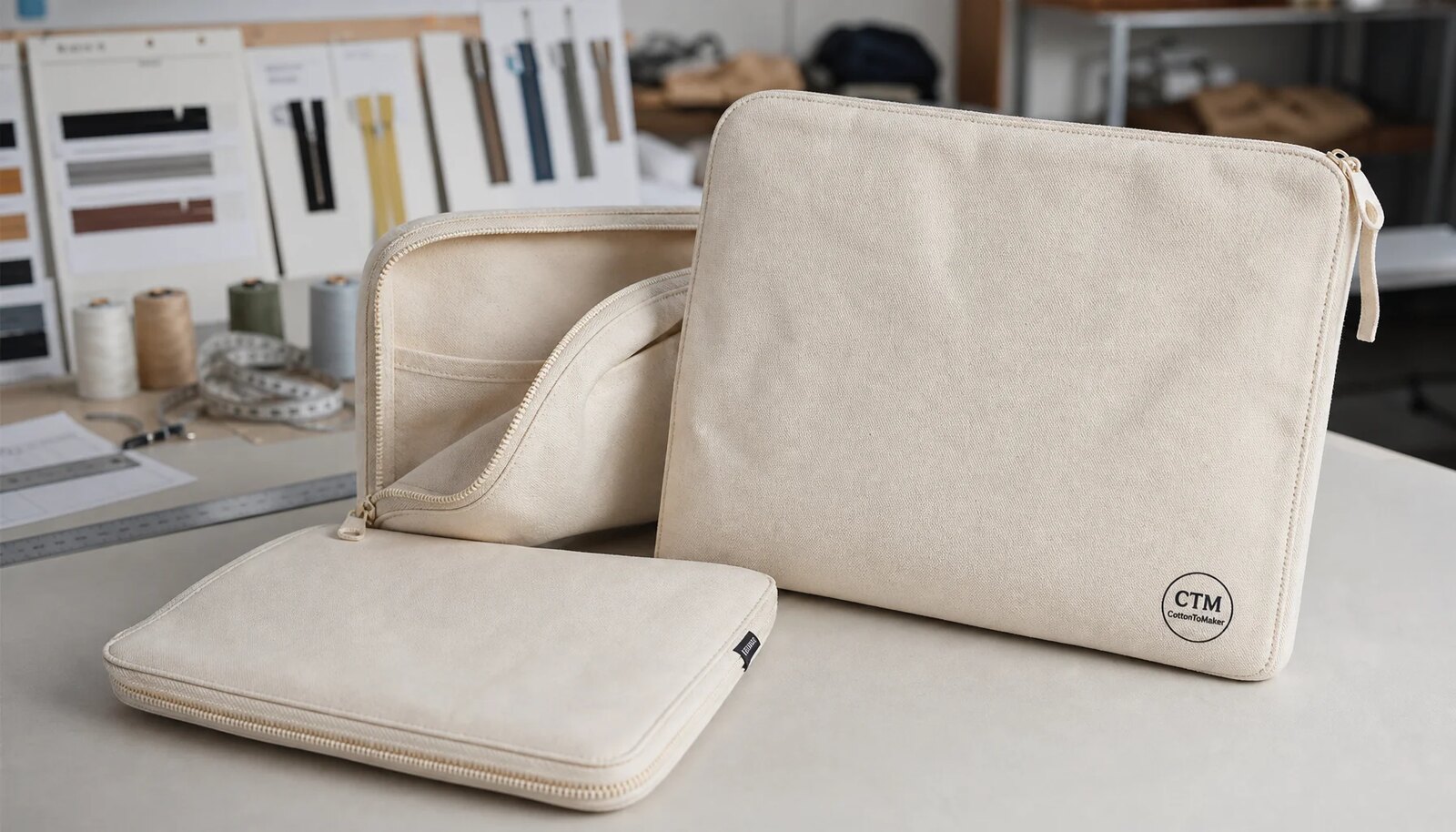
Buying Problem: The Proof Looks Fine, Then Bulk Goods Do Not
Custom canvas zipper portfolios can look straightforward in a mockup. A rectangle of natural canvas, a zipper, a hotel logo, perhaps a woven label. In bulk production, the weak points show up quickly: the logo drifts toward the zipper, the natural canvas shade changes by carton, the zipper tape waves after sewing, the portfolio will not hold the spa menu without bending it, or the print scuffs because the goods were packed like low-cost promotional pouches instead of retail merchandise.
Most of these failures are not caused by one careless worker. They happen because the order is treated as a print job when it is really a sewn retail product with a branded surface. Fabric stretch, cutting tolerance, seam bulk, zipper quality, thread tension, ink absorption, curing, and carton pressure all affect the finished piece. If the PO only says natural canvas zipper pouch with logo, the supplier has too much room to make assumptions.
Hotel retail adds another layer. The same item may be sold in a gift shop, used for guest documents, included in a welcome kit, packed with event materials, or distributed to several properties with different logos. It does not need luxury construction everywhere, but it does need the details guests notice: a square shape, smooth zipper, clean print, consistent shade, neat seams, protected packing, and carton labels the receiving team can trust.
- Treat the item as a sewn retail portfolio, not only as a flat printed pouch.
- Approve physical fabric, zipper, thread, label, lining, print, and packing before mass production.
- Define whether the portfolio is sold empty, filled with documents, used for amenity packaging, or bundled with retail goods.
- Write measurable tolerances for size, logo location, zipper function, seam quality, shade, and carton condition.
- Keep one approved sample with the buyer and one with the factory, tagged with date, version, and PO reference.
Start With Use Case, Size, and Insert Fit
The first specification should not be the logo. It should be the job the portfolio must do. A hotel buyer may need the piece to hold an A4 welcome letter, a US letter invoice pack, a spa treatment menu, a stationery set, a guest map, event badges, or a retail insert card. Each use case changes the needed internal clearance, zipper opening, seam finish, and packing method.
Avoid describing the size only as A4, letter, menu size, or document size. Those terms do not tell the factory how much space is lost to seam allowance, lining, zipper tape, or corner construction. State the finished outside width and height, gusset if any, usable internal clearance, zipper opening length, largest insert size, and insert stack thickness. If the document stack is 8 mm thick, say so. If the portfolio must remain flat on a shelf, say that too.
A portfolio can measure correctly outside and still fail in use. The insert may snag on loose inner threads. The zipper opening may be shorter than the document width. A lined version may look better but reduce internal space. For flat portfolios, +/-5 mm is a common finished-size tolerance, but it should be confirmed after sewing and packing. If fit is critical, inspect with the real insert, not a ruler alone.
- State finished dimensions as width by height by gusset, with separate usable internal clearance.
- Provide the largest insert size, insert thickness, and whether inspection is done empty, filled, or both.
- Confirm zipper opening length, not only total zipper length, because seam ends reduce usable access.
- Choose raw seams, overlocked seams, bound seams, or full lining based on retail presentation and budget.
- Ask the factory to mark safe print area, seam allowance, zipper position, and insert clearance on the technical drawing.
Specify Canvas by Weight, Finish, and Shade
Canvas is both a cost driver and a brand signal. A 10 oz cotton canvas, often around 320-340 GSM depending on weave, can work for lightweight event pouches or short-term amenity packaging. A 12 oz canvas, commonly around 380-410 GSM, is a practical starting point for hotel retail portfolios because it gives the piece enough body without making the zipper corners too bulky. A 14 oz canvas can feel more substantial, but it may slow sewing, increase needle stress, create thick seams, and raise carton volume.
Ask for both oz and GSM. Suppliers and mills may use different conventions, and two fabrics described with the same ounce weight can feel different because of weave and finishing. Composition should be written clearly as 100% cotton canvas or a specified cotton-poly blend. If the buyer needs a natural, low-key hotel retail look, natural cotton canvas is often suitable, but natural is not a color standard. It may show seed flecks, slubs, cream undertones, and roll-to-roll shade variation.
Dyed, bleached, pigment-washed, or pre-washed canvas needs more control. Dyed canvas should be approved by lab dip or physical swatch before bulk fabric booking. Washed canvas may have intentional variation, so define the acceptable shade range instead of expecting perfect uniformity. If the portfolio may be washed by hotel staff or guests, approve a washed sample and record dimensional change after wash. Even if it is not intended for laundering, fabric stability matters because shrinkage can distort logo shape, zipper alignment, and final size.
- Use 10 oz canvas for lighter packaging where long-term structure is not critical.
- Use 12 oz canvas for most hotel retail portfolios needing stable handfeel and clean print appearance.
- Use 14 oz canvas only after checking seam bulk, zipper corner thickness, sewing difficulty, and carton volume.
- Request GSM, oz weight, composition, weave, finish, shrinkage condition, and approved shade standard.
- Approve logo color on the actual canvas shade because natural, bleached, dyed, and washed grounds change perceived ink color.
Lock the Zipper, Puller, and Sewing Details
The zipper is the part guests touch first. For most medium-weight canvas zipper portfolios, a No. 5 nylon coil zipper is the safest baseline. It is smoother and stronger than many No. 3 zippers while avoiding the heavy look of No. 8. Metal zippers can look premium, but they add weight and can mark neighboring products if packing is tight. The right choice depends on the brand, the fabric weight, and how often the portfolio will be opened.
The quote should identify zipper tape color, teeth color, slider material, puller style, plating or coating, stopper type, and zipper end treatment. Tone-on-tone tape gives a quieter retail look. Contrast tape can suit resort or seasonal ranges, but it must be approved against the actual canvas, thread, and print. Painted pullers should be checked for chips and scratches. Custom logo pullers may require tooling, sample approval, longer lead time, and higher MOQ, so they should be decided early, not added after the sample is approved.
Sewing construction deserves the same attention. Confirm seam allowance, topstitching distance, thread color, stitch density if used as a control point, lining attachment, zipper end reinforcement, corner shape, and inside seam finish. A zipper can feel smooth on an empty sample and catch when the portfolio is filled. Test both conditions before signing off.
- Specify zipper size, material, tape color, teeth color, slider finish, puller material, puller shape, and zipper stops.
- Open and close the zipper fully several times, checking for catching, splitting, dragging, skipped teeth, or wavy tape.
- Inspect zipper ends for secured stops, no sharp edges, no loose tape, and no bulky knots near the opening.
- Approve contrast zipper tape against actual canvas, thread, label, and print, not only a zipper-card swatch.
- Avoid late custom puller changes unless mold timing, sample approval, MOQ, and replacement risk are already in the schedule.
Proof the Print Like a Textile Product
A digital proof confirms artwork direction. It does not prove that the logo will print cleanly on canvas. Screen printing is usually the best starting point for solid hotel logos, property names, and one- to three-color designs. It can be durable and cost-efficient when ink, mesh, pressure, curing, and fabric surface are controlled. The tradeoff is detail. Fine serif type, thin rules, tight letter spacing, dense reverse-out artwork, and small registration gaps can close up on textured canvas.
Heat transfer can reproduce gradients, small text, and high color counts, but the edge of the film and the handfeel must be approved. Some transfers look too promotional for hotel retail if the design and film are not chosen carefully. Digital printing can work for complex artwork, but buyers should confirm color strength, abrasion resistance, and coverage on the actual canvas. Embroidery can add texture, but it may pucker flat panels or create a rough inside surface if backing is not controlled. Woven labels are useful for subtle secondary branding, but they should not be treated as a replacement for a visible front logo when the item is sold as branded hotel merchandise.
Placement language must be measurable. Instead of saying centered or near the corner, define the logo size in millimeters and reference its position from the body centerline, bottom seam, side seam, or lower corner. For many sewn canvas goods, +/-5 mm is practical, but the supplier must confirm it is repeatable. If the logo sits near the zipper or close to a seam, leave enough safe zone so the print does not disappear into bulk, curve around a corner, or look crooked after sewing.
- Supply vector artwork, Pantone references, print size in millimeters, and a placement diagram with reference points.
- Use language such as logo centerline +/-5 mm from body centerline and bottom edge +/-5 mm from bottom seam.
- Keep fine text, thin lines, and reverse-out details large enough for textured canvas and the selected print method.
- Ask whether the supplier prints panels before sewing or finished goods; panel printing often gives better control for flat logos.
- Approve ink color, edge sharpness, texture coverage, curing, and handfeel on the actual canvas, not only on a paper proof.
Build the RFQ Around Real Cost Drivers
MOQ is not just a number a supplier chooses. It is shaped by fabric purchasing, cutting efficiency, print setup, zipper procurement, sewing line changeover, packing materials, inspection, and destination sorting. A supplier may accept 300 pieces when the buyer uses stock natural canvas, stock zipper colors, one print color, no lining, and simple packing. The same item may move to 1000 pieces or more with dyed canvas, custom zipper tape, custom pullers, multiple property logos, barcode labeling, or property-level carton splits.
Unit price comparisons are often misleading. One quote may include 12 oz canvas, individual packing, screen charges, woven label setup, and carton marks. Another may assume lighter fabric, bulk packing, and excluded setup costs. Procurement teams should ask suppliers to separate product unit cost, print setup, sample fee, custom component charges, packing materials, barcode application, inspection support, inland freight, export documentation, and freight assumptions.
Price breaks should match the buying plan. If the launch is 500 pieces but the replenishment plan may reach 3000, request both. If a hotel group needs different logos by property, ask whether MOQ is per artwork version or total combined order. Some factories can combine cutting and sewing quantity while separating print runs, but each artwork version may still need separate screens, proofing, records, and inspection attention.
- Request price breaks at realistic quantities such as 500, 1000, 3000, and 5000 pieces.
- Separate costs by size, canvas color, zipper color, print design, label version, and packing method.
- List one-time charges for screens, sample making, custom puller mold, woven label setup, barcode setup, and special cartons.
- Confirm overrun and underrun tolerance before production, especially for custom printed and sewn goods.
- Compare estimated carton dimensions and gross weight because freight can erase the benefit of a lower unit price.
Approve Samples With Inspection-Level Notes
A pre-production sample is not a sales prop. It is the control standard for bulk production. The final approval sample should use the same canvas weight, shade, zipper, thread, lining, label, print method, ink, seam construction, and packing as the production order. If an early development sample uses substitute fabric or a temporary zipper, mark it clearly and do not release bulk production until a production-equivalent sample is approved.
Review the sample the way a guest or hotel retail team will use it. Insert the actual document stack. Close the zipper. Hold the portfolio upright. Check whether the shape collapses, the corners twist, the zipper ends pull, or the insert bends. Measure outside dimensions, zipper opening, and usable clearance. Compare logo color under consistent light. Bend the printed area gently after curing and check for cracking, flaking, pinholes, or exposed canvas texture. Look inside for loose threads that could catch paper.
Sample comments should be specific enough to act on. Instead of the logo is slightly low, write move logo up 8 mm from current sample position. Instead of the zipper should be smoother, write slider catches at left corner when portfolio is filled with 8 mm document stack. Each revised sample should be checked against the comment sheet. Once approved, the buyer and factory should each keep a signed, tagged sample with version number, approval date, and PO reference.
- Measure finished width, height, zipper opening, and usable clearance with the intended insert inside.
- Photograph logo position with a ruler so production and inspection teams can see the reference clearly.
- Check zipper straightness, puller feel, and corner stress when the portfolio is empty and filled.
- Review print edge quality, ink coverage, color match, curing, and cracking after gently bending the printed fabric.
- Keep signed approval samples with buyer and factory, and refer to the sample number in the purchase order.
Plan Retail Packing Before Cartons Are Made
Packing is often where an acceptable product becomes a rejected retail item. Canvas can pick up dust, lint, oil marks, and moisture. Printed surfaces can scuff when pieces rub. Metal pullers can press into adjacent panels and leave marks. Hotel retail usually needs more protection than loose bulk packing, even when the design is simple.
Individual recycled polybags, glassine bags, tissue wrap, paper belly bands, hangtags, or barcode-ready sleeves may be suitable depending on the hotel brand, sustainability policy, display method, and inventory process. The packing choice should be approved with the sample because it affects presentation, scuff protection, carton size, and receiving labor. If the portfolio is sold with an insert card, include that card in the packing test.
Carton planning should be confirmed before the order is placed. Too many pieces in one carton can indent corners or zipper pullers. Cartons that are too large allow shifting and bent edges. Cartons that are too heavy slow hotel receiving and backroom handling. Define pieces per inner pack, pieces per export carton, carton dimensions, net weight, gross weight, moisture protection, and shipping marks. For hotel groups, carton marks should include item code, PO number, color, size, quantity, carton number, gross weight, net weight, dimensions, and destination or property name if split.
- Use individual protection when prints are dark, large, recently cured, or close to high-friction areas.
- Set inner pack quantities that match hotel receiving, distributor picking, or e-commerce fulfillment units.
- Request carton dimensions, carton quantity, net weight, and gross weight before confirming freight mode.
- Avoid overly tight packing for portfolios with metal pullers, raised labels, thick seams, or heavy zipper ends.
- Specify barcode sticker size, location, scan requirement, and whether it goes on the bag, belly band, hangtag, or polybag.
Set Lead Time Gates and Approval Buffers
A realistic schedule includes artwork confirmation, material sourcing, swatch or lab dip approval, sample making, sample review, revision if needed, bulk material booking, print setup, printing, curing, sewing, inline inspection, final packing, final inspection, and export handover. Stock-material orders may move faster, but dyed fabric, custom zipper tape, custom pullers, multiple property logos, and retail barcode labeling add approval gates.
The biggest schedule risk is releasing production before the proof is stable. If logo size or placement changes after screens are made, the factory may need to remake screens or reprint panels. If zipper color changes after bulk zipper purchase, sewing may wait for replacement materials. If packing is decided after production, carton dimensions and freight estimates may be wrong. Work backward from the in-store date, hotel opening date, event date, or seasonal launch, then protect the approval points that cannot be rushed.
Inspection and shipping buffers should not be treated as optional. Inline checks can catch printed-panel defects and sewing issues before they become finished goods. Final inspection should verify packed cartons, but it is too late to discover a wrong logo position after every piece is sewn and packed. Air freight is not a simple fix because canvas portfolios can be bulky compared with unit value. If the launch date is fixed, price the air-freight fallback early and decide which risks justify that cost.
- Reserve time for sample production, buyer review, sample revision, and final approval, not only factory sewing days.
- Lock canvas color, zipper specification, print artwork, labels, and packing before bulk purchasing starts.
- Add buffer for holidays, courier delays, dye-lot approval, curing time, inspection booking, and export handover.
- For multi-property programs, release artwork in one controlled file set with version numbers and approval status.
- Estimate air freight early if the launch date is fixed, because bulky canvas goods can be costly to expedite.
Write QC Standards Before Production Starts
Quality standards should be agreed before cutting and printing, not negotiated after defects appear. Define critical, major, and minor defects in practical terms. Critical defects may include wrong logo, wrong material, broken zipper function, unsafe sharp metal edges, strong mildew odor, or severe contamination. Major defects may include logo placement outside tolerance, visible print cracking, severe stains, mixed shades in the same carton, open seams, skipped stitches at stress points, or packing that cannot protect the goods. Minor defects may include small loose threads or slight fabric slubs outside the logo area if they do not affect retail appearance.
If the buyer uses AQL inspection, state the inspection level and acceptance limits in the PO or inspection booking. If AQL is not used, still define the sampling method, defect categories, measurement tolerance, and required photo records. Inspection should include component checks, printed-panel checks, sewing checks, and final packed-carton checks. Printed panels should be inspected before sewing because removing a bad print at panel stage is far easier than repairing a finished portfolio.
Rejected goods handling should also be written. Some issues can be trimmed, cleaned, or re-pressed if the repair does not harm the product. Other issues, such as wrong logo, severe ink bleeding, strong odor, zipper failure, or shade mixing, should be replaced rather than repaired. The PO should state whether replacement pieces must be produced before shipment, whether shortages are allowed within an agreed tolerance, and whether the supplier must provide inspection photos or a report before release.
- Define critical, major, and minor defects for zipper function, print, fabric, stitching, odor, shade, labeling, and packing.
- Inspect printed panels before sewing so defective prints are removed before more labor is added.
- Check finished portfolios empty and filled with the intended insert to confirm shape, zipper stress, and usability.
- Use consistent lighting and the approved physical sample when judging canvas shade and logo color.
- Require final packed-carton inspection before shipment release, especially for hotel retail or distributor orders.
Specification comparison for buyers
| Spec decision | Recommended option | When it fits | Buyer risk to check |
|---|---|---|---|
| Canvas body fabric | 12 oz cotton canvas, often about 380-410 GSM depending on weave; request pre-shrunk or sanforized fabric if finished size control is tight | Hotel gift shop portfolios, spa document holders, meeting welcome kits, premium amenity packaging, and reusable retail accessories | Low GSM can collapse around inserts; unstable finishing can distort size, zipper alignment, logo placement, and print shape |
| Fabric color standard | Approved physical swatch for natural canvas; lab dip or approved bulk-roll cutting for dyed, bleached, pigment-washed, or pre-washed canvas | Hotel groups needing consistent presentation across properties, seasonal assortments, or replenishment orders | Natural cotton is not optical white and may show seed flecks, slubs, and shade variation; mixed dye lots can look uneven on a retail shelf |
| Finished size tolerance | Commonly +/-5 mm for flat sewn portfolios after packing, unless a tighter tolerance is confirmed by sample and written into the PO | Document holders, menu sleeves, stationery pouches, invoice packs, room collateral, or A4/letter-size inserts | Generic size terms such as A4 or letter do not define usable internal clearance, zipper opening length, or seam bulk |
| Portfolio structure | Flat canvas portfolio with 5-8 mm seam allowance; optional cotton lining, bound seams, or overlocked inner seams depending on retail finish target | Retail-ready but cost-controlled hotel merchandise where clean appearance and usable document space matter | Full lining adds cost and thickness; unlined construction may expose raw seams, loose threads, or a less finished interior |
| Zipper specification | No. 5 nylon coil zipper with approved tape color, slider finish, secured stops, and metal, painted, cord, fabric, or molded puller | Most medium-weight canvas zipper portfolios used for repeated opening and closing | No. 3 can feel weak on larger sizes; No. 8 can look bulky; poor sliders can catch, split, or close unevenly |
| Logo method | Screen print for solid 1-3 color marks; heat transfer or digital print for gradients or high color count; woven label for secondary branding | Hotel logos, property names, resort collections, event marks, co-branded retail programs, and amenity packaging | Fine serif text can fill in on textured canvas; transfers may show film edges; embroidery can pucker flat panels |
| Print placement tolerance | Written reference such as logo centerline +/-5 mm from body centerline and logo bottom edge +/-5 mm from bottom seam | Orders with multiple sizes, multiple property logos, corner placement, pocket placement, or logo near zipper tape | Without a fixed reference point, bulk goods may pass factory visual review while looking uneven across cartons or displays |
| MOQ planning | Often 500-1000 pcs per size, canvas color, zipper color, and print design for efficient material purchase and production setup | Initial hotel retail launch, distributor stock order, amenity program, property opening kit, or seasonal merchandise run | Very low MOQ usually means stock fabric, stock zipper colors, limited packing choices, and fewer custom component options |
| Retail packing | Individual recycled polybag, glassine bag, tissue wrap, paper belly band, or barcode-ready sleeve, then 20-50 pcs per export carton depending on size and hardware | Hotel receiving, gift shop storage, e-commerce fulfillment, property transfer, and distributor handling | Loose bulk packing can scuff prints, crush corners, bend zipper ends, damage barcodes, and increase hotel-side sorting time |
Buyer checklist before sampling
- Define the final channel: hotel gift shop retail item, in-room amenity pouch, spa document holder, event welcome kit, stationery portfolio, room-key packet, invoice pack, or distributor resale product.
- State finished dimensions as width by height by gusset, then separately list usable internal clearance, zipper opening length, largest insert size, insert thickness, and finished-size tolerance.
- Specify canvas weight in oz and GSM, fiber composition, weave, color standard, shrinkage expectation, washing or pre-shrinking requirement, lining requirement, seam finish, and whether natural slubs are acceptable.
- Provide vector artwork with Pantone or brand color references, printed logo size in millimeters, print method preference, orientation, location diagram, safe print zone, and placement tolerance from defined reference points.
- Choose zipper size, zipper material, tape color, teeth color, slider finish, puller material, puller shape, stopper type, zipper end treatment, and whether a branded puller or fabric zipper tab is required.
- Request a physical pre-production sample using the same bulk canvas, zipper, thread, lining, label, print ink, production method, and retail packing proposed for mass production.
- Set QC thresholds for wrong material, wrong logo, zipper failure, strong odor, stains, shade variation, logo misregistration, ink bleeding, print cracking, seam puckering, skipped stitches, loose threads, and carton damage.
- Confirm individual packing, barcode or sticker location, inner pack quantity, master carton quantity, carton dimensions, gross weight limit, moisture protection, shipping marks, and property-level carton splits.
- Ask the supplier to separate unit price, sample fee, print screen or setup cost, custom puller mold, label setup, special packing, inspection support, inland freight, export documentation, and freight-related assumptions.
- Reserve lead time for artwork review, swatch or lab dip approval, sample making, sample revision, print proof approval, material booking, production, inline checks, final inspection, packing, and export handover.
Factory quote questions to send
- What canvas weight, GSM, composition, weave, finish, and shrinkage condition are included in the base quote, and is the fabric stock natural, bleached, dyed, washed, greige, or pre-shrunk?
- What color standard will you use for natural, bleached, dyed, or washed canvas, and can you provide a physical swatch, lab dip, or approved bulk-roll cutting before production?
- Is the quoted zipper No. 3, No. 5, or No. 8, and what tape, teeth, slider, puller, stopper, zipper end treatment, plating, coating, or painted finish is included?
- Which print method are you quoting, how many colors are included, and what screen charges, transfer sheets, digital setup, curing steps, color-matching attempts, or test prints are included?
- What is the MOQ per size, canvas color, zipper color, print design, label version, packing format, and shipping destination split, and what price breaks apply at higher quantities?
- Can the pre-production sample be made with the same bulk canvas, zipper, thread, lining, label, ink, print process, seam construction, and retail packing materials intended for production?
- What finished size tolerance, print placement tolerance, seam allowance tolerance, zipper length tolerance, shade tolerance, and overrun or underrun tolerance will you accept in the production specification?
- Do you print panels before sewing or print finished goods, and how do you control logo position, ink curing, panel contamination, and rejected printed panels before assembly?
- How many pieces per inner pack and export carton do you recommend, and what estimated carton dimensions, net weight, gross weight, and carton strength should we use for freight costing?
- What defects do you classify as critical, major, and minor for zipper function, print quality, fabric defects, stains, odor, stitching, shade variation, labeling, barcode readability, and packing damage?
Quality-control points to confirm
- Finished size should remain within the written tolerance, commonly +/-5 mm for flat portfolios unless a tighter tolerance is approved by sample and proven repeatable in production.
- Usable internal clearance and zipper opening should be checked with the intended insert, because a portfolio can meet outside dimensions while failing to hold documents cleanly.
- Zipper must open and close smoothly for the full length without skipped teeth, slider looseness, splitting, catching fabric, wavy tape, sharp ends, unsecured stops, or bulky zipper corners.
- Logo color should be judged against the approved physical sample under consistent light, with no ink bleeding, pinholes, cracking, ghosting, heavy texture loss, or unapproved transfer edge.
- Print placement should stay within the agreed centerline, bottom-edge, side-edge, or corner-reference tolerance across sampled cartons, not only on the top pieces.
- Stitching should be even and secured at stress points, with no broken threads, skipped stitches, open seams, exposed raw edges, loose seam ends, severe puckering, or inconsistent seam allowance.
- Canvas surface should be free of oil marks, mildew smell, water stains, dark contamination, severe slubs in logo areas, and obvious shade mixing within the same carton or retail lot.
- Zipper puller, label, lining, pocket, thread color, zipper tape, reinforcement, and seam finish should match the approved sample and bill of materials, not factory stock substitutions.
- Packing should prevent print-to-print abrasion, zipper-puller indentation, corner crushing, moisture exposure, barcode damage, carton overweight, and product deformation during export handling.
- Inspection should include both empty and filled checks using the intended document or retail insert, because zipper stress and portfolio shape can change when loaded.