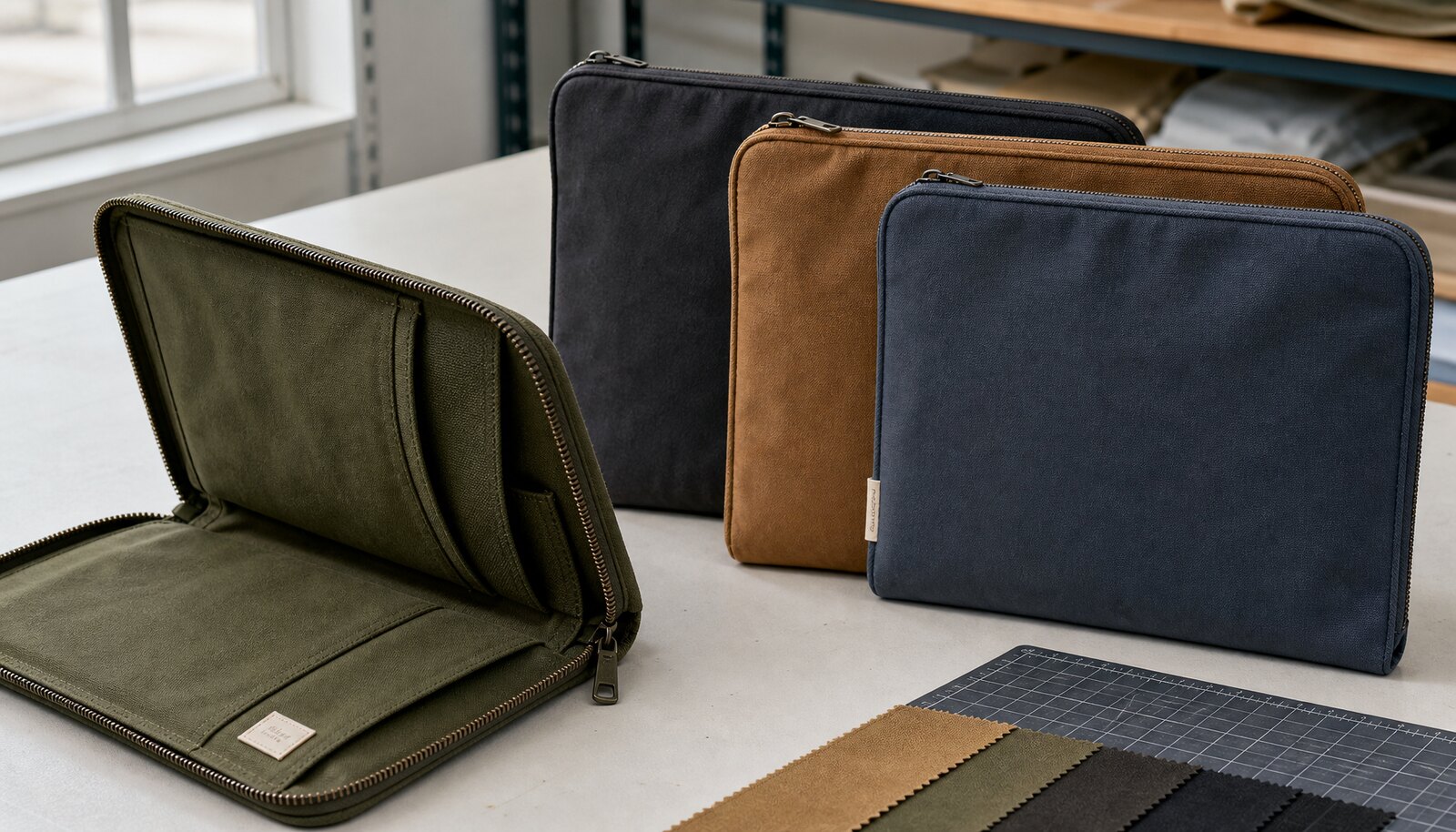
Why gift-shop buyers get burned on this SKU
Custom canvas zipper portfolios look simple from the outside: a canvas body, a zipper, a logo, and a carton. In procurement, that simplicity is exactly why mistakes slip through. The product can be built many ways, with different fabric weights, zipper grades, sewing allowances, print methods, and packing levels. If those choices are not pinned down before quoting, the finished item can miss the retail target even when it technically matches the order description.
Gift-shop channels are less forgiving than warehouse or office-supply channels. The item has to look neat from arm’s length, feel clean in the hand, and survive shoppers opening and closing it on the sales floor. A portfolio that would be fine for storage can still look cheap in a gift display if the canvas wrinkles, the print sits off-center, or the zipper catches at the curve. Procurement teams should treat this as a presentation item with functional requirements, not just a pouch with a longer body.
The most expensive mistake is often the quote that leaves too much open to interpretation. “Canvas zipper portfolio” by itself tells the factory almost nothing about insert size, brand feel, retail finish, or QC severity. The safer buying approach is to define the use case first: what it holds, how often customers will open it, how visible the logo must be, and what the receiving team expects on arrival. Once that is clear, the production spec becomes much easier to control.
A strong procurement brief should also separate appearance choices from structural requirements. For example, a gift shop may prefer natural canvas and minimal decoration, but that preference does not replace the need to specify seam reinforcement, zipper length, or carton labeling. Buyers who keep those layers separate usually get better quotes because suppliers can see which details are fixed and which are negotiable.
The practical sourcing challenge is that this SKU sits between a soft good and a branded retail item. That means a supplier can satisfy the literal wording and still miss the commercial intent. The buyer’s job is to close that gap before sampling starts, not after the first shipment lands.
- Define the end use first: stationery, documents, maps, postcards, or gift inserts.
- Treat shelf appeal, handfeel, and zipper performance as equal priorities, not optional extras.
- Write the request so the factory cannot substitute hidden quality differences without acknowledgment.
Build the RFQ around dimensions, function, and appearance—not just material names
A useful RFQ for custom canvas zipper portfolios starts with finished size in millimeters and the exact item the portfolio must accommodate. A4, letter, or custom retail inserts are not interchangeable. If the buyer only says “document size,” the factory may optimize for its own standard pattern, and the final bag can end up too tight at the seam, too loose in the body, or too short for the zipper opening to feel natural. This is also the point where the buyer should state whether the product is meant to lie flat, hold a small stack of papers, or carry a thicker bundled set of items.
Material language should be equally specific. “Canvas” is not enough for sourcing. The brief should include fiber content if known, target weight, finish, and whether the canvas will be printed or left natural. A natural canvas can look premium in a gift shop, but it must be consistent from batch to batch because uneven shade or slub variation can create the impression of contamination rather than texture. If the product is dyed or bleached, ask for the color standard and whether there is a wash or pre-shrink step before sewing. That matters because shrinkage can shift the zipper line and change finished dimensions.
The functional requirement is where many procurement briefs stay too soft. A portfolio sold at retail needs more than “it opens and closes.” Buyers should define zipper length, opening path, the presence or absence of interior pockets, and whether the portfolio needs to slide easily into gift wrap or display packaging. If there is a printed front panel, define the no-print seam margin and the zone where artwork must not cross a fold or zipper end. Those boundaries reduce artwork disputes later and make the sample review more objective.
Good RFQs also state what is allowed to vary. If the buyer is flexible on inner lining but strict on zipper grade, say so. If the buyer can accept small natural-fabric variation but not print misplacement, put that in writing. That prevents the supplier from trimming quality where it matters most to the retail customer.
For procurement teams managing multiple gift-shop SKUs, it helps to use a one-page spec sheet with line items for size, fabric, zipper, print, interior structure, packing, and defect thresholds. The goal is not bureaucracy. It is to make sure every quote responds to the same request and every sample is judged against the same standard.
- State finished size plus the exact insert type the portfolio must fit.
- Separate negotiable preferences from non-negotiable quality points.
- Include no-print zones, zipper path, and seam margin in the artwork brief.
Choose the canvas spec with the shelf, the hand, and the sewing line in mind
For most custom canvas zipper portfolios, 14oz cotton canvas is a strong default because it gives enough structure for retail display without making the item hard to sew or expensive to ship. That said, the right spec depends on positioning. A souvenir-style gift shop SKU that competes on impulse price may work on 12oz canvas if the sewing is clean and the print is bold. A higher-end stationery or museum shop product may need 16oz canvas if the buyer wants a firmer body and a more substantial feel in hand. The weight alone is not the whole answer, but it is the first control point.
Canvas finish matters just as much as weight. Pre-shrunk or controlled-shrink material reduces the risk that the portfolio changes shape after pressing, packing, or customer handling. If the canvas is too coarse, small artwork loses sharpness and the product can read as rustic rather than premium. If the canvas is too smooth for the chosen print method, ink adhesion or transfer definition can suffer. In other words, the fabric should be selected to fit the art, not just the price target.
Natural canvas also needs a cleanliness rule. Buyers should define what counts as acceptable fiber speck, slub, or shade variation. Some variation is inherent to the material and can be part of the product’s appeal. But if the batch looks uneven across units, the item can appear inconsistent on a gift shelf. That is especially true when the order ships in mixed cartons to multiple retail locations. A simple color sample card or signed fabric swatch can prevent endless arguments about whether the batch is “natural-looking” or just inconsistent.
From a production perspective, the buyer should also ask whether the factory’s cutting and sewing process is set up for the chosen weight. A very heavy canvas can slow stitching speed, stress needles, and create bulk at the zipper ends and corners. That does not automatically make it a bad choice, but it should be reflected in the price and quality plan. If the supplier quotes a higher canvas weight at no cost change, the procurement team should ask what else has been reduced to compensate.
The safest practice is to lock the fabric spec before artwork approval. Once the print layout is finalized, changing canvas finish can affect color, opacity, and the position of seam boundaries. It is easier to revise a swatch than to relaunch artwork after the sewing line is already prepared.
- Use 14oz as the starting point unless price or stiffness drives a different choice.
- Require a fabric swatch or reference card for natural, bleached, or dyed base cloth.
- Check whether the chosen canvas weight will slow sewing or create bulky zipper ends.
Zipper construction: the part customers touch most often
The zipper is where the portfolio either feels trustworthy or immediately cheap. For this product category, nylon coil zippers are usually the most practical option because they open smoothly, flex around corners, and keep production cost under control. A standard #5 coil zipper is enough for many gift-shop portfolios, especially when the item holds papers, notebooks, or flat stationery. Move to #8 only when the portfolio is oversized, filled more heavily, or positioned as a sturdier travel-style business bag. Choosing a larger zipper “just in case” can add cost, stiffness, and visual bulk without a meaningful retail benefit.
The slider and puller deserve their own review. Buyers often ask for zipper type but forget the puller finish, and that leaves room for a cheap substitution. A thin puller, rough plating, or sharp edge can scratch the canvas or feel underdeveloped in hand. If the portfolio is a gift item, the tactile impression matters more than it would in a back-office pouch. Ask the supplier whether the zipper is a branded source, a tested equivalent, or an in-house substitute. If the answer is not clear, the quote is not sufficiently controlled.
A zipper should also be tested where it actually works: along a curve and at the ends, not just on a straight sample. Many closures run fine on a flat test strip but snag once sewn into the bag body. Ask the factory to show a sample with the zipper fully sewn into the actual portfolio shape. Then inspect for tape waviness, exposed tape ends, twisted seams, and mismatch between the zipper tape color and the canvas edge. Those are not cosmetic small points. They are the details buyers notice when they open the product for the first time.
For procurement approval, a useful practical test is repeated opening and closing on several random samples from different cartons. You do not need laboratory-level testing to catch a weak zipper. If the operation starts to drag, feels rough, or catches at the curve after modest repeated use, that is enough evidence to stop and investigate. Ask the supplier to explain the issue before more units are produced. A small correction at sample stage is far cheaper than a bulk hold.
The zipper end finish should also be evaluated as part of the final appearance. Clean end stops, no frayed tape, and no visible thread nests around the seam help the product look finished on shelf. In retail packaging, the customer may see the zipper before they notice the logo. That makes zipper quality a front-line quality issue, not a hidden technical one.
- Use nylon coil for smooth retail handling unless the SKU clearly needs a heavier build.
- Test zipper function on the actual sewn product, not on a standalone strip only.
- Reject sharp pullers, waviness, exposed ends, or rough attachment points that affect handfeel.
Print method, logo placement, and the right way to control artwork quality
Print is where a lot of procurement briefs sound precise but still leave enough room for disappointment. “One-color logo on front” is not a production instruction. A supplier needs the exact print area, distance from seams, acceptable placement tolerance, and file type. If the buyer skips those details, the factory may center the logo in a way that looks technically acceptable but visually off when the zipper seam or pocket line is visible. For gift-shop packaging, visual balance is part of product quality.
Screen printing is generally the strongest choice for simple logos, bold type, and larger orders. It gives good opacity on canvas and keeps unit economics reasonable when the color count stays low. The downside is setup: each color and each location increases preparation and makes short runs less efficient. Heat transfer or digital printing can make more sense for multi-color art, small text, or lower MOQ, but buyers should look closely at surface durability and fold-line cracking. The best method is the one that matches the art and the planned order size, not the one that merely looks cheapest in isolation.
The buyer should also define what “good print” means on textured canvas. A print that looks fine on a smooth proof may lose edge sharpness or show tiny pinholes once transferred to coarse weave. That is why a strike-off or pre-production printed sample matters. It lets the team see whether the art remains legible at the planned size and whether ink coverage stays stable at the edges. If the design includes fine lines or small text, ask the supplier to state the minimum readable size they recommend on that particular fabric. This is a practical check, not a guess.
Placement tolerance is another area that should be quantified. If the logo is supposed to sit 35 mm from the left seam and 25 mm from the top edge, write that down. A verbal instruction to “center the print” can result in line-to-line variation that becomes obvious when the product is displayed side by side. The same applies to print size. Some factories will slightly reduce artwork dimensions to make registration easier unless the buyer defines the allowed range. A few millimeters can matter on a small retail item.
Finally, ask how the print is cured, meaning enough for the ink or transfer to handle folding and packing without smudging or cracking. If the supplier cannot explain print durability in terms of handling and fold resistance, that is a warning sign. The logo should survive normal retail handling, not just the first unboxing.
- Require exact print placement in millimeters from at least two reference edges.
- Approve a strike-off or pre-production sample for every new artwork.
- Ask whether small text remains readable on the chosen canvas weave.
Comparison matrix: supplier route, cost structure, and quality control depth
A useful comparison for custom canvas zipper portfolios should look beyond the unit quote. For this SKU, supplier route affects how consistently the finished product matches the approved sample, how much hidden work is charged separately, and how easy it is to fix problems before bulk shipment. The matrix below compares common sourcing routes with practical tradeoffs that matter to gift-shop buyers.
The goal is not to crown one route as universally best. It is to choose the route that matches your risk tolerance, forecast stability, and retail expectations. If you are buying for a branded gift shop chain, quality traceability matters more than getting the absolute lowest ex-factory number. If you are testing a seasonal design, speed and lower sample cost may matter more than engineering depth.
A useful way to read the matrix is to ask one question for each supplier: how much of the bag is under one roof? If cutting, sewing, printing, and packing all sit in one facility, the path from sample to bulk is easier to control. If those steps are split across multiple vendors, the quote may look attractive while the quality gap widens during production.
- Compare routes on repeatability, not only initial responsiveness.
- Ask which production step is in-house and which step is outsourced.
- Treat hidden charges as part of the landed cost, not as a footnote.
Supplier route comparison table: quality, cost, and decision thresholds
Use this table when two or more suppliers appear similar on paper but differ in structure. It helps identify which route gives the best balance of control, speed, and retail readiness. If one quote is significantly lower, check whether it assumes simpler packing, lighter canvas, a different zipper grade, or looser print control rather than assuming the supplier is simply more efficient.
Packing rules should cover flat packing, insert board if needed, SKU bundles, carton weight limit, moisture protection, and barcode visibility. These details affect cost, damage rate, receiving speed, and whether the goods can move directly into retail or distribution. A retail-ready carton plan is worth more than a slightly lower unit price if the receiving team can put the product away without rework.
| Supplier route | Typical strength | What to verify before awarding | Best use case | |---|---|---|---| | Direct factory, fully integrated | Better control over cutting, sewing, print, and packing | Material source, in-house QC, sample-to-bulk continuity, and defect handling | Reorders, branded programs, and buyers who need repeatable quality | | Factory with outsourced print or packing | Can be cost-effective and flexible on low MOQ | Who handles each step, whether artwork stays consistent, and how rework is managed | Seasonal or smaller runs where cost and speed matter more than deep control | | Trading company / sourcing agent | Easier communication, more supplier options, simpler initial quoting | Actual factory name, who owns sample approval, and whether the same line makes bulk | Buyers who need help comparing options and consolidating communication | | Small workshop or mixed-production vendor | Fast samples and custom attention | Stitch consistency, capacity, and carton-level packing control | Early testing, niche designs, or very small trial orders |
When comparing routes, ask whether the sample was made on the same machine, by the same process, and from the same material lot as the planned bulk order. That single question often exposes whether the low quote is genuinely competitive or just loosely connected to the final production path.
- If two quotes differ by more than a small margin, verify whether the fabric, zipper, or packing spec is actually identical.
- Use one spec sheet and one sample reference for every supplier in the comparison.
- Do not compare a bulk-packed offer against a retail-packed offer without normalizing the packing cost.
What to lock in before sample approval
The sample should prove the exact construction you plan to buy in bulk, not just the general design idea. A common procurement error is approving a sample that looks right but was made from different fabric, different zipper stock, or a different print process than the planned production. That kind of sample is useful as a visual proof, but it is not a proper golden sample unless the supplier confirms material traceability and process continuity. If bulk substitutions are likely, they should be written into the approval record before the first unit is signed off.
Sample review should be hands-on and sequence-based. Start with the opening action, then inspect the zipper ends, then check seam straightness and the feel of the canvas body, then examine print placement under bright light. After that, fold the item the way it will be packed and see whether it springs back with ugly creases. Gift-shop buyers should care about how the product looks after packing, because that is often how it will sit in the carton and on the shelf. A good sample can still fail if the fold line lands across the logo or causes a permanent wrinkle.
This is also the point to settle tolerance language. Decide how many millimeters of size variation are acceptable, what kind of stitch irregularity is still minor, and which defects are automatic reject conditions. A signed sample without tolerance notes forces the receiving team to rely on memory later, which is poor control. Keep one physical sample, one photo record, and one written approval note that includes the approved spec version. If any future batch deviates, the dispute process becomes much simpler.
For buyers managing multiple gift-shop SKUs, it helps to mark the sample with what matters most for the channel: logo orientation, zipper feel, pack format, barcode position, and whether the product arrives display-ready. That makes the sample more than a keepsake. It becomes a practical benchmark for production and receiving.
If there is any disagreement at sample stage, resolve it before the factory starts bulk material allocation. Once fabric is cut, the supplier’s flexibility drops and the cost of change rises quickly.
- Only approve a sample as golden if the material source matches the planned bulk source, or the difference is documented.
- Check the product after folding and after reopening, not only in the flat sample state.
- Keep a signed sample, photos, and tolerance notes together as one approval record.
Inspection checklist with product-specific acceptance criteria
For B2B procurement, inspection should be written in a way that a buyer, factory, and third-party inspector can all use the same language. Broad labels like “good quality” do not survive a dispute. For custom canvas zipper portfolios, the defect plan should define what counts as minor, major, and critical in the context of this product. A tiny thread end may be minor. A crooked logo may be major if it affects shelf presentation. A zipper that will not close, a wrong size, or the wrong artwork is critical because it changes the functional or commercial identity of the item.
A practical acceptance plan usually starts with an agreed sampling method such as AQL, but the AQL number alone is not the answer. The buyer still has to define the defect examples. For instance, a major defect might include print misplacement beyond the agreed millimeter range, visible oil marks, seam gaps, or zipper waviness that is obvious to the customer. A critical defect might include missing zipper teeth, severe contamination, a wrong SKU, or incorrect carton marks for the destination warehouse. The point is to make the inspector’s judgment repeatable.
Inspection should also be carton-aware. It is not enough to pull a few samples from the top layer of the first carton. Random units should be checked across cartons and packing positions so the team can detect line drift, packing damage, or contamination that only appears deeper in the shipment. When a canvas portfolio is folded too tightly, the zipper can get pressed into the fabric and leave a line or scratch. That issue is often a packing problem rather than a sewing problem, which is why inspection has to include packaging condition.
Acceptance criteria should be measurable whenever possible. Finished dimensions should be checked with a ruler or gauge. Print placement should be measured from a seam reference. Stitch density can be counted over a short distance. Zipper travel can be tested by repeated opening and closing. Packaging should be checked for dust, tear, crush, and label legibility. Those are simple checks, but they are the checks that keep gift-shop inventory from arriving half right and fully unsellable.
If you use a third-party inspector, give the inspector the product photo, the signed sample, the defect list, and the carton plan in one packet. Without those references, the inspection report may describe general bag quality instead of the exact expectations of this SKU.
- Use AQL plus a defect list specific to this portfolio, not a generic bag standard.
- Measure size, print placement, and stitch consistency with actual tools during inspection.
- Check random units from different cartons and packing positions.
Packing, carton data, and retail-ready receiving
Packing has a bigger effect on perceived quality than many buyers expect. Canvas is durable, but it also picks up dust, crease marks, and zipper abrasion quickly if packed badly. A portfolio that leaves the sewing line in good shape can still arrive looking tired if it was folded too tight, packed without tissue, or allowed to rub against a hard carton edge. Gift-shop buyers should treat packing as part of product quality, not a separate logistics afterthought.
The right packing format depends on the channel. Individual polybags are common when barcodes, retail hanging, or clean shelf presentation matter. Tissue wrapping can help reduce crease memory, but it adds labor and may not be necessary for lower-priced SKUs. Bulk packing can work when the channel accepts it and the product is robust enough, but then the carton design, internal separation, and loading pattern need more attention. If the buyer wants a lower-plastic presentation, the supplier should still state exactly how dust, scuffing, and folding are controlled without overpacking.
Carton information should be fully specified because receiving teams use it to plan putaway and replenishment. Ask for unit count per inner pack, outer carton count, carton dimensions, gross weight, and outer mark format. If the distribution center scans barcodes at receipt, make sure the barcode label size and placement are practical, not decorative. A label that looks tidy on the unit but is hard to scan in receiving is a hidden failure. The same is true of mixed SKU cartons and unclear carton marks.
Buyers should also ask about drop handling and compressive protection if the product will travel far or stack under heavier cartons. A lightweight canvas portfolio does not need overly engineered packaging, but it does need enough protection that the zipper does not rub, the corners do not flatten sharply, and the print face does not crease through the bag. The cheapest carton plan is not always the cheapest landed solution if it creates unsellable presentation damage.
For retail replenishment, align pack count with the store’s breakpack pattern. If the order lands in cartons that are awkward to split, the inventory team pays the penalty later. Packaging design should serve both transport and receiving.
- Specify fold direction and whether the zipper pull sits inside or outside the fold.
- Require dust protection and crease control suitable for shelf display.
- Match carton count and outer marks to the receiver’s barcode and breakpack process.
Specification comparison for buyers
| Procurement decision | Recommended spec or route | Best fit for gift-shop buyers | Main tradeoff / risk to control |
|---|---|---|---|
| Canvas weight | 14oz cotton canvas as the default starting point; 12oz for entry price, 16oz for a firmer premium feel | Most gift shops that want visible structure without making the product bulky or expensive to sew | Too-light canvas can wrinkle, telegraph print distortion, and feel thin on shelf; too-heavy canvas can increase sewing difficulty and freight weight |
| Canvas finish | Pre-shrunk or controlled-shrink canvas; specify natural, bleached, or dyed base before print approval | Orders with front-and-center printing or repeat replenishment where color and size consistency matter | If shrinkage is not controlled, zipper line alignment and finished dimensions can shift after pressing or handling |
| Zipper type | Nylon coil zipper, typically #5 for standard portfolios; #8 only for oversized or heavily loaded items | Retail handling, frequent opening, and general-purpose stationery or document portfolios | Cheap zipper tape can wave, jam on curves, or leave rough ends that reduce perceived quality |
| Puller / slider | Smooth-edged metal puller or coated puller with a tested finish | Gift-shop SKUs where the buyer wants a slightly elevated feel without changing the whole product category | Sharp edges, thin plating, or weak attachment points can scratch canvas or fail after repeated use |
| Print method | Screen print for simple logos and larger volumes; heat transfer or digital print for complex art or lower MOQ | Buyers with logo-only or limited-color artwork and a clear forecast | The wrong method can either overpay on setup or underdeliver on opacity, durability, and print sharpness |
| Print control | Placement measured in millimeters from seam lines; require strike-off or pre-production sample | Orders where logo position and shelf appearance must stay consistent across replenishment | “Centered” is not enough for production; vague placement language causes line-to-line variation |
| Closure style | Three-side zipper for maximum opening; two-side zipper only if the interior use case is simple and flat | Portfolios that hold papers, notebooks, maps, or small gift inserts | Poorly designed opening geometry can make the item awkward to load and increase returns |
| Supplier route | Direct factory with in-house cutting, sewing, printing, and packing control | Reorders, branded retail programs, and buyers who need repeatable QC | Trading routes may be easier to start, but sample and bulk can come from different lines unless you lock the source |
| Packing format | Individual polybag with barcode sticker for retail receiving; bulk pack with tissue only if transit risk is low and the channel accepts it | Gift shops and distribution centers that need shelf-ready units and clean receiving data | Loose folding can create wrinkles, zipper abrasion, and dust contamination |
Buyer checklist before sampling
- Confirm finished dimensions in millimeters and state the exact insert size: A4, letter, postcard, notebook, or custom retail insert.
- Lock canvas weight, fiber content, finish, and whether the fabric is natural, bleached, dyed, pre-shrunk, or washed before print approval.
- Define zipper tape type, slider style, puller finish, zipper length, and whether the zipper must pass around a corner without binding.
- State print method, artwork file type, Pantone references if relevant, print area size, and the allowable placement tolerance from seam lines.
- Set seam allowance, stitch density, and reinforcement expectations at stress points, zipper ends, and corners.
- Specify whether the portfolio needs lining, inner pocket structure, gussets, or a flat unlined interior.
- Choose packing format: folded flat, tissue-wrapped, individual polybagged, barcode labeled, or bulk packed with carton marks.
- Request a physical pre-production sample, not only photos, and sign off on one golden sample tied to the approved material spec.
- Ask for carton count, gross weight, carton dimensions, outer mark format, and whether the cartons need drop-test handling for retail distribution.
- Write acceptance criteria for visible defects: stains, crooked print, loose threads, zipper waviness, seam gaps, and packaging contamination.
Factory quote questions to send
- What exact canvas weight, weave type, finish, and shrinkage allowance are included in this quote, and can you state the measurement method?
- Which zipper specification are you using by type, size, and puller finish, and what functional test do you apply before shipment?
- Is the bulk production using the same fabric lot and zipper source as the approved sample, or are there substitutions?
- What is the MOQ by colorway, print method, and packing format, and which line item drives the MOQ the most?
- Does the price include artwork setup, strike-off, sample revisions, labels, tissue, polybags, and carton marks, or are these charged separately?
- What is your sample lead time, bulk lead time after approval, and the most common reasons for delay?
- What placement tolerance do you guarantee for print, zipper alignment, and finished dimensions?
- What inspection standard do you use: AQL level, sample size logic, and defect classification for minor, major, and critical issues?
- Can you share photos or a QC summary from a similar canvas zipper portfolio order, including packing and carton condition?
- If the order requires lower MOQ, what concession is being made in fabric sourcing, print setup, or packing efficiency?
Quality-control points to confirm
- Finished dimensions: measure width, height, and depth on random units; reject if the batch drifts enough to affect insert fit or shelf presentation. Use a pre-agreed tolerance band and record actual results by carton.
- Fabric spec: verify canvas weight and base color against the signed sample or technical sheet. Reject lighter substitute fabric if it changes drape, opacity, or the look of the print.
- Stitching: check stitch density, straightness, seam allowance, corner finish, and bar-tack placement. Loose threads can be minor; skipped stitches, open seams, or weak reinforcement are major defects.
- Zipper function: open and close each sampled unit several times. Reject snagging, tape twisting, wave distortion, teeth skipping, incomplete closure, or pullers that bind at the curve.
- Zipper alignment: inspect whether the zipper sits evenly along the opening and does not wander at the ends. End stops should be neat, secure, and free from exposed rough edges.
- Print quality: verify centering, color consistency, opacity, registration, and edge sharpness. Reject obvious smear, pinholes, cracking on fold lines, ghosting, or off-position logos beyond the agreed tolerance.
- Surface condition: inspect under bright light for stains, oil marks, dust, lint, needle holes, or crease marks that cannot be removed before retail display.
- Packaging condition: confirm the unit is clean, folded correctly, and protected from abrasion. Polybags should not be torn, mislabeled, or oversized enough to allow rubbing in transit.
- Carton accuracy: check count, barcode placement, carton marks, gross weight, and carton integrity. Wet, crushed, or mixed-SKU cartons should be treated as receiving exceptions.
- Sampling logic: inspect across cartons, not just top-layer units. For a commercial order, use an agreed AQL plan with defect definitions written specifically for this SKU.