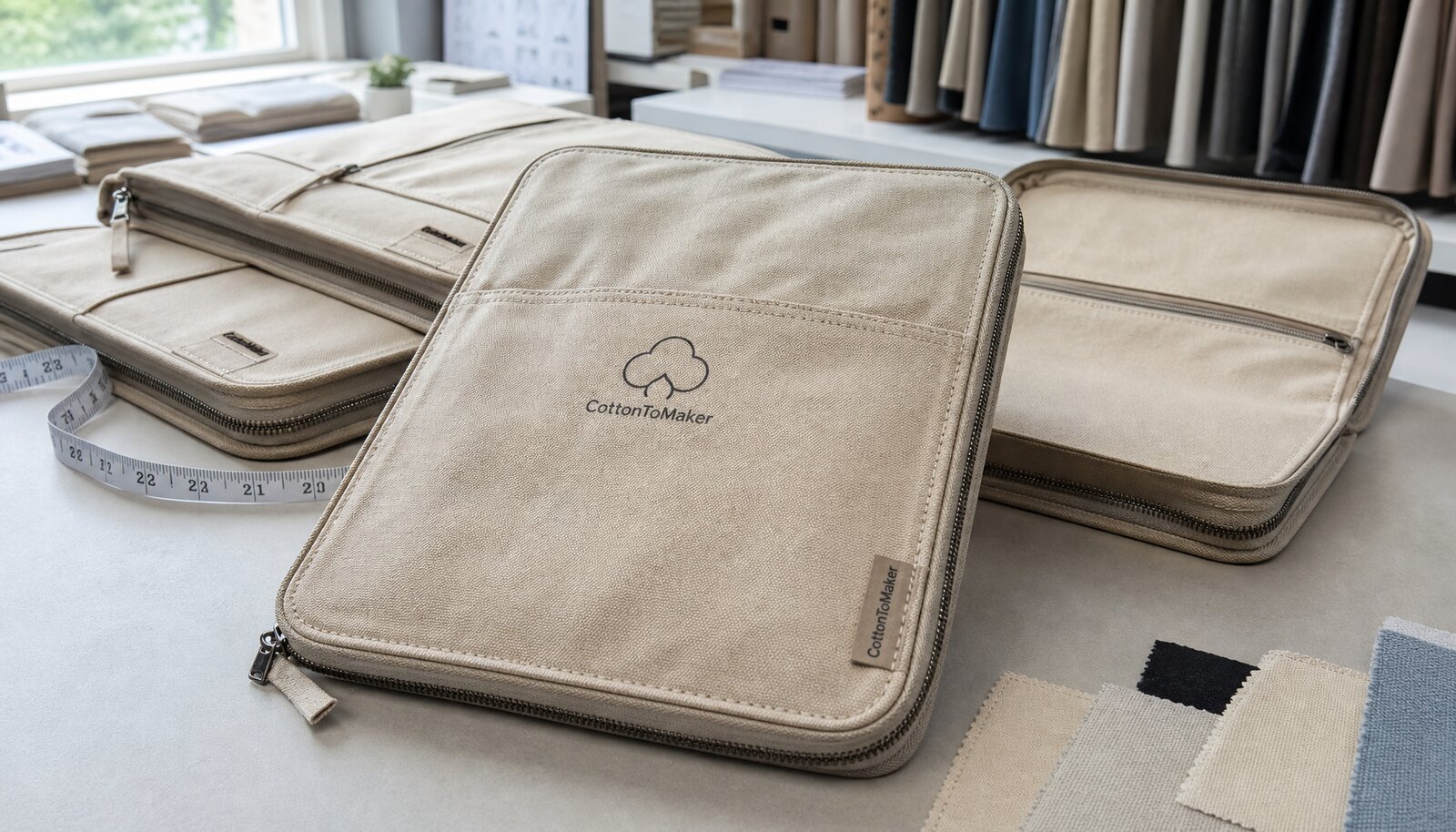
1. Why fabric weight is the starting point for gift-shop portfolio buying
When gift shops buy custom canvas zipper portfolios, the canvas weight does more than change the fabric feel. It changes how the product sits on a shelf, how the zipper line behaves, how the print holds up on textured fabric, and how much freight you pay to move the finished carton. That is why procurement should start with finished fabric weight, not with logo artwork or zipper color.
The most common mistake is treating canvas like a decoration choice. In reality, the fabric weight drives the whole build. A lighter canvas can make the product look flatter and lower cost, but it also increases collapse at corners and makes the portfolio feel less purposeful when customers pick it up. A heavier canvas can create a stronger retail impression, but it adds sewing resistance and may push the bag into a bulkier, more expensive shipping profile.
For gift-shop assortments, the target is usually a product that feels neat, sturdy, and easy to open. That balance is often easier to reach when the buyer writes the RFQ around finished performance: it should lie flat, close cleanly, open smoothly, and keep a crisp front panel after packing and unpacking. Once those requirements are defined, the supplier can recommend the best canvas weight instead of guessing from a one-line brief.
- Start with end-use: document sleeve, souvenir portfolio, tablet carry, or branded retail accessory.
- Treat fabric weight as a system input that affects print, zipper function, and shipping cost.
- Ask the supplier to quote finished weight, not just raw fabric source data.
2. How to choose between 10 oz, 12 oz, and 14 oz canvas
For most gift-shop buyers, 12 oz canvas is the practical default. It usually gives enough body to keep a portfolio looking tidy without making it feel stiff or overbuilt. It also tends to be forgiving in production, which matters when the order combines a zipper, a pocket, printed artwork, and retail packing. If you want one weight that can handle a broad range of gift-shop use cases, 12 oz is usually the safest starting point.
Move down to 10 oz only when the product is intentionally simple or price-driven. This is a better choice for flat document sleeves, promotional portfolios, or low-cost retail items where shelf structure is less important than margin and lightness. The tradeoff is that the body can wrinkle more easily, the corners can crush in transit, and the front panel may not look as premium under store lighting.
Move up to 14 oz when the product is meant to feel substantial. That can make sense for higher-end souvenir collections, tablet portfolios, or larger formats that must stay visually upright. The risk is that the build becomes less forgiving. Sewing through a thicker body can slow production, and zipper ends, pocket edges, and binding intersections need tighter control to avoid puckering or skipped stitches.
A buyer does not need to memorize every weight conversion, but it helps to request the supplier’s recommendation in both oz and gsm, then confirm whether the quoted weight refers to finished fabric or raw greige fabric. That one clarification can prevent a lot of quote confusion later.
- 10 oz: lowest-cost option, softer hand feel, better for flat or lightweight uses.
- 12 oz: balanced option for most retail portfolios and best all-around procurement baseline.
- 14 oz: premium and structured option, best for heavier use or stronger shelf presence.
3. Canvas construction details that affect appearance and durability
Fabric weight is only one part of the canvas story. Two 12 oz canvases can behave very differently if one has a tighter weave, better yarn consistency, or a different finish. When the product is meant for a gift shop shelf, those differences show up quickly. A clean, even weave gives the print a sharper edge and makes the bag look more intentional. A loose or irregular weave can create a rustic look, but it also raises the chance of print feathering and uneven surface appearance.
The finish matters as much as the weight. Natural uncoated canvas keeps the artisanal look that many gift shops want, but it can absorb ink more readily and show handling marks. Washed canvas can feel softer and more relaxed, but excessive washing may change the finished dimensions or make repeat batches harder to match. Light coating or calendaring can improve print crispness and surface smoothness, but too much treatment can make fold lines look stiff or cause cracking over time.
Lining and interfacing should be decided at the quote stage, not after the sample arrives. A self-lined portfolio can keep cost and weight down, but it needs a stable body panel if the product must keep a clean retail shape. Light interfacing in the front or back panel can help the bag stand up, while full-body stiffening can make the zipper harder to run and increase material cost. For procurement, the question is not whether to use lining or interfacing in general; it is where those materials are needed to meet the shelf and handling requirement without overbuilding the item.
Buyers should also ask about seam allowance and edge finishing. On canvas portfolios, a hidden extra margin can help the factory absorb normal variation, but if the allowance is too narrow, the zipper line can drift and the outer dimensions can shrink below spec. If the allowance is too wide, the inside may feel bulky and the zipper opening may not sit flat. The supplier should be able to state where they build tolerance into the pattern and how that tolerance is controlled in mass production.
- Ask whether the canvas is plain weave, pre-washed, coated, or calendared.
- Confirm whether the portfolio is self-lined, partially lined, or fully lined.
- Request the factory’s seam allowance target and whether it is measured from the cut line or the sewing line.
- If the item must stand upright, specify where stabilizer or interfacing is allowed.
4. Zipper gauge, tape, and puller choices for retail portfolios
For zipper business bags and portfolios, zipper selection can make or break the buying decision. A smooth zipper gives the product a clean, retail-ready feel. A poorly chosen zipper can snag, wave, or look mismatched against the canvas. The most common choice for this product type is a nylon coil zipper because it balances cost, smooth operation, and color flexibility. It is also easier for many factories to source consistently than specialty metal or molded options.
The gauge matters. For many portfolio sizes, a #5 zipper is the practical standard because it is strong enough for daily opening and closing without making the line too stiff. A smaller zipper can reduce cost but may feel underbuilt, especially on larger or fuller portfolios. A larger zipper can be appropriate for oversized formats or heavier contents, but overspecifying the zipper often increases cost and can make the opening less elegant.
Tape width and puller finish should be in the quote. Buyers often focus on the slider style and ignore the tape. That is a mistake because cheap zipper tape can ripple against natural canvas, and the puller finish can look inconsistent across a multi-SKU gift-shop line. If the product will be displayed in a boutique setting, ask for a zipper that matches the tone of the canvas and does not look glossy or industrial unless that is the intended design language.
Zipper testing should be practical, not abstract. Ask the supplier to cycle a sample open and closed repeatedly and report whether the slider catches at the seam joins, whether the end stops are secure, and whether the zipper lies flat after closing. If the portfolio includes a gusset, the zipper must also behave well where the seam transitions from flat panel to depth. That is one of the most common failure points in this category.
- Prefer nylon coil zippers for most gift-shop portfolios.
- Use #5 as the first quote benchmark unless the product is oversized or heavy-duty.
- Request zipper tape width, puller finish, stop style, and source origin in the BOM.
- Reject any sample that snags at seam intersections or waves visibly along the zipper line.
5. How print method changes the buying decision on canvas
Print method should be selected after the buyer decides the canvas weight and surface finish. On textured canvas, simple logos generally look best when the method is matched to the fabric rather than forced onto it. Screen print is usually the most dependable option for one- or two-color branding because it gives solid coverage and predictable repeatability. It is often the most gift-shop-friendly method when the logo is clean and the design needs to stay readable from a short distance.
Digital print or heat transfer makes sense when artwork is more detailed, seasonal, or multicolor. Those methods can be useful for shorter runs where the design changes often. The tradeoff is that the print may sit differently on canvas than a screen-printed design, and the surface can feel glossier or less integrated with the textile. For retail buyers, that matters because the product may need to fit a natural, handmade, or premium souvenir aesthetic.
Print placement should be dimensioned like a spec, not described casually. A phrase like “center logo on front pocket” is not enough. The quote should say how far the logo sits from the top edge, the zipper line, and the side seam, and the supplier should confirm the tolerance they can hold in sewing and print registration. If the logo includes small text or thin strokes, it should be checked on the actual canvas weight selected for bulk, not just on a paper proof.
Another issue is cure and rub resistance. Canvas portfolios are handled often, especially in gift shops where customers pick up, set down, and reopen the product before purchase. Ask the supplier what drying or curing process is used and whether they can show that the print survives light dry-rub handling without visible transfer. A print that looks fine in a photo but rubs off in the store is a return risk, not a style choice.
- Screen print is usually best for simple logos on natural canvas.
- Digital or heat transfer suits multicolor or short-run artwork, but must be rub-tested.
- Define print placement from fixed edges and require a measured tolerance.
- Review print on the actual fabric weight you intend to order, not a generic sample.
6. A more useful comparison of sourcing routes and quote structures
Many articles stop at saying direct factories are cheaper and trading companies are easier. That is too vague to help a buyer compare suppliers. The real question is how much control you need over the BOM, sample consistency, and the chance of component substitution. For a custom canvas zipper portfolio, a direct factory is best when you need tight control over fabric weight, zipper spec, print method, and packout. You can usually push harder on construction detail and get cleaner accountability for defects.
A trading company can be useful when your buying program is broader and the portfolio order is one item in a larger gift-shop assortment. They may help you consolidate other products, manage smaller MOQ needs, or source trim options that a single factory does not stock. But the buyer should expect to work harder to keep spec drift out of the process. The quote must identify the actual factory, the exact BOM, and the approved sample reference, otherwise a later order can quietly move to a different setup.
This is where the quote structure matters. The supplier should not only give an ex-factory number. They should break the cost into fabric, zipper, labor, print setup, label, packing, and carton. If one supplier gives a clean BOM and another gives a single blended price, the blended price often hides a lower fabric weight or a cheaper zipper. You cannot compare them fairly until the same elements are on the table.
A good procurement habit is to make suppliers quote the same item three ways: standard bulk pack, individual polybag, and retail-ready insert card. That exposes how much the packaging choice changes the final cost and helps the buyer understand where presentation can be improved without rebuilding the bag itself.
- Direct factory: better for tighter BOM control and repeatability.
- Trading company: useful for mixed programs, but ask for the real production source.
- Compare quotes only after the BOM, packing, and sample reference are aligned.
- Request three packout options to see the true cost of retail presentation.
7. What a useful BOM-style quote should include
A BOM-style quote is the easiest way to stop confusion before it starts. For this category, the quote should tell you exactly what is inside the price. That means the fabric weight and finish, the size and placement of the zipper, the lining or interfacing use, the number of pockets, the print method, the trim details, and the packout. If any of those elements are missing, the quote is not fully comparable.
The buyer should also ask whether the factory is quoting greige fabric or finished fabric. That difference affects weight, feel, shrinkage, and print behavior. If the factory is using a washed or coated canvas, the quote should say so clearly. The same goes for zipper sourcing. Some suppliers buy zipper tape externally, while others use a different grade depending on availability. If the quote does not specify zipper gauge, tape width, and puller type, there is room for substitution later.
A helpful quote format also separates one-time cost from unit cost. Screen setup, label tooling, sample shipping, and special carton printing may not belong in the unit price, but they still affect landed cost. Buyers who only compare the unit price often miss the real difference between two suppliers. If a supplier seems expensive, check whether they are including stronger packing, a better zipper, or more precise print setup rather than assuming they are simply overpriced.
When you ask for the quote, send a single spec sheet and do not allow each supplier to redesign the product around its own default materials. The goal is not to get ten different portfolio concepts. The goal is to compare the same build on the same terms.
- Require a line-by-line BOM quote, not just a total unit price.
- Separate one-time charges from recurring charges.
- State whether the quote uses greige, finished, washed, or coated canvas.
- Keep one master spec sheet for all suppliers to avoid spec drift.
8. Sample approval and size tolerance rules that prevent disputes
A sample is only useful if it proves the factory can repeat the order. That means the sample must match the final construction, not just the look. If the sample uses a different zipper, a different label, or a different packing method, it should not be approved as the production reference. It may be acceptable as a development sample, but not as the sign-off standard for bulk.
Size tolerance should be written into the approval process. For small and medium portfolios, a practical buyer target is about ±3 mm on the finished dimensions, with slightly wider tolerance possible on large soft goods if the product is intentionally flexible. Logo placement should also be measured. Don’t use phrases like “close enough to center.” State the accepted shift from seam to logo edge in millimeters and require the supplier to acknowledge it before production.
The sample should also prove zipper function over repeated use. Open it fully, close it fully, and check the travel at both ends. Look for snagging where the zipper hits the seam or where the fabric thickness changes. If the product includes an inner pocket, check that the pocket top does not interfere with zipper movement. These are small issues on a sample and expensive issues in bulk.
It helps to keep two references: one sealed approved sample and one measured spec sheet with photos. The sealed sample shows what “right” looks like physically, while the spec sheet documents what was accepted. If a later shipment drifts, you need both references to identify whether the change came from fabric, sewing, print, or packing.
- Approve only a sample that matches the final BOM.
- Use measured tolerances for size and logo placement, not visual judgment alone.
- Cycle the zipper repeatedly before approval.
- Retain both a sealed sample and a photo-measured spec sheet.
9. QC methods for canvas, stitching, zipper, and retail-ready packing
Basic QC statements are not enough for procurement. For custom canvas zipper portfolios, the inspection plan should cover the fabric, sewing, zipper function, print durability, and packing integrity. The most useful tests are simple enough to run in a warehouse or supplier inspection room without special equipment. That keeps the process practical and makes defects visible before they reach the gift shop.
Start with the fabric. Check the weight on a measured sample and look for weave irregularity, weak spots, and surface stains. Then inspect the seams. Corner seams, zipper ends, and pocket joins are the most common failure points, so those areas should be checked carefully for loose threads, skipped stitches, and inconsistent seam allowance. If the product has binding or edge tape, confirm that the edge lies flat and does not twist after stitching.
Move to zipper function. A zipper should open and close smoothly across the full travel length, and the slider should not catch at the fabric join. The puller should sit straight and feel secure, not loose or sharp. A practical buyer test is to cycle each sample multiple times and feel for resistance spikes. If resistance is uneven, the bag may be over-tight at the seam or misaligned at the zipper insertion.
Finally, inspect retail presentation. The portfolio should arrive without odor, oil marks, crushed corners, or dirt on the natural canvas. Polybags should be clean and properly sealed if included. Carton count, carton labels, and packing list must agree, because a mismatch can delay receipt and trigger avoidable chargebacks or rework. For gift-shop programs, appearance is part of quality, not a cosmetic afterthought.
- Inspect fabric weight, weave uniformity, and visible staining before assembly approval.
- Check seam allowance consistency at corners, zipper ends, and pocket joins.
- Cycle the zipper several times and reject snagging or uneven travel.
- Review odor, loose threads, carton damage, and packing list accuracy before shipment release.
10. Landed-cost logic, freight tradeoffs, and how to order for gift-shop margins
A good sourcing decision is not based on the ex-factory quote alone. Gift-shop buyers need to look at landed cost: unit price, sample fee, packing, carton cost, freight, duties, inland handling, and the expected cost of defects or repacking. A portfolio made from 14 oz canvas may cost more at the factory, but if it arrives with fewer crushed corners and better shelf presentation, it can still be the better margin choice.
Weight affects freight in a very direct way. Heavier canvas increases carton weight, and extra lining or rigid inserts increase volume. That matters when the item is being shipped internationally or distributed across multiple retail locations. If the supplier can reduce damage by improving carton count or packout, the higher ex-factory price may be offset by lower warehouse labor and fewer returns. Buyers should model that before judging the quote.
For gift shops, the best order is usually the one that can be repeated with minimal surprise. That means choosing a canvas weight the factory can source consistently, a zipper spec they can maintain, and a packing method that protects the portfolio without making the carton too heavy. Seasonal buying adds another layer of risk, because a delayed order can miss the retail window entirely. If the product is tied to a tourist season, holiday reset, or local event, add schedule buffer rather than cutting the spec too close.
The most useful final question is not “what is the cheapest quote?” It is “which quote gives the most stable product at the lowest landed cost after defects, freight, and handling are included?” That is the buying logic procurement teams can defend internally.
- Compare landed cost, not only ex-factory price.
- Model freight and handling impact from heavier canvas and stronger packing.
- Choose the build that reduces defects and repacking, even if the factory unit price is slightly higher.
- Add schedule buffer for seasonal gift-shop programs.
Specification comparison for buyers
| Procurement decision | Practical recommendation | Best fit for gift shop buying | Failure mode to watch |
|---|---|---|---|
| Canvas weight | 12 oz / about 340 gsm finished canvas | Most gift-shop portfolios: structured enough for shelf display, still flexible enough for clean zipper operation | Too light collapses at the corners; too heavy can make the portfolio bulky and increase sewing defects at the zipper line |
| Canvas weight | 10 oz / about 280 gsm finished canvas | Price-sensitive retail, flatter document sleeves, or promotional portfolios with minimal structure | Print may look softer, corners may crumple in packing, and the body can show wrinkling if no interfacing is used |
| Canvas weight | 14 oz / about 400 gsm finished canvas | Premium souvenir sets, tablet-sized portfolios, or products that must stand up visually on a shelf | Higher freight cost, slower sewing around seams, and a stronger risk of skipped stitches if the factory machine setup is not tuned |
| Canvas construction | Plain weave canvas with tight, even yarn count | Buyers who need predictable print quality and consistent hand feel across repeat orders | Loose weave can cause ink spread, inconsistent panel appearance, and a softer-than-expected body |
| Canvas finish | Uncoated or lightly washed natural finish | Gift shops that want a natural, tactile, artisan look | Excessively washed fabric can shrink unpredictably or distort size after cutting |
| Canvas finish | Lightly coated or calendared finish | Programs that need cleaner print edges, a smoother hand feel, and better stain resistance | Too much coating can crack at fold points or make the portfolio feel stiff and low-comfort |
| Lining / structure | Self-lined body or light lining with stabilizer only in key panels | Mid-range retail SKUs where price, weight, and appearance need to stay balanced | No lining can let the back side of print show through; too much interfacing can make the bag boxy and difficult to sew |
| Zipper spec | Nylon coil zipper, generally #5 for most portfolios | Most gift-shop items where smooth opening and reliable sourcing matter more than decorative hardware | Cheap zipper tape can wave, jam at seam intersections, or discolor against natural canvas |
| Zipper spec | #8 zipper only when the product is oversized or holds heavier contents | Larger portfolios with wider openings or stronger visual presence | Overspecifying the zipper increases cost and can make the opening feel overly rigid |
Buyer checklist before sampling
- Write the canvas weight in the RFQ as finished weight in gsm or oz, and state whether it is plain, washed, coated, or calendared.
- Define the portfolio size in millimeters and inches, including finished width, height, zipper opening length, gusset depth, and any pocket dimensions.
- State what the portfolio must hold: A4 paper, letter-size sheets, brochures, tablets, or a mixed gift-shop insert set.
- Specify the lining requirement, interfacing location, seam allowance target, and whether the product should stand upright or remain flexible.
- Call out zipper type and gauge, zipper tape color, puller finish, zipper stop style, and acceptable smoothness requirement.
- Provide artwork as vector files and name the logo position using fixed measurement points from top, side, and zipper edges.
- Ask for a sample that matches the final fabric, zipper, label, packing, and print method; do not approve a substitute build.
- Request separate pricing for unit price, sample fee, print setup, packaging, carton cost, and any surcharge for special trim.
- Confirm packout format: bulk pack, individual polybag, insert card, barcode label, carton count, and carton mark layout.
- Ask the supplier to state lead time by stage: material booking, pre-production sample, bulk sewing, inspection, and export packing.
Factory quote questions to send
- What is the exact fabric construction you are quoting, including finished weight, weave type, and whether the canvas is pre-shrunk or post-washed?
- Is the quoted weight the greige fabric weight or the finished weight after washing, coating, or dyeing?
- What seam allowance do you build into the pattern, and will the final dimensions stay within your stated tolerance after sewing?
- What zipper specification are you using: coil size, tape width, puller type, and whether the zipper is sourced in-house or subcontracted?
- How many sewing operations are included in the price, and are lining, pocketing, binding, or edge finishing charged separately?
- What is the MOQ by color, by logo version, and by packing format?
- Can you quote the same portfolio with three packing options: bulk pack, individual polybag, and retail-ready insert card?
- What print method are you pricing, what is the setup fee, and how many colors are included before the price changes?
- What sample will you send for approval, and what exactly will be matched in bulk: fabric, zipper, label, print, and packing?
- What tolerance do you accept for logo placement, finished size, and zipper centering?
Quality-control points to confirm
- Fabric weight should be verified on a measured sample, not assumed from the supplier name alone. For buyer control, accept a practical tolerance of about ±5% on finished canvas weight unless your spec requires tighter control.
- Check weave uniformity by holding the canvas against light and looking for slubs, thin streaks, and uneven yarn spacing. Any visible inconsistency in the logo area should be treated as a defect risk because it affects print appearance.
- Measure finished portfolio dimensions at three points for width and height, not just one. A reasonable control target is ±3 mm for small portfolios and ±5 mm for larger formats unless the item is intentionally soft-constructed.
- Inspect seam allowance consistency at corners, zipper ends, and pocket joins. If the allowance varies too much, zipper alignment shifts and the bag can twist when opened.
- Run the zipper 10 to 20 full open-close cycles on sample units. Reject if the slider catches, teeth separate, the tape waves, or the zipper jams at seam intersections.
- Check stitch density on main load seams and zipper attachment seams. For most canvas portfolios, consistency matters more than raw density, but visible gaps, loose loops, or skipped stitches should fail inspection.
- Measure logo placement from fixed edges, not from the center of the panel. A practical acceptance rule is no visible drift to the eye and a measured shift that stays within the agreed tolerance on the spec sheet.
- Inspect print adhesion with a dry rub and light finger rub after the print has cured. Reject if pigment transfers easily, the print cracks when folded, or the edges feather into the canvas texture.
- Review lining and interfacing by flexing the portfolio at the fold line. Over-stiff construction can break down at corners, while under-supported construction can collapse and wrinkle in display.
- Check zipper tape color against the approved sample under daylight or standardized inspection lighting. Natural canvas makes slight color shifts easy to see, so do not approve by screen image only.