The Buying Problem: Good Looking Samples That Fail in Use
Custom canvas zipper portfolios often look acceptable in a product photo, but the real test is daily handling. A tech startup may use them for employee onboarding, developer conference kits, investor meeting packs, retail accessories, or reseller bundles. In all of these cases, the portfolio is opened repeatedly, carried with documents and cables, stacked in cartons, and sometimes shipped individually to remote teams. The weak points are usually the zipper ends, corner seams, print surface, and fabric body after compression.
The useful sourcing question is not simply whether the supplier can make a canvas zipper portfolio. The question is whether the quoted construction matches the load, presentation level, and distribution method. A low unit price may come from lighter canvas, a smaller zipper, no bartacks, thin lining, loose carton packing, or substituted print ink. A proper durability testing checklist gives procurement teams a way to compare quotes before price negotiation becomes misleading.
- Treat the product as a working business accessory, not only a promotional pouch.
- Test the approved sample with realistic contents: documents, notebook, pen, cable, small charger, or tablet if relevant.
- Use the same acceptance criteria for all suppliers so quote comparison is fair.
- Do not approve bulk production from photos only when the portfolio has zipper, lining, and structural details.
Define the Use Case Before Choosing Fabric
Canvas weight should follow the use case. For a light conference document folder, 10 oz to 12 oz canvas may be enough if the portfolio is unlined and used for paper only. For a tech startup onboarding kit or retail business portfolio, 12 oz to 16 oz canvas is more realistic because the bag may carry documents, stickers, a notebook, a cable set, and small electronics. In GSM terms, many practical programs land around 380-540 GSM for the outer shell, but the hand feel also depends on weave density, finishing, and whether the fabric is washed, dyed, or resin treated.
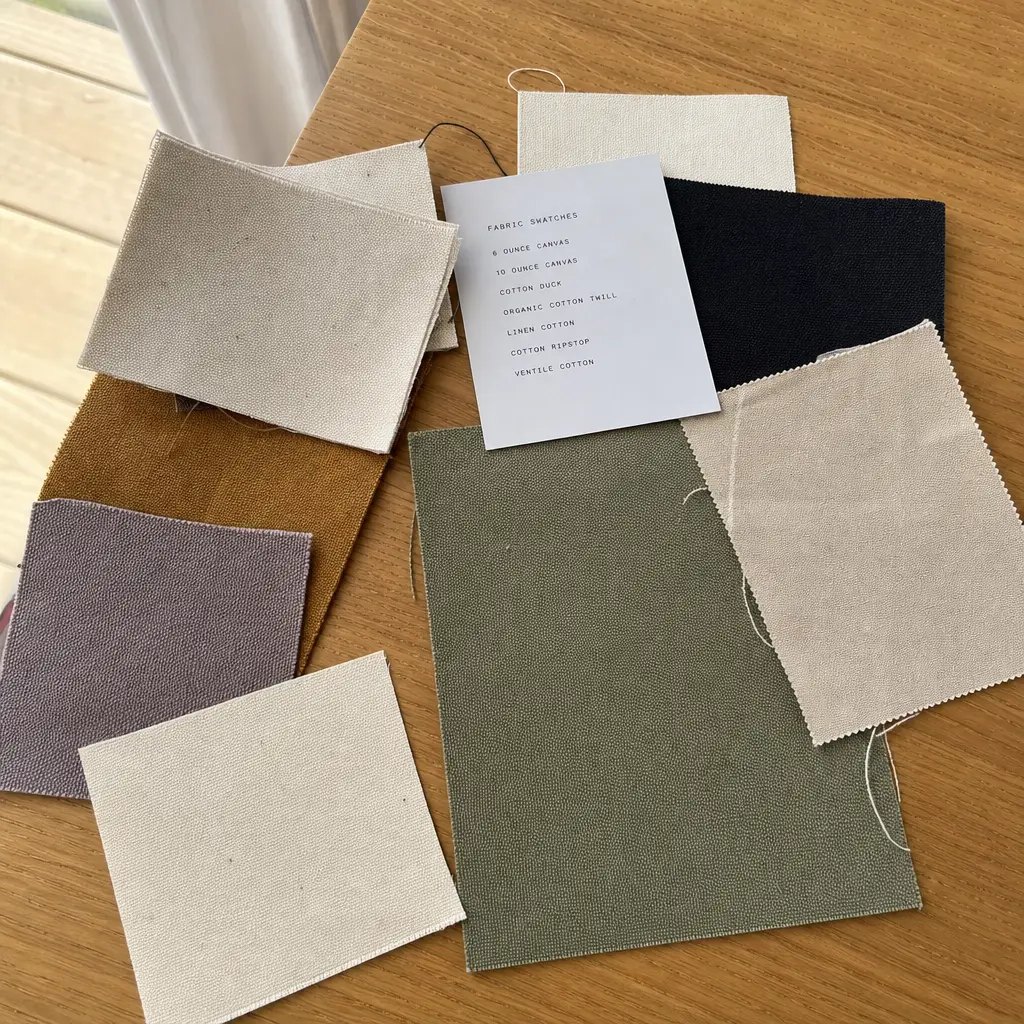
Do not let suppliers quote only by fabric ounce without detail. One mill's 12 oz canvas may feel different from another mill's 12 oz canvas because of yarn count, finishing, and moisture content. Natural canvas may also show cotton seed flecks and shade variation, which can be acceptable for an eco look but not for a clean corporate black or white logo program. If brand consistency matters, request a fabric swatch card before sample making and lock the approved swatch for bulk.
- Light document use: consider 10 oz to 12 oz canvas with simple lining or no lining.
- Daily office use: consider 12 oz to 14 oz canvas with reinforced seams and stable zipper tape.
- Premium retail use: consider 14 oz to 16 oz canvas, lining, structured edges, and tighter color control.
- Avoid very heavy canvas if the design has tight rounded corners because sewing bulk can create puckering and uneven zipper curves.
Zipper Durability Is the Main Failure Point
For custom canvas zipper portfolios, zipper selection is not a small trim decision. The zipper controls the user's first impression and the product's usable life. A No. 5 nylon coil zipper is usually a safe choice for flexible canvas portfolios because it bends smoothly around corners and keeps cost controlled. A metal zipper can look more premium, but it adds weight, can feel rough if the teeth are not polished, and may not suit tight curves or tablet-facing interiors unless protected by fabric lips.
The zipper test should include smoothness, alignment, puller strength, end reinforcement, and fabric bite risk. A common defect is the slider catching the canvas because the seam allowance or zipper tape width was not controlled. Another common issue is zipper wave after carton compression, especially when portfolios are over-packed flat and the zipper path is forced into a curve. The sample should be cycled many times with realistic contents inside, not tested empty on a table.
- Specify zipper number, type, tape color, puller shape, puller finish, and zipper end treatment.
- Require bartacks or reinforced stitching at both zipper ends where users pull hardest.
- Reject samples where the zipper catches lining, bends sharply at corners, or separates under light tension.
- For metal zippers, review scratch risk against tablets, notebooks, printed inserts, and hands.
Print and Branding Choices That Survive Handling
Most tech startup buyers prefer clean, simple branding: a one-color logo, small woven label, debossed patch, or tone-on-tone print. Screen printing is often the most economical for solid logos on canvas, especially at medium and bulk quantities. Heat transfer can work for detailed artwork, but it may feel less integrated with rough canvas and needs stronger rub testing. Embroidery gives texture but can distort thin panels or make document pockets uneven if the backing is not handled well.
The print position matters as much as the method. A large logo near the zipper curve or corner seam is more likely to crack, wrinkle, or lose registration. If the portfolio will be stacked in cartons or mailed individually, heavy ink coverage can pick up abrasion marks. Good artwork preparation includes Pantone reference, artwork file type, maximum print area, edge distance, and approval of print texture on the actual canvas color.
- Screen print: best for bold one-color or two-color marks on flat canvas panels.
- Woven label: good for subtle brand control and lower risk of print cracking.
- Embroidery: best for small marks away from zipper curves and pocket seams.
- Debossed patch: premium look, but confirm material composition if the buyer wants cotton-only construction.
MOQ Logic: Why Small Spec Changes Move the Quantity
MOQ is usually not one fixed number. A factory may offer a lower MOQ when using stock canvas color, standard zipper tape, standard puller, existing size pattern, and screen print logo. MOQ rises when the buyer requests custom dyed fabric, custom zipper pullers, woven labels, special lining color, custom retail packaging, or a non-standard size that changes cutting efficiency. Procurement teams should separate the base product MOQ from each custom component MOQ.
For a startup launch, it is often smarter to start with a standard A4, letter, or 13 inch document portfolio size and spend the customization budget on better zipper, reinforced seams, and clean branding. A custom dimension may look precise on the tech pack but create fabric waste, pattern revisions, and higher sample risk. If the first order is a market test, standardizing the body and customizing the logo can keep lead time and cost under better control.
- Base MOQ may be driven by sewing line setup and cutting efficiency.
- Custom dyed canvas MOQ is often driven by fabric mill dye lot requirements.
- Custom zipper puller MOQ is driven by trim tooling and plating batch size.
- Woven label MOQ can be separate from the bag MOQ and should be quoted clearly.
- Retail packaging MOQ may be higher than the portfolio MOQ if it uses custom printing.
Sample Approval Should Test Construction, Not Just Appearance
A proper sample for a canvas zipper portfolio should use the same fabric weight, zipper type, lining, print method, thread color, and packing method planned for production. A substitute fabric sample is useful only for size and layout review; it is not reliable for durability approval. The buyer should label each sample stage clearly: prototype, revised sample, pre-production sample, and sealed approval sample. The sealed approval sample becomes the reference for bulk inspection.
During sample review, load the portfolio as it will be used. Insert documents, a notebook, a pen, a charging cable, and any planned insert card. Close the zipper without forcing it, hold the product by corners, shake lightly, and check seam strain. Then inspect the print surface after rubbing with a dry white cloth and fingernail pressure. This simple office-level testing will catch many problems before formal inspection.
- Measure finished size, pocket depth, zipper opening length, and logo position against the spec sheet.
- Open and close the zipper repeatedly while the portfolio is filled, not empty.
- Check whether documents catch on lining seams, zipper tape, thread ends, or labels.
- Review smell, fabric dust, loose fibers, oil marks, stains, and color shade under daylight.
- Photograph approved details and keep one sealed sample for final inspection comparison.
Durability Testing Checklist for Bulk Approval
The durability checklist should be practical enough for factory use and clear enough for third-party inspection. Not every startup order needs a full laboratory package, but every bulk order should have defined thresholds. For example, zipper cycling can be tested in-house, seam strength can be checked by controlled pull testing, and print rub can be checked with a dry and slightly damp cloth. Higher-value retail or distributor programs may add lab tests for colorfastness, abrasion, and restricted substances if required by the destination market.
Acceptance criteria prevent disputes. Instead of writing that the zipper must be strong, write that the zipper must open and close smoothly after repeated cycles without separation, jamming, slider breakage, or fabric bite. Instead of writing that the print must be good, write that the print must show no obvious peeling, flaking, or transfer after agreed rub testing. The goal is not to over-engineer a simple product; the goal is to remove ambiguity before the sewing line starts.
- Zipper cycling: repeated open-close movement with realistic contents inside.
- Seam pull: stress main seams, zipper ends, pocket corners, and any handle or loop points.
- Abrasion: rub high-contact canvas areas and printed areas to detect early wear.
- Colorfastness: check dark canvas against light paper, lining, and white cloth.
- Drop-loaded carton simulation: pack sample cartons, drop or compress within reasonable handling assumptions.
- Dimensional stability: compare sample before and after handling, compression, or light steaming if used.
Cost Drivers Hidden Inside Similar-Looking Quotes
Two quotes for the same canvas zipper portfolio can look close on the surface while covering very different products. The main cost drivers are fabric weight, fabric dyeing, lining, zipper grade, stitch complexity, logo method, defect allowance, packing method, and inspection requirements. A supplier quoting 10 oz canvas, standard nylon zipper, no lining, and one-color print will not be directly comparable with a supplier quoting 16 oz canvas, lining, metal zipper, woven label, and reinforced corners.
A clean RFQ should request quantity breaks and itemized assumptions. The buyer does not need the supplier's full factory cost sheet, but the quote should state what is included. Important fields include unit price by quantity tier, sample cost, mold or screen charge, label charge, packaging cost, carton details, estimated CBM, payment terms, lead time, and validity period. For importers and distributors, carton size and gross weight matter because a slightly cheaper product can become more expensive after freight and warehouse handling.
- Fabric: outer canvas GSM, lining material, padding or board insert, and color source.
- Trims: zipper type, puller, thread, label, patch, elastic loop, and hardware if used.
- Labor: seam complexity, corner shape, pocket layout, bartacks, and inspection level.
- Branding: screen setup, print colors, label MOQ, patch tooling, and artwork revisions.
- Packing: individual bag, carton quantity, moisture protection, barcode, carton marks, and pallet needs.
Packing Details That Protect Shape and Zipper Function
Packing is part of durability. A portfolio can pass sample testing and still arrive with crushed corners, zipper waves, fabric creases, or moisture odor if the carton plan is weak. Flat packing is common, but the number of pieces per carton must be controlled. Over-compression saves freight space but can deform zipper paths and leave pressure marks on printed logos. The carton should protect the product without exceeding the buyer's warehouse weight limit.
For clean presentation, each portfolio can be packed in a recycled polybag, paper sleeve, or unbagged bulk pack depending on the brand's sustainability policy and retail needs. If the product ships by sea, moisture control is important for cotton canvas. Carton liners, desiccants, and dry storage before loading help reduce mold risk. Buyers should request carton dimensions, gross weight, net weight, pieces per carton, and estimated CBM per quantity before placing the purchase order.
- Use flat packing with enough room to avoid zipper distortion and corner crushing.
- Place printed faces so they do not rub directly against zipper teeth or rough carton surfaces.
- Keep carton gross weight practical for warehouse handling, often below the buyer's internal limit.
- Add moisture protection for long sea freight routes or humid production seasons.
- Confirm carton marks, SKU labels, barcode placement, and mixed-carton rules before packing starts.
Lead Time and Schedule Risk for Tech Startup Orders
Tech startup orders often connect to fixed dates: onboarding waves, product launches, investor events, conferences, or retail drops. The risky part is that buyers sometimes count only sewing time and forget artwork approval, fabric sourcing, sample revisions, trim lead time, inspection, packing, export booking, and customs documents. A realistic schedule starts when artwork, deposit, fabric, and pre-production sample are approved, not when the first email inquiry is sent.
Schedule risk increases with custom dyed fabric, custom hardware, complex logo placement, and multiple approval stakeholders. If the order has a fixed launch date, prioritize stable materials and standard trims. The best way to protect timing is to freeze the spec before sample making, approve color standards early, and reserve time for one sample revision. For urgent programs, choose stock canvas colors and standard zipper options rather than building a fully custom material package.
- RFQ stage: prepare dimensions, artwork, quantity, packing, destination, and test requirements.
- Sampling stage: allow time for material sourcing, print setup, sewing, review, and one revision.
- Pre-production stage: approve sealed sample, fabric swatch, trim card, and carton plan.
- Bulk production stage: include cutting, printing, sewing, trimming, inspection, and packing.
- Shipping stage: plan export documents, freight booking, customs clearance, and warehouse receiving.
Specification comparison for buyers
| Spec decision | Recommended option | When it fits | Buyer risk to check |
|---|---|---|---|
| Outer fabric weight | 12 oz to 16 oz cotton canvas, roughly 380-540 GSM depending on weave and finish | Tech startup onboarding kits, conference packs, retail portfolios, and reusable document holders needing a structured hand feel | Do not compare quotes by ounce only; request GSM, yarn count if available, shrinkage range, and whether fabric is pre-shrunk or resin finished |
| Zipper construction | No. 5 nylon coil zipper for flexible portfolios, or No. 5 antique brass metal zipper for a more premium look | Nylon coil fits high-volume promotional orders; metal zipper fits executive kits and retail brand programs | Metal zippers raise cost and can scratch tablets if poorly positioned; require zipper tape color, puller style, end-stop reinforcement, and smoothness test |
| Corner and seam reinforcement | Double-needle stitching at main seams with bartacks at zipper ends, handle points if added, and pocket stress areas | Orders expected to carry documents, chargers, cables, notebooks, and small tech accessories | Many low quotes use single stitching and skip bartacks; request stitch density, seam allowance, and photos of inside seam finishing |
| Internal structure | Canvas shell with light cotton lining, document pocket, elastic pen loop, and optional thin board or padding insert | Brand buyers wanting a portfolio that does not collapse flat but still ships efficiently | Over-stiff board can crack at fold lines and increase carton weight; approve folded recovery and edge feel during sampling |
| Logo application | Screen print for solid startup logos, woven label for subtle branding, or debossed faux leather patch when the brand accepts mixed materials | Screen print suits clean one-color branding; woven label suits retail programs; patch suits premium gifting | Large ink coverage on canvas can crack if ink is too thick; request rub test, wash or wipe test if relevant, and color tolerance under daylight |
| Durability test level | Pre-production sample tested for zipper cycling, seam pull, abrasion, colorfastness, and drop-loaded packing simulation | Bulk orders above a few hundred pieces, distributor programs, or startup kits shipped to multiple offices | A sample that looks good can still fail after repeated zipper use; require acceptance criteria, not only visual approval |
| MOQ and size logic | Use standard portfolio sizes first, such as A4, letter size, or 13 inch laptop document format, before tooling custom dimensions | Startups testing a new employee kit, reseller bundle, or retail launch with controlled budget | Custom size, custom lining, custom zipper puller, and custom dyed fabric each add MOQ pressure; separate must-have specs from nice-to-have specs |
| Packing method | Individual recycled polybag or glassine-style paper sleeve, flat packed 20-50 pieces per export carton with moisture control | Importers needing clean presentation and reduced transit creasing for warehouse receiving or retail packing | Over-compressed cartons cause zipper waves and corner deformation; require carton dimensions, gross weight, and stacking test assumptions |
Buyer checklist before sampling
- Define the exact use case: document folder, onboarding kit, tablet accessory pouch, conference portfolio, retail SKU, or distributor giveaway.
- Specify outer canvas by GSM or ounce, color, weave, finish, shrinkage expectation, and whether recycled or organic cotton is required.
- Confirm finished dimensions with tolerance, allowing for documents, notebooks, cables, or a tablet sleeve without forcing the zipper closed.
- Select zipper type, zipper size, puller style, tape color, and whether zipper ends need bartacks, fabric tabs, or metal stops.
- Lock logo method by artwork size, Pantone reference, print position, ink type, label material, or patch construction.
- Require a pre-production sample with the same fabric, zipper, lining, logo method, stitching, and packing method planned for bulk.
- Set durability acceptance criteria for zipper cycling, seam strength, abrasion, print rub, colorfastness, and carton compression.
- Request quote data split by material, logo, packing, sample charge, tooling charge, unit price by quantity tier, lead time, and carton details.
- Approve carton packing by weight, flatness, moisture protection, barcode or carton mark requirements, and retail presentation needs.
- Keep a sealed approval sample and compare bulk production against it during inline and final inspection.
Factory quote questions to send
- What is the exact outer canvas weight in oz and GSM, and is the fabric pre-shrunk, dyed to order, or from stock color inventory?
- Which zipper type, zipper number, tape material, puller style, and zipper brand or grade are included in the quoted price?
- What stitch density, seam allowance, bartack positions, and inside seam finishing are included for the quoted construction?
- Which logo method is quoted, what is the maximum print or label size, and are screen setup, patch mold, or woven label charges separate?
- What is the MOQ for the base portfolio, and what MOQ changes if we use custom dyed fabric, custom zipper puller, custom lining, or retail packaging?
- What durability tests can be performed in-house, and which tests require a third-party lab or additional cost?
- How many samples are included, what sample lead time applies, and will the sample use mass-production materials or substitute materials?
- What are the production lead time assumptions after artwork approval, deposit, material approval, and pre-production sample confirmation?
- What are the export carton dimensions, gross weight, pieces per carton, individual packing method, and estimated CBM per 1,000 pieces?
- What inspection standard, AQL level, defect classification, and replacement policy apply if zipper, stitching, or logo defects exceed agreed limits?
Quality-control points to confirm
- Finished size tolerance should normally stay within plus or minus 5 mm for width and height unless the design has thick padding or board inserts.
- Zipper should open and close smoothly for repeated cycles without tooth separation, slider jamming, sharp edges, or fabric tape twisting.
- Main seams should show consistent stitch density, no skipped stitches, no loose thread chains, and no puckering around corners or zipper curves.
- Bartacks should be placed at zipper ends, pocket stress points, handle attachment points if used, and elastic or loop attachment areas.
- Print should pass dry rub and light scratch testing without obvious flaking, smearing, heavy ink buildup, or color bleeding into the canvas texture.
- Fabric color should match the approved swatch within the agreed tolerance under daylight or D65 light source, especially for natural, black, navy, and grey canvas.
- Inside lining should not twist, bunch, fray, or show glue marks; documents should slide in without catching on unfinished seam edges.
- Each piece should be checked for zipper alignment, corner shape, odor, stains, oil marks, needle holes, mold risk, and visible dirt before packing.
- Cartons should not exceed the buyer's warehouse weight limit and should protect portfolios from compression marks, moisture, and zipper deformation during sea freight.
- Final inspection should compare bulk goods with the sealed approval sample, not only with a written specification sheet.