Start With the Campus Use Case
A custom canvas zipper portfolio for a university bookstore has a harder job than a flat promotional pouch. It may sit on a retail shelf, move through a crowded receiving room, get handled by students between classes, and carry documents that should not be bent or dirtied. It has a working zipper, stress points at the corners, internal pockets, and a logo that needs to look intentional after repeated handling. That makes it a small sewn product with real functional requirements, not simply a canvas panel with school branding.
The first buying decision is not fabric color. It is what the portfolio must carry. A department giveaway for loose orientation documents can be lighter and simpler than a retail portfolio expected to hold a notebook, charger, tablet, pen, and course packet. If the intended contents are not described, the factory will make its own assumption. That assumption may be reasonable for a low-cost document holder but wrong for campus retail, where students judge the product by zipper feel, shelf presence, and whether it survives daily use.
For procurement teams, the phrase custom canvas zipper portfolios durability testing checklist for university bookstores should translate into a practical RFQ: define the load, specify the materials, test the zipper while loaded, inspect the print on the actual fabric, and approve packing before the goods ship. The goal is not to over-engineer the item. The goal is to remove the vague places where quote differences and quality disputes usually hide.
- Define the buyer channel: bookstore retail, orientation kit, department merchandise, alumni gift, or staff welcome pack.
- List the heaviest realistic contents, such as letter documents, A4 sheets, notebook, tablet, charger, pen, or gift insert.
- State whether the portfolio should lie flat, open wide, hold shape on a shelf, or fit into a backpack.
- Treat the zipper, pocket corners, logo area, and packed corners as durability zones.
- Ask for one loaded sample before bulk approval, not only a clean empty sample photographed from above.
Write Dimensions Buyers Can Actually Inspect
Finished size is where many portfolio specs sound clear but are not. A line such as 14 x 10 inches may describe the outside panel, the flat finished piece, or the size the supplier thinks will fit letter documents. It does not necessarily describe the usable opening after seam allowance, lining, zipper tape, and internal pocket construction are added. For bookstores, that matters. A portfolio that technically measures correctly can still be frustrating if a standard notebook catches on the zipper or the document pocket is too narrow for course handouts.
A better RFQ separates outside dimensions from usable internal size. If the portfolio must hold letter-size folders, specify the folder size and the required clearance. If it must fit A4 sheets for international programs, say so directly. If art, architecture, music, or lab departments need larger inserts, do not let the factory infer the scale from a logo mockup. Sewn canvas goods also need tolerance. A realistic tolerance depends on shape and construction, but buyers should agree on one before production. For many canvas portfolios, plus or minus 0.25 inch to 0.5 inch may be workable, while tighter tolerances need stronger pattern control and inspection discipline.
Opening style affects usable space too. A top-zip portfolio is simpler, usually less expensive, and easy to pack. A three-sided zipper lets the product open wider, which is useful when students need to remove papers or a tablet quickly. It also adds corner stress and more sewing complexity. The size spec should therefore include zipper path, opening width, and any gusset or depth. Once those are clear, price comparisons become cleaner because each supplier is quoting the same working object.
- State outside finished width and height.
- State usable internal opening width and height.
- Include depth or gusset if the portfolio must carry thick contents.
- Name the largest real item that must fit without forcing the zipper.
- Set dimensional tolerance for width, height, opening, and pocket depth.
- Confirm whether the sample will be measured empty, loaded, or both.
- If shelf fixtures or barcode placement matter, include those dimensions in the RFQ.
Choose Canvas by Behavior, Not Adjectives
Words like heavy, premium, natural, and durable are not enough for canvas procurement. They describe a feeling, not a spec. A university bookstore buyer should request canvas weight in both ounces and approximate GSM, then confirm whether the fabric is greige, dyed, washed, coated, or otherwise finished. In the practical middle of the market, 12 oz to 16 oz cotton canvas is often the most useful range for zipper portfolios. It has enough body for shelf presentation, prints well when the surface is controlled, and can still be sewn cleanly around zipper corners.
Lighter canvas can work, especially for budget document holders or short-term orientation packs. A 10 oz body fabric may reduce cost and freight weight, but once a zipper, lining, and pocket are added, it may feel soft or collapse on the shelf. Heavier canvas can feel substantial, but it brings its own risks. A 20 oz fabric can make corners bulky, strain zipper turns, and require more careful needle, thread, and seam planning. Durability is not simply the heaviest cloth available. It is the balance between fabric, zipper, lining, thread, reinforcement, and the way the product is loaded.
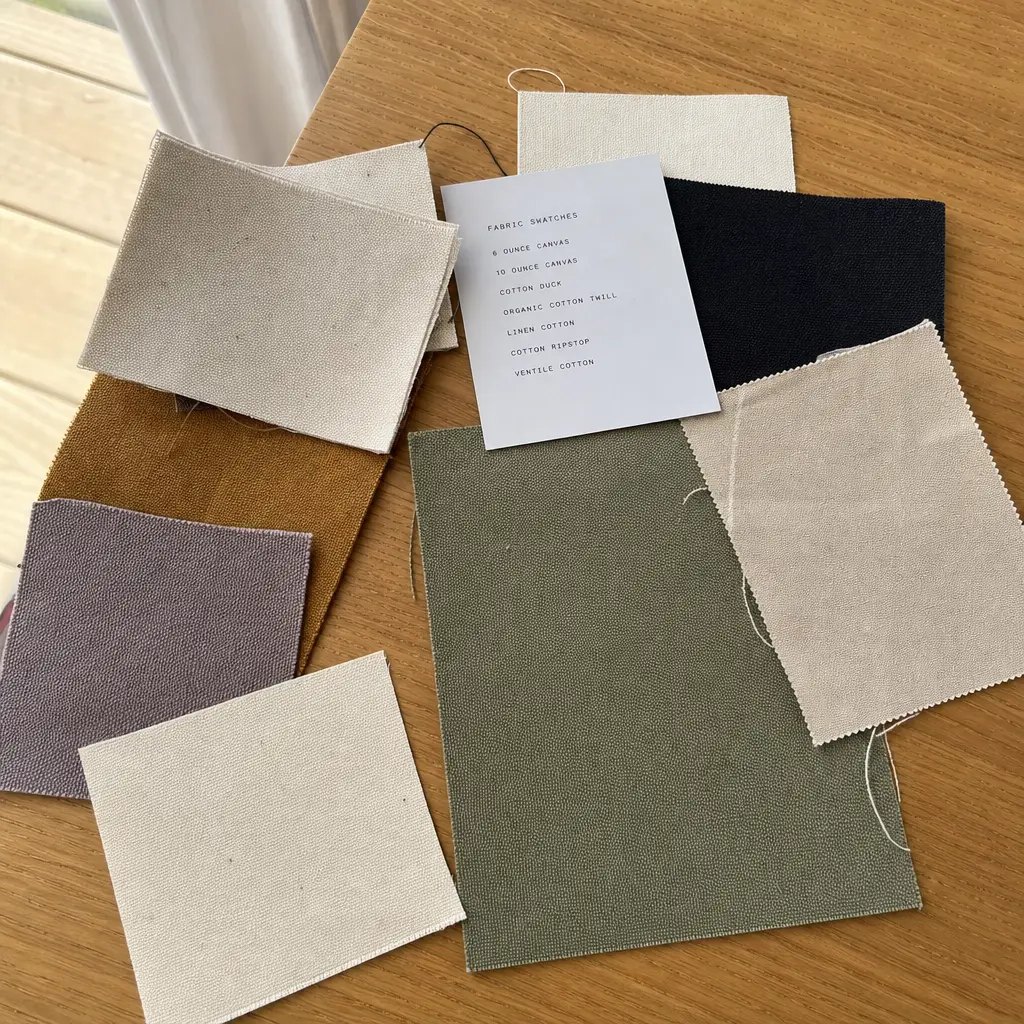
Finish changes performance. Washed canvas often has a softer hand and a casual retail look, but it may show more shade variation and shrinkage. Finished or coated canvas can give a cleaner print surface, but inks and transfers need adhesion checks because the surface may resist decoration. Natural canvas can vary in slub, color, and speckling. That variation may be acceptable for a bookstore lifestyle item, but not for a tightly controlled university logo program. Buyers should ask to see fabric swatches from the intended lot whenever color or surface consistency matters.
- 10 oz canvas: useful for budget document sleeves, but often soft for premium portfolios.
- 12 oz canvas: balanced for orientation kits and mid-range bookstore merchandise.
- 14 oz canvas: stronger hand feel and better shelf presence for daily campus use.
- 16 oz canvas: more substantial, but zipper corners and seam bulk need careful control.
- Washed canvas: softer and casual, with higher need for shade and shrinkage approval.
- Finished canvas: cleaner for printing, but rub and adhesion testing become more important.
- Natural canvas: attractive and familiar, but visible slubs and tone variation should be accepted or rejected in writing.
Specify the Zipper Like a Core Component
The zipper is the part students touch first and use most often. A portfolio can have excellent canvas and still feel cheap if the slider catches, the puller is too short, or the tape twists at a corner. For most bookstore canvas portfolios, a No. 5 nylon coil zipper is a sensible default. It is smooth, flexible, and generally forgiving when sewn into canvas. A No. 8 nylon coil zipper may be appropriate for larger portfolios, heavier contents, or a deliberately rugged look. Metal zippers can add a premium feel, but they need stronger slider control and careful inspection for tooth alignment, scratching, and end finish.
Buyers should avoid writing only zipper included. The quote should identify zipper type, size, tape color, slider finish, puller style, and zipper path. Tape color matters because a mismatched zipper can make an otherwise clean school-branded product look improvised. Puller length also matters. A small metal pull can look tidy in a photo but be awkward for students who open the portfolio repeatedly or when the zipper sits close to thick canvas seams. A fabric pull tab, leather-like tab, or branded puller may improve usability, though each adds cost and approval work.
Zipper path is a design and durability choice. A top zipper is easier to sew and pack, but limits access. A two-sided or three-sided zipper makes the portfolio more useful as a file case or presentation organizer, yet increases stress at the corner turns. Those turns need reinforcement and a smooth curve. If the zipper must pass around tight square corners, expect more puckering and more inspection failures. Ask the supplier how they build the corner and how they test it after loading.
- No. 5 nylon coil: strong default for standard bookstore portfolios.
- No. 8 nylon coil: better for larger sizes, heavier contents, or rugged styling.
- Metal zipper: premium appearance, but requires slider, tooth, and scratch inspection.
- Plastic molded zipper: possible for casual products, but usually less refined for document portfolios.
- Specify tape color, slider finish, puller length, and puller material.
- Require zipper cycling with the intended contents inside.
- Inspect zipper turns, end stops, and tape stitching before approving bulk production.
Build Reinforcement Into the Pattern
Most canvas zipper portfolios fail at places where the user naturally pulls, stuffs, or bends the product. Zipper ends, pocket openings, corner turns, pen loops, and strap tabs carry concentrated stress. If those areas are not reinforced, the defect may not show in a photo or even in a light sample review. It appears later, after documents are inserted and removed, the zipper is pulled under load, or a student carries the portfolio by one corner between classes.
The RFQ should describe stitch type, stitch density, seam allowance, reinforcement method, and visible finish. Lockstitch construction around 8 to 10 stitches per inch is common for canvas goods, but the ideal setting depends on fabric thickness and thread. Too few stitches can weaken the seam. Too many can perforate the fabric and create a tear path, especially on heavier canvas. Backtacks or bar tacks should be used where stress is predictable. For a wide document pocket, the top corners deserve special attention. For a pen loop, the loop must hold common pen sizes without tearing or becoming too tight to use.
Interior finish affects perceived quality. A bookstore customer may not know seam terminology, but they notice loose threads, raw edges shedding fibers into papers, and corners that feel lumpy. Bound internal seams, folded construction, or neatly trimmed seam allowances all help the product feel finished. If the item is sold as premium merchandise, the inside should not look like an afterthought. Ask for an inside photo, a construction sample, or a simple technical sketch before approving a price that seems unusually low.
- Backtack zipper ends so the slider does not pull into a weak seam.
- Reinforce wide pocket openings with backtacks, bar tacks, or patches.
- Control seam allowance so fraying cannot reach the stitch line.
- Check corner shaping for bulk that distorts the zipper path.
- Test pen loops with actual common pen diameters.
- If a handle or wrist strap is included, specify pull direction and attachment reinforcement.
- Ask the factory to mark reinforcement points on a sketch or sample photo before final costing.
Match Branding to Canvas Reality
University bookstore branding can be deceptively tricky. A school logo may include fine lines, small text, registration marks, mascot art, or department names. The decoration method has to match the artwork and the fabric surface. Screen printing is usually dependable for bold one to three color logos on cotton canvas. It works well for bookstore wordmarks, department names, and simple marks. Heat transfer can carry finer detail, gradients, or tight edges, but it must be tested for adhesion on the actual canvas finish. Embroidery can look premium, yet dense stitching on a flat portfolio panel may pucker the fabric unless backing and stitch count are controlled.
Woven labels and patches are often underrated. They can give a retail product a quieter, more durable branded finish, especially when the bookstore wants the portfolio to feel like merchandise rather than a giveaway. A woven side label, small front patch, or sewn badge also avoids some print cracking issues. The tradeoff is placement control and sewing consistency. A label that drifts or tilts on a clean canvas panel is very visible.
Approval should include more than artwork size. Buyers should specify print area, placement tolerance, color reference, cure standard where relevant, and acceptance limits for edge quality. If a logo sits close to a zipper or pocket seam, the factory may need to print before sewing, which introduces alignment variation after assembly. A centered logo on a flat digital mockup does not guarantee a centered logo on a sewn product. For brand-sensitive programs, request a print strike-off on the actual production fabric and then a sewn pre-production sample with the final placement.
- Screen print: best for bold campus marks and simple one to three color artwork.
- Heat transfer: useful for fine detail, but check edge lift, cracking, and adhesion.
- Embroidery: premium for small marks, but can pucker large flat panels.
- Woven label or patch: durable, subtle, and retail-friendly.
- Set logo placement tolerance, especially near seams, zippers, and pockets.
- Use Pantone or approved brand references when color control matters.
- Test decoration after packing compression, not only immediately after printing.
Use Samples to Remove Variables
A sample process should answer one question at a time. The first development sample can confirm the overall format: size, opening style, zipper path, pocket layout, hand feel, and logo scale. It may not use final bulk materials, and that is acceptable as long as everyone knows its purpose. The mistake is treating a rough development sample as permission to start mass production. For durability decisions, the important sample is the pre-production sample made with bulk-intended canvas, zipper, thread, lining, reinforcement, decoration, and packing.
Keep the approval record clean. If the buyer asks for a deeper pocket, longer puller, different zipper tape, or revised logo placement, note the change in measurable terms. Good revision notes sound like raise front logo 10 mm, increase pocket depth to 8.5 inches, use No. 5 nylon coil zipper with 45 mm puller, or add backtacks at pocket corners. Vague notes such as make stronger or improve zipper are hard to inspect later. They also create room for disagreement when bulk goods arrive.
For bookstore programs with multiple departments, approve the base construction separately from each logo version. That keeps cost and quality control manageable. The portfolio body, zipper, lining, and reinforcement can stay constant, while logo strike-offs confirm each artwork. If every department version gets its own fabric, zipper color, and packing style, the order becomes a collection of small custom projects. That may be necessary, but it should be priced and scheduled that way.
- Development sample: confirms format, hand feel, pocket layout, and opening style.
- Print strike-off: confirms logo size, color, edge quality, and performance on actual fabric.
- Pre-production sample: confirms final bulk construction before mass production.
- Sealed reference sample: supports incoming inspection and supplier accountability.
- Working sample: used for loaded fit, shelf presentation, and internal team review.
- Revision notes should be measurable and dated.
- If fabric, zipper, lining, or print method changes after approval, require a new approval sample.
Run Practical Durability Checks
Durability testing for custom canvas zipper portfolios does not need to become a full laboratory program for every bookstore order. It does need to be specific enough that the supplier can perform it and the buyer can inspect the result. The core checks are loaded zipper cycling, pocket stress, seam pull, print rub, dimensional stability, and packing compression. These tests are simple, but they catch the common failures that a clean photo sample misses.
A useful zipper cycle check opens and closes the portfolio 50 to 100 times while loaded with the intended contents. The number can be adjusted by order value and product complexity, but the test should be loaded, not empty. After cycling, the slider should move smoothly, teeth should not separate, tape should not twist, and stitching should not loosen at the ends. Pocket stress can be checked by repeatedly inserting and removing the heaviest expected notebook, document stack, or tablet sleeve. The top pocket corners should not tear, stretch badly, or show thread failure.
Print checks should happen on the actual production canvas. A dry rub with a clean white cloth can reveal uncured ink, weak transfer adhesion, or surface damage. A light scratch check can show whether thick ink is brittle. For heat transfers, inspect edges for lift after bending and after packing pressure. Dimensional checks should be made empty and loaded because a portfolio may pass flat measurements but bulge enough under load to strain the zipper. The test sheet can be simple: sample lot, date, operator, test method, pass or fail, and notes. Simple is fine. Unwritten is not.
- Loaded zipper cycle: 50 to 100 open-close cycles with intended contents inside.
- Pocket stress: repeated insertion and removal of the heaviest expected item.
- Seam pull: manual tension at zipper ends, pocket corners, and strap points if included.
- Print rub: dry cloth rub on the logo area, followed by visual review for transfer or damage.
- Transfer edge check: bend and inspect for lifting or cracking where heat transfer is used.
- Corner compression: pack one sample under carton-like pressure and inspect shape recovery.
- Loaded closure check: confirm the zipper closes without bulging, catching, or forced alignment.
Inspect Bulk Like the Approval Sample Matters
Incoming inspection should compare bulk goods to the approved sample, not to memory or a marketing image. The approved sample defines the standard for fabric hand, shade, dimensions, zipper behavior, logo placement, pocket layout, and finish. If a sealed reference sample is available, the receiving or QC team can quickly identify drift. Without one, disagreements become subjective, especially when natural canvas variation is involved.
Inspection should include a mix of visual, measurement, and functional checks. Visual review catches stains, shade variation, loose threads, crooked labels, poor print edges, and obvious sewing defects. Measurement confirms outside dimensions, usable opening, and pocket depth. Functional checks confirm that the zipper runs smoothly and the loaded product closes cleanly. For larger orders, buyers can use an agreed sampling plan with the factory or inspection partner. The exact plan depends on order size and risk, but the important point is that the inspection categories are written before production.
Do not ignore cartons. A good portfolio can arrive with crushed corners, creased logos, or mixed SKUs if packing is uncontrolled. Inspect carton labels, item counts, SKU separation, and whether the zipper was packed closed. If the bookstore needs barcode labels, retail sleeves, or department-specific cartons, those details should be verified before shipment. Receiving rooms are busy during semester peaks. Clear carton marks reduce manual sorting and help prevent a quality order from becoming an operations problem.
- Compare bulk goods against the sealed approved sample.
- Check fabric shade, surface defects, stains, slubs in logo areas, and panel grain direction.
- Measure outside size, internal opening, pocket depth, and logo placement.
- Open and close zippers across the full path on sampled units.
- Inspect pocket corners, zipper ends, thread trimming, and internal seams.
- Verify SKU labels, barcode requirements, carton marks, and quantities.
- Record defects by type so rework or replacement discussions stay specific.
Plan Packing for Bookstore Receiving
Packing is part of product quality. Canvas portfolios often look sturdy, but corners, zippers, printed panels, and internal boards can be damaged by tight cartons or careless folding. Flat packing is usually safer for structured portfolios and front-panel decoration. Folding may reduce freight volume, but it can create permanent creases, distort the zipper line, or mark the logo. If folding is being considered, approve a packed sample after it has been compressed for a realistic period, not just folded once on a worktable.
Individual protection depends on the sales channel. A polybag keeps the canvas clean and protects the print during receiving. A recyclable paper sleeve may better match bookstore presentation goals, but it needs to protect against scuffing and moisture during handling. A tissue insert or flat card can help the product hold shape if the portfolio has a structured panel or gift-ready presentation. If the product is meant to be placed directly on a shelf, the packing should preserve a retail-ready shape so staff are not spending time fixing crushed corners.
Carton labels should match the purchase order structure. If the order includes different department logos, colors, or barcode SKUs, avoid mixed cartons unless the distribution plan requires them. Mark item name, color, logo version, quantity, PO number, and barcode information where applicable. Keep carton weights within the receiving team's manual handling limit. During back-to-school periods, clear labeling is not a nicety. It is the difference between a smooth receiving process and a pile of correct products that are slow to sort.
- Pack structured portfolios flat whenever possible.
- Close zippers before packing to help maintain shape.
- Use sleeves or bags that protect the print and keep canvas clean.
- Avoid overcompressed cartons, especially with board, foam, metal zippers, or raised patches.
- Keep carton quantity consistent, with final partial cartons clearly labeled.
- Separate department logos or SKU versions unless mixed cartons are specified.
- Approve barcode placement and retail labels before production starts.
- Test packing compression before shipment approval.
Specification comparison for buyers
| Spec decision | Recommended option | When it fits | Buyer risk to check |
|---|---|---|---|
| Canvas body fabric | 12 oz to 16 oz cotton canvas, roughly 400-540 GSM depending on weave, shrinkage, and finish | Best for bookstore retail, orientation kits, faculty gifts, department merchandise, and programs where the portfolio needs visible structure | If GSM, finish, and shrinkage are not stated, suppliers may quote different fabrics under the same product name |
| Zipper type | No. 5 nylon coil zipper for most standard portfolios; No. 8 nylon coil for larger or heavier-loaded styles; metal only when a premium look is worth the added control work | Nylon coil is smooth for frequent student use and usually easier to keep within a campus merchandise budget | Weak sliders, short pullers, loose tape stitching, and poor end stops can create complaints even when the canvas is strong |
| Internal structure | Cotton or polyester lining with reinforced document pocket, optional pen loop, and optional light board or foam only where shape retention is needed | Useful when the portfolio carries notebooks, handouts, tablets, course kits, or gift sets and must look organized on a shelf | Unreinforced pockets tear at top corners; over-stiff board can make the zipper hard to close when loaded |
| Stitching standard | Lockstitch at stress seams, commonly 8-10 stitches per inch, with backtack or bar-tack reinforcement at zipper ends and pocket corners | Appropriate for repeated retail handling, daily campus use, and distribution through bookstore receiving rooms | Loose tension, skipped stitches, thread fray, or missing backtacks usually show up first around the zipper and pockets |
| Logo method | Screen print for bold one to three color logos; heat transfer for detailed marks; woven label or patch for subtle retail branding | Screen print suits bookstore wordmarks and department marks; woven labels work well for neutral retail collections | Heavy ink can crack if not cured correctly; transfers need edge-lift and adhesion checks on the actual canvas finish |
| Edge and corner treatment | Bound internal seams or folded-and-stitched construction with trimmed corners and controlled bulk | Important for portfolios displayed on shelves, sold as premium campus merchandise, or used in gift programs | Raw seams shed fibers into documents, while bulky corners can distort the zipper path and make the product feel unfinished |
| MOQ structure | Quote one production body color and one logo version per MOQ first; split colors, zipper tape, lining, and artwork only after minimums are confirmed | Works for bookstore programs serving several departments while keeping one core construction | Too many splits can create hidden setup fees, longer material lead times, and inconsistent inspection results |
| Packing plan | Individual sleeve or polybag, zipper closed, flat insert or tissue where needed, SKU-ready carton labels, and master carton weight limits | Recommended for bookstore receiving, mixed SKU distribution, and retail shelf presentation | Overpacked cartons deform corners; vague carton marks slow receiving during semester rush and can cause miscounts |
Buyer checklist before sampling
- Define the loaded-use scenario in writing: loose documents only, notebook plus pen, tablet plus charger, course packet, or bookstore gift set.
- Specify canvas weight in both ounces and approximate GSM, not only the word canvas.
- State whether the portfolio must hold shape on a retail shelf, lie flat in a backpack, open like a file case, or fold for freight savings.
- List finished dimensions, usable internal opening, seam allowance, and acceptable tolerance separately.
- Choose zipper type, zipper size, slider grade, puller length, tape color, and zipper path before sample approval.
- Require reinforcement at zipper ends, pocket corners, pen loops, and any wrist strap or handle attachment points.
- Set stitch density, seam allowance, backtack positions, thread color, and visible finish standards for stress areas.
- Match logo method to the artwork: screen print for solid marks, heat transfer for fine detail, woven label or patch for long-term retail identity.
- Request print cure, rub, scratch, or adhesion checks on the actual canvas color and finish, not substitute fabric.
- Approve one loaded pre-production sample using the intended notebook, documents, tablet, insert, or gift contents before bulk production.
Factory quote questions to send
- What canvas weight are you quoting in ounces and GSM, and is it greige, dyed, washed, coated, or finished canvas?
- What weave structure, shrinkage range, and colorfastness expectations apply to the fabric lot?
- Is the quoted zipper nylon coil, metal, or plastic molded, and what size, slider grade, puller style, and tape color are included?
- Does the zipper run across the top only, on two sides, or around three sides, and how are the corner turns reinforced?
- What lining material, pocket construction, pen loop, board, foam, or reinforcement materials are included in the unit price?
- What seam allowance do you cut to, what stitch density do you target, and which seams are backtacked or bar-tacked?
- Which logo method is included, how many colors are allowed, and what print area triggers extra charges?
- What placement tolerance do you hold for print, patch, and label positions on finished sewn goods?
- What MOQ applies per body color, zipper tape color, lining color, logo version, and packing format?
- What pre-production sample cost, sample lead time, revision cost, and bulk lead time should we budget after final approval?
Quality-control points to confirm
- Canvas weight should match the approved spec within the agreed tolerance, verified from the same production fabric lot used for cutting.
- Finished dimensions should be checked both empty and loaded, because a portfolio can measure correctly flat but fail once notebooks or tablets are inserted.
- Cut panels should be checked for grain direction, shading, stains, and surface slubs in visible logo areas before sewing.
- Zipper should open and close smoothly across the full path without slider catching, teeth separation, tape twisting, skipped tape stitches, or end-stop failure.
- Zipper ends and corner turns should be inspected for puckering, uneven seam tension, loose threads, and missing backtacks.
- Pocket corner reinforcement should resist tearing when documents or notebooks are inserted and removed repeatedly.
- Logo placement should stay within the approved tolerance, commonly plus or minus 3 mm for flat-panel screen print when the construction allows it.
- Print surface should pass dry rub and light scratch checks on the actual canvas finish, with no unacceptable ink transfer, cracking, peeling, or edge lift.
- Visible seams should show consistent tension, no skipped stitches, no exposed raw threads on retail-facing areas, and secure trimming inside the product.
- Loaded samples should close cleanly with the intended contents inside, without bulging that distorts the zipper line or forces the slider off track.